
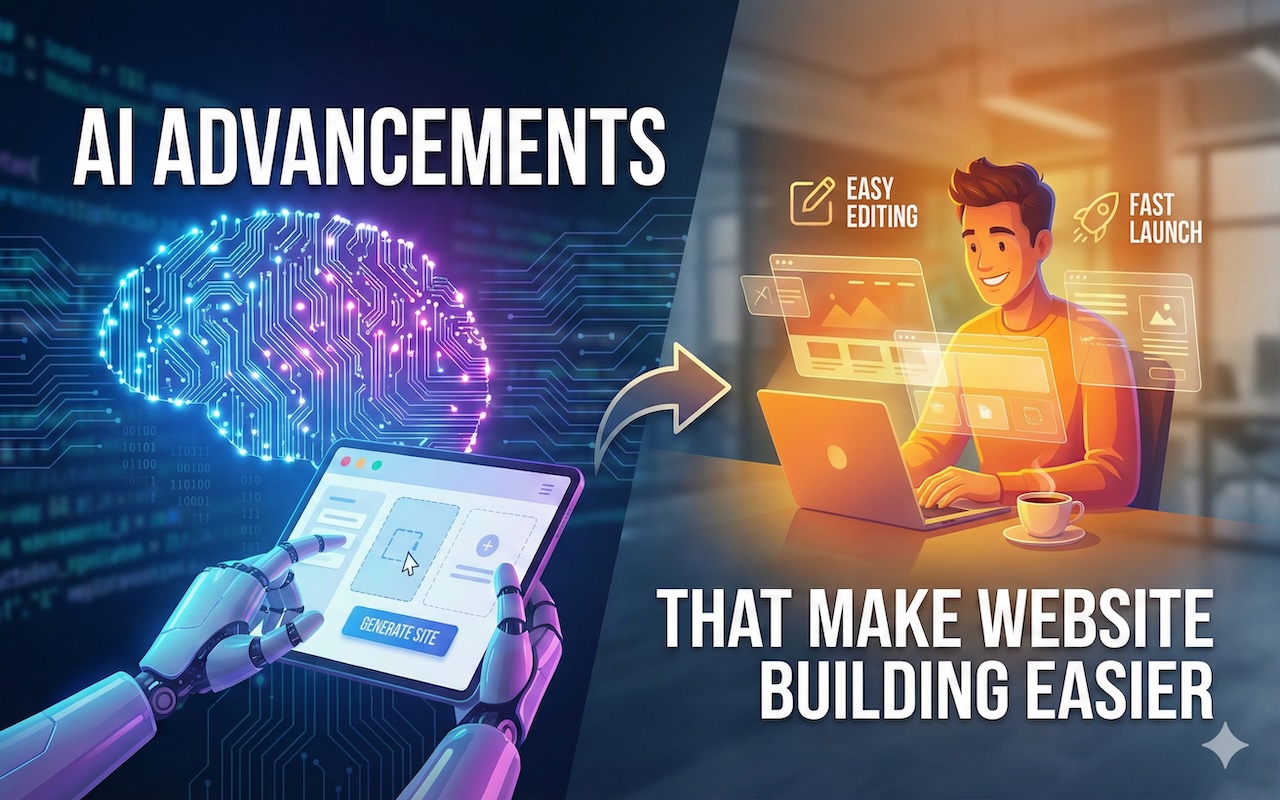
Building a website used to require hiring someone or learning how to code. That stopped being true sometime around 2024, but 2025 made the whole process feel almost unremarkable. You describe what you want. The software builds it. You make adjustments through conversation, not configuration panels. The barrier to entry has dropped so low that the phrase "barrier to entry" barely applies anymore.
Shopify projects that by 2026, generative AI will design and build roughly 60% of new websites and mobile apps. The global website builder market is expected to reach $6.68 billion by 2030, driven largely by these AI-powered tools. These numbers point to something practical: the technology works well enough that people are using it at scale.
From Prompt to Publish
The gap between having an idea and owning a working site has collapsed. Platforms like Greengeeks, v0 by Vercel, Lovable, and Builder.io accept plain text descriptions and return functional code built on React and Tailwind CSS. Wix provides more than 15 tools for this purpose, including an AI website builder that can complete setup in under 60 minutes. Durable claims 30 seconds.
These systems handle layout, copy, images, and forms without requiring users to open a code editor. Squarespace Blueprint AI offers over 1.4 billion design combinations. Shopify generates three store layouts from a single prompt. The technical steps that once took weeks now resolve in minutes.
Wix Has an Eight-Year Head Start
Wix introduced AI features to its platform in 2016. That head start matters. The company has had time to test, fail, and refine its tools in ways that newer entrants have not.
According to Website Builder Expert, the platform now includes an AI website builder, content generation, and automated image enhancement. A text creator lets users describe what they need and request tweaks. Zapier reports that Wix launched an AI marketing agent that operates through a chat interface. It asks about goals, recommends actions, writes blog posts, sends email campaigns, generates social media content, and optimizes Google Ads.
Expert Market tested Wix and Squarespace side by side. Given identical prompts, Wix produced a greater variety of templates. Users are less likely to receive a generic result.
Squarespace Caught Up Fast
Squarespace launched its first AI products in 2024, eight years after Wix. The gap in experience has not stopped it from building something notable.
Blueprint AI was named among TIME Magazine's Best Inventions of 2025. The system asks a handful of questions and generates unique web designs, including imagery curated by in-house designers. Users tweak pages rather than start from scratch. Spark Plugin reports over 1.4 billion possible design combinations through Blueprint.
The company's Refresh 2025 announcement introduced Squarespace Beacon AI, described as a personal business partner. It guides users through content creation, marketing automations, and general online operations. Soon, users will be able to start a project via chat by describing what they want, and the system will generate imagery, copy, and design recommendations.
Full-Stack Generation Without the Stack
The AI-first platforms operate differently. They do not add AI features to an existing website builder. They treat AI as the starting point.
v0 by Vercel launched in August 2025 and accepts natural language prompts to build complete applications ready for deployment. TechCrunch reported that Vercel released v0-1.0-md, an AI model optimized for front-end and full-stack web development, accepting both text and image inputs.
FindMyAITool describes v0 as using multiple AI agents that plan tasks, reason through next steps, debug issues, and handle integrations automatically. The code output consists of clean, modular React components using shadcn/ui with Tailwind CSS by default.
Lovable operates similarly. UI Bakery notes that the platform allows users to describe an app and receive a working full-stack codebase in minutes. Codecademy found that Lovable's Agent Mode reduces build errors by 90% and handles complex development tasks without user intervention. This mode became the default interface in July 2025.
Visual Development Without Writing Code
Builder.io targets teams that want visual control over their output. The platform integrates with existing codebases and design systems while providing AI-enabled workflows.
Visual Copilot converts Figma designs into React, Vue, Svelte, Angular, Qwik, Solid, React Native, or HTML code with a single click. The tool uses AI models and an open-source compiler to transform flat designs into code hierarchies.
Motion tested 14 AI website builders and identified Builder.io, v0, and Lovable as the strongest AI-first platforms available. The evaluation considered prompt accuracy, ease of use, pricing, and design quality for small businesses.
Shopify Built It Into the Checkout
Shopify introduced its AI store setup in March 2025. Users describe their niche or brand in a few words, and the system generates three store layouts pre-populated with products, images, descriptions, navigation, and SEO-friendly content.
Sidekick, Shopify's assistant, connects data points to uncover opportunities, create content, and execute tasks. It handles domain setup, metafield management, and transforms complex operations into automated workflows. The system analyzes data in real time and provides proactive recommendations.
Shogun AI gained traction by allowing users to type design ideas and instantly generate custom code in HTML, Liquid, CSS, or JavaScript. Many builders fail at producing accurate code from prompts. Shogun does not.
WordPress Arrived Late
WordPress.com launched its AI website builder in April 2025, according to Shopify's blog. The system asks about a site's purpose, style preferences, and content needs, then generates a complete WordPress site in seconds. This brought generative AI to the most widely used content management system.
What This Means Practically
Relume claims its AI design tool costs less than 1% of an average project budget and saves half the delivery time. User testimonials suggest the tool makes designers 10 times more productive. These figures vary by project, but the direction is consistent.
The friction has moved. It used to sit between wanting a website and having the skills to make one. Now it sits between knowing what you want and being able to articulate it clearly in a prompt. The software handles the rest. You still need to understand your audience, your product, and your goals. No AI tool has solved for that yet.
Conclusion
AI website builders have quietly shifted web creation from a technical exercise into a communication task. The challenge is no longer learning how to build a site, but deciding what the site should say, who it serves, and how it creates value. Platforms now handle design systems, code generation, content structure, and deployment with speed and reliability that would have seemed unrealistic just a few years ago.
What differentiates successful projects in this new landscape is not access to tools, but clarity of intent. The teams and individuals getting the most out of AI builders are those who understand their audience, define their goals, and iterate thoughtfully through prompts rather than configurations. As generative AI continues to mature, website creation will become even faster and more automated—but the responsibility for strategy, direction, and meaning will remain firmly human.
Featured Image generated by Google Gemini.
Share this post
Leave a comment
All comments are moderated. Spammy and bot submitted comments are deleted. Please submit the comments that are helpful to others, and we'll approve your comments. A comment that includes outbound link will only be approved if the content is relevant to the topic, and has some value to our readers.
Comments (0)
No comment