

Agentic AI vs Robotic Process Automation: Which Is the Future?
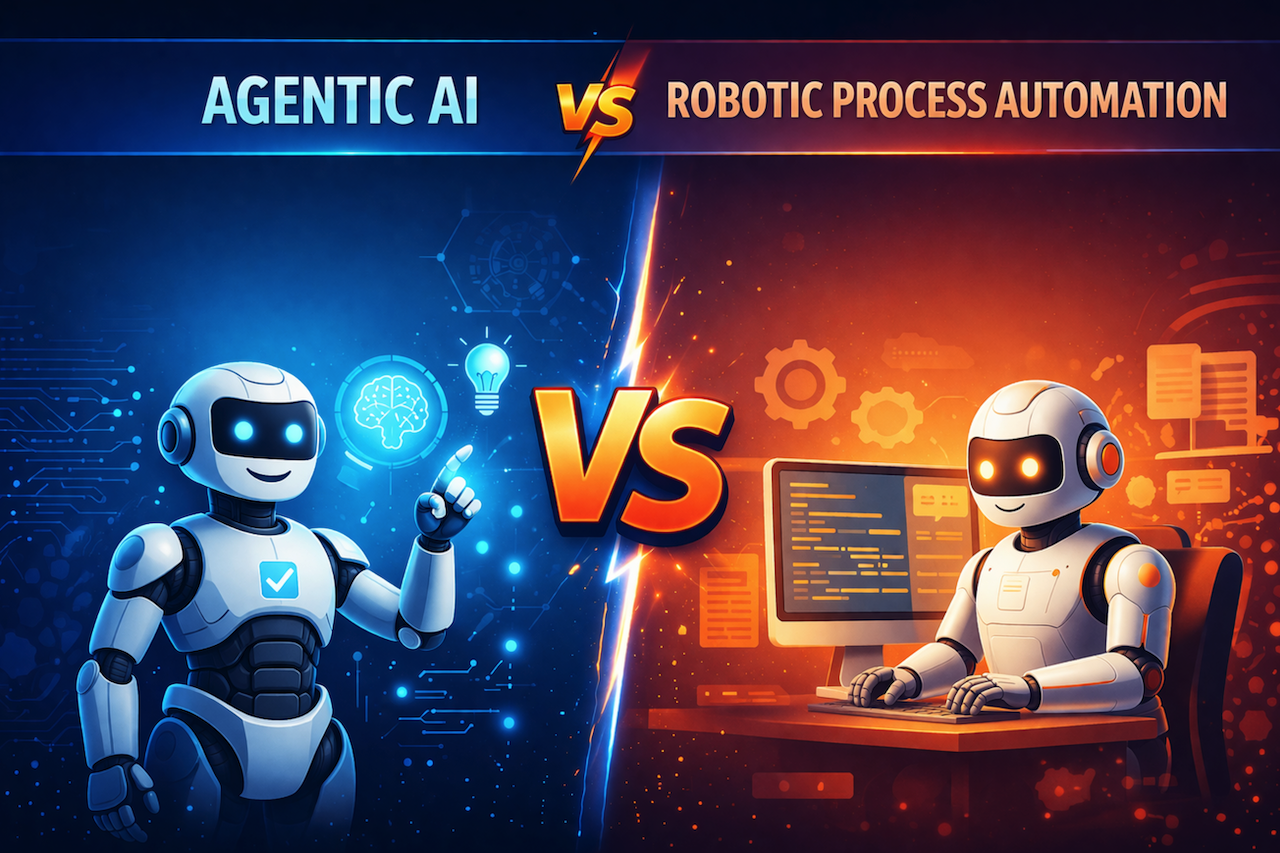
The field of automation has moved way past the stage of using simple scripts and running tedious tasks. Businesses are instead seeking systems that can change, make decisions, and enhance their operations. This has brought two main concepts into focus: Robotic Process Automation (RPA) and Agentic AI.
These two concepts are distinctly different, though they share the same end destination: to reduce human interaction and maximize efficiency. This understanding can allow a businessperson to make the exact decision for their enterprise.
What is Robotic Process Automation (RPA)?
RPA is intended to handle repetitive, rule-based operations. This implies that it is programmed to adhere to a set of instructions and is best suited to situations where processes are organized and remain constant.
For instance, some examples of what RPA can include:
- Data extraction from forms
- Processing invoices
- Transferring data
- Dealing with routine customer queries
These systems are authentic for tasks that do not change often. They lessen manual mistakes and save time, making them beneficial for back-office operations.
At the same time, RPA has limits. It cannot easily adapt to change or handle tasks that require judgment. Once conditions shift, the system needs updates or reconfiguration.
What is Agentic AI?
Agentic AI moves the concept of automation one step further by adding decision-making and flexibility. Agentic AI does not simply act based on set rules; it can also analyze the data it receives and learn from the results.
Agentic automation enables more efficient, effective automation by adding features to the system. Agentic automation can:
- Interpret complex inputs
- Make decisions based on the context
- Work effectively with unstructured data
- Become more efficient and effective
This is where agentic AI stands out. It brings more flexibility and intelligence to processes that were previously hard to automate.
Through AI agent development, businesses can create systems that go beyond task execution and actively manage processes.
Key Differences Between Agentic AI and RPA
| Feature | Robotic Process Automation (RPA) | Agentic AI |
|---|---|---|
| Functionality | Rule-based automation | Decision-driven automation |
| Adaptability | Limited | High |
| Data Handling | Structured data only | Structured and unstructured data |
| Learning Capability | No learning | Learns and improves over time |
| Use Cases | Repetitive tasks | Complex workflows and decision-making |
| Flexibility | Requires manual updates | Adjusts based on new inputs |
Where RPA Still Fits
RPA remains useful for organizations that rely on repetitive, predictable processes. RPA is easy to implement and is best suited for processes such as:
- Payroll processing
- Data entry
- Compliance reporting
- Invoice management
In all these processes, RPA provides instant results with little or no setup. It remains a practical choice for handling structured workflows.
Where Agentic AI Makes a Bigger Impact
However, with the increasing complexities of business operations, agentic AI systems are seen as viable alternatives. They are capable of handling operations that require judgment and are adaptable and continually improving.
Some of the major applications of AI agents are:
- Customer Experience: AI agents can handle conversations and respond with appropriate information.
- Operations Management: AI agents can monitor operations and improve them in real time.
- Data Analysis: Agentic AI is proficient at evaluating data and deriving insights crucial for decision-making.
- Sales and Marketing: AI agents can improve the performance of sales and marketing functions.
These capabilities show how agentic automation moves beyond basic task handling into intelligent execution.
Why Businesses Are Shifting Toward Agentic AI
Today's business needs are not just rules-based automation but rather systems that can respond to change and grow with the business.
- Greater Flexibility: Agentic systems can respond to new inputs without constant reprogramming.
- Better Decision-Making: Agentic systems are capable of analyzing data and generating insights that lead to superior decision-making.
- Continuous Improvement: The system can learn from the data, thereby enhancing its performance over time.
- Reduced Dependency on Manual Work: The reliance on manual work is reduced, allowing teams to focus on strategy.
The above-mentioned factors have pointed us toward the growing role of agentic artificial intelligence solutions in the business world.
Challenges to Consider
However, RPA as well as agentic AI have their own limitations too, which are as follows:
Challenges Faced by RPA
- Changes in processes
- Handling unstructured data
- Scalability in a dynamic environment
Challenges Faced by Agentic AI
- Higher investment
- Data infrastructure
- Monitoring and refinement
The choice of a suitable methodology will be based on business goals, existing systems, and the level of complexity.
The Future of Automation
Automation is shifting from simple execution to intelligent actions. RPA created a foundation for this by automating routine tasks. Agentic AI is further developing this foundation to include learning and decision-making functions.
Rather than replacing RPA, agentic AI is likely to be used alongside it. Businesses can utilize RPA for routine processes and agentic AI for complex processes. This will result in a more balanced and efficient mix of automation.
What This Means for Business Owners
For business owners, the focus should be on the long-term value. Automation is not just about saving time anymore; it is about improving how decisions are made and how processes are optimized.
Investing in AI agent development can help businesses create systems that will grow with them. This will create opportunities to enhance efficiency, reduce costs, and improve the customer experience.
However, using RPA for uncomplicated tasks could also help balance and ensure consistency in how the business is run.
Closing Thoughts
The distinction between RPA and agentic AI highlights how automation technology is evolving. RPA is especially effective at precision when performing repetitive, organized tasks. Agentic AI, on the other hand, integrates intelligence, flexibility, and continuous improvement into business operations.
The way forward for businesses seeking to remain efficient is to strike a balance between the two. With the continued advancement of automation technology, agentic automation and intelligent systems will increasingly determine the way businesses are conducted.
Related Articles
March 24, 2026
Why AI Automation Is Becoming Essential for Daily Workflows
Artificial intelligence is gradually becoming part of everyday work. Instead of being limited to large systems or technical teams, AI is now used by individuals to manage tasks, or...
Read More
November 15, 2025
AI Agents: The Future of Business Automation and Customer Engagement
As companies are stepping into the era of digital transformation, AI has been a foundational force leading them on. It is not only there in the backdrop of the processes, but is al...
Read More
August 27, 2025
The Future of AI Website Builder Tools: How They Are Transforming Web Development
Creating a website has traditionally been a challenging process, requiring technical skills, significant time, and considerable effort. Today, that landscape is changing thanks to...
Read More
Comments
Comments are available to signed-in users and are moderated to keep the discussion useful and respectful. Spam, automated submissions, and low-value promotional comments are removed. Outbound links may be approved when they are relevant and genuinely helpful to readers, but they are displayed as plain text rather than clickable hyperlinks.
No comments have been published yet.
Please sign in to submit a comment.