
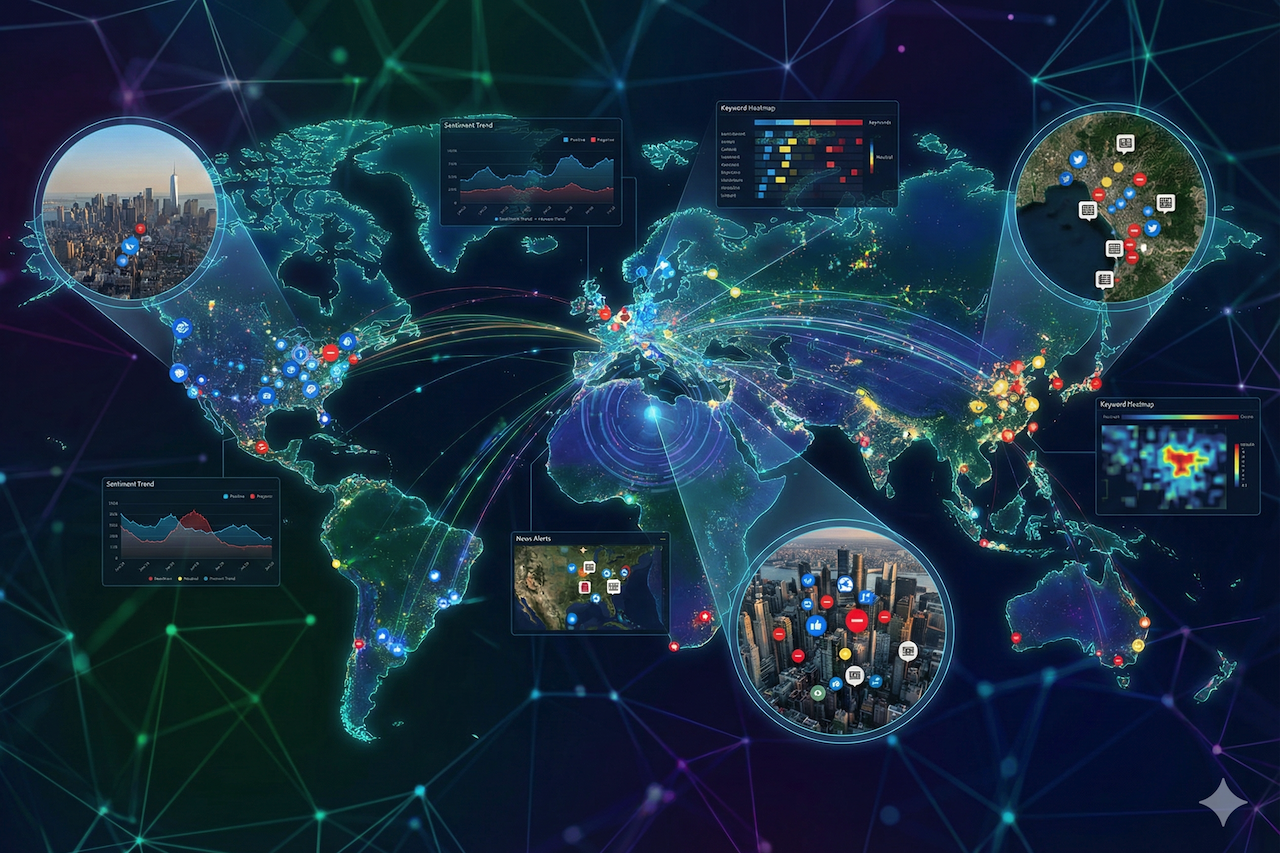
In today’s connected and global digital environment, media conversations move rapidly and no longer respect geographic boundaries. To keep up, brands, governments, and organizations need more than traditional monitoring. Advanced media intelligence combined with geolocation is transforming how organizations understand and respond to public discourse. By integrating real-time media analysis with location-based data, teams can identify what is being said, where it is happening, and why it matters—all at the same time.
This development is changing the way businesses use media intelligence software to preserve their reputations, discover opportunities, and respond more rapidly to emerging risks.
Advanced Media Intelligence
Media intelligence is not just a simple observation. It does not just gather mentions; it also determines the context, feelings, influence, and tendencies in news, social media, forums, and broadcasting outlets. Advanced platforms use machine learning and natural language processing to transform large amounts of data into insights.
Intelligence can be even stronger when geolocation is introduced. Companies can identify the geographic source of discussions, regional discrepancies in feelings, and monitor how stories propagate from one geographic location to another.
The Geolocation and Its Role in Media Intelligence
The inclusion of geolocation provides a geographical dimension to the analysis of media. All mentions, articles, and posts can be geotagged to a particular country, city, or region. This enables teams to:
- Determine the areas where the stories are spreading
- Identify local problems early, before they go international
- Compare snetiment across different markets
- Customize responses by region
This is an important insight for global brands and multinational organizations. A crisis in one area might call for a different approach to a similar crisis in another area.
Smarter Media Notifications with Geolocation Insights
Traditional alerts notify teams when a keyword is used. The more sophisticated systems also add geolocation filters to media alerts. This implies that, in addition to being fast, alerts are also relevant.
To illustrate the point, a sudden increase in negative feelings toward a city or country will trigger an immediate alarm, and the teams can take action before the problem becomes widespread. Location-conscious notifications minimize noise and help decision-makers concentrate on what is really important.
Media Tracking and Geographic Accuracy
Media tracking is no longer just about counting mentions. Modern platforms provide deeper insights that are accessible to organizations of all sizes. Geolocation integration will enable organizations to monitor the changes in coverage in different areas and time zones. This assists in answering such questions as:
- What are the key regions that are fuelling the discussion?
- In what areas does brand perception rank the highest and the lowest?
- What about the performance of competitors in other markets?
The resulting data is also represented in interactive maps and dashboards using advanced media-tracking software, making it easy to review and disseminate across teams.
Enhancing News Monitoring Services
The news monitoring services are also enhanced by geolocation. Organizations can also focus on news sources based on geographic relevance and influence, rather than treating all news coverage the same. A local news report in one of the major markets can be more effective compared to global reporting in other areas.
This method enhances market intelligence, policy analysis, and risk assessment. It enables groups to differentiate between local noise and indicators that represent larger trends or reputational risks.
Use Cases Across Industries
State-of-the-art media intelligence, including geolocation, provides value in a variety of industries:
- Brand and Reputation Management: Monitor feelings and address it with localized messages.
- Crisis Management: Identify early warning signs in particular areas before the global escalation.
- Marketing and Campaign Analysis: Get campaign performance across regions.
- Public Affairs and Policy Monitoring: Learn how the discussion of regulatory or political issues varies geographically.
- Competitive Intelligence: Compare market presence across locations.
In both instances, location-based knowledge leads to better, more accurate decision-making.
Why It Matters in 2026 and Beyond
With the ongoing growth of digital conversations and their dynamism, organizations cannot afford to use superficial data any longer. Raw media can be enhanced into strategic intelligence by processed media intelligence enhanced with geolocation.
It enables faster responses, better understanding, and more intelligent planning. With media intelligence software, real-time media alerts, solid media tracking, and location-aware news monitoring services, organizations will have an upper hand in an increasingly competitive, breakneck media environment.
Final Thoughts
The future of media analysis would be advanced media intelligence with geolocation. It helps close the divide between global presence and local inclination, so that organizations not only listen to the conversation but also have specific knowledge of how it affects them geographically.
Location-based intelligence is no longer a luxury. In today’s fast-moving digital landscape, understanding where conversations emerge is often just as important as understanding what is being said.
Disclaimer
The information provided in this article is for general informational and educational purposes only and does not constitute professional, legal, financial, or strategic advice. Readers should seek independent guidance from qualified professionals before making any decisions based on the content presented.
Any references to products, services, companies, or third-party platforms are for informational purposes only and do not represent endorsements or recommendations. Features, availability, and performance may vary and are subject to change without notice.
This article may include links to external websites for convenience and additional information. iplocation.net does not control, verify, or guarantee the accuracy, reliability, or completeness of any third-party content and shall not be liable for any loss, damage, or consequences arising from the use of or reliance on external links or services.
Readers are encouraged to review the official websites, policies, and terms of any service providers before engaging with them.
Featured Image generated by Google Gemini.
Share this post
Leave a comment
All comments are moderated. Spammy and bot submitted comments are deleted. Please submit the comments that are helpful to others, and we'll approve your comments. A comment that includes outbound link will only be approved if the content is relevant to the topic, and has some value to our readers.
Comments (0)
No comment