
Software development is not just about writing code. It requires a structured approach that guides teams through planning, development, testing, and deployment. This structured approach is known as the software development process.
A software process model outlines the activities, workflows, and the order in which software will be developed. In addition to creating order within development teams, these development frameworks help identify and manage risks, ensure a certain level of quality, and, in the end, allow teams to meet timelines. Based on the software's size and complexity, there are models specifically tailored to address the customer's needs.
In this blog, we will explore seven widely used software process models that continue to shape modern software engineering practices.
What is a Software Process Model?
A software process model is a framework that outlines how software should be designed, developed, tested, and maintained. They provide a clear structure for managing the entire development lifecycle.
The models help identify and manage development risks and, most importantly, guarantee that the finished software product actually meets the end user's needs.
The different models emphasize different things. Some emphasize the need for a comprehensive plan to be followed in sequence. In contrast, other models advocate adopting an iterative approach that allows change to be introduced even midway through the development cycle.
Different Software Process Models That Shape Software Development
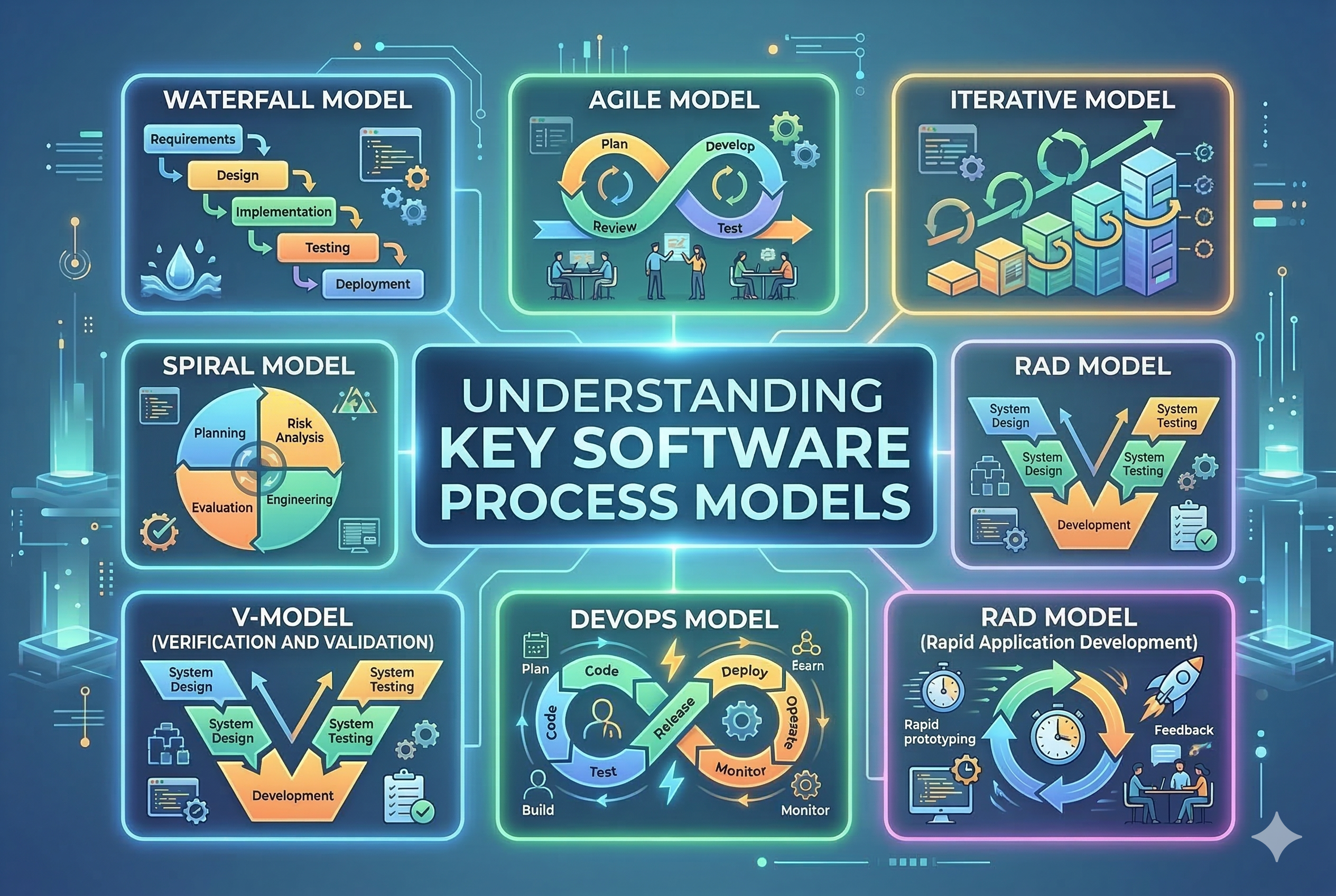
Image generated by Google Gemini.
1. Waterfall Model
The Waterfall model is one of the first and most established development models used in software engineering.
In this type of model, development is implemented in a linear, inclusive manner. No other phase can start until the current phase is complete. The most common phases are collecting requirements, system design, implementation, testing, deployment, and maintenance.
The Waterfall model is best suited for projects in which requirements are identifiable, unambiguous, and, most importantly, unlikely to change. This model is widely used in structured environments; this is why most government projects and several large businesses opt for it.
The major problem with this model is its lack of flexibility. Changes to requirements later in the project can make implementing them a nightmare, and, obviously, it will be more expensive.
2. Agile Model
One of the most utilized development methodologies for today's fast-paced digital products is the Agile model.
Agile is not like traditional linear models. This model emphasizes iterative development. Rather than building the entire software in one go, the project is divided into multiple cycles, called sprints. Each sprint provides a small, yet functional, piece of the product.
This methodology fosters close collaboration between developers, stakeholders, and end clients. Agile allows responsive development to changes by collecting feedback regularly.
This model is especially advantageous for startups, SaaS, and mobile app development, as product requirements are constantly changing.
3. Iterative Model
The Iterative model is another popular model among development approaches. This model requires the software to be built in cycles or iterations.
Rather than providing end users with the complete product in one release, developers first build a "skeleton" of the product. In each iteration, more features are added.
Every cycle consists of a planning phase, a development phase, testing, and then an evaluation phase. This method allows the team to focus on one step at a time and develop their product in small increments.
Large and complex projects with poorly defined requirements are well-suited to the Iterative model.
4. Spiral Model
The Spiral model takes elements from the Waterfall and Iterative approaches. It is a development model built specifically to handle project risks.
The development is broken down into spiral cycles. Each cycle consists of planning, risk evaluation, development, and a final evaluation. Before proceeding to the next cycle or phase, the development team assesses risks and develops a strategy to mitigate or address them.
This model is most commonly used for large, complex projects in which risks and complexity are also high, such as banking systems, defense projects, or complex enterprise software.
The Spiral model is also expensive to implement and quite complex.
5. V-Model (Verification and Validation Model)
The V-model is a modification of the Waterfall model and is widely used among development models that focus on quality assurance practices.
As such, each phase of development corresponds to a phase of testing. For instance, system design corresponds to system testing, and module design corresponds to unit testing.
Because of the nature of the process, the V-model is most commonly used in healthcare software, aviation systems, and financial software, where accuracy and reliability are of utmost importance.
6. DevOps Model
The DevOps model is one of the growing development approaches that emphasize collaboration between development and operations.
Traditionally, the roles of developers and operations are separate. Developers build the software, and operations manage the deployment and infrastructure. DevOps removes that separation, fuses both roles, and creates a continuous workflow.
The model enables the organization to release software continuously while keeping the systems stable and responding promptly to end-user feedback.
7. Rapid Application Development (RAD) Model
The Rapid Application Development (RAD) model applies to processes that prioritize quick turnarounds and iterative user feedback.
Among modern development approaches, RAD emphasizes iterative user feedback and rapid prototyping. Developers create a prototype, get user feedback, and adjust the system. Because of its rapid feedback cycle, the model is well-suited to small, agile systems that require rapid deployment.
That also means the model is more resource-intensive and, in development, demands very skilled developers. It also requires active collaboration from the client.
How to Choose the Right Software Process Model

Choosing among different software process models depends on several factors related to the project and organization. Project size and complexity play a major role. Large enterprise systems often benefit from structured models such as the Waterfall or Spiral approach, while smaller or evolving products may perform better with Agile or RAD.
Client involvement is another important factor. If continuous feedback is required, iterative models are usually more effective.
Finally, the level of risk and required quality assurance should also influence the decision. Projects in regulated industries may prefer models with strict verification and testing processes.
Conclusion
The success of a software project depends heavily on the development process used to build it. Development models provide the framework that guides teams through planning, development, testing, and deployment. From traditional approaches like the Waterfall model to modern practices such as Agile and DevOps, each model offers unique advantages depending on project requirements.
By understanding these seven development models, organizations can choose the most suitable approach for their development strategy, improve collaboration, reduce risks, and deliver high-quality software solutions more efficiently.
Featured Image generated by Google Gemini.
Share this post
Author

Read the latest articles from Sarah Lewis
Why Enterprise Product Teams Are Prioritizing AI-Native Infrastructure and Workflows in 2026

May 19, 2026
Today, product organizations see Generative AI as more than just a “science experiment.” By 2026, generative AI has evolved into a strategic priority for enterprises focused on improving productivity, accelerating product development, automating workflows, and enhancing customer experiences. Organizations acr [...]
Learn moreLeave a comment
All comments are moderated. Spammy and bot submitted comments are deleted. Please submit the comments that are helpful to others, and we'll approve your comments. A comment that includes outbound link will only be approved if the content is relevant to the topic, and has some value to our readers.
Comments (0)
No comment