
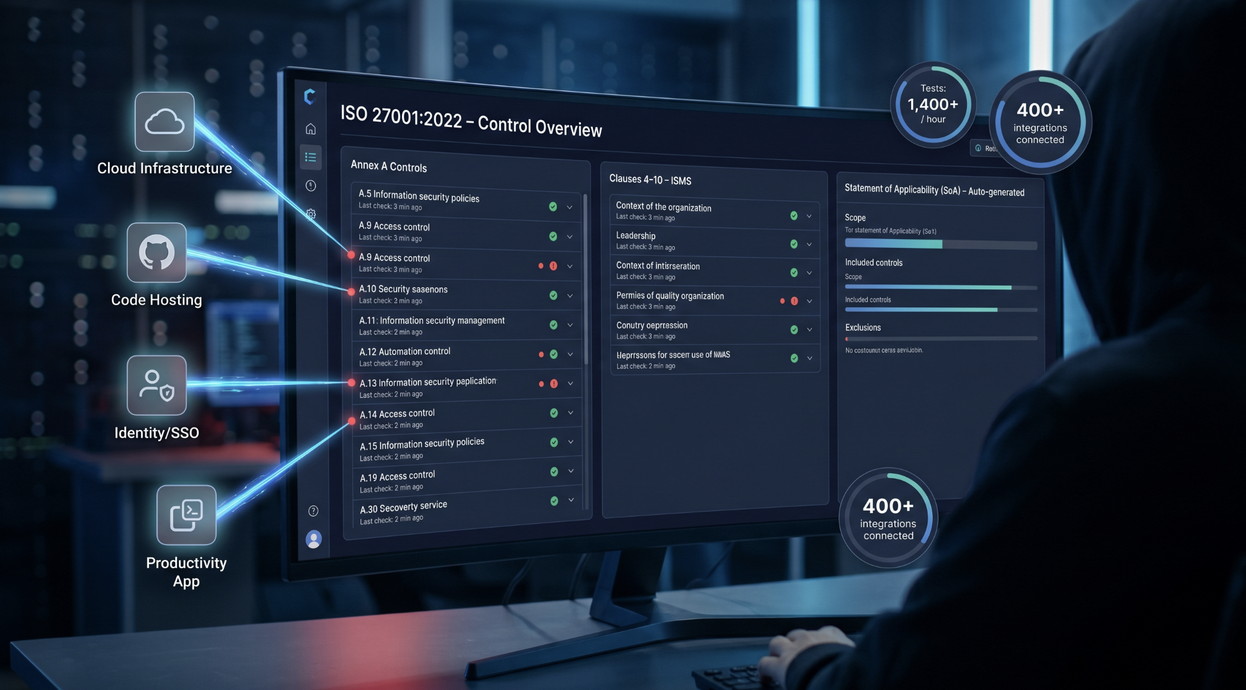
Getting ISO 27001 certified feels great until the daily evidence chase begins. Enterprise buyers expect continuous proof of security, not a once-a-year PDF. The 2025 transition to ISO 27001:2022 only raises the bar, and that workload can swallow engineering time faster than a feature sprint.
That is why SaaS teams adopt ISO 27001 compliance software. Modern platforms connect to AWS, GitHub, Okta, and the rest of your stack, automatically collect evidence, flag drift as it happens, and keep you audit-ready without living in spreadsheets.
In this guide, you’ll see how four leading tools solve the same problem in different ways so that you can choose the best fit for your stage, tech stack, and budget.
1. Vanta: Deep Automation for Teams That Want Continuous ISO 27001 Readiness
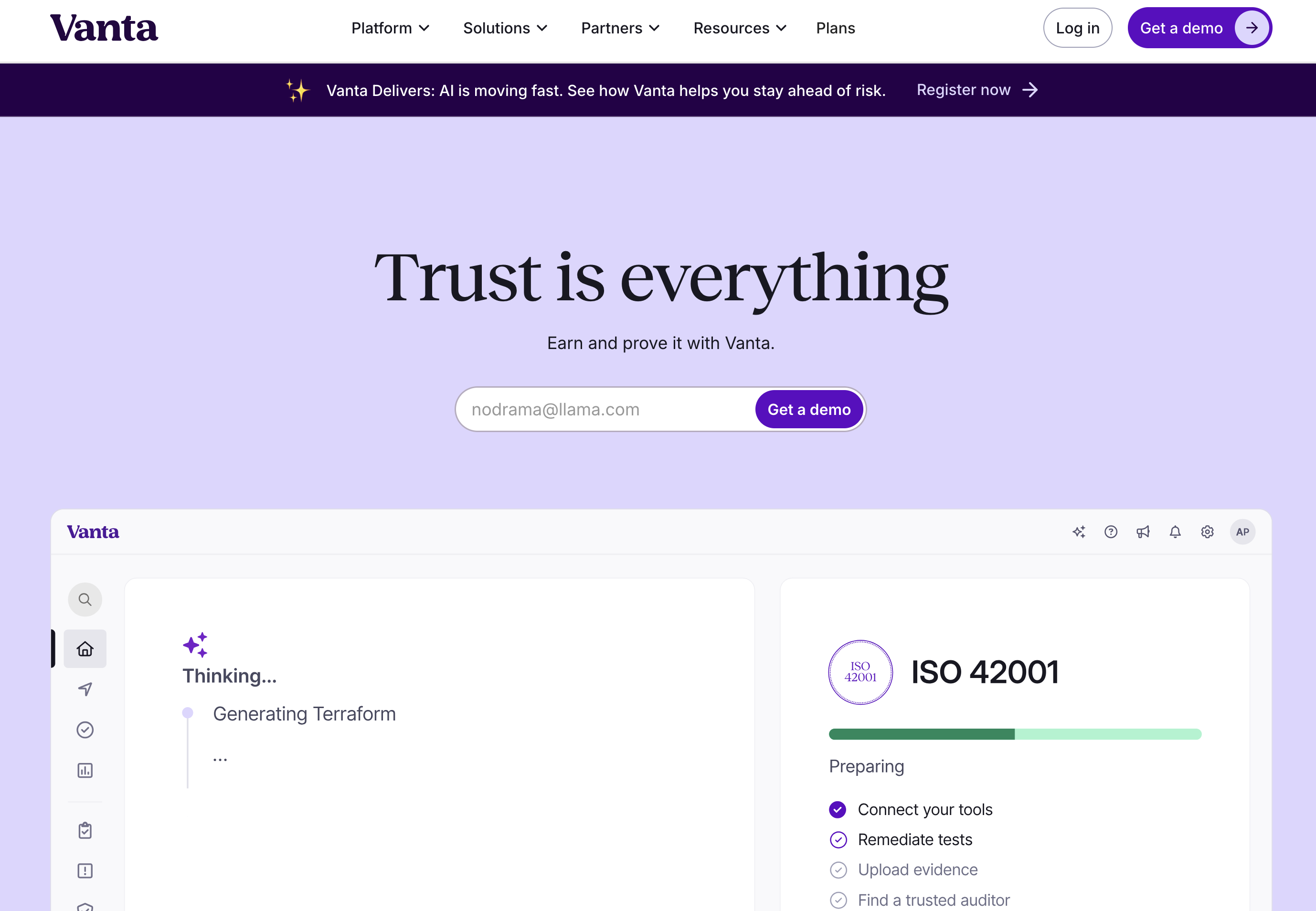
When you activate ISO 27001:2022, Vanta loads the full set of controls, including Annex A, and maps them to live signals from your environment. It also supports the broader ISMS requirements across Clauses 4 to 10, not just the technical controls.
Two areas stand out for ISO-heavy work:
- Auto-Generated Statement of Applicability (SoA): Vanta can generate the SoA using current control data, linked exclusions, and related risk context, thereby removing a large chunk of manual documentation effort.
- Risk and ISMS Foundations: Vanta includes an Enterprise Risk Manager with an ISO-aligned risk library and treatment workflows, plus ISO-specific policy templates, including ISMS documents created with BSI Group.
Integrations, Tests, and Monitoring Cadence
Living up to its reputation as one of the best automated compliance software platforms, Vanta integrates with 400+ native systems and runs 1,400+ automated tests hourly. That shows up in day-to-day operations as continuous monitoring rather than a quarterly scramble. When controls drift, alerts can fire, allowing you to correct issues before an auditor or a customer notices.
Multi-Framework Efficiency (ISO 27001 Plus SOC 2)
If your roadmap includes SOC 2, Vanta’s cross-mapping is designed to reduce duplicated work. ISO 27001 and SOC 2 typically have 70-80% evidence overlap, and Vanta can reuse evidence at the evidence level when you toggle on an additional framework.
Time to Certification and Audit Workflow
Most teams can reach ISO 27001 certification in 2 to 3 months, depending on readiness and audit scheduling. Vanta supports this with an auditor workflow that includes:
- A curated network of accredited audit partners, with the option to bring your own auditor
- An auditor portal for reviewing evidence and tracking issues in one place
- Vanta reports a 100 percent first-time audit success rate across 20,000+ successful audits
Named customer outcomes include Henchman, which reported achieving ISO 27001 in 2 months, and Duolingo, which reported saving 12+ hours per week while achieving ISO 27001.
AI Capabilities That Reduce Review and Remediation Work
- An AI Agent that can search across controls, tests, and policies, and help with mapping and program questions
- AI evidence evaluation that flags gaps before audit time
- AI-guided remediation, including step-by-step fixes and code snippets for failed tests
- Questionnaire Automation to accelerate security reviews
- AI chatbot option for buyer-facing Trust Center Q&A
Pricing and Trade-Offs to Know Up Front
Vanta is quote-based and typically packaged from Essentials through Enterprise. Pricing scales by employee bracket, and additional frameworks are priced separately so that multi-framework programs can increase total cost. Some capabilities, including more advanced risk features, are tied to higher-tier packages.
Vanta is also primarily a software platform. If your ISO program needs hands-on consulting for nuanced risk treatment or ISMS interpretation, you may want to pair it with an external advisor from Vanta’s partner ecosystem.
Best Fit
SaaS companies with roughly 20 to 2,000+ employees that want the strongest automation and monitoring depth, expect to add frameworks beyond ISO 27001, and need a system that stays “always on” for surveillance audits, customer security reviews, and scale.
2. Scytale: Hands-On GRC Support for First-Time ISO 27001 Teams
Scytale automates evidence collection through integrations and supports ongoing program management with a built-in risk register, risk scoring, and treatment planning. It also runs 500+ automated tests and surfaces drift alerts when controls fall out of compliance.
The most important ISO-specific gap is documentation-heavy. Scytale does not auto-generate the Statement of Applicability (SoA). For ISO 27001, that typically means more manual effort to assemble, justify exclusions, and keep the SoA aligned to the state of your environment.
Integrations and Monitoring Cadence
Based on the competitive research provided, Scytale supports ~90+ integrations across common SaaS infrastructure and productivity tooling, including AWS, identity providers, and ticketing systems.
Monitoring is presented as continuous, but the test cadence is daily rather than hourly. In practice, that can mean longer detection latency when something drifts, compared to tools that recheck controls more frequently.
There are also ecosystem constraints to account for as you scale:
- No integration-level scoping (for example, excluding dev environments)
- No shadow IT discovery
- No native MDM and device monitoring
Multi-Framework Programs
Scytale supports cross-mapping so you can avoid rewriting controls for every framework. Framework counts vary by source. Competitive intel places Scytale at 40+ frameworks, while Scytale’s marketing may cite a higher number (up to 80+).
Coverage includes common programs such as ISO 27001 and SOC 2, and it added SOX ITGC capabilities through the AudITech acquisition (June 2025). A notable gap is the lack of HITRUST support.
Audit Experience: Where Scytale Is Strongest
Scytale’s audit experience is intentionally human-forward. Customers get a dedicated specialist for gap analysis, control customization, audit preparation, and ongoing guidance, with audit partners available across 45+ countries.
If you value certainty and someone to “run the playbook,” this is the clearest reason to choose Scytale. The trade-off is that you are paying for a services layer that can be unnecessary if you already have a mature GRC function, or if you want the software to do more of the heavy lifting.
Time to Certification and Pricing Model
Scytale’s guidance is that ISO 27001 timelines can range from a few weeks to 6+ months, depending on company readiness. Pricing is still quote-based, but AWS Marketplace listings provide useful reference points. The base platform starts around $7,500 per year for one framework, with additional frameworks and service add-ons priced separately. Competitive research also suggests Scytale can be 30–40% cheaper than Vanta for some buyers, and monthly billing is available.
AI Capabilities
Scytale includes the “Scy” AI Agent to answer compliance questions and assist with evidence-related workflows. Based on the research provided, its AI is more focused on basic task automation than end-to-end audit preparation or deeper remediation workflows.
Best Fit
First-time ISO 27001 teams that want hands-on guidance and are comfortable trading some automation depth for a high-touch compliance experience, especially if budget is a primary constraint and you expect to rely on a dedicated specialist to keep the program moving.
3. Hyperproof: Governance-First Workflows for Scaling Compliance Programs
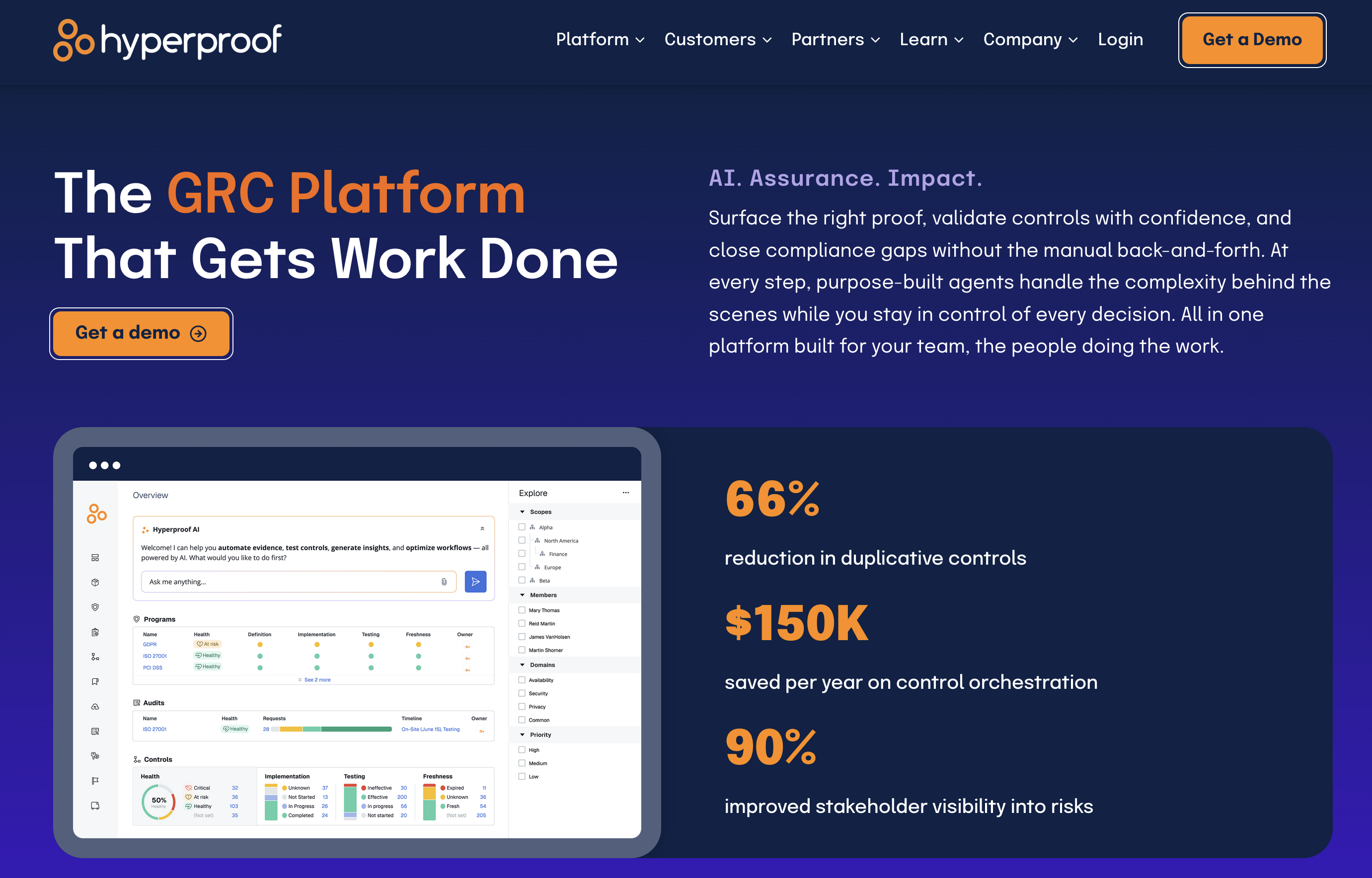
Hyperproof provides an ISO 27001 starter template that covers requirements and Annex A controls, and it supports both the 2013 and 2022 versions with a Framework Update migration path.
The trade-off is setup effort. Hyperproof does not ship with automated tests preconfigured out of the box. Teams need to manually configure and maintain each test, including basic logic coding, which can slow time to value compared to tools that deliver pre-built tests immediately. It also does not auto-generate the Statement of Applicability. Producing an SoA requires manual configuration using custom fields.
Where Hyperproof is consistently strong is in traceability. Controls map back to risks, test activity is logged, and findings can be tracked through remediation to closure.
Integrations and Evidence Collection Model
Hyperproof has fewer than 100 integrations. Its evidence collection is centered on:
- Hypersyncs, which pull evidence on demand or on a schedule
- Livesyncs, which continuously sync files, but only from a limited set of repositories (Google Drive, Confluence, SharePoint, Dropbox, Amazon S3)
There is also an SDK for custom integrations, but that typically requires engineering effort. If your ISO evidence depends on deep security telemetry and broad SaaS coverage, this smaller ecosystem can translate into more manual work.
Monitoring Cadence
Hyperproof’s test cadence tops out at daily, not hourly. In practice, the program can look more point-in-time than continuously monitored, especially compared to platforms that run frequent automated checks and alert within the hour.
Multi-Framework Efficiency and What Hyperproof Does Best
Hyperproof’s biggest differentiator is breadth. It offers 140+ framework templates, which is one of the largest libraries in the category. It uses Adobe CCF for cross-mapping, and its Jumpstart feature can map existing ISO 27001 controls across other frameworks to reduce duplicate work.
For teams building a portfolio of compliance programs, this breadth matters. It is a different value proposition than “automate everything,” and it tends to resonate once you are juggling many frameworks at the same time.
Audit Operations, Reporting, and Adjacent Workflows
Hyperproof supports internal audit-style workflows and remediation tracking, with task integrations limited to tools like Jira, Asana, and ServiceNow. It does not bundle an audit firm, so you still need to source your own registrar or auditor.
There are also ecosystem gaps to consider for customer-facing trust workflows. Hyperproof lacks a native Trust Center and questionnaire automation and instead relies on a HyperComply partnership with a 72-hour human-reviewed SLA.
For analytics, competitive research notes reporting is limited enough that some teams export data to Snowflake to build dashboards externally.
Hyperproof also offers an EU hosting option, which can matter for data residency requirements, and it does not use user seats as the primary pricing lever, since seats are unlimited.
Pricing, AI, and Operational Considerations
Pricing varies by frameworks, add-ons, integrations, and services. Available market signals place Hyperproof in the $22K to $54K range, with a median ACV of around $39K, and an implementation fee of around $10K.
Hyperproof introduced AI capabilities in September 2025, but the research describes them as nascent. Current AI features focus on monitoring and locating compliance data, suggesting tests and ingestion flows, and summarizing evidence, rather than delivering deep remediation guidance.
Finally, if support velocity is a priority, note the research callout of December 2025 layoffs that impacted engineering and support.
Best Fit
Mid-market to enterprise teams with dedicated GRC capacity that want strong governance workflows, risk-to-control traceability, and a broad library of frameworks. Less ideal for lean security teams that need out-of-the-box automated tests and fast automation-driven time to value for their first ISO 27001 certification.
4. Thoropass: Bundled Software Plus Audit, With Real Trade-Offs on Independence
Thoropass automates evidence collection primarily through cloud integrations and a unified controls model that maps work across frameworks. It also includes policy templates and acknowledgment workflows, plus AI features like First Pass AI, which pre-screens evidence before an auditor review.
The limitation is that monitoring is often described as snapshots for auditor review, and internal competitive research frames it as point-in-time evidence rather than comprehensive continuous testing. If your ISO program depends on frequent, automated verification across a broad stack, you should validate how many controls are truly tested automatically versus tracked as tasks.
A second practical constraint is environment coverage. Thoropass’s evidence automation refers almost exclusively to cloud integrations. In on-prem environments, evidence collection can revert to traditional manual methods, such as screenshots and CSV exports.
Integrations and Reliability Considerations
Thoropass markets 200+ integrations, but competitive research notes that this count can be inflated (for example, counting individual AWS services separately). Third-party sources cite 100+ integrations, and internal intel references around 145, with fewer automated tests than deeper automation platforms.
Reliability is worth pressure-testing in demos. Gong signals include customer feedback that key integrations and checks can be flaky, and that some integrations may stop working without clear communication.
Framework Coverage and Multi-Framework Mapping
Thoropass supports 30+ frameworks (as of June 2025) and uses unified controls, so you can complete a control once and map it across programs such as ISO 27001 and SOC 2. It also supports multi-framework audits in a single audit cycle and allows custom frameworks.
Time-to-Certification Claims Versus Lived Timelines
Thoropass advertises ISO 27001 audit readiness in 6 to 12 weeks. The expert research also highlights a gap between this marketing claim and real customer experience in some cases. Gong signals describe timeline slippage, broken promises on product updates, and situations where teams pursued audits for extended periods.
The takeaway is not that fast timelines are impossible; it is that your timeline will still depend on your current maturity and the consistency of the assigned audit experience, even in a bundled model.
Audit Model: The Biggest Differentiator and the Biggest Risk
The integrated audit is the reason many teams consider Thoropass. The same model creates its most serious downside. Competitive intel and Gong calls document a strong concern about auditor independence, including reports being rejected by enterprise clients, not just questioned on principle. There are also signals of inconsistent auditor quality, including customers being moved between multiple auditors and receiving conflicting guidance, which can delay certification.
If your buyers scrutinize independence, or if you want the option to choose an external registrar, this is the main decision point.
Pricing, AI, and Best Fit
Thoropass pricing is quote-based, but available signals indicate that the platform subscription starts at around $8,700 per year, with a median deal of around $30,728 per year. Because the model bundles software, advisory, and audit, first-year ISO costs often land in the mid five figures all-in, depending on scope and add-ons.
On AI, Thoropass includes First Pass AI for evidence pre-screening and a GenAI DDQ capability for questionnaire automation. These features can reduce bottlenecks, especially when audit review and evidence collection are tightly coupled.
Best Fit
Small to mid-size SaaS teams that value a single purchase order and an integrated audit workflow, and are comfortable with the constraints of a bundled auditor model. Less ideal for organizations that need auditor choice, have on-prem-heavy environments, or sell into enterprise buyers that may challenge or reject reports due to independence concerns.
Conclusion
Choosing the right ISO 27001 compliance platform depends on how your organization balances automation, audit support, scalability, and internal compliance resources. Some teams prioritize deep continuous monitoring and multi-framework automation, while others may value hands-on guidance, governance workflows, or bundled audit services.
By comparing Vanta, Scytale, Hyperproof, and Thoropass across integrations, monitoring depth, audit workflows, AI capabilities, and pricing models, SaaS companies can better evaluate which platform fits their current compliance maturity and long-term security strategy. The right tool should not only help achieve ISO 27001 certification, but also support ongoing compliance, customer trust, and operational efficiency as the company grows.
Share this post
Leave a comment
All comments are moderated. Spammy and bot submitted comments are deleted. Please submit the comments that are helpful to others, and we'll approve your comments. A comment that includes outbound link will only be approved if the content is relevant to the topic, and has some value to our readers.
Comments (0)
No comment