
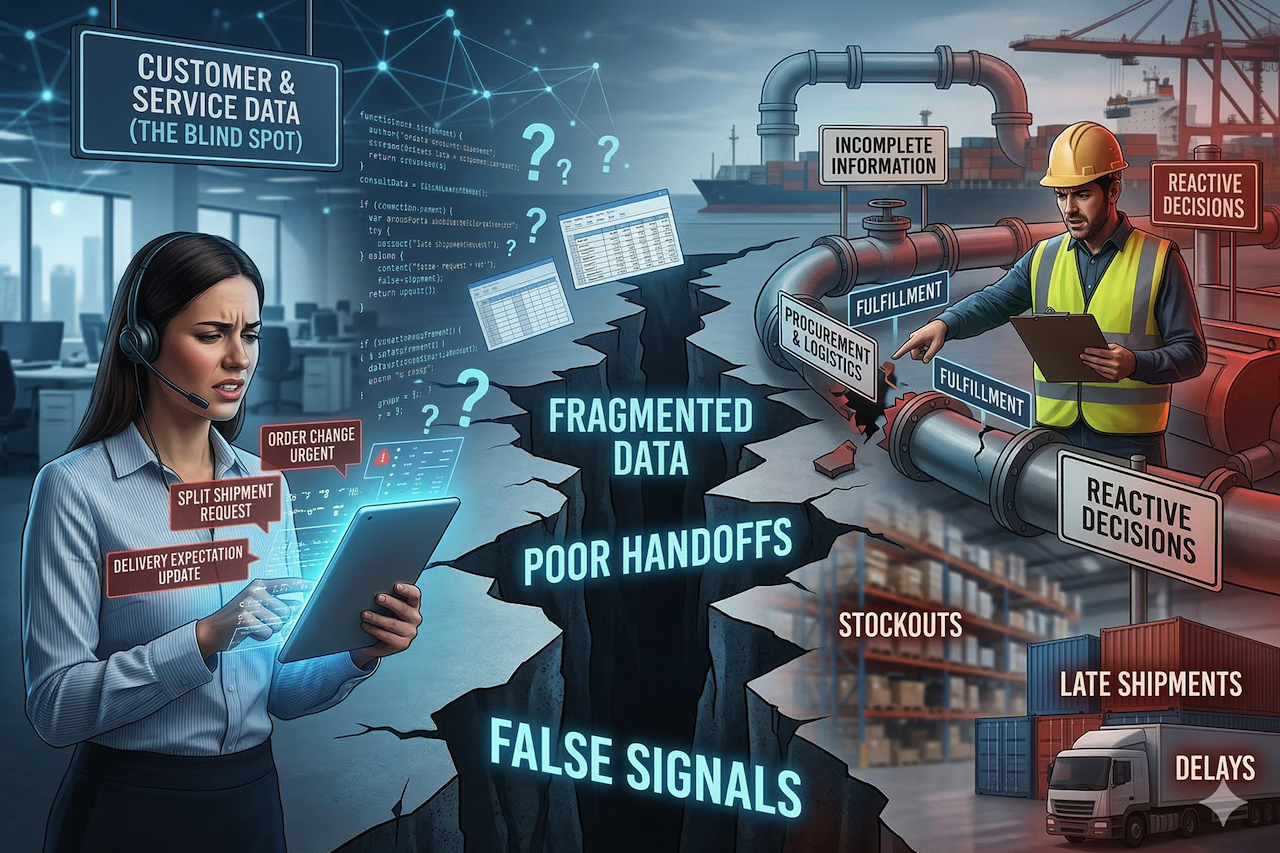
Supply chain teams usually get pulled into the same headline problems: late shipments, stockouts, supplier delays, and rising freight costs. But much of the disruption starts much earlier, in places that do not even look like supply chain work at first glance.
One of the biggest blind spots is customer and service data. If the commercial side and operations side are not working from the same picture, small issues get louder fast. That is where understanding the role of CRM in software systems becomes useful, not as a sales topic, but as an operational one.
For procurement and logistics leaders, this matters because customer promises, order changes, returns, and escalations all shape what happens downstream. You can have a solid supplier base and still feel like the business is constantly firefighting.
1. Fragmented Customer and Order Data Creates False Signals
This is the quiet one, and it causes a ton of noise.
A sales rep updates a delivery expectation. Customer service logs a complaint about damaged goods. Operations has a different shipment status. Procurement is looking at demand patterns that are already stale. Everyone is working hard, but they are reacting to different versions of the truth.
In practice, this shows up in ordinary ways. A customer requests a split shipment, but the warehouse never receives the note. A service team notices repeated complaints tied to a single supplier batch, but the pattern never reaches purchasing in time. Or somebody exports a spreadsheet "just for now," and that file becomes the unofficial system for two months.
None of this looks dramatic on its own. Combined, it distorts planning. Teams start making decisions based on incomplete signals, and then they wonder why the plan keeps failing.
2. Poor Handoffs Between Teams Turn Small Exceptions Into Service Failures
Most supply chain problems do not arise within a single department. They break at the handoff.
A delayed PO becomes a customer issue. A customer issue becomes a finance issue. A finance hold becomes a fulfillment issue. Then everyone starts chasing updates by email because no one is fully sure who owns the next step.
This is where process discipline matters more than "more tools." Strong organizations design around handoffs, not just tasks. They define who owns the exception, what information must accompany it, and how quickly the next team must respond. That kind of thinking is closer to end-to-end processes than to traditional silo management.
A simple example: if a shipment is delayed, does customer service have a clear path to trigger a procurement or supplier review when delays become repeat behavior? In many companies, the answer is no. The issue is solved at the frontline, but the root cause persists.
3. Weak Issue Tracking and Data Ownership Slow Response When Risk Appears
When pressure hits, the real test is not whether a team can "work hard." It is whether they can respond clearly.
If no one knows where key customer, order, and supplier risk data lives, response time drops immediately. People re-check the same facts. Access permissions become a bottleneck. Teams duplicate effort. Sometimes, the right people are not even looped in until the issue has already taken legs.
This is also why cybersecurity in supply chain management is becoming part of the same conversation. Supply chain resilience is not just physical movement of goods anymore. It is also information integrity, access control, and confidence in the data used to make decisions.
Final Thought
Companies often pursue resilience by increasing inventory buffers or adding more suppliers. Sometimes that is necessary. But a surprising amount of disruption can be reduced by fixing the quieter problem first: broken information flow between customer-facing teams and supply chain operations.
Get the handoffs right, make ownership explicit, and the whole system starts to feel less reactive. Not perfect, just more reliable. And honestly, that is what most teams need.
Featured Image generated by Google Gemini.
Share this post
Leave a comment
All comments are moderated. Spammy and bot submitted comments are deleted. Please submit the comments that are helpful to others, and we'll approve your comments. A comment that includes outbound link will only be approved if the content is relevant to the topic, and has some value to our readers.
Comments (0)
No comment