

IP Address, Cybersecurity, Proxies
The Complete Click Fraud Detection Guide To Protect Spend

Click fraud detection is the boring-but-vital job that decides whether your ad budget buys customers or just pads a scammer's payday. Every day, bots, rival businesses, and click farms tap your paid ads with zero intention of buying anything. You pay for each of those clicks the same as a real one. Nobody hands you a refund.
And that is exactly what we are going to sort out here. We will show you the whole thing, from the warning signs to the detection methods that genuinely protect your spend. One quick habit to start with. Whenever a click looks off, you can trace exactly where it came from in a couple of seconds. Doing that a few times teaches you more than any blog post.
What Is Click Fraud Detection?
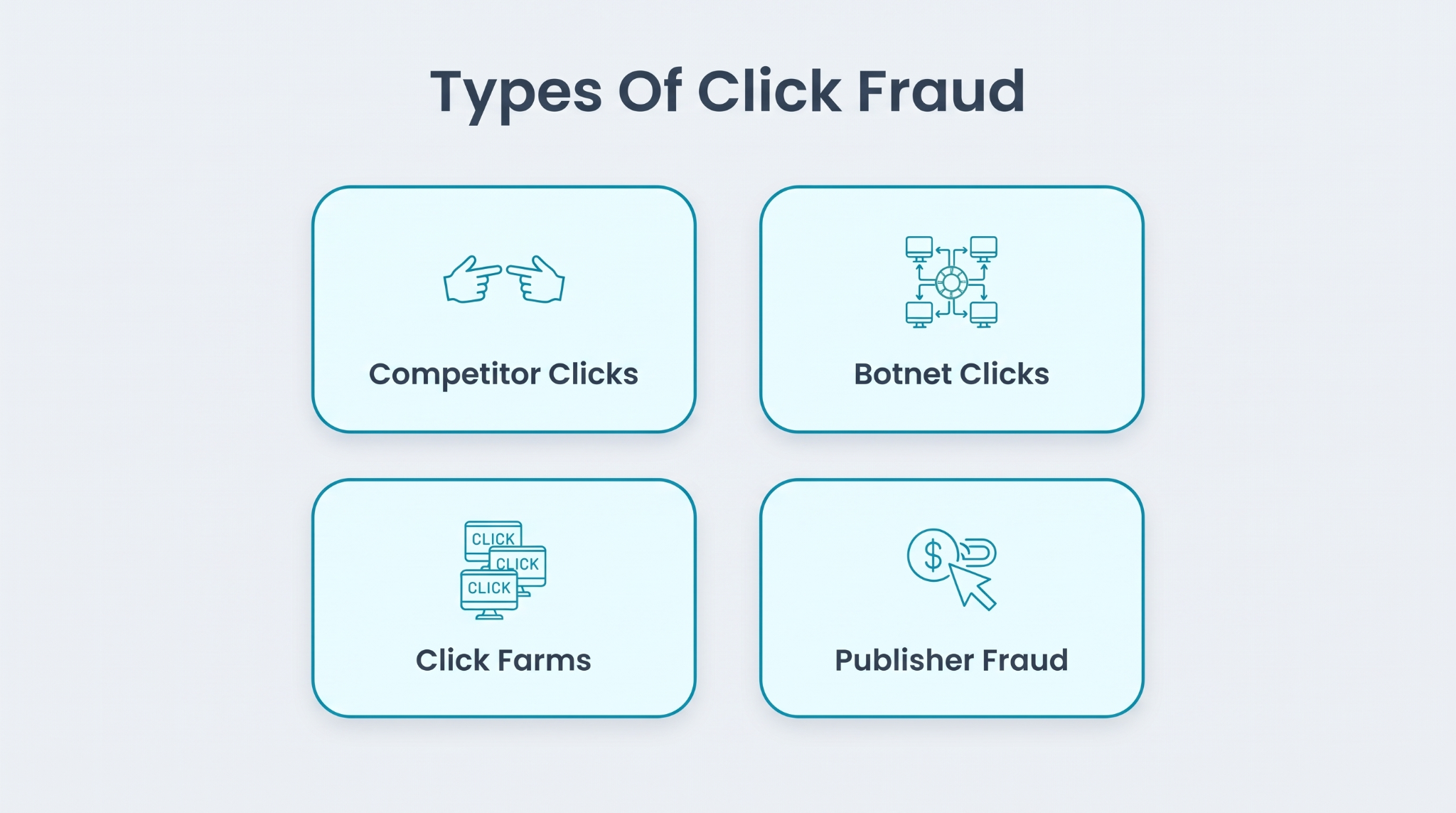
Click fraud detection spots the ad clicks that were never real interest and shuts them down before they burn your budget. Good detection tells a curious human from a bot or from a competitor clicking your ad to nowhere, regardless of which search engine delivers the ad. The catch is that every fake click bills you as if it were a real one.
And what click fraud costs companies is honestly grim. TrafficGuard reckons about 22% of global ad spend vanished to fraud in 2026. That is roughly a fifth of every dollar gone before a single real person sees your offer. It is why so many businesses now lean on IP intelligence to prevent fraud at the front door.
| Type Of Click Fraud | Who Is Behind It | What It Costs You |
|---|---|---|
| Competitor clicks | A rival draining your budget | Your daily cap gone by noon |
| Botnet clicks | Automated scripts at scale | Skewed data and wasted spend |
| Click farms | Paid humans clicking for hire | Fake engagement that fools reports |
| Publisher fraud | Shady sites juicing ad revenue | Payment for worthless placements |
The Signs You Are Already Paying For Fake Clicks
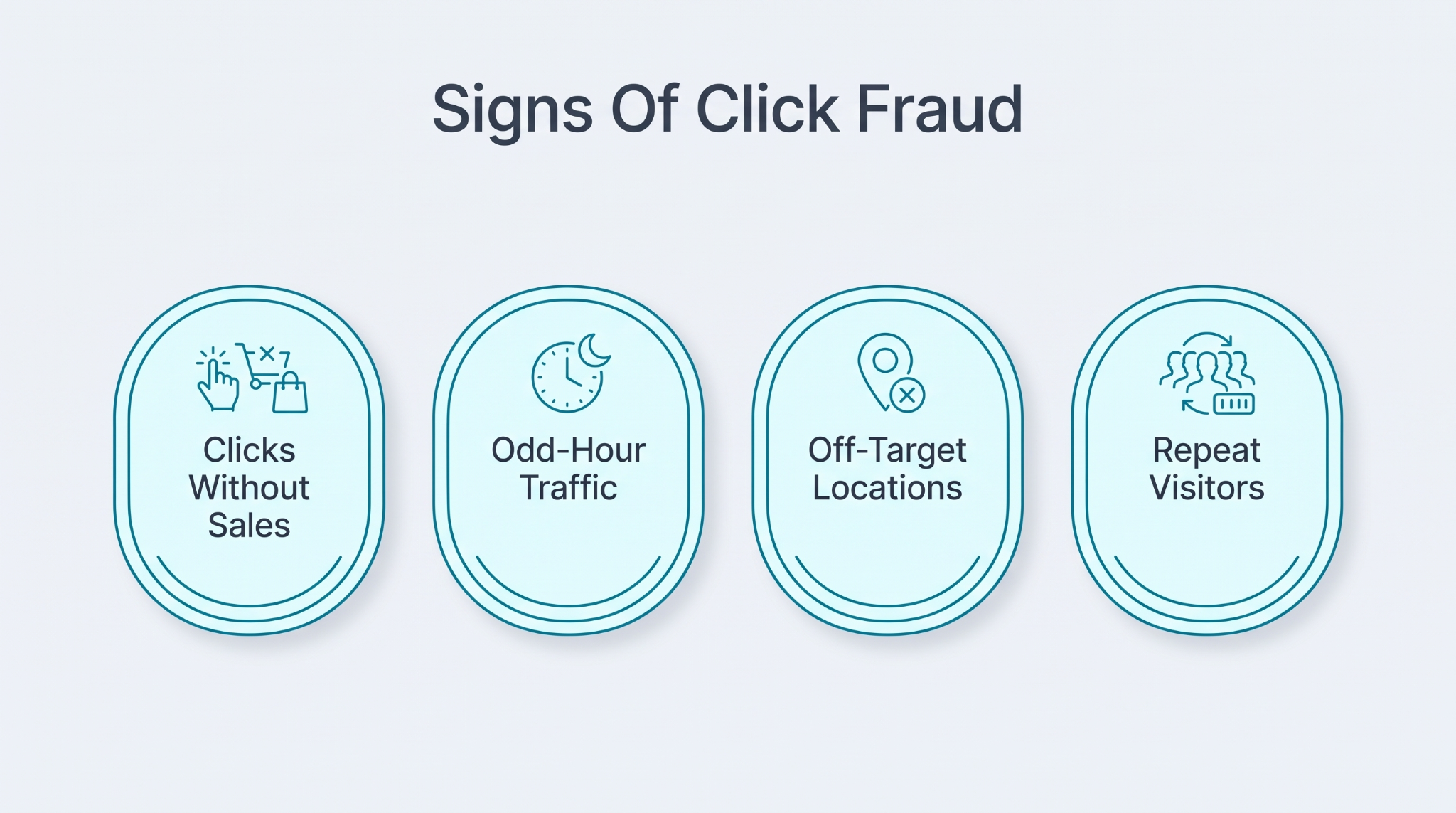
First warning signs are already hiding in the reports you check every week. No single one proves ad fraud on its own, but a couple of them together should make you nervous.
1. A Flood Of Clicks With No Extra Sales
This is the loudest one by far. Your clicks jump, and your advertising cost climbs right along with them, while your sales don't budge an inch. Genuine demand almost never increases clicks without moving conversions at least a little. So when those two lines rip apart, something is clicking that was never going to buy.
2. Traffic Pouring In At Hours Nobody Shops
Take a look at when your clicks actually happen. A big wave at three in the morning, your time, is a dead giveaway, since your real customers are fast asleep. Automated bots don't keep human hours. When your deadest sales window suddenly turns into your busiest click window, that is not some happy accident.
3. Clicks From Places You Don't Even Sell To
Pull up the geography of your traffic. If you are a plumber in the U.S. getting clicks from three other continents, those aren't shy long-distance customers. Fraud rings bounce their traffic through wherever is cheapest, so it turns up in countries you never once targeted. A sudden cluster from one random region deserves a hard look.
4. The Same Few Visitors, Clicking Over And Over
Real buyers almost never click the same ad 10 times in one afternoon. Fraud does it constantly, usually from the same address or a small cluster of them. If a few visitors are generating dozens of clicks, pull their details and hold them against what a real connection fingerprint looks like. The fakes tend to stand out fast.
7 Click Fraud Detection Methods That Protect Your Ad Spend
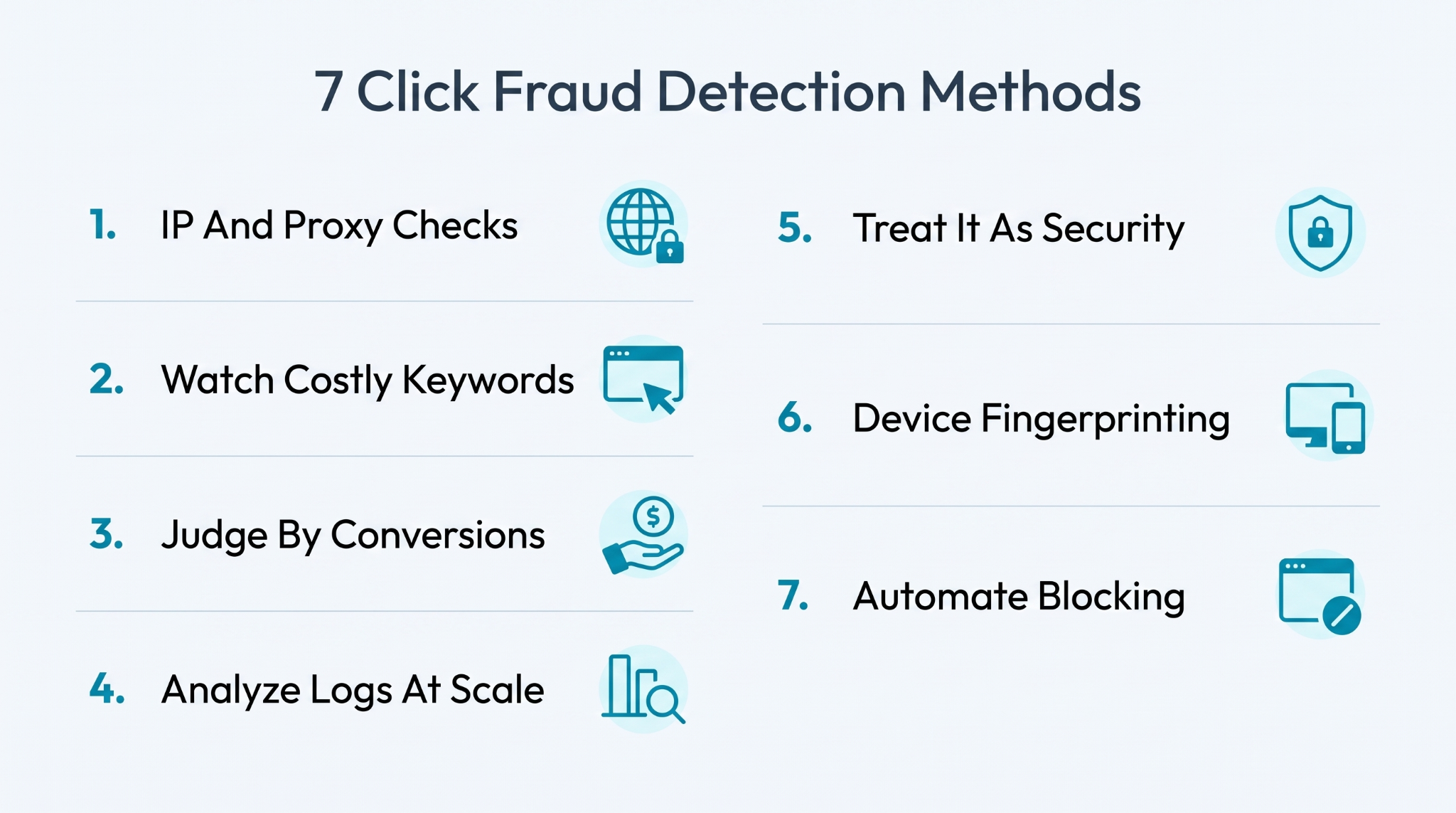
Signs tell you something is not right. These 7 methods are how you detect and shut down click fraud. Each one attacks a different layer, so running several at once lets far less fraud get through.
1. Start With IP Reputation, Proxies, And Datacenter Traffic
Most fraudulent clicks blow their cover at the network level before you check anything else. Real people browse from home wifi and phone data. A ton of fraud comes through data centers and cheap proxies set up to hide its real source. That mismatch is the easiest fraud signal there is to read.
The numbers make the case. In Pixalate's Q2 2025 benchmark, data-center traffic accounted for 53% of invalid desktop-web clicks. So when one IP address looks shady, a fast proxy and VPN check usually settles it right there.
- Block known data center and hosting IP ranges so they never see your online advertising.
- Flag any click arriving through a proxy, VPN, or Tor exit node.
- Compare each visitor's claimed location against the IP's real network for mismatches.
- Score every IP by reputation and auto-block anything past your risk threshold.
2. Watch Your Most Expensive Keywords First
Not every click costs you the same, so not every click deserves the same attention. Fraud hurts most where clicks are priciest, because a few fake taps can waste a real budget in under an hour. Your attention is finite, so aim it at your costliest digital ad campaigns first. That is simply where your money gets wasted fastest.
This gap between niches can be huge. High-value industries are especially vulnerable because a small number of fraudulent clicks can quickly burn through a campaign's budget. The more a business pays for each click, the more important it becomes to identify unusual activity before it affects campaign performance.
For example, a business promoting a high-value service, such as a truck accident lawyer, may compete for expensive search terms where every wasted click matters. The same problem applies across insurance, finance, home services, and B2B industries: repeated clicks from bots, competitors, or other invalid sources can consume the daily budget before legitimate prospects ever see the ad.
The data isn't subtle here. Fraud Blocker's 2026 numbers put the invalid-click rate for legal keywords at 14.70%, well above most other industries.
Businesses can reduce this risk by monitoring their highest-cost keywords closely and watching for repeated activity from the same IP addresses or suspicious traffic sources. This approach is especially useful in industries with expensive clicks, including legal services, insurance, finance, home services, and high-value B2B markets.
- List your advertising campaigns by cost per click and audit the top ones first.
- Set a hard daily cap so that a single burst of fraud can't drain everything at once.
- Limit how many clicks a single IP can trigger on pricey keywords.
- Review your priciest campaigns daily, not monthly like the cheap filler ones.
3. Judge Traffic By Conversions, Not Just Clicks
Clicks are a vanity stat. A fraudster can gin up a thousand of them overnight, but they can't fake a real quote request or a finished sale. So the most trustworthy fraud signal is the gap between traffic and actual outcomes.
When clicks flood in, and real conversions don't follow, those clicks were probably junk from the start. That gap also shows how click fraud can affect the numbers before anyone spots the source.
- Track real conversions like quote requests and sales, not just raw clicks.
- Watch the click-to-conversion rate on every campaign and flag any sudden collapse.
- Set up proper conversion tracking for accurate data before you pour real money into online ads.
- Treat high clicks with zero inquiries as a fraud flag, not bad luck.
This gets slippery in businesses where the actual sale never happens on the website. For example, industrial manufacturers. Nobody drops a custom-molded part or a whole production line into a shopping cart. For them, the real conversion is a quote request, so your entire fraud test depends on whether the site is even built to capture those in the first place.
This is where it gets real. If a manufacturer's site is a thin brochure with a contact form at the bottom, every click looks equally worthless, and fraud just blends in.
But give the site clear quote paths and real lead tracking, and a pattern jumps out. Genuine buyers dig into specs and pricing, while fake traffic bounces in seconds without touching a thing. That contrast is your ad fraud protection.
For manufacturers, that can mean making sure the website is structured around measurable actions such as quote requests, specification downloads, and contact inquiries. Resources covering manufacturing website design illustrate how industrial sites can be structured around these types of conversion paths. When those actions are properly tracked, advertisers have more useful signals to distinguish valuable traffic from clicks that never progress beyond the landing page.
4. Analyze Your Traffic Logs At Scale For Patterns
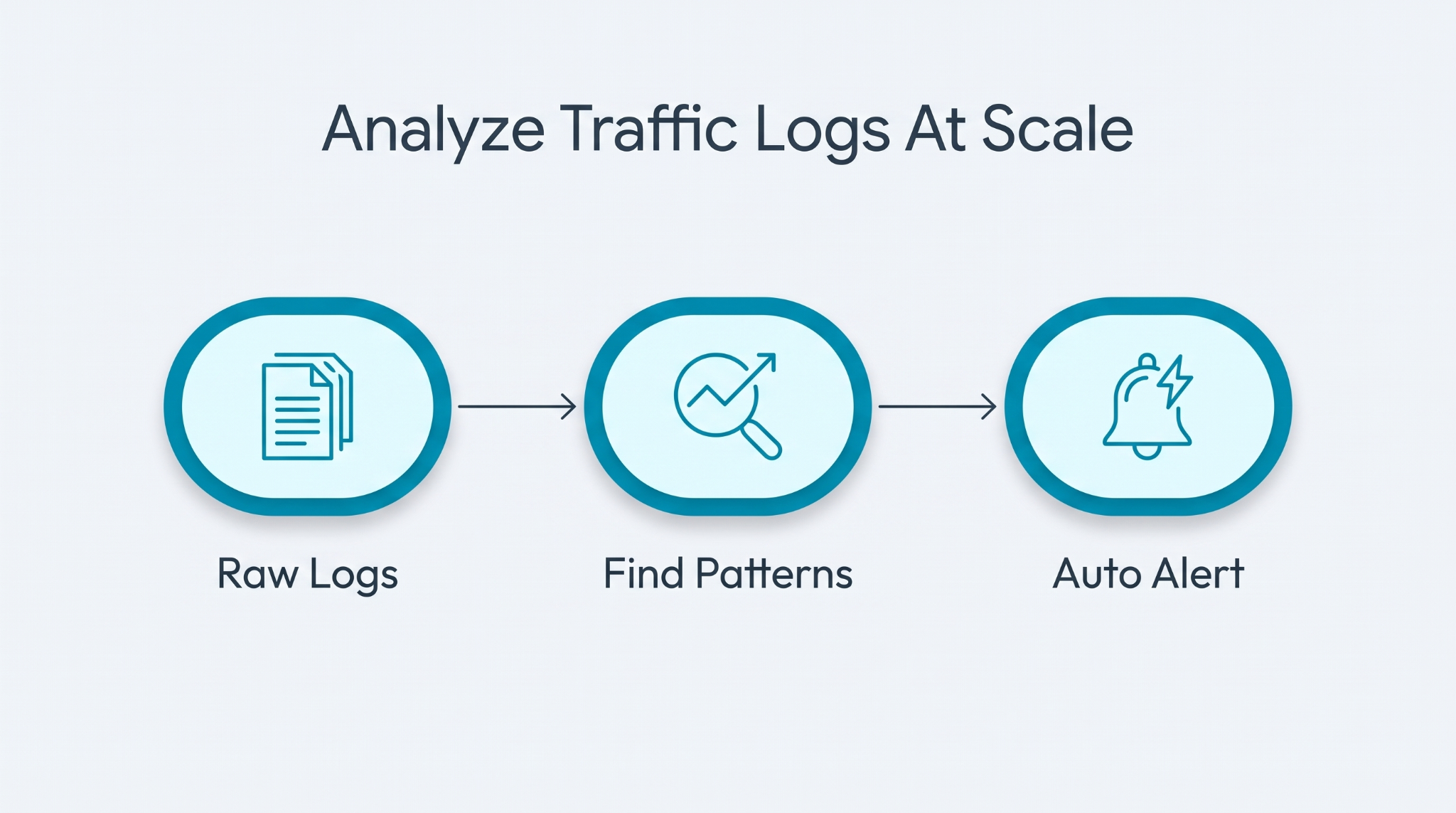
Some fraud only shows itself in bulk. One click looks perfectly normal on its own. But line up a million and the patterns leap out, like clicks with identical screen sizes or spaced exactly four seconds apart. Catching that means actually digging through raw log data, not glancing at a dashboard summary.
- Pull clickstream logs from every ad platform into one place you can query.
- Search your logs for identical devices or suspiciously exact gaps between the clicks.
- Automate alerts that trigger the moment traffic starts behaving like a script.
- Compare patterns across campaigns to find coordinated fraud attacks nice and early.
The issue is that this is a genuine data problem, not just a marketing one. You may be looking at millions or billions of clickstream rows coming from ad platforms, analytics tools, and your own servers. At that scale, suspicious patterns can be difficult to identify when the data remains scattered across separate systems.
Centralizing click, conversion, and traffic data makes those patterns easier to analyze. Instead of reviewing each advertising platform separately, teams can compare activity across campaigns and sources to identify recurring devices, unusual timing, coordinated traffic bursts, and other signals that may indicate click fraud.
Depending on the organization's existing technology stack, this may involve a data warehouse, cloud analytics environment, or support from a Microsoft Fabric partner to integrate data from multiple sources. The specific platform matters less than having the relevant click and conversion data in a form that can be queried and compared consistently.
Teams can then set automated alerts for suspicious patterns, such as sudden traffic spikes, repeated activity from similar sources, or unusually consistent click intervals. For advertisers handling large volumes of traffic, this makes it easier to detect coordinated fraud that may not be obvious in individual campaign dashboards.
5. Treat Click Fraud As A Security Threat, Not Just A Marketing One
This is the mental switch most advertisers never make. Big-time click fraud isn't a marketing annoyance; it is a cyberattack in disguise. The nastiest of it runs on botnets, the same networks of hijacked phones and laptops security teams battle daily. Your ad dashboard sees odd clicks. It can't see the malware and control server pulling the strings.
That blind spot is the whole problem. Marketing tools are built to tune campaign performance, not to track threat infrastructure. They can block an IP once it acts up, but they have no clue that address belongs to a botnet-for-hire that will hit you from 10,000 fresh ones tomorrow.
Click fraud at this scale needs to be treated like any other threat, with the setup blocking invalid traffic while the security team investigates what is behind it.
For larger organizations, this can also mean connecting advertising traffic analysis with broader security operations. Technologies and approaches used in areas such as agentic SOC environments can incorporate threat intelligence and automated monitoring to identify activity associated with known malicious infrastructure. That additional context can help security teams investigate suspicious traffic that extends beyond what an advertising dashboard can show.
For an enterprise advertiser, folding click fraud into real security monitoring changes it from a mystery line on the invoice into a threat you can watch coming and block early.
- Feed known malicious IP and botnet threat lists straight into your ad blocking.
- Match your click bursts against botnet campaigns already active across the web.
- Bring your security team in whenever large-scale ad traffic starts looking suspicious.
- Monitor ad traffic in real time rather than in a weekly catch-up report.
6. Fingerprint Devices And User Behavior
Even when fraud hides its IP, the device and behavior rat it out. Real people wiggle a mouse in loopy, indecisive paths and pause to read. Bots are too tidy. They hit the exact same pixel and vanish in a flat half-second, usually from a headless browser no human runs. Those tells identify fraud that slips past network checks.
- Capture device fingerprints so one machine can't fake dozens of separate users.
- Flag headless browsers and automation tools that real users never use.
- Track mouse movement and scroll behavior to tell real humans from scripts.
- Watch for impossible speed, like a form filled in under a second.
7. Automate The Blocking And Keep Your Lists Fresh
Detection is worthless if you are doing it by hand once a month. Fraud runs nonstop and cycles through fresh IPs constantly, so a block list you built in January is basically dead by March. The whole thing has to run itself.
It should update automatically and act the second a bad source shows up, or the fraud just outruns you. Automating blocking click fraud at the source keeps that response from depending on someone checking a list manually. That is where click fraud software can take over the repetitive detection and blocking work.
It also helps to borrow public reputation data instead of building your own from scratch. Before you trust an IP, it is worth checking whether it is already flagged on known blacklists. And when you have a whole batch of suspects at once, you can screen them all in bulk rather than one at a time.
- Auto-update your IP exclusion lists rather than editing them by hand monthly.
- Push blocks to every ad platform at once, not one by one.
- Recheck flagged IPs on a schedule, since fraud networks recycle addresses fast.
- Set rules that block a source automatically the moment it trips thresholds.
3 Click Fraud Detection Mistakes That Keep Draining Spend + How To Fix Them
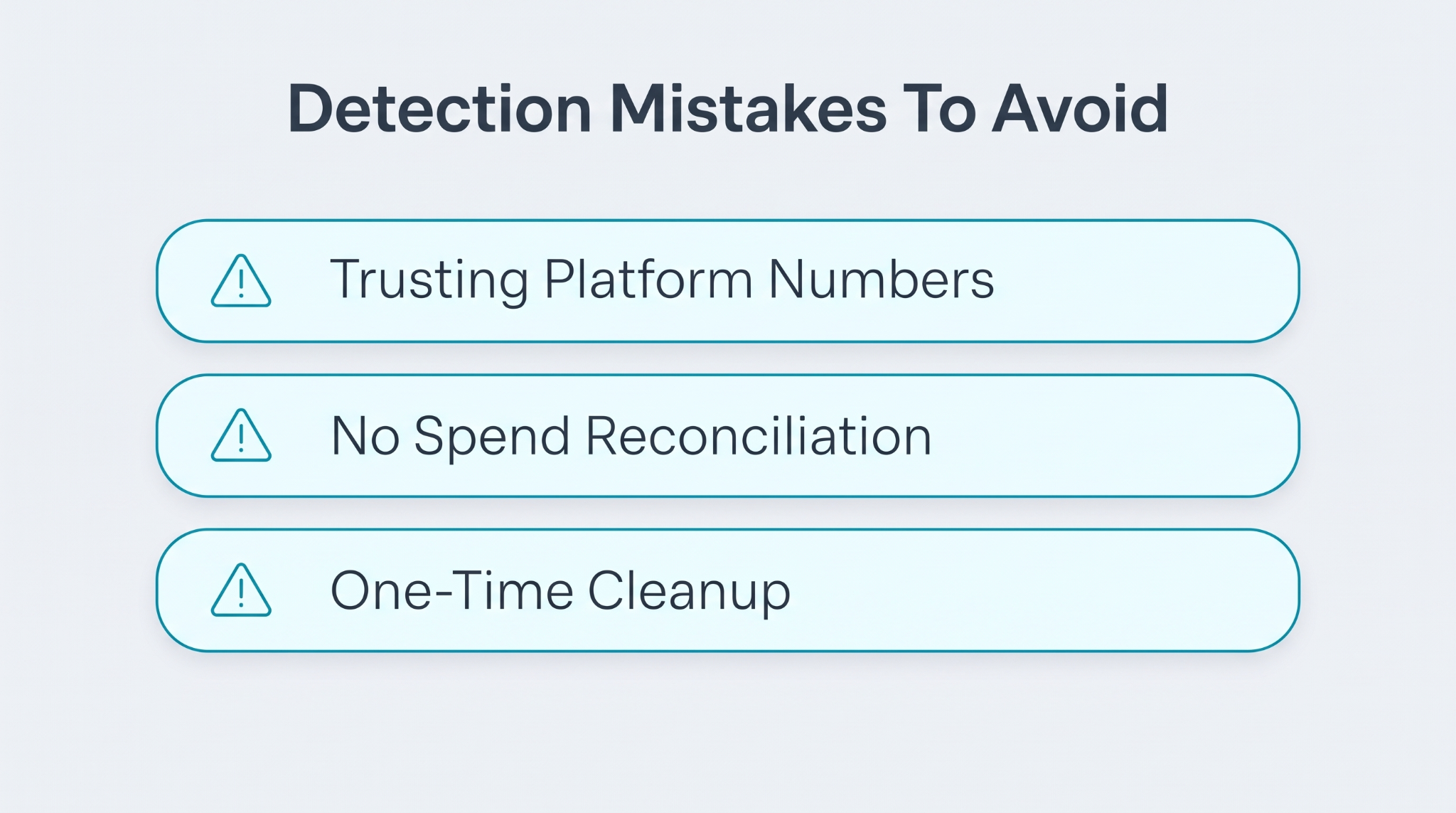
A few mistakes can undo all your good click fraud protection work. Keep an eye out for these three, because they let fraud keep winning even after you have done everything else right.
1. Trusting "Invalid Click" Numbers Of Google Ads And Other Ad Platforms
Google, Meta, and Microsoft Ads do filter out some invalid clicks and refund you, which sounds comforting. Trouble is, they are grading their own homework. These advertising platforms make money on ad clicks, so they have every reason to define fraud narrowly and only catch the clumsy bots. Plenty of clever fraud sails straight through their filters and shows up as a perfectly billable click.
How to Fix: Run your own independent detection next to the platform's numbers, and treat the two as a cross-check instead of taking either on faith. Whenever your figures and theirs disagree, go dig into the gap. That difference is usually exactly where the fraud they missed is hiding.
2. Never Reconciling Wasted Spend To A System Of Record
Most advertisers file click fraud under "marketing metric", something to poke at in the ad account and then brush aside. That is fine right up until someone has to actually account for the money.
For any business under real financial scrutiny, every ad dollar has to line up against the books at some point. Fraud-wasted spend that never gets recorded turns into a hole nobody can explain when the questions start.
How to Fix: Tie advertising spend into a financial system of record and track suspected fraud losses alongside other campaign costs. This becomes particularly important in industries with stricter accounting and reporting requirements. For example, an ERP for government contractors may be used to centralize financial and operational records where traceability is especially important. Regardless of industry or platform, the goal is to make wasted advertising spend measurable rather than leaving it buried inside campaign-level metrics.
3. Treating It As A One-Time Cleanup, Not An Ongoing Watch
The most common trap is believing you can fix click fraud once and walk away. You block a batch of bad IPs, watch the numbers improve, and leave it at that. But the people running fraud adapt within days, spinning up fresh addresses the instant the old ones stop working. A setup you never maintain slowly rots into something useless.
How to Fix: Treat click fraud prevention as a standing job with an owner, not a project you tick off. Schedule regular reviews of your traffic and refresh your rules on a set cadence. The goal isn't one clean report this week; it is staying a step ahead of people whose full-time job is getting around you.
Conclusion
The honest truth about click fraud detection is that you will never drive it to zero. The real aim is to make your ads a rotten target, so the bots and rivals go bother someone else. Use a few of these methods and keep them running, and the budget leak shrinks to something you can shrug at.
IP data can be one useful part of that process. Resources such as IPLocation.net provide information and tools for examining IP addresses, proxy activity, network details, and other signals that can help teams investigate suspicious traffic alongside their advertising and analytics data.
Comments
Comments are available to signed-in users and are moderated to keep the discussion useful and respectful. Spam, automated submissions, and low-value promotional comments are removed. Outbound links may be approved when they are relevant and genuinely helpful to readers, but they are displayed as plain text rather than clickable hyperlinks.
No comments have been published yet.
Please sign in to submit a comment.