

Digital Marketing, Artificial Intelligence
How AI Agents Improve Lead Generation and Conversion Rate
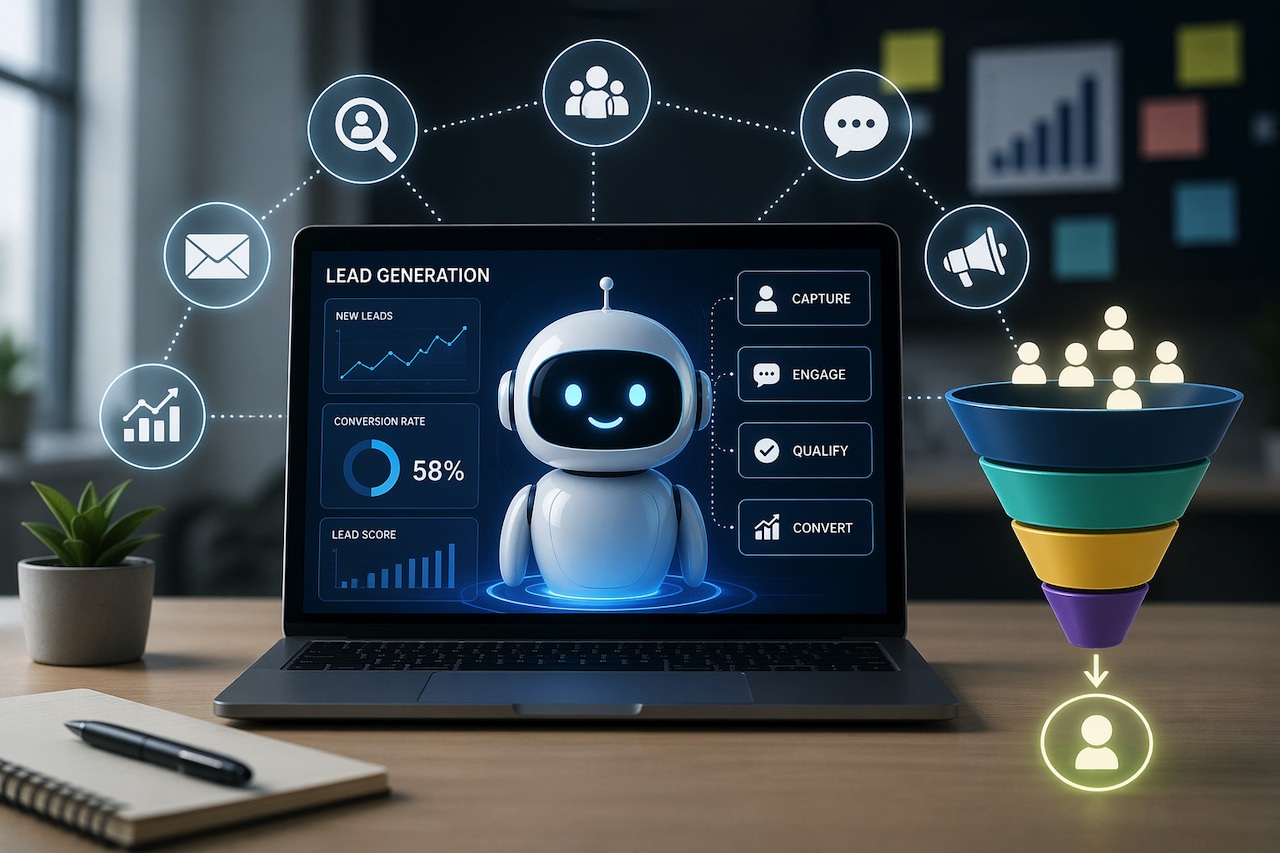
When a company faces the challenge of improving customer relationships, service quality, and lead generation, the advice that usually comes up is to integrate an AI agent.
Now, you’re probably wondering hhow these systems improve lead generation—they bring greater agility, scalability, and optimization to every operation because they focus on achieving their own objectives to deliver the best results.
Let’s say your company handles lead generation the traditional way. If so, this means you’ll have to manage a large volume of prospects manually, deal with lost opportunities due to slow response times, and face inefficiencies with manual lead scoring.
Clearly, if this were your reality, you’d be in a frustrating situation. That’s why the best solution for the modern market is to integrate an advanced, intelligent tool. Let's see how to achieve it!

What Are AI Agents in Lead Generation?
AI for lead generation is the ability to identify, engage, and manage your prospects into strategic groups.
In other words, you can identify opportunities in seconds and take the right action by leveraging the capabilities of artificial intelligence.
Definition, Core Capabilities, and Benefits
These systems are software programs designed to perform marketing and sales tasks autonomously or semi-autonomously.
In the context of lead generation, they can identify prospects in seconds by capturing and analyzing data to inform their planning, execution, and monitoring.
Ultimately, they boost your operations and improve your strategies using machine learning, natural language processing, and predictive analytics.
According to an article published by IBM on AI for lead generation, the benefits of using this tool include increased efficiency, improved lead quality, tailored messaging, and scalability for better AI sales funnel automation.
Overall, it is an advanced tool with great potential for success.
AI Agents vs Traditional Automation Tools
You’ve likely already encountered a traditional automation tool and recognized it immediately thanks to the basic, impersonal response it provided.
That doesn’t happen with more advanced systems, since they don’t operate based on predefined actions but instead provide seamless assistance focused on business objectives.
So, when it comes to lead generation, their goal is to boost conversion through personalized messages and actions that nurture leads.
How AI Agents Improve Lead Generation by Analyzing Data
Beyond analyzing data, these systems improve lead generation by interpreting actions in real time. They identify the information customers provide, evaluate it in seconds, and use it to deliver precise assistance.
In addition, they are prescriptive—meaning they can recommend actions and, in some cases, execute them—providing a predictive and dynamic assessment.
How AI Agents Improve Lead Generation Quality
When seeking to improve the quality of marketing efforts, the best approach is to automate lead qualification with AI, as they provide precise, strategic actions that help optimize every step and business decision.
Behavioral Data Analysis and Intent Detection
When working with customer data, you can assess their behavior and intentions. Once you identify the first steps they will take and act accordingly, you will achieve higher conversion rates and increased sales.
Predictive Lead Scoring Models
These systems identify the optimal time to act using predictive lead-scoring models, ranging from rule-based approaches to machine-learning methods that assess the likelihood of a successful conversion.
Through strategic and intelligent actions, they then determine how and when to act by identifying hidden patterns in the data.
Filtering and Prioritizing High-Value Prospects
While all prospects are important and necessary, some are more valuable than others, depending on their purchase intent and interest in the brand.
Since it’s not feasible to give every prospect the same level of attention, these systems filter and prioritize high-value prospects, improving overall lead quality.
How AI Agents Increase Conversion Rates
When customers feel they are the focus of a company, conversion rates increase significantly.
Many companies have achieved this using AI-driven systems to improve operational efficiency. However, connecting that efficiency to concrete revenue remains a hurdle, with research showing that 77% of sales teams haven't measured AI ROI or confirmed positive returns yet.
Ultimately, this type of intelligent system enables productivity gains through a range of functions.
Real-Time Engagement With Prospects
When an AI agent tool is used in customer interactions, its speed can shorten the sales cycle by up to 25% by enabling real-time responses.
This benefits both parties: companies can streamline their processes, and prospects can be smoothly guided toward a sale.
Personalized Communication at Scale
The way we communicate with customers plays a significant role in conversion rates.
In this regard, companies use these systems to design personalized communication at scale, fostering closer relationships with leads and increasing engagement.
A McKinsey study noted that by mid-2025, companies using AI-driven tools for hyper-personalized campaigns achieved conversion rates 2 to 3 times higher than those of traditional methods.
Optimized Follow-Ups and Timing
Among the functions AI performs is automating lead scoring, which includes tracking each process and optimizing the timing.
This allows you to connect with more leads without burning out, thereby improving your conversion rate through continuous and effective processes.
AI Agents Across the Lead Generation Funnel
The way these systems improve lead generation is closely tied to sales funnel automation.
When you build a seamless, advanced sales funnel, you achieve greater operational efficiency and increase the potential for business growth. One way to verify this is to see how each stage works.
Top of Funnel: Automated Lead Capture
In the past, generating leads required working with static lists, which limited selection and growth; today, the process relies on active, signal-based prospecting.
This enables automated, consistent prospect capture through clear signal monitoring and in-depth analysis of the information provided.
Middle of Funnel: Intelligent Nurturing
The most important point (and also the tipping point for every user) is the moment when you need to nurture the lead intelligently to keep them interested.
These systems improve these processes through automated follow-ups and the creation of dynamic, personalized content that supports user engagement without being intrusive.
Bottom of Funnel: Conversion Optimization
Once you’ve captured the right potential customer and maintained their interest, only the final step remains: conversion.
These systems optimize lead generation processes through predictive analytics. By analyzing conversations, they can evaluate performance and identify potential improvements within the funnel.
According to a 2025 Google Cloud report, 39% of organizations using AI-driven tools for lead generation reported a doubling of business productivity.
Integrating AI Agents With Marketing and Sales Systems
With an understanding of how these systems support conversion, the next step is to integrate them effectively with marketing and sales systems.
Outreach guides you through essential steps and a questionnaire, and we’ll tell you which tools to consider when building your ideal team.
CRM and Marketing Automation Integration
CRM software is relationship management software that, when paired with these systems, combines data collection and analysis with the ability to deliver more personalized communication.
Additionally, marketing automation must go hand in hand with this, as it optimizes every stage of lead generation.
Multichannel Communication Workflows
In addition, multichannel communication can be integrated alongside these systems to support broader audience reach and more flexible workflows.
Industry Adoption and Observations
AI agents are increasingly being adopted across marketing and sales teams, particularly in environments that rely on multichannel communication and CRM systems.
Studies and industry reports suggest that companies using AI-driven tools can improve conversion rates and strengthen relationships with prospects through faster response times and more personalized interactions.
Rather than serving only as conversational tools, these systems can support broader marketing strategies by improving efficiency, lead qualification, and customer engagement.
Final Tip: Best Practices for Using AI Agents in Lead Generation
Once you’ve integrated this type of system, the magic doesn’t happen on its own; you need to know how to use it to ensure you achieve all the results we’ve outlined.
In this case, there are essential best practices, such as:
- Ensuring Data Quality and Accuracy: You can’t overlook your company’s most valuable information; the data you integrate must align with and complement the information your customers provide, or else your actions will be inconsistent and inaccurate.
- Avoiding Excessive Automation: We understand that it’s very exciting to work entirely in an automated way, but it has also been shown to cause many drawbacks, primarily reducing your team's quality and your leads' interest.
- Balancing AI With Human Interaction: What you’re building is a team, so it’s important to balance the use of AI with human representatives; you can let the former focus on repetitive tasks and the latter on hands-on actions.
Brief Summary
In summary, AI agents play a significant role in improving both lead generation and conversion processes.
They function as advanced systems capable of interacting with customers, analyzing data, capturing potential leads, and supporting nurturing efforts throughout the funnel.
They also contribute to higher lead quality through behavioral analysis, predictive lead scoring, and the prioritization of high-intent prospects.
In addition, they support conversion optimization by enabling more efficient and personalized sales funnel processes aligned with business goals and customer preferences.
Overall, these systems provide a practical approach to improving efficiency and scalability in modern marketing and sales operations.
Featured Image generated by ChatGPT.
Related Articles
June 17, 2025
Turning IP Data Into Revenue: The Overlooked Power of an AI Marketing Tool
A site may receive 10,000 visits on a given day, yet how many of those visitors convert? And the embarrassing fact is that the majority will not. They will not click, they will not...
Read More
March 25, 2024
Leveraging AI for Creative Video Editing: Tips and Techniques
The integration of Artificial Intelligence (AI) into video editing is not just a fleeting trend; it's a paradigm shift that is redefining the boundaries of what's possible in the r...
Read More
February 7, 2023
The Impact of AI and Machine Learning in Market Research
It's a fact that consumer habits are changing. The most significant factor is the pervasive influence of technology in people's daily lives. It is hastening and altering the custom...
Read More
Comments
Comments are available to signed-in users and are moderated to keep the discussion useful and respectful. Spam, automated submissions, and low-value promotional comments are removed. Outbound links may be approved when they are relevant and genuinely helpful to readers, but they are displayed as plain text rather than clickable hyperlinks.
No comments have been published yet.
Please sign in to submit a comment.