

Privacy, Cloud Services, Artificial Intelligence
Why the Next Wave of AI May Run Locally Instead of in the Cloud
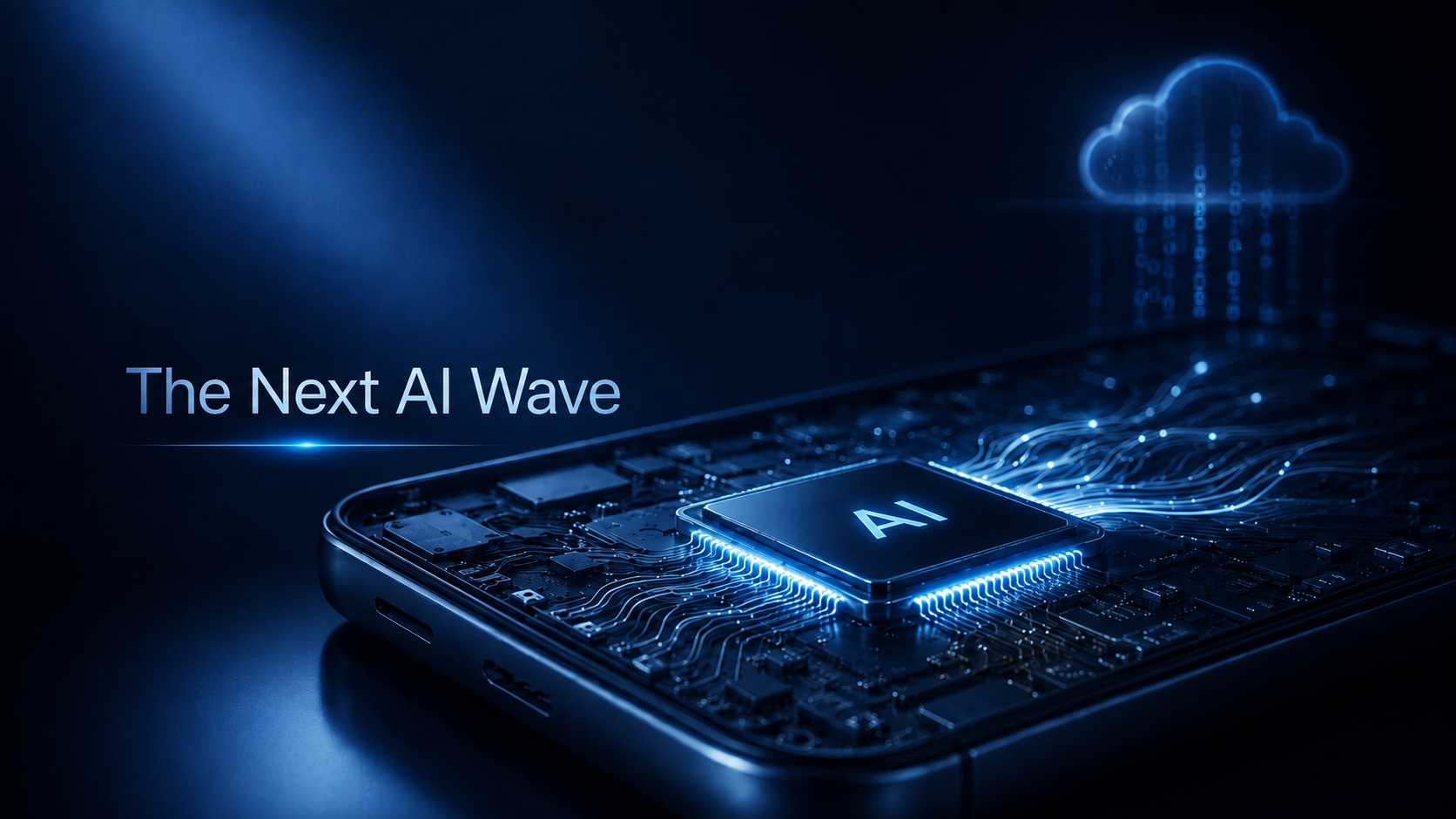
AI has taught people to expect a round trip. A prompt leaves the device, reaches a distant data center, runs through a large model, and returns as text, an image, a summary, or a decision. That made sense when useful models demanded more memory and compute than consumer hardware could provide. It is becoming less absolute.
Dedicated neural processors are now common in premium consumer hardware, smaller models are improving, and techniques such as quantization and distillation are lowering the cost of inference. Gartner projected that AI PCs would reach about 143 million units in 2026, representing roughly 55% of the PC market, while Microsoft already defines Copilot+ PCs as those with NPUs capable of more than 40 trillion operations per second. The important shift is not that the cloud disappears. It is that more AI work can happen before a device needs the cloud at all.
Why the Cloud Came First
Cloud AI became dominant for practical reasons. Large language and multimodal models need substantial memory bandwidth, specialized accelerators, fast interconnects, and enough power to sustain heavy workloads. Centralizing that infrastructure allowed developers to run models that would have been unrealistic on ordinary consumer hardware.
The cloud also simplified distribution. A company could improve one server-side model for every user, monitor failures centrally, patch vulnerabilities, and scale capacity without asking customers to buy new machines. Almost any phone or browser could access intelligence far beyond what its local processor could produce.
That arrangement, however, ties every interaction to connectivity and server capacity. It also means a provider continues to pay for inference after the software has been sold or subscribed to. As AI moves from occasional chatbot use toward continuous assistance, background classification, live translation, document indexing, sensor interpretation, and personal automation, sending every small task to a remote cluster starts to look inefficient.
Five Changes Making Local AI Practical
The case for on-device AI is being built by several changes happening at once. None is sufficient by itself, but together they alter the economics and engineering limits that favored cloud-only systems.
Smaller models are becoming useful for narrow jobs: A device does not need a frontier-scale model to identify entities in a document, summarize a short note, classify an image, rewrite a sentence, transcribe speech, or interpret a simple command. Apple, for example, introduced an on-device model with roughly 3 billion parameters in its first Apple Intelligence architecture and, in 2026, described a new generation that still includes a 3-billion-parameter Core model alongside more capable local and server models.
Consumer chips now reserve silicon specifically for AI: CPUs and GPUs can run neural networks, but NPUs are designed to handle many inference workloads with better power efficiency. The significance is not the TOPS number by itself. It is that AI acceleration is becoming a standard hardware resource that operating systems and applications can plan around.
Compression techniques have become part of deployment, not an afterthought: Quantization can represent model weights with fewer bits, reducing memory pressure and often improving inference speed. Distillation can transfer useful behavior from a larger model into a smaller one, while pruning can remove low-value computation. The result is a model engineered for a device rather than copied from a server.
Applications can split work instead of choosing one location: A local model can handle simple or sensitive tasks, then route difficult requests to a larger cloud system. Apple’s current developer documentation makes this distinction explicit: its on-device model is intended for always-available tasks without a network connection, while its Private Cloud Compute model offers a larger context window and stronger reasoning for workloads such as long documents and extended conversations.
Privacy is becoming an architectural decision: If audio, documents, photos, or behavioral signals can be processed locally, the application may not need to transmit the raw material at all. That is materially different from encrypting information on the way to a server and promising to handle it carefully after arrival.
Local AI Changes More Than Speed
The easiest benefit to demonstrate is latency. If a model runs on the device, there is no network round trip before inference begins. But latency is only one part of the change.
A local system can operate continuously without turning every observation into an upload. A laptop could index files, a phone could classify notifications, a camera could flag unusual movement, and a vehicle could interpret sensor data when coverage is poor. These are workloads where a remote round trip or constant data upload adds little value.
Local inference also makes AI more tightly coupled to personal context. A device may hold calendars, messages, documents, preferences, application state, sensor readings, and years of user behavior. Giving an AI system selective access to that information locally can support richer personalization without requiring the entire context to be copied into a provider’s cloud.
This matters because the next generation of useful AI may be less about asking a chatbot isolated questions and more about software that understands what is happening on a device at the moment a decision is needed.
Local vs. Cloud Is the Wrong Contest

Treating local and cloud AI as competing architectures misses how products are already being designed. The more realistic model is workload routing: use the cheapest, fastest, or most private location that can complete the task well enough, then escalate only when necessary.
| Workload | Local processing is attractive when | Cloud processing is attractive when |
|---|---|---|
| Voice and transcription | Immediate response, offline use, or sensitive audio matters | Longer context or advanced reasoning is needed |
| Image understanding | Images are private or arrive continuously from a camera | The request needs a large multimodal model |
| Personal assistants | Device context can answer the request without leaving the hardware | Fresh web information or broad reasoning is required |
| Industrial monitoring | Millisecond-level response and unreliable connectivity are concerns | Data from many sites must be compared centrally |
| Creative tools | Small edits, enhancements, or classification can run locally | High-resolution generation needs heavier compute |
A hybrid assistant might therefore summarize a notification locally, search private documents on the device, and send only a complex reasoning request to a larger server model. The architectural shift is subtle but important: the cloud changes from the default location for every inference into an escalation layer for tasks the device cannot justify handling itself.
The Economics Favor Selective Inference
Every cloud inference has a marginal cost. A company may pay for accelerator time, electricity, networking, memory, storage, redundancy, and the engineering needed to keep the service available. The cost of one short request can be tiny, but repeated across millions of users and background tasks, it becomes a permanent operating expense.
Local inference changes who supplies part of the compute. The user has already paid for the phone, laptop, vehicle computer, or industrial device. If a frequently repeated task can run efficiently on that hardware, the software provider can reduce dependence on centralized capacity and network traffic.
Local AI is not free. Developers inherit the costs of optimization, cross-chip testing, updates, support for older devices, thermal limits, storage, and model security. A cloud model can be replaced centrally; a local model may exist in many versions across hardware, each updated at different times.
The economic advantage therefore appears strongest for high-volume, predictable tasks. There is little reason to spend frontier-model compute on a job that a small model can perform accurately in a few hundred milliseconds on hardware the user already owns.
When Digital Decisions Become Physical
Local AI becomes more consequential when it is embedded in systems that affect the physical world. Driver-assistance features, warehouse machinery, home security devices, medical monitoring equipment, delivery robots, and industrial controllers can make or support decisions using sensor data without waiting for a distant server.
When something goes wrong, the resulting evidence may be partly physical and partly computational. Device logs, sensor readings, firmware versions, model outputs, timestamps, and configuration changes can all help reconstruct what a system detected and how it responded. In an accident or disputed sequence of events, that technical record may sit alongside more traditional evidence and may be relevant to parties involved in a claim, including a personal injury lawyer, engineers, or other specialists examining the circumstances. The broader technology problem is how to preserve enough evidence to explain an automated decision without turning every local AI device into a permanent surveillance system.
Local AI Creates an Observability Problem
Cloud systems are comparatively easy to observe. A provider can identify which model handled a request, inspect infrastructure logs, measure error rates, reproduce failures, and roll back a problematic release. Local AI spreads that visibility across millions of individual devices.
Imagine an assistant that misclassified a document three weeks ago on a laptop that was offline at the time. Since then, the application may have updated, the operating system may have changed, and the local model may have been replaced. Reconstructing the failure can depend on several details:
- The exact model build and quantization format may affect how the same prompt is processed.
- The hardware accelerator and application state can influence how inference actually runs.
- The context supplied to the model and any fallback logic may also determine why the original result appeared.
This creates a difficult tradeoff. Collecting detailed telemetry makes debugging easier, but it weakens the privacy case for keeping computation local. Collecting very little protects user data but can make serious failures difficult to reproduce.
A sensible middle ground may involve compact audit records rather than raw content. Model version, execution path, timing information, confidence signals where appropriate, and whether processing remained local or moved to a server can provide sufficient context for investigating problems. For high-stakes systems, being able to explain which software made a decision may become as important as the model’s benchmark score.
The Device Becomes Part of the AI Product
Traditional cloud software largely hides hardware differences because two different laptops can access the same server-side capability. Local AI brings hardware back into the product experience.
A model that runs comfortably with a fast NPU and abundant unified memory may be impractical on a three-year-old laptop. Thermal design, memory bandwidth, and battery capacity all limit how long models can run and how much work they can perform in the background.
This can create AI feature tiers based on hardware rather than subscription alone. An older device may support short summaries and basic transcription, while newer hardware handles multimodal understanding, larger local context windows, or continuous indexing. Gartner projected that 40% of software vendors would prioritize investment in AI capabilities running directly on PCs by the end of 2026, up from 2% in 2024, which suggests that these hardware differences are likely to matter to software design rather than remain a niche concern.
For PC and phone makers, that creates a new upgrade argument. Processor speed once sold machines; later battery life, displays, and cameras did. Local AI performance may become another reason why a new device can offer functions an older one cannot realistically reproduce through software updates.
Local Does Not Automatically Mean Private
“On-device” is becoming a useful product label, but it can easily be misunderstood. A model may execute locally while the surrounding application continues to send analytics, metadata, account information, crash reports, embeddings, or fallback requests to remote servers.
It is therefore useful to separate several claims that are often treated as interchangeable.
| Product claim | What it actually tells the user |
|---|---|
| On-device AI | At least some inference happens on local hardware |
| Offline capable | Selected features can operate without a network connection |
| Local storage | Certain data remains stored on the device |
| Hybrid AI | Work can move between local and remote models |
| Privacy-focused architecture | Data flows are intentionally limited, but the exact limits still need to be examined |
Apple’s architecture illustrates the distinction. The company says many Apple Intelligence tasks run locally, while more complex requests can be routed to Private Cloud Compute; its security documentation states that data sent to that service is used for the request and not retained afterward. The design is still hybrid, even though local processing is central to it.
For users and IT teams, the practical question should be more specific than “Does it use on-device AI?” They need to know which tasks stay local, what causes cloud escalation, what information leaves the device, what is logged, and whether those behaviors can be controlled.
Developers Need a Different AI Stack
Moving inference onto end-user hardware changes application engineering. A server team can choose a known accelerator, allocate a fixed memory budget, and tune around predictable infrastructure. A local application has to survive far more variation.
Several constraints become part of product design:
- Memory has to be budgeted alongside the rest of the application. A model that technically fits on a device can still make the product unpleasant if it competes aggressively with browsers, games, creative software, or the operating system for limited memory.
- Battery and thermals determine whether continuous AI is practical. A feature that works well in a short benchmark may drain a laptop or throttle a phone if inference runs for long periods in the background.
- Model delivery becomes a software-maintenance problem. Developers need mechanisms to download large model files, verify them, update them safely, roll them back when necessary, and decide what happens when storage is limited.
- Hardware fragmentation affects quality. The same model may use different runtimes or accelerators across AMD, Apple, Intel, Qualcomm, and other platforms, so performance testing has to cover more than a single server configuration.
Those constraints also affect how the model itself is used. A smaller local model may need clearer instructions, narrower context, or more structured inputs than a much larger cloud model handling the same feature. Techniques associated with prompt engineering, such as structuring instructions and providing relevant context, can therefore be considered alongside the technical constraints involved in deploying AI on a device.
Local AI therefore rewards developers who treat the model, its instructions, available context, and hardware as parts of the same constrained system rather than as an API endpoint with unlimited remote compute behind it.
What Will Stay in the Cloud
On-device inference does not remove the reasons cloud AI became powerful. Frontier models still benefit from enormous memory pools and expensive accelerators, while very long context, large-scale generation, current web information, and organization-wide data often fit centralized infrastructure better.
Cloud systems are also easier to update and govern. A company can patch a model, change safety rules, add tools, or improve retrieval without waiting for thousands of endpoints to download new weights. Centralized models can also combine information from multiple services in ways a private local model cannot.
The better prediction is therefore not that devices replace data centers. It is that applications become more selective about using them. A request that once traveled automatically to the cloud may first be classified, filtered, summarized, or completed on the device. Only the portion that genuinely needs larger-scale reasoning has to leave.
AI Will Become More Distributed
The next major change in AI may be architectural rather than purely model-driven. The cloud will remain essential for the largest models, but it no longer needs to be the first stop for every piece of intelligence a device performs.
Hardware is gaining dedicated AI capacity, smaller models are becoming capable enough for practical jobs, and software frameworks are making it easier to divide workloads between local and remote systems. The result is likely to be a three-layer AI stack: devices for immediate and private computation, nearby edge infrastructure for heavier low-latency work, and the cloud for frontier-scale reasoning and shared services.
The strongest products will know where a task should run, how much information it needs, and when sending data to a distant server adds enough value to justify the cost. The next wave of AI may therefore feel less like visiting an intelligence service and more like carrying one inside the devices people already use.
Comments
Comments are available to signed-in users and are moderated to keep the discussion useful and respectful. Spam, automated submissions, and low-value promotional comments are removed. Outbound links may be approved when they are relevant and genuinely helpful to readers, but they are displayed as plain text rather than clickable hyperlinks.
No comments have been published yet.
Please sign in to submit a comment.