

Privacy, Technology, Data & Database
Why Digital Records Matter More as Technology Moves Into Everyday Life
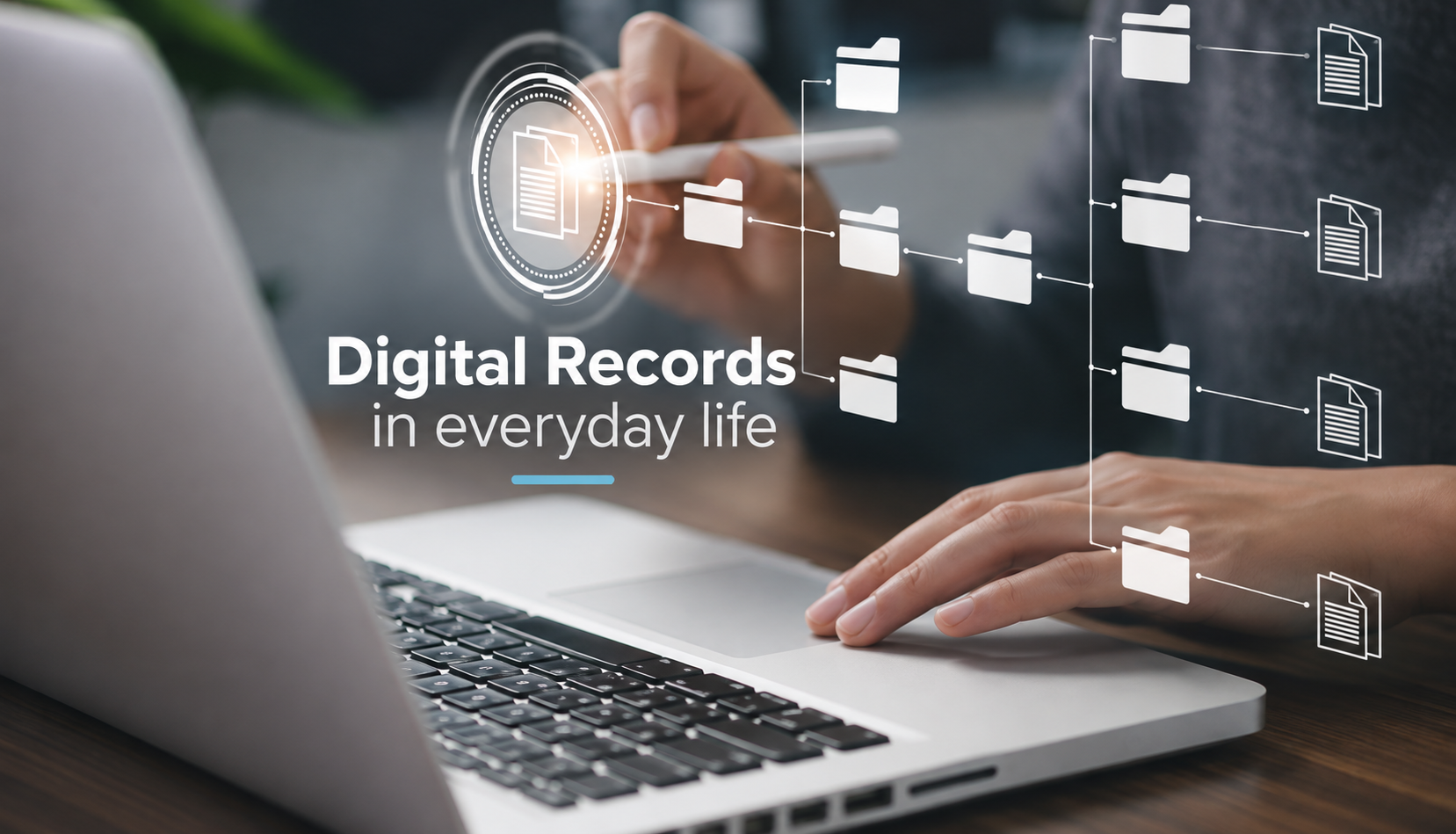
Before we finish our first coffee, we've already generated a stack of records. Our phone logged its unlock and your location. A card tap timestamped your purchase. A watch synced our heart rate, and a car quietly noted our speed and braking. None of it was written by hand, and we never chose to keep most of it.
For most of history, a record was a deliberate act: a signed ledger, a filed certificate, a doctor's handwritten note. That relationship has flipped. Records are now the automatic exhaust of ordinary living, produced by default rather than by decision. This article looks at what that shift actually means: what these records do, why they matter far more than the old paper kind, and what happens when they're tested, fail, or start being read by machines.
The Quiet Explosion: How Much We Now Record
The scale is hard to hold in your head. Analysts at IDC have estimated the world's data would reach roughly 175 zettabytes by 2025, a zettabyte being a trillion gigabytes. A widely repeated industry line holds that the large majority of all data in existence was generated in just the past couple of years, and while that claim conveniently renews itself every year, the underlying curve is real and steep.
Most of that growth isn't people typing. It's things sensing. The number of connected devices phones, cars, meters, doorbells, medical monitors is estimated to have passed 15 billion and is projected to roughly double by 2030. Each one is a small, tireless record-keeper.
The important change isn't just volume; it's the shift from intentional to ambient record-keeping. A filing cabinet held what someone decided was worth filing. Your devices hold what happened, whether or not anyone judged it worth keeping. The default flipped from "record if notable" to "record everything, sort later," and "later" increasingly means never.
A single modern car makes the point. Newer vehicles are estimated to generate on the order of terabytes of data per day across their sensors, cameras, and control systems, vastly more than the entire paper trail a car produced across its lifetime a generation ago. Almost none of it is ever reviewed. It exists because recording is now cheaper than deciding what not to record, which is the quiet economic engine behind the whole explosion.
From Filing Cabinet to Nervous System
A paper record was a destination. You went to it, retrieved it, read it, and put it back. It sat still between those moments and did nothing on its own. Digital records don't sit still. They are queried constantly by other systems, often thousands of times a day, without anyone opening a drawer.
Consider a hospital record. It used to be a folder that a nurse physically carried between wards. Today it's a live node: pharmacy software checks it for drug interactions, billing systems read it, lab machines write to it, and an insurer's platform pings it all in real time, all without a human retrieving anything. The record stopped being an archive and became a participant.
This is the deeper meaning of "records matter more." They no longer just describe the world after the fact; they actively coordinate it as it happens. When a record like this is wrong, the error doesn't sit quietly in a folder; it propagates. A single mistyped allergy or a mismatched identity can ripple through every connected system in seconds, which is a failure mode paper never had.
The scale of this dependence is easy to underestimate. In the United States, essentially all non-federal acute-care hospitals well above 95% now run on certified electronic health records, up from a small minority around 2008. In barely fifteen years, an entire critical sector moved from paper as the default to paper as the exception. The same quiet migration has occurred in banking, government benefits, and property records, each converting its filing cabinets into live, queryable nodes.
What Digital Records Actually Do
It helps to be precise about the jobs these records perform, because "data" is too vague to reason about. In practice, digital records serve four distinct functions, and most important records perform several at once.
- Identity proving who someone is: A record links a person to an account, a right, or an obligation. Your bank doesn't know your face; it knows a cluster of records, credentials, device fingerprints, and behavioral patterns, and treats that cluster as you. Increasingly, the record is the identity, not merely a description of it.
- Continuity serving as external memory: No clinician remembers your medication history; the record does. This lets strangers pick up exactly where others left off, which is why continuity of care, credit history, and employment history all depend on records outliving any single person's memory.
- Coordination letting systems act together: A delivery, a diagnosis, and a payment involve separate organizations that never speak directly. They coordinate by reading and writing to shared records, which serve as the common language between systems that were never designed to trust one another.
- Proof establishing what happened: This is the quietest function until it isn't. Timestamps, logs, and immutable entries exist to enable a disputed event to be reconstructed and settled. Most of the time no one looks. When something goes wrong, this becomes the only function that matters.
Notice that these functions escalate in consequence. Identity and continuity make daily life convenient. Coordination makes the economy run. But proof is where records quietly acquire real power over people's lives, and it's the function most people never think about until they suddenly need it.
The four functions also tend to collapse into a single record without anyone designing it that way. A payment log is simultaneously proof that a transaction happened, a coordination signal between a merchant and a bank, a thread in your financial identity, and a piece of memory a future lender will read. One quiet entry doing four jobs at once is why a small corruption in it can do disproportionate damage: fix it in its role as proof, and it may still be wrong in its role as identity. There is rarely one clean copy to correct.
The Stress Test: When a Record Becomes Evidence
Everyday technology logs silently and invisibly, and almost none of it is created to settle an argument. A dashcam records because it's on. A car's event-data recorder captures the seconds leading up to a hard stop because regulations and engineering require it. A phone notes location because an app asked for it months ago. Then something is contested, and all that indifferent exhaust becomes the decisive account of what happened.
The stakes become obvious the moment an account is disputed. Consider a routine intersection collision. Within seconds it has generated a remarkable spread of records, none of them intended as evidence:
- Vehicle event-data recorders in both cars, logging speed, throttle, brake application, and seatbelt status in the moments before impact, a feature now standard in the overwhelming majority of new vehicles.
- Phone sensor and location logs, which can indicate motion, direction, and whether a screen was active at the time.
- Dashcam and nearby traffic-camera footage, timestamped and often the clearest single account of sequence and fault.
- Medical records generated in the hours afterward, tying injuries to a specific time and mechanism.
Consider a driver who is rear-ended during an afternoon commute. By evening, the relevant facts may be scattered across several systems that do not communicate with one another, and some records may already be subject to routine deletion or overwriting. Reconstructing the event can involve insurers, investigators, technical specialists, or an injury lawyer, depending on the circumstances. The broader challenge is preserving relevant records and integrating separate sources of information into a coherent account before potentially useful data becomes unavailable.
It's a vivid case of a general truth: digital exhaust, created for no particular reason, routinely becomes the single most consequential version of the truth. The record you never thought about ends up speaking for you when you can least afford it to be incomplete.
What makes this fragile is timing. Much of that evidence is volatile by design; dashcam loops overwrite themselves within hours, event-data recorders can be reset when a vehicle is repaired, and phone logs roll off on a schedule. The proof exists in a narrow window and then quietly erases itself. This is the practical difference between paper and digital evidence: a paper file waits patiently in a drawer, while a digital record is often actively working to forget, unless someone intervenes in time to preserve it.
The Fragility Problem: Records That Fail
The more life leans on records, the more a bad or missing one costs. And digital records fail in ways paper rarely did quietly, at scale, and sometimes irreversibly. Fragility isn't the exception; it's a permanent property of the system.
| Failure mode | What goes wrong | Why it's worse than paper |
|---|---|---|
| Breach | Records copied or stolen en masse | One intrusion can expose millions of records at once, not one folder |
| Silent error | A wrong value entered or synced | It propagates instantly across every linked system before anyone notices |
| Identity collision | Two people's records merge or swap | Automated matching means no human catches the mix-up |
| Format obsolescence | The software to read a file no longer exists | Perfectly intact data becomes unreadable "bit rot" with no paper equivalent |
The financial weight of just the first row is enormous. IBM's annual analysis has put the average cost of a data breach at roughly $4.9 million, and healthcare breaches, where records are most sensitive and most interlinked, run consistently higher than any other sector.
The subtler danger is obsolescence. A shoebox of letters from 1970 is still readable today. A hard drive of files from 2005 may hold formats no current program can open. As more of life's important records exist only digitally, we've quietly created a category of loss with no analog precedent: information that survives perfectly yet can no longer be understood.
Breaches, meanwhile, have stopped being rare events and become background weather. Large-scale exposures affecting hundreds of millions of records now happen several times a year, and because records are interlinked, a single breach at one custodian can compromise identity, financial, and health data simultaneously. The paper world had no equivalent to losing ten million people's most sensitive records in one automated theft; the physical effort alone made it impossible. Digitization removed that friction along with all the others.
Who Controls the Record?
Here's the uncomfortable asymmetry. You generate the records, but you almost never hold or govern them. The data about your body sits with hospitals and app makers; the data about your movements sits with carriers and platforms; the data about your money sits with banks and processors. You are the subject of the record and, in most cases, the least powerful party to it.
This gap surfaces in ordinary friction. Try to get a complete copy of your own medical history, and you'll often hit fees, delays, and formats designed for institutions rather than people. Regulations like Europe's GDPR and various data-portability rules exist precisely to narrow this gap, granting rights to access, correct, and move your own records, but exercising those rights is still far harder than the systems make it to generate the data in the first place.
The distance between subject and custodian is the central governance problem of the era. It's easy to produce records about a person and difficult for that person to see, correct, or reclaim them, and that imbalance grows every time a new device starts recording on your behalf without asking twice.
The correction problem is especially sharp. When a record is wrong - a mistaken identity on a credit file, an erroneous entry in a medical history - the burden of proof usually lands on the person, not the institution that got it wrong. You have to discover the error, identify who holds it, prove it's mistaken, and hope every downstream system that already copied the bad data gets the fix. Because records now propagate automatically, a single error can seed dozens of copies faster than any individual can chase them down.
The AI Layer: Records That Read Themselves
Until recently, a record was passive. It stored the past and waited to be read by a human who would interpret it. AI changes the verb. Records are now increasingly read, summarized, and acted upon by systems, including AI-powered communication tools that can process conversation records, identify relevant information, and help organize or generate responses.
| Task | Records before AI | Records with AI |
|---|---|---|
| Reviewing history | A clinician reads pages of notes | A model summarizes years of records into a paragraph and flags risks |
| Detecting problems | Errors found when someone happens to look | Anomalies surfaced automatically across millions of records |
| Making decisions | Records inform a human judgment | Records feed a score that shapes credit, hiring, or care directly |
This is a genuine shift in what a record is for. It no longer only documents the past; it becomes raw material for predictions about your future, your likelihood to repay, to relapse, to reoffend, to churn. A note written to record a fact is now an input to a forecast, often without the person who wrote it, or the person it's about, ever knowing.
That raises the cost of every earlier problem. A silent error, an unfair gap, a biased history once these feed automated inference, they don't just misdescribe the past; they help decide what happens next. Accurate records were always useful. In an AI layer, they become a form of self-defense.
There's also a permanence effect worth naming. Because models can extract meaning from records that once looked like noise, data collected years ago for a trivial purpose can acquire new significance long after the fact: a location history, a set of purchases, a pattern of activity re-read for something it was never gathered to reveal. Records used to fade in relevance as they aged. Under an AI layer, old records can become more revealing over time, not less, upending the old assumption that yesterday's data is safely stale.
Verdict: The Account of a Life
Digital records stopped being something we keep and became something we constantly emit: the running, machine-readable account of a life, assembled mostly by devices acting on our behalf. They prove who we are, carry the memory that lets strangers help us, let separate systems act in concert, and, when it counts most, establish what actually happened.
That's precisely why they matter more as technology moves deeper into everyday life. We built a load-bearing structure from records, treating them as clutter. The reasonable response isn't alarm; it's a serious understanding of what these records do, insisting on the right to see and correct our own records, and recognizing that, in a world of automatic memory, the account is never really neutral. It's always about to be read.
Comments
Comments are available to signed-in users and are moderated to keep the discussion useful and respectful. Spam, automated submissions, and low-value promotional comments are removed. Outbound links may be approved when they are relevant and genuinely helpful to readers, but they are displayed as plain text rather than clickable hyperlinks.
No comments have been published yet.
Please sign in to submit a comment.