

Network, Cloud Services, Web Hosting
When a Growing Business Should Move to a VPS

The Moment Shared Hosting Starts Holding You Back
Almost everyone starts on shared hosting, and for good reason. It costs little, asks nothing of you, and just works. Then the business grows. Traffic climbs. Then, one morning, dead in your busiest hour, the site drags to a halt. There it is. Your cue. Move to a VPS and the resources are finally yours, the control is real, and there is room to stretch, all without paying for a whole server. What follows are the giveaway signs you have outgrown the cheap plan, the benefits of moving to a VPS, and a way to switch over without the panic.
When the Low Cost Plan Starts to Hurt
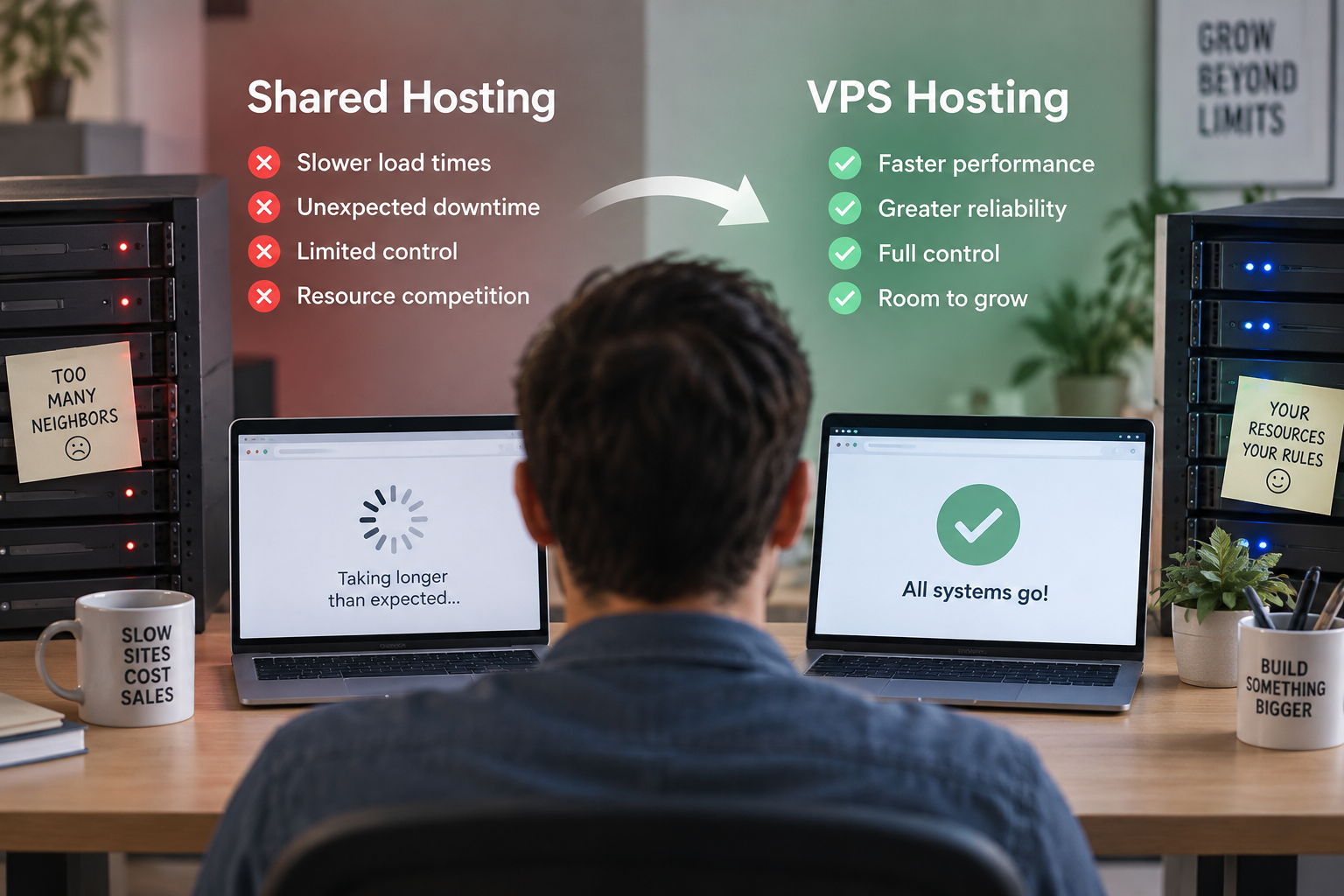
Shared hosting puts you on one machine with hundreds of neighbors. For a while, that is fine. Growth changes the math.
Watch for these warnings:
- Slow load times during your busy periods.
- Sudden downtime when a promo drives traffic.
- You need to install something the host forbids.
- A noisy neighbor on your server drags you down.
- Security worries as you handle real customer data.
Any one of these means it is time to look up. A VPS answers all five, since your resources are yours alone, not shared with a crowd of strangers whose traffic spikes become your slowdowns.
What a VPS Gets You
VPS hosting is often the natural next step when a website outgrows shared hosting. Server location can also affect speed and overall performance.
Data obeys physics. As Cloudflare’s learning center explains, latency grows with distance, so a server closer to users can reduce delays. A VPS can help keep loading times responsive and provide a smoother experience.
| Business type | Why a nearby VPS helps |
|---|---|
| Online store | Fast checkout, fewer drop-offs |
| SaaS app | Low latency for daily users |
| Content site | Quick loads, better ranking |
There is a market angle too. The United States has a large and competitive hosting market, giving businesses a wide range of VPS providers, configurations, and pricing options to compare. The availability of data centers across the country can also provide more flexibility when choosing server locations and building redundancy. A cloud VPS hosting performance comparison can also highlight differences in factors such as speed, reliability, and infrastructure across hosting environments.
Moving Up Without the Stress
The jump sounds scary. Honestly, it is not, provided you plan the move rather than throwing it together on a hectic Monday.
Choose a plan that leaves enough headroom for future growth. Move the site during a quieter traffic window, then test key pages, forms, databases, and other functions before switching the domain over. Managed hosting providers, such as Antihost, may handle some of the technical work involved in migration and server management. Keep a backup of the previous setup until the new environment has been fully tested and is operating reliably.
A word of advice: resist the urge to over-buy on day one. Choose VPS hosting that scales, start with what you need now, and add power when the traffic truly demands it. Paying for idle capacity helps nobody, and it is money better spent on marketing that actually grows the business.
Grow on Your Own Terms
A VPS is the right move when shared hosting starts throttling your business, when downtime costs real money, or when you need control the cheap plan will not give. A VPS provides more resources, flexibility, and room to scale as your website grows. Watch for the warning signs, pick a plan you can scale, and move during a quiet moment. Do that, and your infrastructure can keep pace with your business instead of holding it back.
Comments
Comments are available to signed-in users and are moderated to keep the discussion useful and respectful. Spam, automated submissions, and low-value promotional comments are removed. Outbound links may be approved when they are relevant and genuinely helpful to readers, but they are displayed as plain text rather than clickable hyperlinks.
No comments have been published yet.
Please sign in to submit a comment.