

IP Address, Privacy, Geolocation
What Is the Real Cost of Smart Glasses Geolocation and Privacy Tracking?
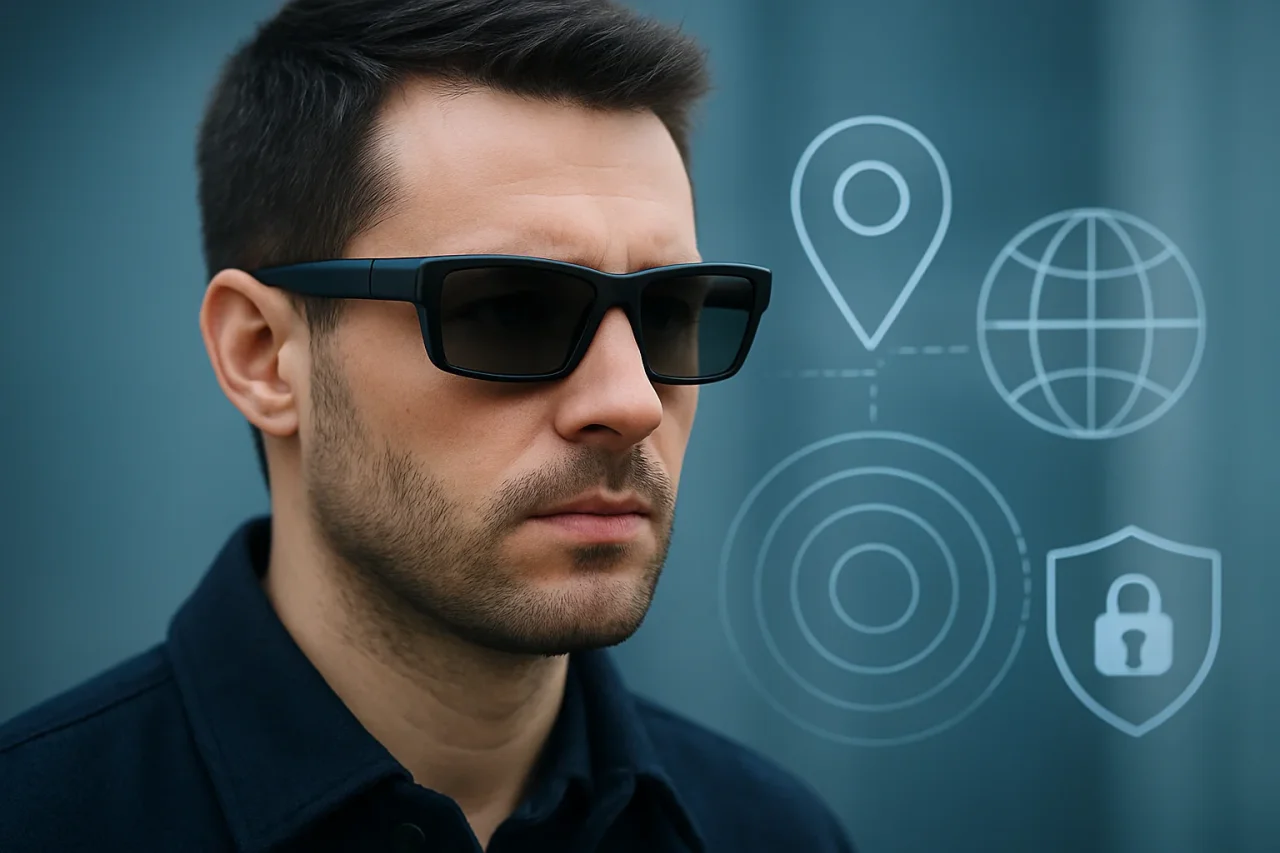
You buy a sleek pair of internet-connected shades. You think you look like a tech-forward early adopter. You are actually walking around as a human telemetry beacon. Smart glasses continuously log GPS data, siphon network metadata, and expose your exact physical coordinates through Wi-Fi handshakes and IP tracking. The convenience of an AI-powered head-up display costs you your anonymity. The hardware requires constant network connectivity to function, meaning every query, photo, and step you take is packaged, routed, and stored on a remote server. You paid premium retail prices to become a data point.
The State of the Wearable Data Economy
The wearable tech market isn't just growing. It is exploding violently. Hardware manufacturers realized long ago that the margins aren't in the plastic or the glass. The real profit lies in the behavioral data you generate while wearing the device. According to industry analysis, the global smart glasses market is valued at $878.8 million in 2024 and is projected to reach $4.1 billion by 2030. That astronomical financial growth is completely funded by surveillance capitalism.
Google Glass failed a decade ago because it looked like surveillance gear. The public rejected it. The new iteration of smart wearables succeeds entirely because the technology is hidden inside classic fashion. People drop their guard when the threat looks like a stylish accessory. The transition from obvious cyborg tech to invisible monitoring is a deliberate, highly calculated marketing strategy.
When you put on meta glasses or any competing augmented reality spectacles, you feed a vast corporate ecosystem. The device relentlessly pings local network nodes. It records ambient audio automatically to listen for wake words. It captures high-definition video at eye level. It geotags every single file with absolute, terrifying precision. Your daily commute becomes a mapped data set. Your coffee shop visits turn into predictive advertising models. The product is not the glasses. The product is you.
What Data Do Smart Glasses Actually Collect?
You might assume a pair of shades only captures what you explicitly ask it to. Wrong. The default settings almost exclusively favor the manufacturer. The data extraction is constant.
We can break down the exact telemetry these devices siphon from your daily routine.
- Visual Data and Metadata: They don't just snap a picture. They log the exact millisecond, the lighting conditions, and the spatial coordinates of the shot. Every image contains a fingerprint of your location.
- Ambient Audio and Voice Commands: Your voice assistant is always listening. It must keep the microphone open to catch your commands. Background conversations are processed alongside your voice.
- Network Identifiers: Your glasses scan and log MAC addresses, Bluetooth beacons, and local Wi-Fi SSIDs continuously.
- Sensor Fusion Analytics: The onboard gyroscopes and accelerometers track your head movements. The hardware knows if you are walking, running, or looking down at a phone.
- IP Addresses: Every single time your frames connect to a new router, your IP address updates and broadcasts your new location to the server.
These data points are never kept in isolation. They are aggregated. By cross-referencing your network connections with your GPS coordinates and accelerometer data, brokers construct a terrifyingly accurate map of your life. Anyone operating an internal IP tracker on a web service you interact with can log your geographical coordinates the second your glasses send an API request. You never see it happen. It occurs silently in the background while you check the weather overlay.
Why Do Wearables Demand Your Location Permission?
Why does a pair of sunglasses need to know where you are standing? Companies claim geolocation is strictly for user convenience. The technical documentation tells a very different story.
Meta explicitly states that their companion applications require location permissions on iOS and Android devices just to connect via Wi-Fi for basic media imports. You cannot simply opt out if you want the product to work. The operating systems bundle Wi-Fi scanning with location services because scanning for local network names is an effective way to pinpoint your location. The hardware physically refuses to operate at full capacity unless you surrender your whereabouts.
Most users fold immediately. We prioritize minor conveniences over foundational security. We click "agree" on the prompt because the alternative is owning a very expensive pair of glasses with limited functionality. This resignation is a designed feature of the modern internet. The tech giants built their privacy policies around user exhaustion.
The latest consumer data proves this engineered apathy is working perfectly. A massive 79% of Americans feel they have little to no control over what the government does with their data, and 73% feel the same about corporations. We know we are being watched. We simply stopped fighting it. We hand over the keys to our digital lives because resisting takes too much effort.
How Does IP Geolocation Expose Wearable Users?
Every internet-connected device has an IP. Smart glasses are absolutely no exception to the rigid rules of network routing.
When you tether your frames to your smartphone, the IP address of that cellular connection broadcasts your approximate location to every single application server you ping. You load an AR map overlay. The server logs your IP. You ask the voice assistant to translate a street sign. The server logs your IP.
The illusion of privacy vanishes the moment you look at the raw network traffic. You can use standard network tracking tools to see exactly how much metadata is visible from a simple HTTP request. The Internet Service Provider. The city. The zip code. The device type. It is all packaged neatly in the network header.
When your glasses switch from your 5G cellular connection to a local coffee shop's public Wi-Fi network, your IP changes. This seamless handoff allows data brokers to trace your exact physical movements across a city block. They know exactly when you entered the cafe. They know exactly how long you stayed. They know when you left.
Are Public Spaces Becoming Unconsented Surveillance Zones?
Yes. Completely.
Bystanders have absolutely no say in your decision to wear an active camera. The implicit social contract of public privacy is dead. We expect privacy in an elevator. We expect privacy at a urinal. Smart glasses destroy these implicit agreements without asking for permission.
When you point your face at a stranger on the subway, your glasses can theoretically cross-reference their face with massive, publicly available databases. The technology is not science fiction. It is currently deployed and highly effective. Harvard University researchers have already demonstrated how video taken from smart glasses and livestreamed to social platforms can feed into facial recognition algorithms. The algorithms instantly pull internet data on strangers, identifying them in real-time. This turns a public sidewalk into a digital police lineup.
Manufacturers argue that an LED light on the frame alerts bystanders when a recording starts. However, a piece of electrical tape can cover the recording indicator. A layer of black nail polish can accomplish the same thing. The subject may never know they are being logged, categorized, and fed into an AI training set. The hardware can potentially be misused for stalking or surveillance purposes.
What Are the Real-World Consequences of Wearable Geolocation?
We obsess over abstract privacy concepts but ignore the physical realities of broadcasting our location in real-time. The damage is not theoretical. It happens every day.
Stalking is the immediate, visceral threat. When your photos are automatically geotagged and instantly uploaded to a social feed, anyone watching knows exactly where you are. The delay between capture and publication is essentially zero. A predator does not need to follow you physically. They just need to follow your API calls.
Corporate espionage is another massive vector. An employee wearing connected glasses inside a proprietary research facility is an active security liability. The glasses scan the whiteboard. The audio captures the confidential meeting. That highly sensitive data is then processed on a third-party server. The enterprise loses control of its own intellectual property because a mid-level executive wanted to test a new gadget at work.
Then there is law enforcement overreach. A subpoena sent to a wearable manufacturer can instantly produce a map of your whereabouts, complete with first-person video evidence and audio logs. You are paying a corporation thousands of dollars to maintain an active wiretap on your own life.
How Can Users Protect Their Location Data?
You cannot stop the data collection entirely if you want to use the device. You can, however, limit the amount of data shared. Security requires friction. You must actively break the seamless integration these companies sell you. Here is exactly how you minimize the sharing of your personal telemetry.
- Revoke Background Access: Dig into your smartphone settings. Restrict the companion app's location permissions to "Only While Using." Never let the application poll GPS coordinates while the app is closed. Force the hardware to ask for permission every single time.
- Spoof Your Network Traffic: Route your phone's internet traffic through a strict virtual private network. Because your glasses tether to your phone for data processing, the outbound traffic will display the VPN's server address rather than your actual IP location lookup.
- Disable Automatic Geotagging: Open the camera settings within the wearable app. Turn off the feature that writes longitude and latitude coordinates into the EXIF metadata of your photos and videos.
- Deny AI Training Data: Find the toggle in your privacy settings that allows the company to use your media to train their artificial intelligence models. Turn it off immediately. Make them pay for their own data.
- Audit Your App Logs: Check what the application has actually recorded. Review the voice command history and the location history. Delete the entire cache weekly.
- Power Down in Sensitive Areas: Take them off in banks. Take them off in hospitals. Take them off in your own home. If you are not actively using the device, it should be placed in a case and powered off entirely.
The Takeaway
Data is the absolute currency of the twenty-first century. Your eyes are the newest extraction point. Hardware manufacturers will aggressively continue to push the boundaries of passive data collection because the resulting dataset is worth infinitely more than the hardware itself. You are willingly wearing a high-powered tracking device on your face. Act accordingly.
Comments
Comments are available to signed-in users and are moderated to keep the discussion useful and respectful. Spam, automated submissions, and low-value promotional comments are removed. Outbound links may be approved when they are relevant and genuinely helpful to readers, but they are displayed as plain text rather than clickable hyperlinks.
No comments have been published yet.
Please sign in to submit a comment.