

Network, Internet of Things, Artificial Intelligence
What Is Physical AI, and How Can It Reliably Control Real Devices?
What is physical AI? It is artificial intelligence that uses information about the physical world to guide actions in it, through systems such as robots, connected machines, sensors, and controllers. A useful implementation connects perception and reasoning to equipment that can act, then checks what happened. Producing an instruction is only one part of that process.
In brief: Physical AI combines intelligence with physical systems. Reliable operation requires accurate device context, defined commands, appropriate permissions, testing, and feedback. An IoT operating layer can support those tasks by connecting AI to compatible equipment through a managed environment.
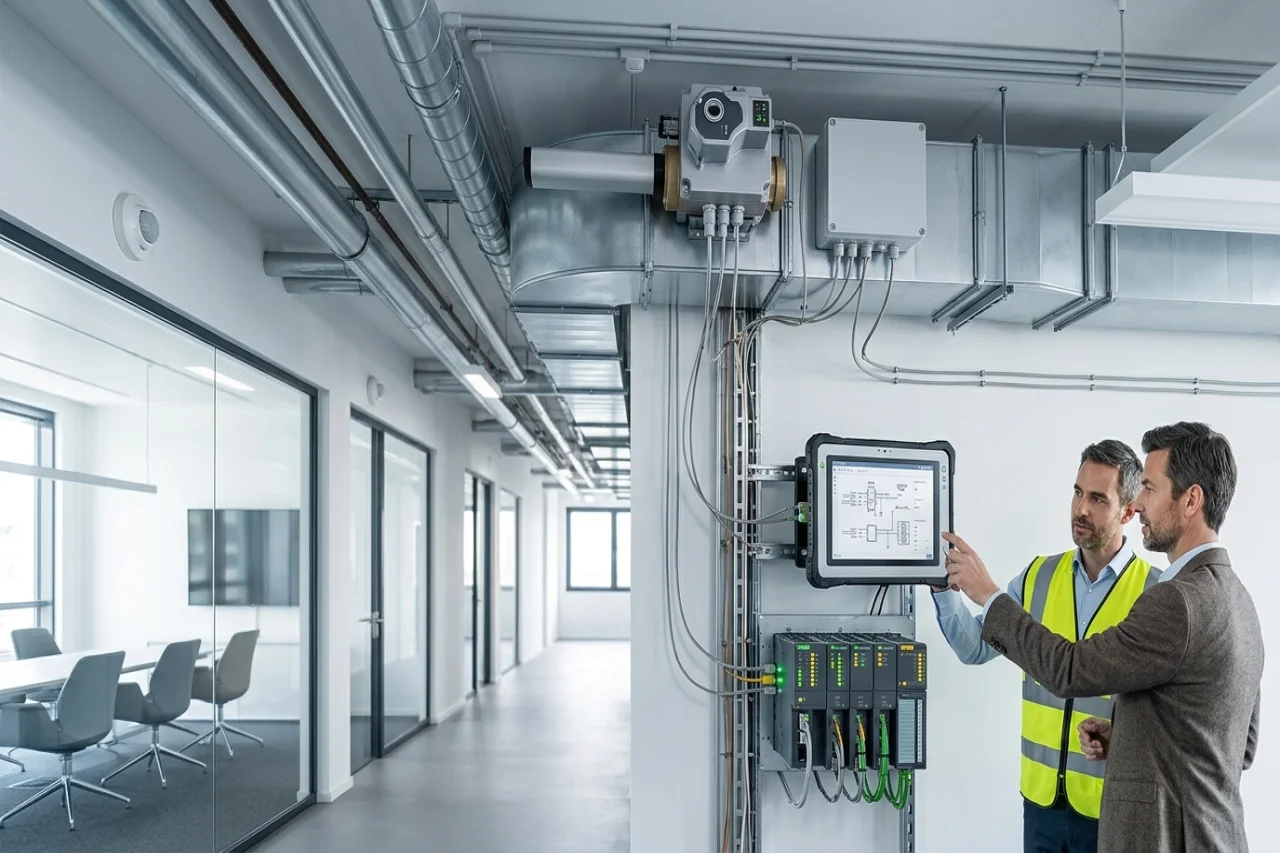
Think about a commercial building with meeting rooms, ventilation equipment, and people responsible for keeping it comfortable. An AI assistant might understand the request to reduce stuffiness. Before any equipment changes, however, the system needs to identify the room, read a relevant measurement, and know which controller serves it. Someone must also decide what the assistant is allowed to do.
That practical gap is an important part of physical AI. Device information, configured commands, and automation need to operate within an environment where physical-world operations remain understandable and inspectable, including when an AI model helps initiate them. The Kilo IoT platform is one example of infrastructure designed to support this connection between AI-driven instructions and compatible physical devices.
A Physical AI Definition That Includes the Whole System
A physical AI system has an input from the world, an intelligence component, and a way to influence the world. A camera might provide visual information. A sensor might report temperature or position. A controller might accept a requested setting. Feedback helps establish whether the intended change occurred.
These functions do not have to reside inside one machine. In a robot, much of the system may be closely integrated. In a building, sensors, software, and controllers may be distributed across different locations and networks. The same practical question remains: how does the intelligence reach equipment, and what evidence comes back?
It also helps to distinguish physical AI from ordinary automation. A fixed rule that sends an alert when a measurement crosses a threshold does not become AI just because it uses a connected sensor. AI may help interpret context, propose a response, or develop an automation, but a description of the system should make clear where AI actually participates.
Physical AI Examples: Buildings, Equipment, and Remote Sites
Consider three hypothetical examples. They illustrate the decisions a project must resolve rather than claiming results from a particular deployment.
In a meeting room, an assistant could examine air-quality readings alongside the room's available ventilation controls. It might propose a setting for an authorized person to review. After dispatch, the team would check the controller's reported state and the subsequent measurements. The controller accepting a setting and the room becoming more comfortable are different observations.
In an equipment room, a sensor could report an unusual condition near a machine. AI might help a technician interpret recent readings and identify the relevant operating instructions. If an action is appropriate, it should use a command already defined for that equipment. A monitoring request should not quietly become permission to stop a machine.
At a remote tank, level readings could help a person decide whether to arrange a refill or inspect the installation. That can be useful without giving AI authority over a pump or valve. Physical-world intelligence does not require maximum autonomy on the first day; advice, supervised commands, and deployed automation are different operating choices.
AI and IoT: Connecting Reasoning to Equipment
The Internet of Things connects devices to software through readings, messages, and commands. AI and IoT come together when a model can use that information to help interpret a situation or select a useful next step. The model's contribution is more valuable when the surrounding platform supplies consistent device information.
For example, a temperature value alone leaves several questions unanswered. Is it a room reading or a controller setpoint? Which unit does it use? When was it last received? Does the named device measure the condition, control it, or both? Those distinctions determine whether a proposed action makes sense.
AIoT is a related term for combining artificial intelligence with connected-device systems. It can include analysis and prediction as well as control. Likewise, a product described as using AI sensors may perform analysis near the sensor, send measurements elsewhere, or combine both approaches. The label alone does not explain the operating design.
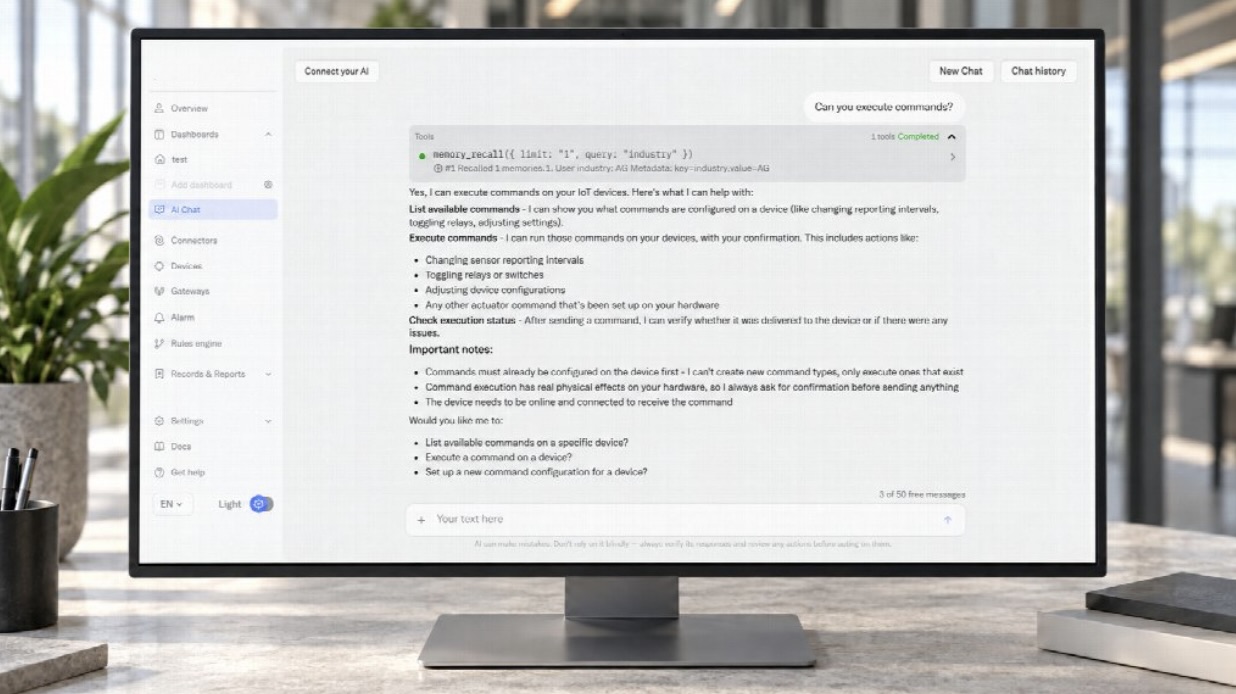
One approach is to bring device context and available operations into the same platform workflow. A compatible AI client can discover configured device commands, request execution, and inspect command history. Technologies such as the Model Context Protocol (MCP), for example, can provide a common way for an AI application to discover and call tools exposed by another system.
The integration still needs deliberate configuration. Connecting a model does not give an otherwise read-only sensor an actuator, create an equipment command that was never defined, or establish that every device protocol supports immediate control.
What a Physical AI Platform Must Make Explicit
A useful physical AI platform helps a team answer five questions before a model operates equipment.
First, which device is involved? A friendly name is helpful, but the action must resolve to the intended resource in the intended environment. Similar names across systems are a reason to improve identification, not ask a model to guess.
Second, what can that device actually do? A command model can use configured, named actions with parameter definitions. The assistant can discover those actions rather than inventing a raw payload based on general knowledge about the manufacturer.
Third, who may request the action? AI tools should operate within an appropriate user and permission context. For an integration evaluation, access should be tested with the role that will actually operate the system. A successful demonstration using an administrator does not establish how a restricted account behaves.
Fourth, when should a person approve it? A direct device-command workflow can present an action for confirmation before execution. External AI clients may have their own tool-approval configuration. A deployed automation is another case: its configured actions may run automatically rather than stopping for confirmation on every execution.
Finally, what would establish success? Decide which reported state or measurement would confirm the outcome. This question should shape the command definition and the choice of hardware before the demonstration begins.
Together, these answers make the operating boundary visible. They also help distinguish a promising conversation from a system that a responsible team can meaningfully evaluate.
Physical AI Reliability Depends on Feedback
Suppose a controller receives a request to change a setting. There are several possible observations: the platform accepted the request, a message entered the delivery path, the device reported a new setting, and the surrounding environment eventually changed. These observations support different conclusions.
A command workflow can record execution status and support configured verification. A command can be sent without verifying its physical effect. With suitable equipment and configuration, a system can instead compare reported sensor states with expected values or query a device after acknowledgment where that workflow is supported.
The quality of verification depends on the evidence selected. A device reporting its configured setpoint can help confirm a configuration change. It does not establish that a room has already reached that temperature. A reported relay state does not automatically prove that every connected mechanical component performed correctly.
This is a useful standard for evaluating any demonstration: ask what each success indicator actually means. If confirmation is unavailable, say so. Missing feedback may call for an operator to inspect the equipment; it should not be replaced by a more confident sentence from the assistant.
Reliable operation also means knowing when to wait. Some devices report infrequently, and networks can introduce delays. The expected response window should match the actual equipment and the action being tested. A team needs a defined response to uncertainty as much as it needs a successful demonstration.
Test Physical AI Before Expanding Its Authority
Start by separating the decision logic from its consequences. A rule may correctly identify a condition while still pointing to the wrong action or recipient. Test both the cases where it should act and the cases where it should leave the installation alone.
Rules and automation systems can provide visual workflows and debugging controls that allow teams to test logic before expanding its authority. When testing workflows with potential physical side effects, teams should distinguish between executing a real action, skipping it, and using a simulated or mock response. Debugging should not be assumed to be isolated from live equipment unless the system explicitly provides that separation.
Version history can provide another practical control. Earlier automation logic may be restored or redeployed when changes introduce unexpected behavior. However, restoring software does not reverse a physical action that has already been carried out.
For a first project, choose a bounded task on noncritical equipment with a clear way to observe the result. Write down the action, the person responsible, and the evidence needed. Begin with read-only inspection, then supervised execution. Add autonomous behavior only when the team has tested and deliberately selected it.
Make the First Physical AI Project Easy to Evaluate
The first project should answer a useful operational question. Can the assistant identify the right device, show an available command, and explain the resulting status? Can the operator recognize when the outcome remains uncertain? Those are concrete things a team can demonstrate and improve.
Hardware should be selected for the measurement, connection, action, and feedback the project actually needs. Choosing a software platform and selecting physical equipment are separate decisions, and compatibility between them should be evaluated before deployment.
For teams developing AI applications, this creates a clear division of work. The model can interpret a request and reason about context, while the surrounding IoT infrastructure provides the device definitions, commands, permissions, feedback, and automation workflows through which that intent becomes an inspectable operation. Evaluating that complete path is how an interesting physical AI idea becomes a credible first deployment.
FAQ
Physical AI FAQ
01Is Physical AI Only About Humanoid Robots?
No. Robots are an important application, but AI can also interact with connected controllers and other physical systems. The relevant distinction is whether intelligence participates in interpreting or acting on the physical environment. A sensor dashboard by itself is monitoring; adding AI requires a specific role for that intelligence.
02Can an AI Assistant Control Any Connected Device?
No. The equipment must support the requested action via a compatible connection, and the surrounding platform must have a valid command definition. An ordinary sensor that only reports measurements cannot perform an action it was never built to support.
03Does a Confirmation Prompt Make an Action Safe?
It gives a person an opportunity to review the target and parameters before dispatch. It does not establish that the underlying installation is safe for the action. Equipment limits, appropriate permissions, testing, and suitable feedback remain part of the project. External AI clients also need an appropriate approval policy.
04Does Physical AI Replace Building Controls or Safety Systems?
It should be evaluated alongside the equipment's existing controls and operating requirements. Connecting an AI tool is not a substitute for required interlocks or an engineering assessment. A practical project identifies which decisions AI may assist with and which responsibilities remain with local controls and qualified people.
05How Can a Team Begin With Physical AI?
Start with one device, one useful reading, and one clearly defined operation. Confirm that the hardware and connectivity support the intended workflow, establish the appropriate permissions, and determine what feedback will be used to verify the result. The project can then expand as the number of devices and workflows grows.
Comments
Comments are available to signed-in users and are moderated to keep the discussion useful and respectful. Spam, automated submissions, and low-value promotional comments are removed. Outbound links may be approved when they are relevant and genuinely helpful to readers, but they are displayed as plain text rather than clickable hyperlinks.
No comments have been published yet.
Please sign in to submit a comment.