

What Are Verifiable Credentials, and Why Should Businesses Care?
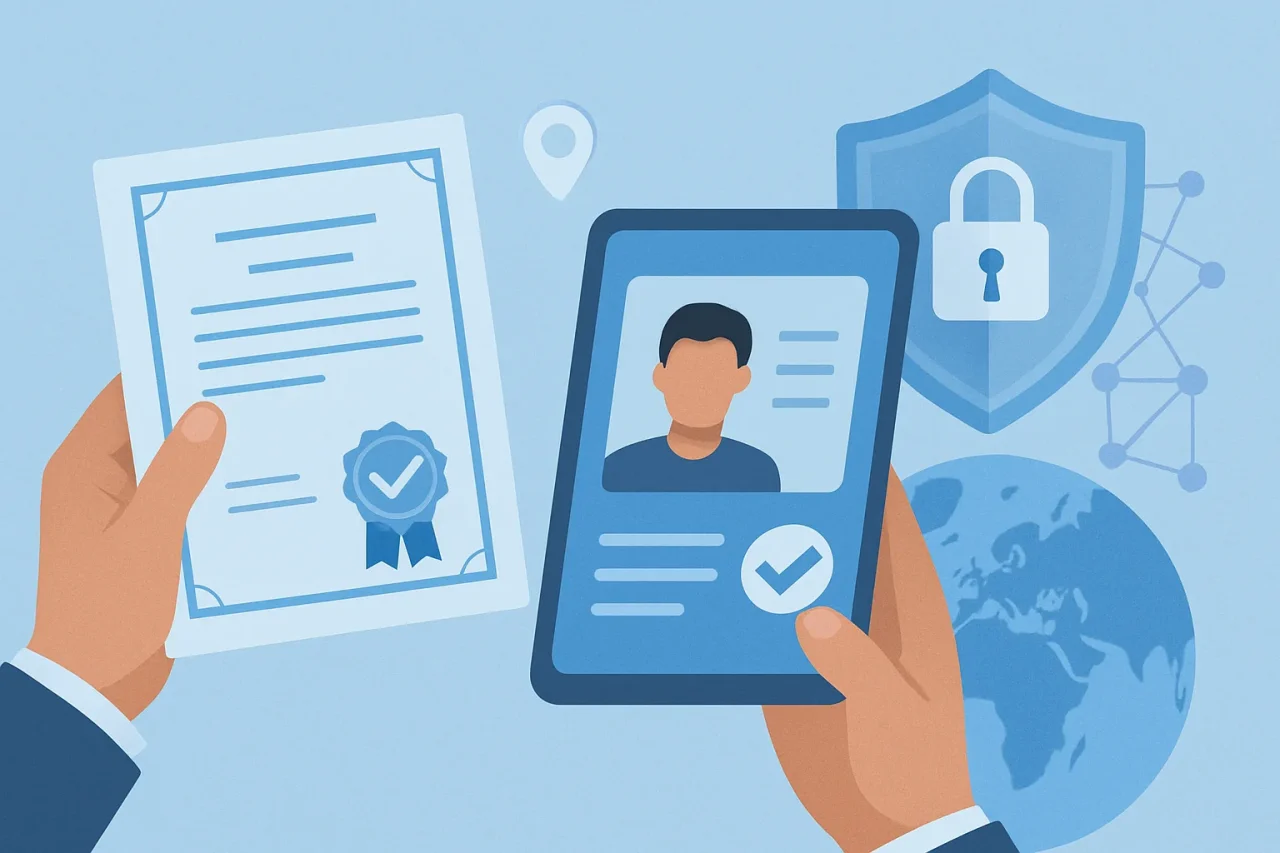
A paper certificate or scanned ID may look official, but checking whether it is genuine often requires manual review, database access, or a phone call to the issuer. Verifiable credentials offer a digital alternative that can be checked quickly and consistently.
For businesses managing identity checks, qualifications, licenses, or membership records, they can reduce repeated paperwork while giving users more control over the information they share.
How verifiable credentials work
A verifiable credential is a digital record containing claims issued by a trusted organization. A university might issue a degree credential, a government agency might issue a digital license, or an employer might confirm that someone completed required training.
The model usually involves three parties:
- The issuer creates and signs the credential.
- The holder receives and stores it, often in a digital wallet.
- The verifier checks the credential when the holder presents it.
Cryptographic proof allows the verifier to determine whether the credential came from the stated issuer and whether its contents were changed after issuance. The W3C verifiable credentials data model defines a standard framework for representing these claims and exchanging them between issuers, holders, and verifiers.
Verification does not automatically prove that every claim is true. It proves that the named issuer made the claim and that the credential has not been altered. A business must still decide which issuers it trusts.
Where businesses can use them
Verifiable credentials are useful whenever an organization needs reliable evidence about a person, company, or device.
Consider employee onboarding. Instead of asking a candidate to upload a scanned diploma, professional license, and training certificate, an employer could request digitally signed credentials from the organizations that issued them. The verification process could confirm their source and integrity without staff having to manually contact each institution.
The same approach can support contractor access, professional memberships, age checks, customer onboarding, insurance eligibility, and regulated workplace training. A financial services company, for example, might request proof that a customer meets a particular requirement without retaining a full copy of every supporting document.
Businesses exploring these workflows should assess whether a verifiable credentials platform can connect issuers, digital wallets, and verification systems without creating another isolated identity database.
Why the model matters for privacy and fraud prevention
Traditional identity processes often collect more information than a business needs. A company confirming that a customer is over a certain age may receive a document containing the person’s full name, address, birth date, photograph, and identification number.
A well-designed credential system can support more limited disclosure. The user may be able to prove a specific fact, such as meeting an age threshold or holding a valid certification, without sharing every field on the original document.
This can reduce unnecessary exposure of personal data. It may also limit the number of copied documents stored across email accounts, shared drives, and customer management systems. Those copies can become difficult to track and protect.
Verifiable credentials can also make basic document alteration harder to conceal. A verifier does not need to judge whether a PDF looks convincing. It can check the issuer’s digital proof and, where supported, determine whether the credential has expired or been revoked.
What to evaluate before adopting verifiable credentials
The technology should fit a clear business problem. Starting with a narrow use case is usually more practical than attempting to replace every identity process at once.
Begin by identifying which credentials your organization already requests and why. Determine whether the relevant issuers can provide digital credentials, whether users have a suitable way to store them, and whether your systems can verify them.
Trust rules also need careful attention. Your organization must define which issuers it accepts, how credential status is checked, and what happens when a credential expires or is withdrawn. A technically valid credential from an unrecognized issuer may still be unsuitable for the transaction.
Interoperability matters as well. A credential that works only inside one vendor’s application may create long-term dependence and limit its usefulness. Open standards can make it easier to exchange credentials across different wallets, systems, and business partners.
Finally, review privacy, security, accessibility, and record-retention requirements before deployment. Verifiable credentials may reduce document collection, but they do not remove an organization’s responsibility to design lawful and understandable verification processes.
A practical shift in digital trust
Verifiable credentials give businesses a more structured way to check digital claims without relying entirely on document uploads and manual review. Their value is not simply that they are digital. It is that their origin and integrity can be checked by machines while the holder remains involved in sharing them.
For businesses, the clearest opportunity is to start with one high-friction verification process and determine whether verifiable credentials can make it faster, more private, and easier to audit.
Conclusion
Verifiable credentials provide a practical approach to modernizing identity verification by making digital claims easier to verify while giving users greater control over the information they share. Although implementation requires careful planning around trust, interoperability, and governance, organizations that start with targeted use cases can improve efficiency, strengthen privacy protections, and reduce reliance on manual document verification.
Comments
Comments are available to signed-in users and are moderated to keep the discussion useful and respectful. Spam, automated submissions, and low-value promotional comments are removed. Outbound links may be approved when they are relevant and genuinely helpful to readers, but they are displayed as plain text rather than clickable hyperlinks.
No comments have been published yet.
Please sign in to submit a comment.