

IP Address, Cybersecurity, Geolocation
Unmasking Fake Traffic: Why IP Geolocation Fails Without Telecom Data
Security teams face a massive problem. Attackers bypass standard IP blocks daily. They buy residential proxies. They hijack IoT devices. They route malicious traffic through clean IP addresses.
When you look at the network data, everything seems fine. The IP geolocation points to a real neighborhood. The WHOIS records show a clean, aged domain. But the traffic still comes from a bot.
If you rely solely on network data, you miss these attacks. An additional validation step is required.
The Blind Spot in Network Intelligence
IP data tells you where a connection originates. It does not tell you who controls it.
Ten years ago, blocking a data center IP was enough. Fraudsters used cheap VPNs. You could block known bad IP ranges and stop 90% of automated attacks. That strategy no longer works.
Today, attackers rent residential proxies. They pay a few dollars to route their traffic through a real user's home router. Your security software sees a legitimate ISP.
It sees a normal home address. It approves the request. You cannot rely on infrastructure data alone when attackers can buy clean infrastructure for pennies.
The Cost Dynamics of Modern Fraud
Fraud is a business. Attackers care about their return on investment. They exploit cheap resources.
Buying 10,000 clean IP addresses is cheap. Buying 10,000 real, physical mobile phones with active SIM cards is incredibly expensive.
Fraudsters cannot afford physical hardware at scale. Instead, they use cheap virtual numbers (VoIP) to register fake accounts and bypass SMS verification.
This creates an opportunity. You can catch attackers by comparing their network footprint to their telecom footprint. Force them to prove they control a real mobile device.
IP Data vs. Telecom Data
| Feature | IP & WHOIS Data | Telecom & Phone Data |
|---|---|---|
| What it shows | Location, ISP, Domain age | Carrier, Line type (Mobile/VoIP) |
| Ease of spoofing | High (using proxies or VPNs) | Low (requires physical SIMs) |
| Cost to attackers | Pennies per IP | Expensive at scale |
| Best use case | Network-level traffic filtering | User-level identity verification |
How Telecom Telemetry Bridges the Gap
You stop evasive traffic by checking the phone number provided during account registration.
Bots use non-fixed VoIP numbers. Real users use physical mobile devices. When a user submits a phone number, you must query the Mobile Network Operator (MNO) data. This requires a carrier lookup integration.
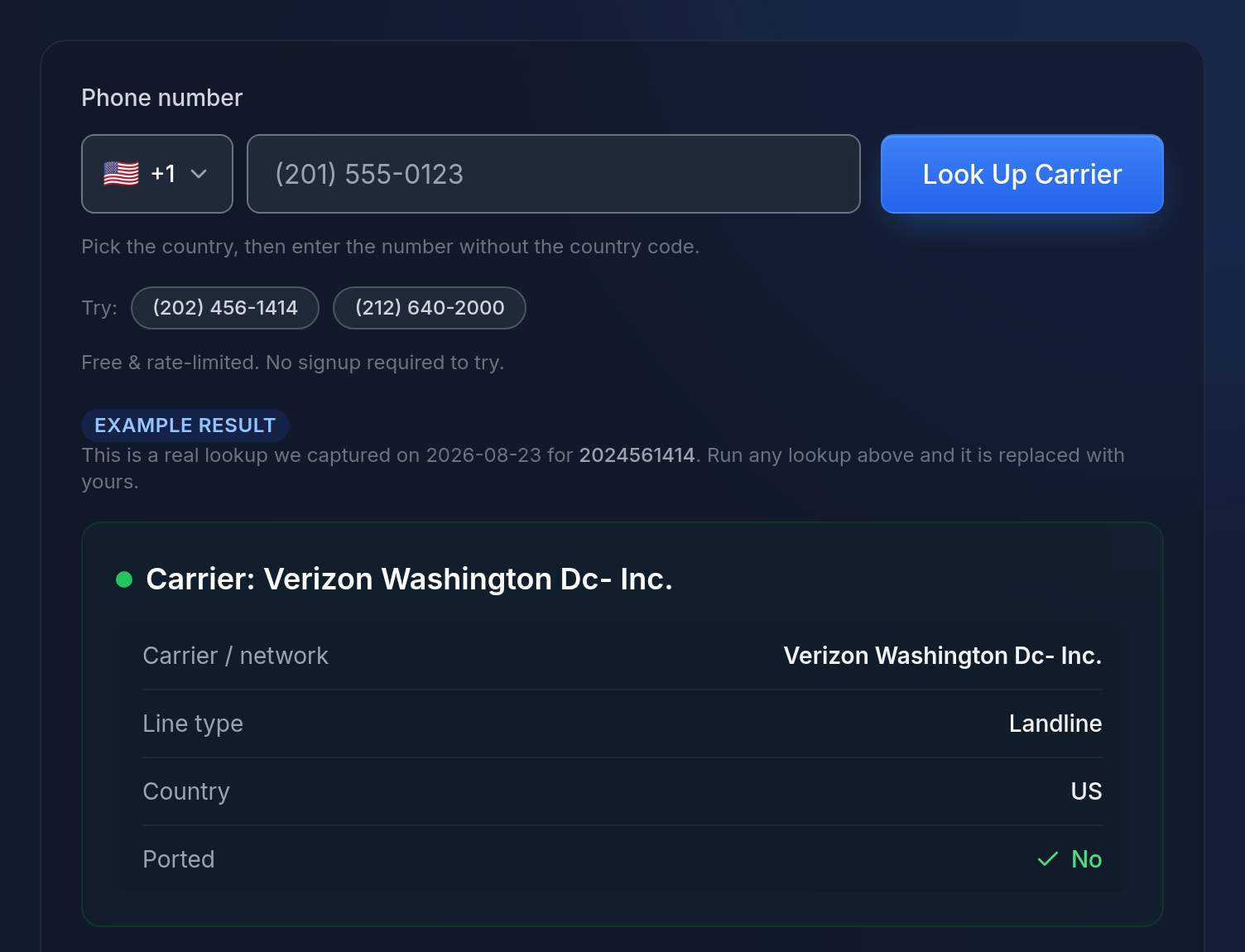
This query returns the exact carrier name and the line type. If the carrier is a known VoIP provider, your risk engine should flag the account.
If the line type is a landline but the user is trying to receive an SMS, you block the request. You cut off the attacker's ability to automate account creation.
Three Steps to Catch Evasive Traffic
You lock down your platform when you combine both data sets. Follow these three steps during user onboarding:
- Validate the line classification: Use a VoIP checker to automatically block virtual VoIP numbers during sensitive actions. Force users to register with legitimate mobile or fixed lines.
- Cross-reference geographic locations: Compare the IP geolocation with the telecom data. Block the user if their IP address shows New York, but their phone carrier operates exclusively in Eastern Europe.
- Monitor carrier reputation: Track which carriers generate the most chargebacks or fake accounts. Blacklist high-risk virtual network operators.
Stop Guessing
Network intelligence maps the attack surface. Telecom intelligence validates the actual user.
Stop relying on IP geolocation alone. Combine your network data with active phone telemetry. You will kill automated fraud before it hits your database.
Comments
Comments are available to signed-in users and are moderated to keep the discussion useful and respectful. Spam, automated submissions, and low-value promotional comments are removed. Outbound links may be approved when they are relevant and genuinely helpful to readers, but they are displayed as plain text rather than clickable hyperlinks.
No comments have been published yet.
Please sign in to submit a comment.