

Cybersecurity, Privacy, Cloud Services
The Technology Behind Secure and Verifiable Digital Certificates
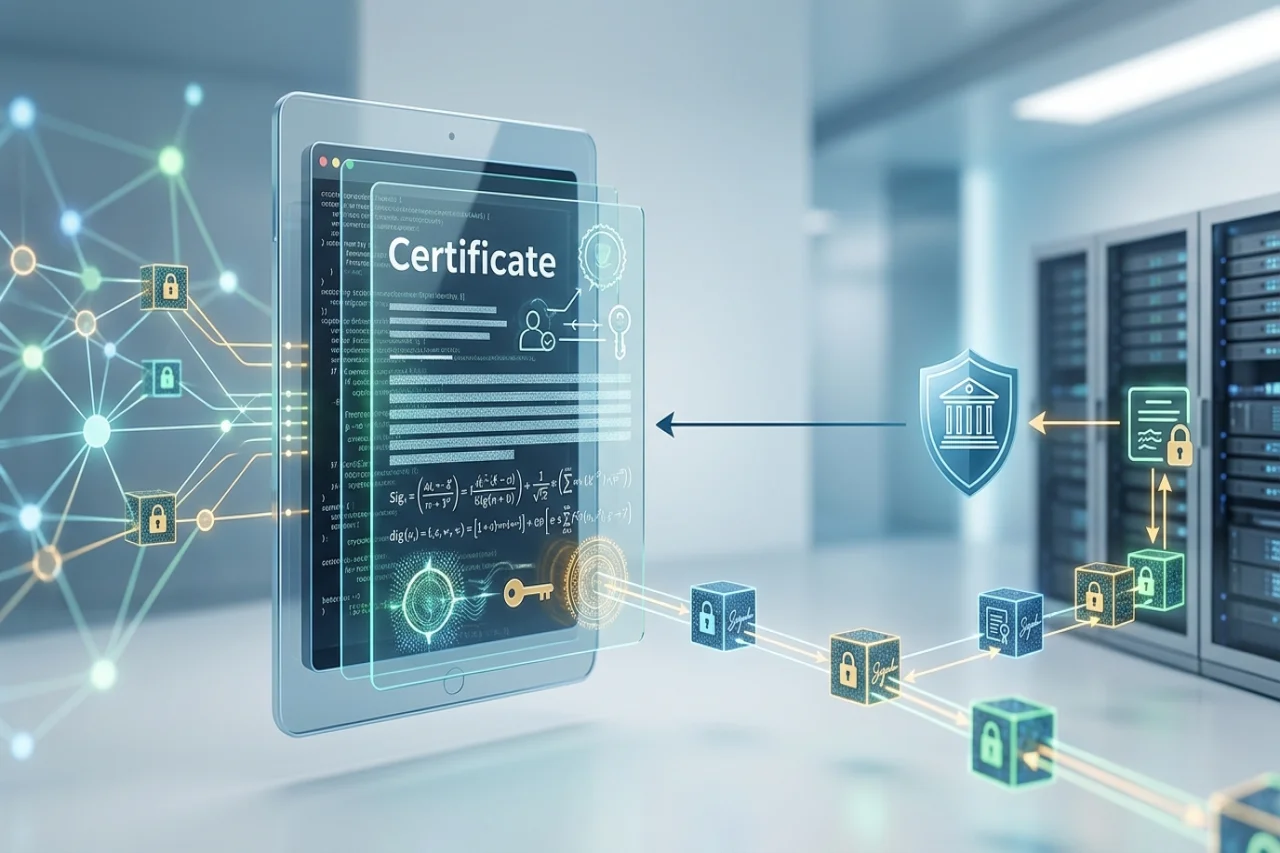
A digital certificate can be presented as a plain old PDF, graphic, or badge. However, its true value cannot be attributed to the graphic representation on the screen. Rather, it lies within the data stored within the certificate itself. If you earn a degree from a university, receive confirmation of a specific skill set on a training platform, or obtain a professional qualification from a company, you will want something beyond a fancy graphic.
Digital certificates can be viewed as miniature bundles of trust. A secure digital certificate typically contains several critical elements that help establish its authenticity, including the identity of the issuer, a description of the achievement, the identity of the recipient, and the issue date. It may also include additional information such as assessment criteria, supporting evidence, an expiration date, or a link to the original record.
Why Ordinary Digital Files Are Not Enough
Imagine that a candidate sends your company a PDF diploma. The document has a university logo, a signature, and an official-looking stamp. You can read it, but you cannot immediately prove that the university issued it. Modern editing software enables virtually anyone to modify a name, date, grade, or qualification.
It is also important where the verification infrastructure will be located. An issuer might want to use a high-performance VPS Windows server to store certificate records, provide verification services, or deploy application components to deliver better performance for European audiences.
Hosting alone cannot make a credential credible. A credible credential system still requires cryptographic signatures, access control, key management, backups, monitoring, and appropriate verification procedures.
The verifiable certificate should include machine-verifiable evidence. It is not only the certificate's visual aspect that the verifier considers. The verifier verifies the certificate's data, the issuer’s identity, and the attached cryptographic signature. It might help to discover whether someone has modified the credential after its issuance.
Digital Signatures Create a Tamper-Evident Seal
A digital signature resembles a mathematical seal in functionality. Its creation involves using a private key belonging to the entity that generates the credential.
It is necessary to protect the private key since it proves the authority to create new credentials. A verifier uses a public key to validate a signature, which is safe to distribute because it does not disclose the private key. Successful validation provides assurance that the expected issuer signed the message and that the signed content has not changed since. According to NIST, digital signatures are used to detect unauthorized changes and to authenticate the message's signer.
Usually, digital signatures are applied to a message digest rather than to each individual byte of a credential. The message digest is created by applying a hash function to the certificate data. It means that any change to the certificate data (for example, changing one letter in the recipient's name) results in a different digest. As a result, the original digital signature becomes invalid.
It provides verifiers with a fast method of checking the certificate's integrity. However, it does not protect against copying and modifying a certificate file.
The Issuer, Holder, and Verifier
Three main roles were defined within the W3C verifiable credentials model.
- The issuer is the party that produces and signs the credential. Issuers may be universities, government organizations, employers, certification bodies, and other organizations that issue training certificates.
- The holder is the individual receiving the credential and managing it. The credential usually resides on the holder's digital wallet, and the holder decides when to present it.
- The verifier is the party validating the credential prior to making a decision. A verifier may be an employer validating qualifications, a university validating prior studies, or a professional organization validating membership.
This way, the tasks are separated between parties. It is not necessary to contact the issuer in person in most cases. The software that verifies credentials can verify the proof, identify the issuer, and check the credential's status. Verifiable Credentials 2.0 became the W3C standard in May 2025.
What Is Contained in a Verifiable Certificate
A secure certificate is normally made of structured data, and not just some text on the page. Such a record may include:
- The type of credential
- The issuer’s identifier
- The recipient or credential subject
- The recognized skill or achievement
- The issue and expiration dates
- The criteria used to award the certificate
- Evidence connected to the achievement
- The cryptographic proof
- Information required for status or revocation checks
Such structured data is understandable for software. For example, a recruiting site can identify the organization issuing it. A university system can identify the type of the achievement. A professional directory can verify the validity of the credential.
Public Key Infrastructure and Trust
While cryptography proves mathematically that a particular key has issued a certificate, it cannot determine whether the entity behind the key is an entity to be trusted. For instance, a criminal can generate a public key, forge a certificate, and claim he represents a reputable university.
The way a trust framework solves this problem is by connecting the keys with trusted entities. In public key cryptography, digital identity certificates and certificate authorities connect a public key to an organization or an individual. As NIST defines it, "a public key certificate is a digitally signed document associating an identifier with a public key."
Depending on the system for credentials management, it might be trusted registries, decentralized identities, accreditation information, or governance lists. The specifics will vary, but there is something common to all these solutions: who verifies the issuer's authority to issue the particular certificate?
A proper verification service certainly answers this question. Besides, while providing the green tick, it will not only check the mathematics but will also verify the issuer's status.
Open Badges Add Meaning to Visual Credentials
Digital badges often represent shorter learning experiences, practical skills, professional development, or specific achievements. The Open Badges standard provides a structured format for these credentials.
Open Badges can carry data about the recipient, issuer, achievement criteria, and evidence for the badge. The Badge itself is just an image, while the metadata will contain a description of what the learner has done. In 1EdTech's definition, Open Badges are visual representations based on a well-defined metadata format.
The connection between Open Badges 3.0 and W3C Verifiable Credentials provides an opportunity to integrate the portability of badge design with cryptographically verifiable claims. Also, the connection enables credentials integration into learners’ profiles and verifiable presentation.
For you, as a reader or an employer, it means that the badge tells you more than the name "Data Analysis Expert". You will be able to see who issued the badge, what the learner did, and the evidence behind the badge.
Verification Does Not Always Require Blockchain
Blockchain is often seen as providing verified certificates. Although blockchain can be used for some trust functions, not all certificate systems require it.
A company can issue secure certificates using standard Public Key Infrastructure, a signed database, or any verification services based on standards. Such systems could provide strong integrity and authenticity if keys and access to them were controlled properly by their administrators.
Blockchain can be applied when several independent organizations have to share a trust registry which is hard to alter. Various proofs, issuer identifiers, accreditations, or credential status data can be stored on such a network. The European Blockchain Services Infrastructure, for instance, is designed to support European projects that rely on verifiable credentials and cross-border trust services.
Professional developers generally avoid including excessive personal information in an immutable ledger. Privacy-conscious designs typically keep private information off the blockchain while recording proofs, identifiers, or status information there when required by the application.
Revocation and Expiration Matter
The validity of the signature means that the document has not been altered. It does not mean that the document is always valid.
An issuing authority might invalidate a certificate in case of fraudulent activity or administrative errors. A professional license may expire. Some cybersecurity qualifications need to be renewed. The system must be able to verify the document's status.
There are several ways for developers to implement this functionality using status lists, registries, or verification endpoints controlled by the issuer. A verifier would check the status together with the signature. An adequate interface will inform the user whether the document is valid, expired, suspended, invalid, or unverifiable.
This makes verification a live process because the status of the document is checked rather than the status at the moment of issuance.
Privacy Requires More Than Encryption
Some digital credentials might include sensitive personal data. A diploma can provide a person’s full name, educational institution, graduation date, and specialization. Medical or professional qualifications can leak even more personal data.
The secure system is expected to enable people to disclose only the data needed by the verifier. Selective disclosure solutions might be used to provide a particular claim without disclosing all the data associated with the credential. You can demonstrate your qualifications without disclosing all the course results. The W3C Verifiable Credentials standards support such privacy-oriented mechanisms.
Clear consent screens are also an important part of privacy-conscious design. A digital wallet should inform users about what data a verifier is requesting and why it is needed. Cryptographic tools alone cannot eliminate privacy risks if users agree to disclose data without a clear understanding of the request.
Secure Storage and Key Management
Even the most sophisticated certificate framework will fall short if the issuer mishandles its private keys. An attacker who gains access to an issuing key could issue valid-looking certificates.
Professional solutions secure keys using special hardware and encryption, key management with restrictions and logging, and role separation among employees. No single individual should be able to manage all aspects of the certificate issuance procedure independently.
Key rotation should also be part of the key-management procedures. The issuer might rotate its keys after an incident, when an existing algorithm becomes obsolete, or at the interval specified in its internal security policy. The verification system should retain sufficient history to confirm credentials signed with previously authorized keys.
Organizations should also think about future cryptographic threats. In 2024, NIST released its initial post-quantum signature schemes standards. These new algorithms are expected to be resistant to future quantum computers. It is unlikely that certificate infrastructures would change their cryptography instantly, but thoughtful designers should ensure that future replacement of the cryptography is possible.
What You Should Look for in a Digital Certificate
When you receive a digital certificate, do not judge it only by its logo or visual quality. Check whether the issuer provides a working verification method. Look for information about the achievement, recipient, issue date, and issuing organization.
A credible verification result should show what the system checked. It should confirm the cryptographic proof, identify the issuer, and report the credential’s current status. It should also warn you when data is missing or when the system cannot establish trust.
For organizations, interoperability matters just as much as security. Open standards reduce dependence on one vendor. They allow learners and professionals to move credentials between wallets, platforms, educational systems, and recruitment tools.
Software That is Able To Verify
Secure digital certificates turn an assertion into information that is verifiable through software. The use of cryptography ensures data integrity. Public keys allow for the verification of information. Trust frameworks link these keys with their respective issuers. Structured data defines the meaning of the credential. Status systems determine the validity of the certificate.
A single technological solution cannot solve all problems. Blockchain does not substitute for key security. A visually appealing badge does not necessarily indicate accomplishment. Encryption alone does not ensure appropriate data exchange. Effective digital credential systems combine these technologies with proper governance and user experience practices.
When developers make every layer work together, you receive more than a digital document. You receive a portable claim with a history, an accountable issuer, and proof that others can independently examine.
Comments
Comments are available to signed-in users and are moderated to keep the discussion useful and respectful. Spam, automated submissions, and low-value promotional comments are removed. Outbound links may be approved when they are relevant and genuinely helpful to readers, but they are displayed as plain text rather than clickable hyperlinks.
No comments have been published yet.
Please sign in to submit a comment.