

The Branded Tech Accessory Stack: Why Corporate Tech Gifting Is Now a Procurement Decision
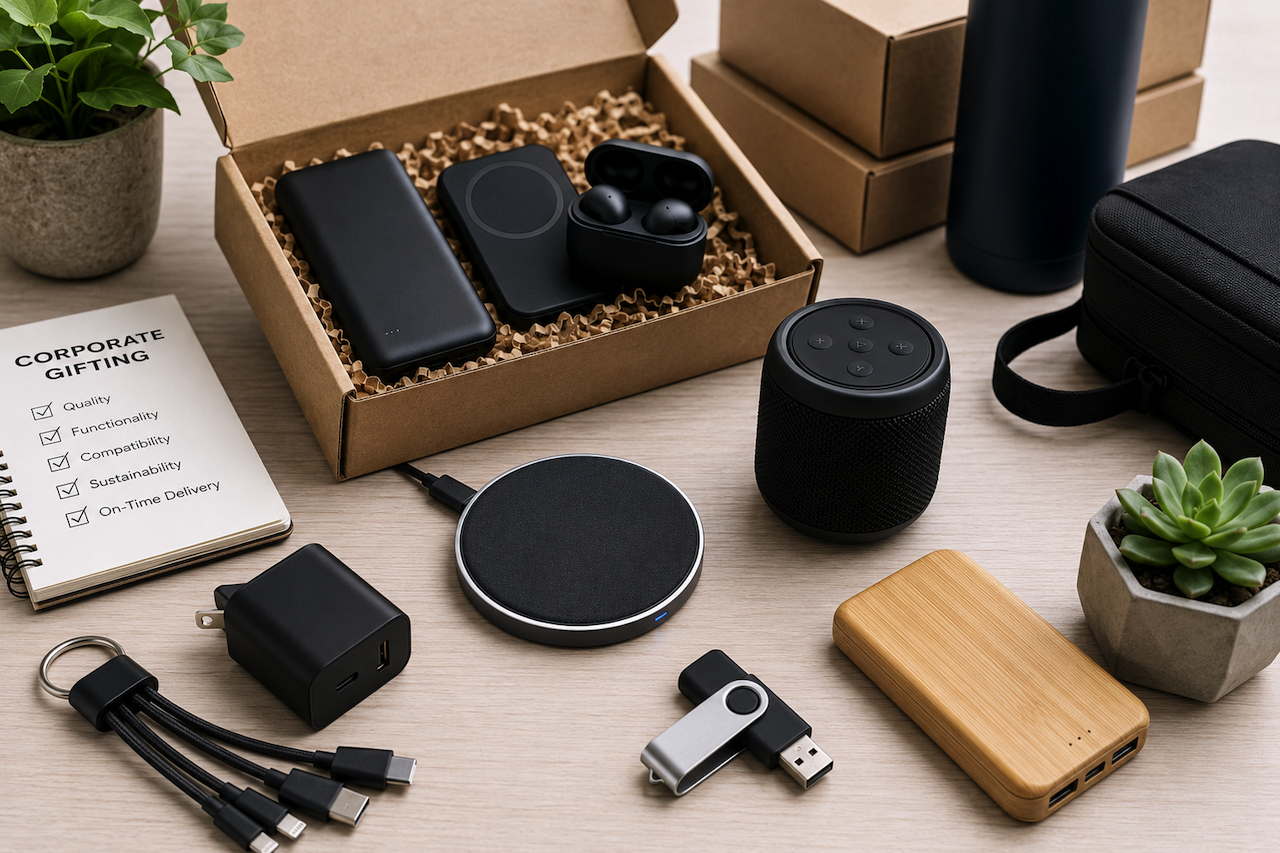
The corporate gift category that used to live in a marketing slide deck has quietly migrated into procurement. Five years ago, a 200-unit order of branded tech accessories for a regional sales kickoff would have been a side project for the events team. Today, it is a line item on an IT-adjacent budget, and the buying conversation increasingly resembles a hardware sourcing decision, complete with spec sheets, charging architecture comparisons, product configuration reviews, and multi-address fulfillment logistics.
For a technology audience that spends most of its time thinking about networking, infrastructure, and the small devices that support modern workflows, this is one of the more interesting under-covered shifts in the B2B tech economy.
The shift is showing up across the entire corporate gifting category. Branded tech accessories, including power banks, wireless chargers, Bluetooth speakers, true wireless earbuds, USB drives, and other portable devices, now represent one of the most practical segments of the promotional products industry. The reason is structural: tech accessories are useful, they are perceived as gifts rather than disposable swag, and they survive the daily-use test that traditional pens and notepads often do not.
Tech Accessory Configuration Is the New Differentiator
The branded tech accessory category used to be viewed as a single promotional category. Today, it has evolved into a broader ecosystem of products with different specifications, capabilities, and use cases. The buying decisions that procurement teams make now look closer to specifying hardware than choosing merchandise.
A modern corporate gifting order might include MagSafe-compatible 10,000 mAh fast-charge power banks for sales teams, smaller keychain chargers for trade show booth giveaways, slim wireless chargers for executive client gifts, Bluetooth speakers for employee recognition programs, branded earbuds for remote workers, USB drives for conference materials, and eco-friendly bamboo-cased accessories for sustainability-aligned brand programs.
The price stack can run from low-cost giveaway items to higher-end executive gifts, and the configuration decisions matter. Battery capacity, wattage, port count, USB-C support, wireless compatibility, Bluetooth features, storage capacity, integrated cable design, material choice, and form factor all map to specific use cases the way a hardware SKU maps to a workload.
The vendor side has adapted to that reality. Corporate gifting catalogs now commonly include detailed product filters across power banks, wireless chargers, speakers, earbuds, USB drives, and related accessories. Organizations developing corporate tech gift programs often evaluate products based on configuration, compatibility, fulfillment requirements, and budget constraints, much like other technology procurement decisions.
What the Technical Specification Decisions Actually Are
For a tech audience, the most interesting part of the shift is that technical specifications are now real decision variables. Three years ago, the buying question was often simple: do we want a branded tech product or not? Today, the question is layered.
Do we want MagSafe-compatible accessories for an iPhone-heavy field force, or USB-C PD devices for a mixed-fleet team? Do we want fixed cables, built-in cables, or accessory cables? Do we want passthrough charging for travel-heavy employees, Bluetooth audio for remote teams, wireless charging for executive gifts, or portable storage for conference attendees?
Product specifications have become a small economy of their own. A multi-port power bank can function as a portable charging hub. Wireless chargers need to match the devices recipients actually use. Earbuds and speakers introduce audio quality, battery life, and Bluetooth compatibility considerations. USB drives raise storage capacity, interface, and data transfer questions.
Procurement teams ordering for these use cases are increasingly specifying features, compatibility requirements, and functionality rather than treating tech accessories as interchangeable promotional items. Vendor catalogs have followed by exposing architecture-specific filtering in ways that resemble electronics distribution more than traditional swag ordering.
The Multi-Address Fulfillment Problem
The other major shift the technology audience tends to notice immediately is logistics. When the corporate workforce was concentrated in offices, a 500-unit order of branded accessories could ship to a single warehouse and be distributed internally by the events team. That workflow no longer exists for many companies.
Recipients are now distributed across home addresses, regional offices, hybrid work setups, and remote-first teams. As a result, the vendor side is increasingly responsible for splitting shipments and routing each unit to the right address.
That is closer to a fulfillment-service problem than a simple print-and-ship problem. The corporate gifting category has responded by adding multi-address fulfillment as a standard service. For a 250-recipient employee onboarding program at a hybrid-work company, that workflow can be more efficient than shipping all products to one office, repacking them, and reshipping them individually.
This fulfillment layer is part of what makes branded tech accessories practical at scale for distributed workforces, and it helps explain why the category has become more closely tied to procurement, operations, and IT-adjacent planning.
Why Tech Coverage Should Pay Attention
The branded tech gifting category does not look like a technology story at first glance because it can read as marketing. But the underlying decisions are increasingly being made on technical and operational grounds, and the supply chain looks more like consumer electronics than the traditional swag industry.
The specification taxonomy matters. The port and wattage decisions matter. The Bluetooth, storage, battery, and wireless compatibility decisions matter. The multi-address fulfillment infrastructure matters. Even the eco-friendly tech accessory category, including bamboo chargers, recycled-material wireless chargers, and sustainably sourced USB drives, is often a procurement-driven response to corporate sustainability goals rather than a simple marketing flourish.
For a technology audience used to evaluating networking products, IT procurement decisions, and small-device markets, the corporate tech gifting category is closer to home than it appears. It is a real volume buyer of consumer-electronics-adjacent hardware, and it has become sophisticated enough to specify products by configuration, compatibility, production timeline, and distributed fulfillment requirements.
Conclusion
Branded tech accessories are no longer simple giveaways. They are becoming a small but meaningful part of the distributed-hardware economy, with procurement teams evaluating them through many of the same considerations used for other technology purchases.
As companies continue supporting remote teams, hybrid events, employee onboarding programs, and client-facing campaigns, corporate tech gifting will likely continue moving away from generic swag and toward more deliberate hardware-style sourcing decisions.
Featured Image generated by ChatGPT.
Related Articles

July 1, 2026
How Hotels Can Reduce Operating Costs Through Smarter Energy Procurement
Many hoteliers assume utility bills are fixed, but smarter energy procurement—proactive buying, contract structuring, load profiling, and group purchasing—can stabilize budgets and...
Read More
March 9, 2026
Why Tech Hardware Companies Are Rethinking Where They Manufacture
It is a quiet shift occurring in the global electronics supply chain—and Eastern Europe is at the center of it. While much of the conversation around hardware manufacturing has...
Read More
December 30, 2024
Smart Tech Outsourcing Moves for Small Business Owners
In today’s fast-paced digital world, small business owners face an ever-growing list of technical challenges, from maintaining cybersecurity to managing online marketing campaigns....
Read More
Comments
Comments are available to signed-in users and are moderated to keep the discussion useful and respectful. Spam, automated submissions, and low-value promotional comments are removed. Outbound links may be approved when they are relevant and genuinely helpful to readers, but they are displayed as plain text rather than clickable hyperlinks.
No comments have been published yet.
Please sign in to submit a comment.