

Software Development, Information Technology, Mobile App Development
Technical Architecture Behind Modern Digital Wellness and Mindfulness Applications

A meditation app can look deceptively simple from the outside: a content library, an audio player, reminders, progress tracking, perhaps a few breathing exercises. Behind that interface, however, a modern wellness product may involve streaming, offline content, subscriptions, personalization, wearable data, analytics, notifications, and synchronization across devices.
This is why building a meditation app is as much an architecture problem as a UI challenge. Decisions that barely matter when an MVP has 30 audio sessions can become surprisingly expensive once the same product has thousands of sessions, several subscription tiers, wearable integrations, and years of user activity.
Start With Clear Separation of Responsibilities
One of the easiest mistakes in an early wellness MVP is allowing everything to grow around the mobile interface. It works while the product is small. Then recommendations, subscriptions, content rules, analytics, and user preferences begin interacting, and a seemingly minor change suddenly touches several unrelated features.
A more sustainable architecture separates the major responsibilities.
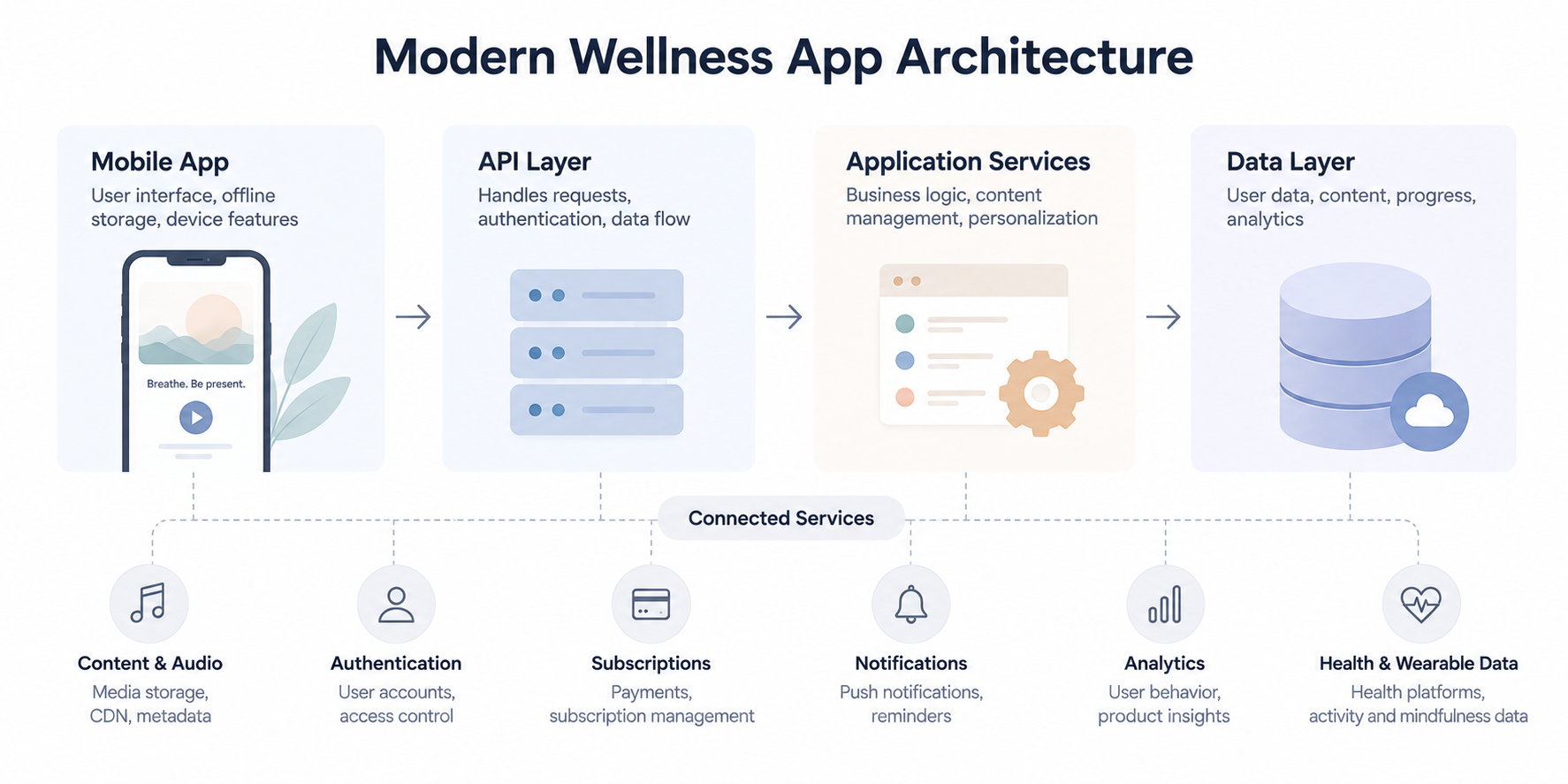
The mobile application handles presentation and device-specific interactions. Application services contain business logic. The data layer manages persistent information, while external integrations remain isolated rather than becoming embedded throughout the app.
There is no single architecture that every wellness app should copy. What matters is maintaining boundaries that allow individual parts of the product to change without forcing a rewrite elsewhere.
Treat Audio as a Core Product System
For meditation and mindfulness products, audio is not simply another media attachment. Quite often, it is the product.
Users expect a session to start quickly, continue when the screen is locked, handle interruptions correctly, and remain available when connectivity is poor. Nobody wants a meditation session to stop halfway through because they walked into an elevator or temporarily lost their connection.
Teams therefore need to think about content delivery, caching, download management, playback state, bandwidth, and storage relatively early.
A useful separation is to keep audio files in dedicated media storage and deliver them through a CDN rather than treating them like ordinary application data. Metadata such as instructor, duration, category, language, or program position can then be managed independently.
It also means the content team can add or reorganize sessions without requiring an app release every time the library changes.
Offline Behavior Needs an Explicit Strategy
Wellness apps are often used precisely when users do not want to think about connectivity: during a flight, commute, outdoor session, or bedtime routine.
Offline support therefore deserves an explicit decision rather than a vague "we'll add it later."
Not everything needs to work offline. Downloaded sessions, favorites, basic progress, and recently accessed content may need local availability, while fresh recommendations or subscription changes can wait for connectivity.
The less obvious problem is what happens afterward. What if progress changes locally and remotely? Which version wins? Can a completed meditation accidentally be recorded twice?
These questions sound small until several features depend on the answers.
Personalization Needs Its Own Data Flow
Personalization can begin very simply. A user selects goals such as better sleep, reduced stress, or improved focus, and the application adjusts what it recommends.
Of course, over time, the inputs may become richer: completed sessions, preferred duration, time of day, skipped content, streaks, sleep information, or wearable signals.
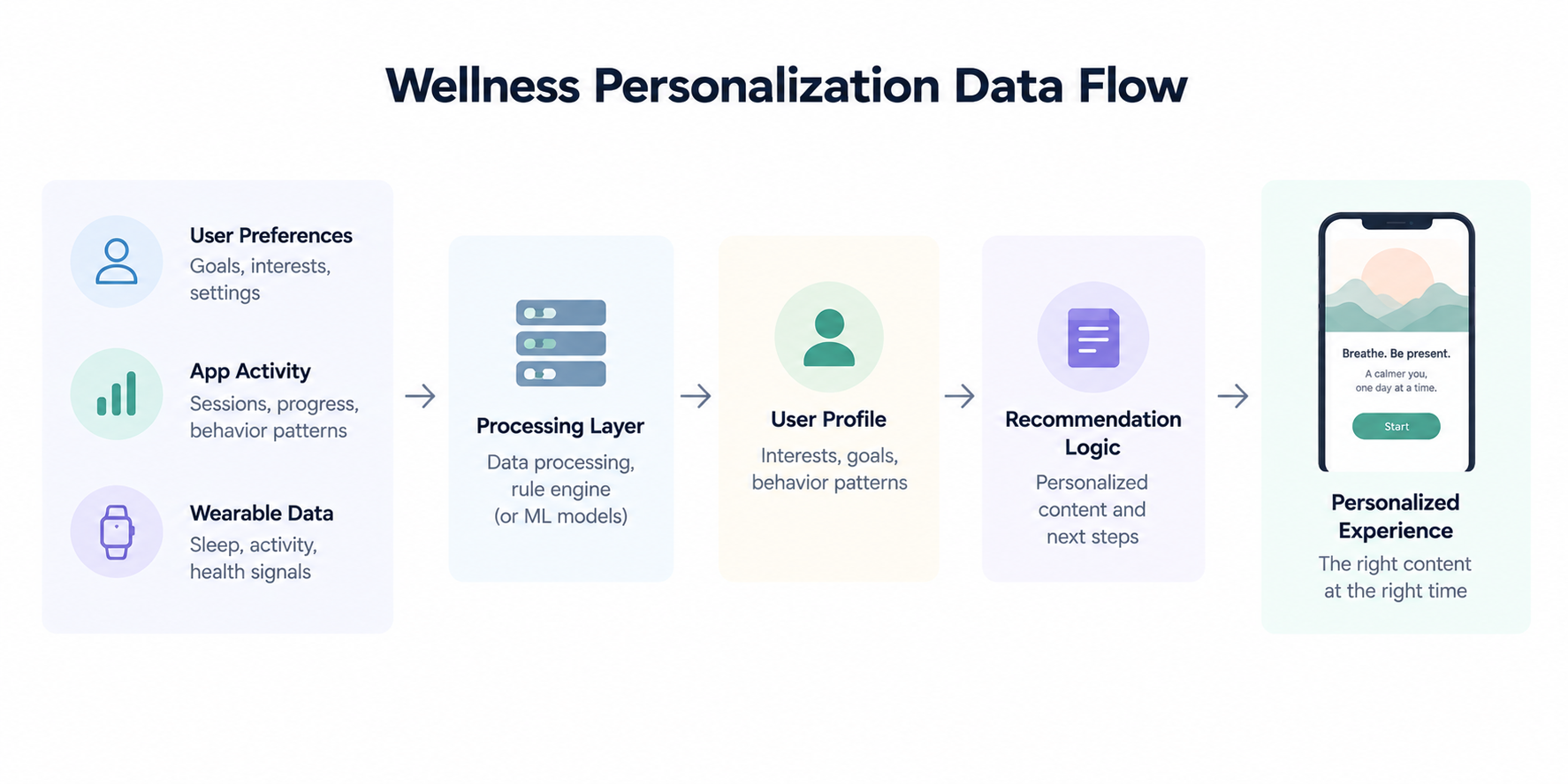
The important architectural choice is not whether AI is involved. In fact, AI may be unnecessary at the beginning. What matters is keeping recommendation logic separate from the interface.
If those rules are scattered across individual screens, every improvement becomes harder. A dedicated layer lets a team start with straightforward logic and introduce more sophisticated personalization later without rebuilding the product around it.
Wearables Add More Than an API Integration
Connecting a wellness product to Apple HealthKit or Android Health Connect sounds like another integration task. But have to admit that, in practice, it introduces an entirely different category of permissions and user-controlled data.
A user may share one type of information and deny another. They may revoke access later. Some signals may be unavailable for days at a time. The architecture cannot assume that every requested data point will always be there.
The product should still make sense when it is not.
This matters increasingly as wellness apps move beyond basic activity tracking. Sleep, workouts, mindfulness sessions, and other signals can provide useful context, but they also increase the number of states the application has to handle.
Design the Data Model for Change
The amount of data behind a wellness app tends to grow faster than expected. What starts with user accounts and preferences can soon expand to programs, session history, favorites, playback progress, subscriptions, device data, and potentially health signals.
A useful data model needs enough structure to accommodate change without becoming unnecessarily complicated.
Take a meditation program - it may initially look like a playlist. Six months later, the business wants ordered sessions, completion rules, locked content, several instructors, multiple languages, and different progress states. If those sessions were modeled as unrelated audio files, the "small" product change suddenly becomes a data problem.
We have seen the same pattern when products move beyond their first version. Shortcuts that save development time during an MVP often reappear later as additional work when the team wants personalization, better analytics, or new content formats.
Build Privacy Into the Data Flow
Wellness data can be sensitive even when an application is not positioned as a medical product. Sleep patterns, mood entries, stress-related activity, health signals, and personal goals can reveal a lot about a user. Architecture should therefore limit collection to information the product genuinely needs and make access intentional.
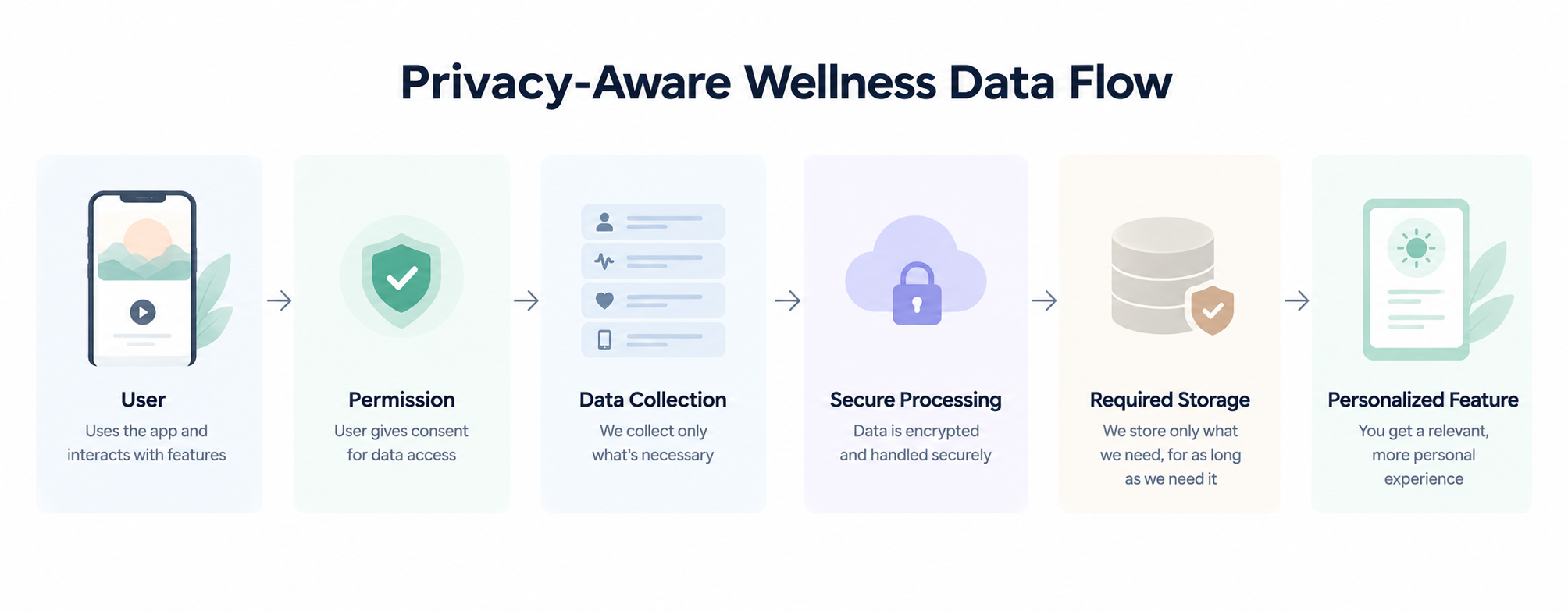
The principle is fairly simple - don't collect a broad dataset just because it might become useful someday. It reduces privacy exposure and also keeps the product's data architecture easier to understand.
Keep Third-Party Integrations Replaceable
A production wellness app may rely on payment providers, subscription management, analytics, push notifications, crash reporting, media delivery, authentication, and health platforms.
It is tempting to integrate each service in the fastest possible way, particularly when an MVP is under deadline. The downside usually becomes visible later, when a vendor changes pricing, the product enters another market, or the team decides to replace an analytics or subscription platform.
Vendor-specific logic scattered throughout the application makes that change unnecessarily painful.
Keeping integrations behind clear interfaces requires slightly more thought upfront, but it prevents one external service from becoming part of the architecture everywhere.
Architecture Should Support Product Evolution
Good architecture does not mean designing an enormous system before the first user arrives. Overengineering a meditation MVP can waste just as much time as ignoring architecture entirely.
The more practical question is: what are we reasonably confident will change?
Content libraries tend to grow. Subscription rules change. Personalization becomes more sophisticated. New devices and health integrations appear. Analytics questions evolve once the team sees how real users actually behave.
Those are good places to create flexibility, and everything else can remain simpler until there is a genuine reason to expand it.
A strong technical foundation does not predict every feature on a three-year roadmap. It gives the team room to change its mind without discovering that one early shortcut now sits underneath half of the product.
For modern wellness applications, that is probably the best measure of architecture - the experience can remain calm and simple for the person using it, even when the technology behind that experience becomes considerably more sophisticated.
Conclusion
Modern digital wellness platforms may appear simple to users, but they often depend on a complex combination of content delivery, data management, personalization, privacy controls, wearable integrations, and third-party services. Keeping these systems clearly separated and adaptable helps support a reliable user experience as content, features, and technical requirements evolve over time.
Comments
Comments are available to signed-in users and are moderated to keep the discussion useful and respectful. Spam, automated submissions, and low-value promotional comments are removed. Outbound links may be approved when they are relevant and genuinely helpful to readers, but they are displayed as plain text rather than clickable hyperlinks.
No comments have been published yet.
Please sign in to submit a comment.