

IP Address, Geolocation, Web Hosting
Selling Across Borders: What IP Location Data Can and Cannot Tell You
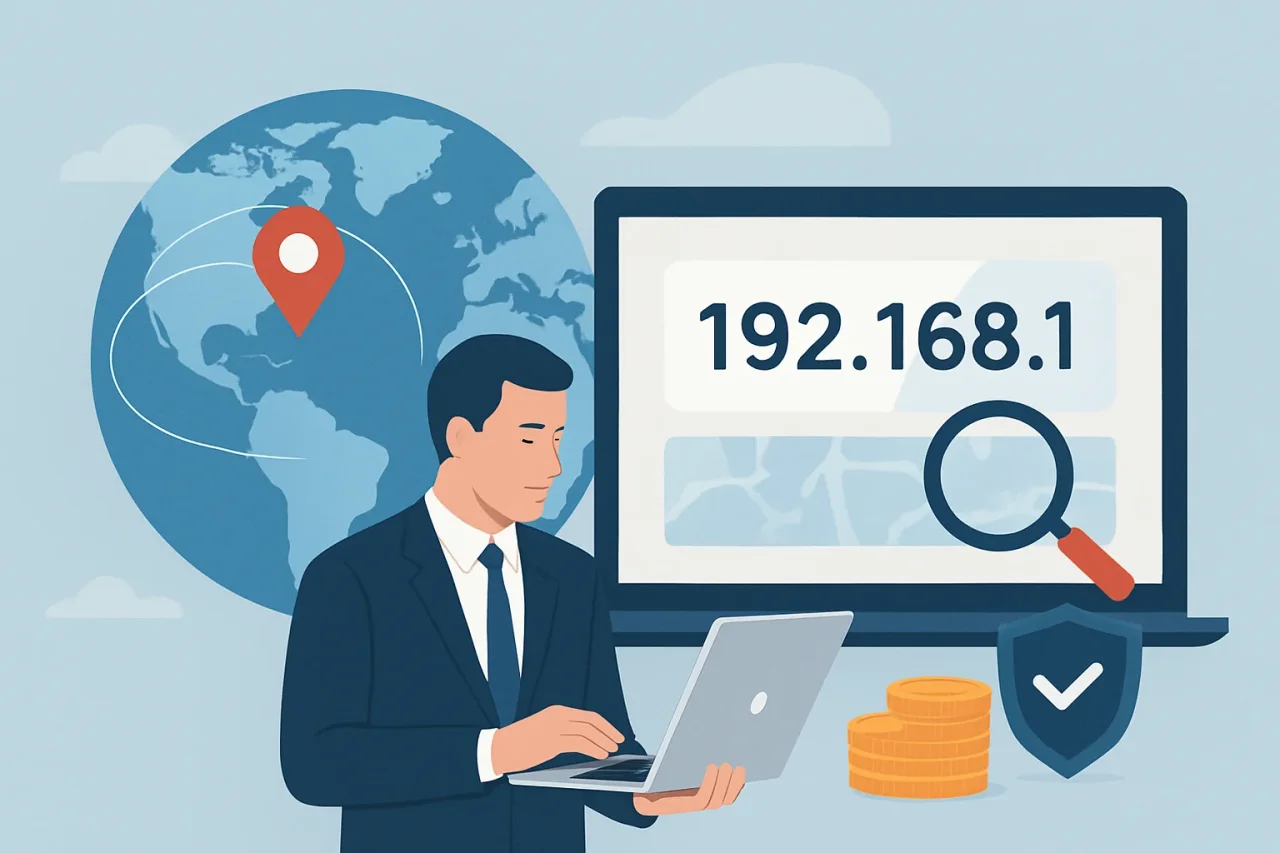
An IP lookup returns a country, a region, a city, and an ISP in a few milliseconds. For a business selling to people in other countries, that lookup is usually the first fact it ever has about a visitor. It arrives before the signup form, before the account, before any payment.
Two teams end up leaning on it harder than they expect. The people trying to reach customers in a new market, and the people trying to get paid by them without eating fraud losses. Both are working from the same lookup, and both get burned in the same way when they trust it too far.
What the data actually is
An IP address belongs to a network, not to a person. Regional registries publish which address blocks are assigned to which ISPs and organizations. Geolocation providers then map those blocks to physical locations using routing data, ISP records, latency measurements between known points, and user-submitted corrections.
That process produces fields with very different reliability, and knowing which is which matters more than any single use case:
- Country. Accurate almost all of the time. You can build rules on it.
- Region and city. Much weaker. Mobile traffic often exits through a carrier gateway hundreds of kilometers from the actual user, so a subscriber in one city can resolve to another.
- ISP and connection type. Useful for separating home broadband from a corporate network from a data center.
- Proxy, VPN, and hosting flags. Check these before you treat any location as real.
The working rule is simple. Treat country as a fact, treat city as a hint, and never let a hint make a decision the user cannot reverse.
Finding out where demand already exists
Before a company spends anything on a new market, its own logs usually already know something. Signups, trial starts, and support tickets broken out by country show where interest exists without any localized effort behind it. That is a cheaper signal than a survey and a more honest one than a keyword tool, because it reflects people who found you anyway.
Once that picture is clear, the geo data does ordinary campaign work. Pricing shown in the local currency. Case studies from companies in the same region. Support hours that match the reader's day. Payment methods people in that country actually use.
One technical trap is worth naming. If you swap page content based on IP, search crawlers will only ever see the version served to their own location, which is usually a data center in the United States. Your localized content then exists for users but not for search. The safer pattern is separate indexable URLs per market, with IP detection reduced to a small banner offering a switch. A saas marketing agency working on international rollouts will normally check this before anything ships, because a personalization script that quietly hides your German pages from Google costs more than the personalization gains.
Getting paid, and paying out
The payments side is where IP data has the longest history. Comparing the visitor's IP country with the billing address country is one of the oldest inputs in card fraud scoring, and it still earns its place.
It is a weighted signal, not a verdict. People travel. People use work VPNs. A mismatch on its own says very little, and businesses that decline on the basis of mismatch alone lose real customers. Two things are more telling. First, a checkout coming from a hosting provider or data center range, since almost nobody buys software from a server. Second, a mismatch combined with other oddities, like a shipping address in a third country or a card that has failed elsewhere in the last hour.
Expansion also runs the other direction. A company selling into several countries starts spending in several countries. Ad platforms bill in one currency, local contractors invoice in another, and the tools the team uses renew in a third. Finance teams comparing the best corporate cards for this situation are usually looking at the same short list of things: which currencies the card actually settles in, what the conversion spread looks like, and whether spend can be split by market cleanly enough to tell which country is profitable. Routing everything through one home currency is simpler to set up and quietly expensive to run.
When the location is wrong on purpose
VPN use is now normal rather than suspicious. Privacy features built into browsers and phones route traffic through relay servers that, by design, hide the origin. Corporate VPNs send staff out through a head office on another continent. None of this is evidence of anything.
So build for the miss. Detection should set a default: never lock a door. Any flow that pins a user to a region based on IP alone will eventually trap someone, and that someone will be a paying customer trying to fix their own billing. Give every guess a visible one-click override, and the problem mostly disappears.
What you are allowed to keep
An IP address is personal data under GDPR, and a lot of teams treat it as though it is not. Reading it once to choose a currency and then discarding it is a very different act from storing it against a user profile for two years or passing it to an ad platform. The second needs a lawful basis and a line in your privacy notice.
The practical version is to decide, on purpose, how long you keep it and what it is joined to. Fraud screening has a decent argument for retention. Choosing which flag to show on a pricing page does not.
A sensible starting point
If you are adding location logic to a product that sells internationally, keep the first version small. Use country only. Make every guess overridable in one click. Keep separate indexable URLs per market instead of swapping content behind one address. In checkout, weigh a country mismatch rather than blocking on it, and pay more attention to data center traffic. Write down what you store and for how long.
Done that way, IP geolocation is not a personalization trick. It is a quiet layer that makes a product feel local to the person using it, and makes the payments behind it a little harder to abuse.
Comments
Comments are available to signed-in users and are moderated to keep the discussion useful and respectful. Spam, automated submissions, and low-value promotional comments are removed. Outbound links may be approved when they are relevant and genuinely helpful to readers, but they are displayed as plain text rather than clickable hyperlinks.
No comments have been published yet.
Please sign in to submit a comment.