

Privacy, Online Tools, Information Technology
What Happens to Your Personal Documents When You Order a Translation Online
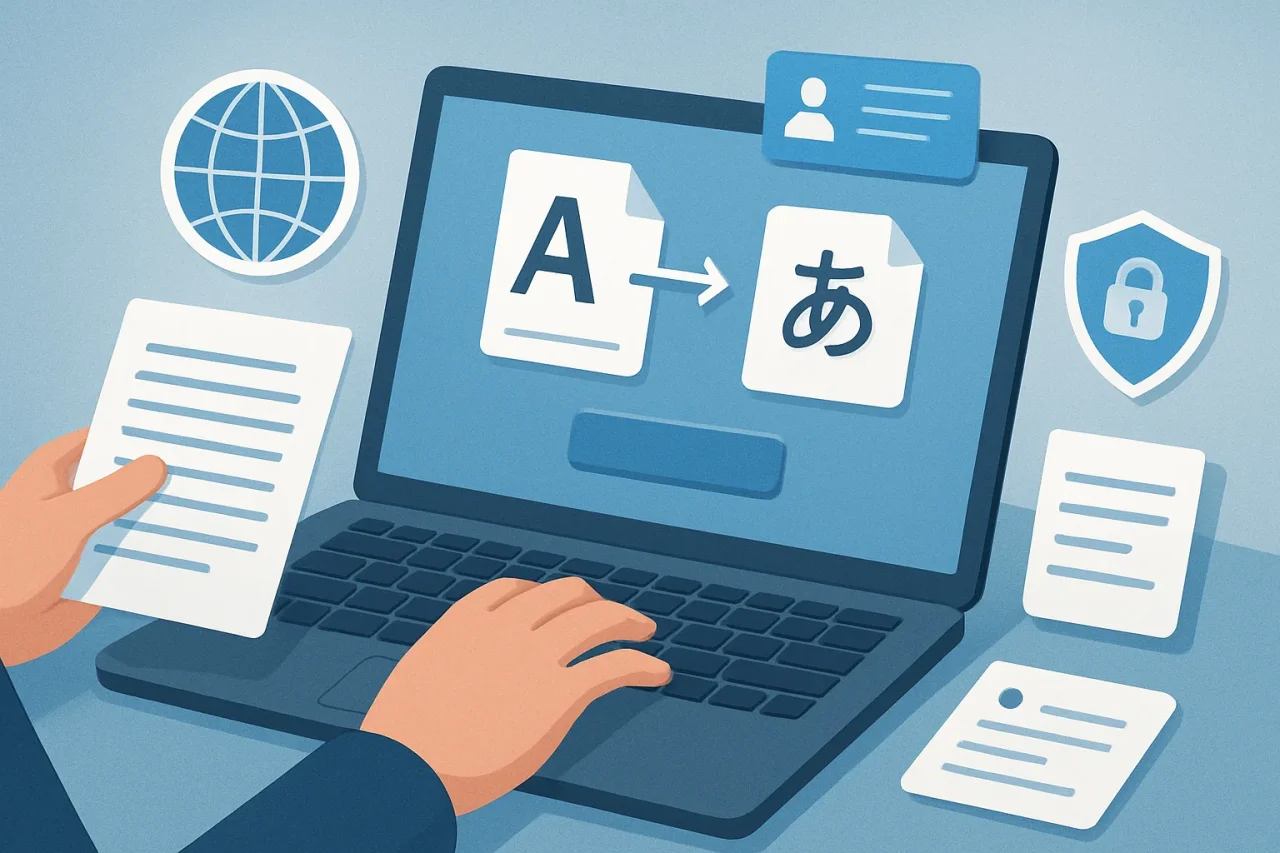
Few things you send over the internet are as sensitive as the documents people get translated. A typical order might include a passport, a birth or marriage certificate, a bank statement or a set of medical records. Between them, those pages carry a full name, a date and place of birth, ID and account numbers, home addresses and sometimes a health history. That is a complete identity kit.
Most people choose a translation service on price and speed. It is worth adding a third question: what happens to your files once they leave your computer?
The journey of a translated document
A document ordered online usually passes through five stages, and each one is a point where it can be exposed:
- Getting a quote. Many sites ask you to upload the file before they show a price.
- Storage. The file sits on the provider's servers, and often in someone's inbox.
- Translation. One or more translators open it, sometimes on their own computers in different countries.
- Delivery. The finished translation usually arrives as a PDF attachment.
- Retention. Copies can stay on servers, laptops and email accounts long after the job is done.
You cannot control all of this, but you can choose a provider that handles each stage carefully.
Five questions to ask before you upload
1. Does the quote tool need my file at all?
Some quote forms send every file you drop in straight to the company's server, even if you never order. Others count the words in your browser, so the document stays on your device until you decide to go ahead. Official Translations works this way: its quote page calculates the word count and price locally, and files only reach the company if you place an order or ask it to review a quote. If a service cannot tell you which approach it uses, assume your file is being uploaded.
2. Who will actually see it?
Some agencies use an in-house team; others pass work to a large network of freelancers. Neither is wrong, but you should know which. Ask whether translators work under confidentiality agreements, and whether the provider will sign a non-disclosure agreement if your documents are especially sensitive.
3. How is it transferred and stored?
An upload page should use HTTPS, the padlock in the address bar. Email is more convenient, but standard email is not end-to-end encrypted, and attachments stay in both inboxes indefinitely. Ask how long the provider keeps your files and whether it deletes them on request.
4. Is machine translation or AI involved?
Machine translation can be a useful tool in a professional workflow, but where it runs matters. Text pasted into a free consumer AI tool may be stored by the tool's operator and, depending on its terms, used to improve its models. Ask whether the provider uses public tools, business tools with data protection terms, or none at all.
5. What rights do I have?
If the provider is covered by the GDPR in the EU or the UK GDPR, you have the right to ask what personal data it holds about you and, in many cases, to have it erased. In the United States, protection depends on where you live, because only some states have broad privacy laws. Either way, a reputable provider explains in its privacy policy how long it keeps documents and how to request deletion.
What you can do yourself
- Send only what is needed. If the authority wants your birth certificate, don't upload your whole document folder just in case.
- Avoid open sharing links. A cloud link set to "anyone with the link" can be opened by anyone who gets hold of it, including from a forwarded email.
- Never email card details. Pay through the provider's checkout page, not by typing card numbers into a message.
- Watch for fake follow-up emails. Scammers know people are expecting a document back. Be wary of messages asking you to "log in" to collect your translation or to pay a second time.
- Clean up afterward. Once your application is submitted, delete the extra copies from your downloads, desktop, and Sent folder.
It also helps to know how to check that a translation service is legitimate before you upload anything. A provider that explains its certification process clearly is usually just as clear about how it protects your files.
The bottom line
A certified translation is often the step that unlocks a visa, a university place or a job abroad, so it is easy to rush. A minute spent checking how a provider handles your files is time well spent. The documents you hand over describe exactly who you are, and they deserve the same care as your passwords.
Comments
Comments are available to signed-in users and are moderated to keep the discussion useful and respectful. Spam, automated submissions, and low-value promotional comments are removed. Outbound links may be approved when they are relevant and genuinely helpful to readers, but they are displayed as plain text rather than clickable hyperlinks.
No comments have been published yet.
Please sign in to submit a comment.