

Network, Cloud Services, Business
Navigating the Copper-to-Fiber Transition with a VoIP Business Phone System
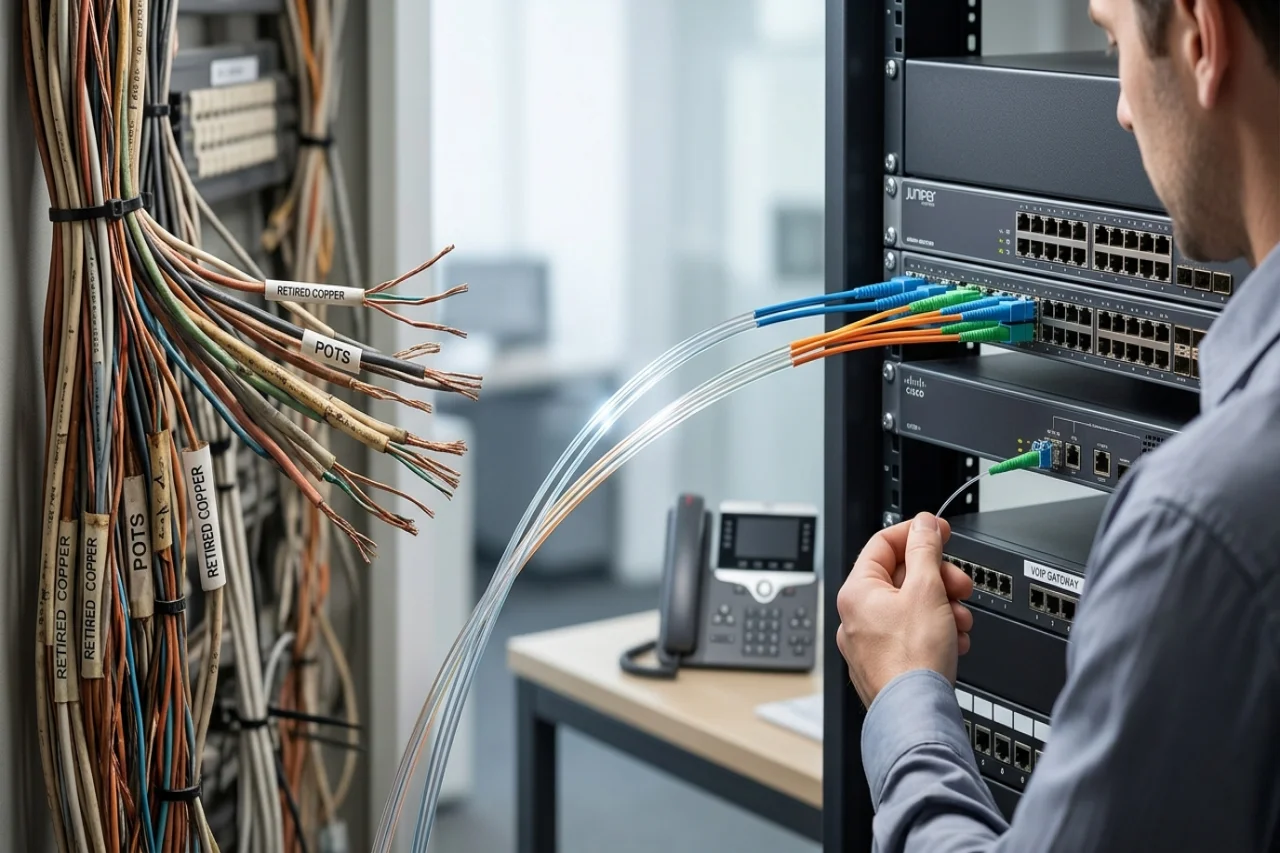
The copper phone line that has served businesses for decades is being switched off. Major carriers are retiring their copper networks and moving customers to fiber and wireless, and federal regulators have cleared the way for them to move faster. For a small business, the landline is no longer a set-and-forget utility. It now comes with a deadline set by the carrier.
The short version
- What's happening: AT&T, Verizon, Lumen and other carriers are retiring the copper networks that carry traditional landline service, known as POTS (Plain Old Telephone Service). AT&T stopped taking new copper orders across 18 states in October 2025, started tearing out copper in about 500 wire centers in June 2026, and aims to be substantially off copper by 2029.
- Why it's speeding up: In March 2026, the FCC adopted rules that shorten the approval process for discontinuing legacy phone service and limit how much states can slow it down.
- What it means for you: If your phones, fax line, alarm panel, elevator phone, or card terminal run over copper, your carrier may decide when that service ends. The remaining copper lines are becoming more expensive and harder to repair.
- What to do: Take inventory of every copper line, decide what each one actually needs to do, and move your voice service to a VoIP business phone system running over fiber or another broadband connection. Plan for internet outages and confirm your 911 location details.
- The upside: A VoIP business phone system is more than a replacement dial tone. It gives a small team auto-attendants, mobile apps, smart call routing, voicemail-to-email, and AI tools that a copper line never could.
The rest of this article covers each of those points in more depth: what the carriers and regulators are doing, what the numbers show, how VoIP helps a small business communicate better, and how to plan a switch without dropping calls.
What's happening to copper phone lines
Carriers are retiring copper because it is old, expensive to maintain, and serves fewer customers every year. Every dollar spent patching a century-old network is a dollar not spent on fiber and wireless, which carry far more traffic at a lower cost per line.
"Copper retirement" means a carrier removes or disables the copper wiring in an area and moves service onto fiber or fixed wireless. The analog phone service that rode on that copper line is discontinued as well. Customers are expected to move to an IP-based replacement, whether that's the carrier's own product or a VoIP service from another provider.
For years, the process was slow. Carriers had to file notices, wait through review periods and often deal with state rules that could delay or block a shutdown. That has changed quickly:
- In March 2025, the FCC waived several of the filing and notice requirements tied to copper retirement.
- In July 2025, the FCC proposed making those changes permanent and simplifying the service discontinuance process.
- On March 26, 2026, the FCC adopted its Network and Services Modernization Order. Discontinuance applications now receive automatic approval after 31 days for all carriers, down from a 60-day review period for large incumbents like AT&T and Verizon. Carriers can also grandfather legacy service (stop selling it) with a simple customer notice, and states can no longer delay or block a discontinuance the FCC has approved.
The order kept some safeguards. Carriers must coordinate with local 911 authorities at least 90 days before discontinuing service that affects emergency calling. But for the business on the other end of the line, the practical result is clear: once a notice arrives, the window to act can be as short as a few months.
"Most of the businesses we talk to don't realize their copper line is being retired until the notice shows up. By then, they're picking a phone system under a deadline. The ones who start early get to treat it as an upgrade instead of an emergency," says Adam Estruch of AVX Cloud, a business phone system provider that helps companies choose, set up, and support VoIP systems.
VoIP companies like AVX Cloud can help a business get ahead of that notice. That means auditing every copper line on the account, flagging alarm, fax, and payment lines that need replacement, porting existing phone numbers, and having a VoIP business phone system up and running before the carrier's deadline.
Key dates in the copper-to-fiber transition
| Date | Milestone |
|---|---|
| March 2025 | FCC waives several copper retirement filing and notice requirements |
| May 2025 | Lumen stops accepting new POTS orders, moves and changes across its 14-state local phone footprint |
| October 15, 2025 | AT&T stops taking new copper POTS orders across 18 states |
| March 26, 2026 | FCC adopts the Network and Services Modernization Order, including a 31-day automatic grant for discontinuance applications |
| June 2026 | AT&T begins permanently decommissioning copper in about 500 wire centers, roughly 10% of its footprint |
| 2026–2027 | Verizon expands its copper retirement projects into more markets, with a goal of moving more than five million legacy lines to fiber |
| 2029 | AT&T's stated goal to be "substantially out of copper" |
Sources: FCC orders and public notices; carrier filings as summarized by Simbase, MetTel and industry press.
The numbers behind the shift
The move away from copper isn't new. Carriers are simply finishing a shift that customers started more than a decade ago. The FCC's own voice subscription data shows traditional landlines falling from 127 million in 2009 to about 15 million by mid-2025, a drop of nearly 90%.
| Date | Traditional switched access lines | Interconnected VoIP subscriptions | VoIP share of wireline voice connections |
|---|---|---|---|
| December 2009 | 127 million | 26 million | 17% |
| December 2011 | 107 million | 37 million | 26% |
| December 2016 | 58 million | 63 million | 52% |
| June 2022 | 27 million | 68 million | 71% |
| June 2025 | 15 million | 63 million | 81% |
Source: FCC Local Telephone Competition and Voice Telephone Services reports. VoIP share is calculated from the line and subscription counts shown.
A few things stand out:
- VoIP overtook traditional landlines in 2016, when interconnected VoIP made up 52% of wireline voice connections for the first time.
- Traditional lines fell about 45% in just three years, from 27 million in June 2022 to 15 million in June 2025.
- Mobile now dominates overall voice service, with about 395 million mobile subscriptions in June 2025. VoIP subscriptions have leveled off as households drop home phones entirely, but for businesses that need a shared main number, call routing and desk phones, VoIP has become the standard landline replacement.
In other words, the businesses still on copper are a shrinking group, and they're paying to keep an increasingly lonely network alive.
What the transition means for business owners
For most small businesses, the copper sunset creates four practical problems.
1. You Don't Control the Timeline
When a carrier retires copper in your area, you get a notice and a deadline. Under the FCC's current rules, a copper retirement can take effect in as little as 90 days after public notice. Grandfathered lines also come with restrictions. In many areas, you can't add a new copper line, move one to a new suite, or make changes to existing service. If you're planning an office move or expansion, that can force a decision earlier than you expected.
2. Copper Is Getting More Expensive and Less Reliable
With fewer customers sharing the cost of an aging network, carriers have raised rates on remaining copper lines, in some cases sharply. Repairs also take longer as crews and parts shift to fiber. Paying more each month for a service that is slower to fix is a poor trade, especially when the line is going away anyway.
3. Your Phones May Not Be Your Only Copper Lines
This is the part many owners miss. Copper lines often support equipment that has nothing to do with answering calls:
- Fire alarm and security panels
- Elevator emergency phones
- Fax machines
- Point-of-sale and credit card terminals
- Gate, door entry and building access systems
- Older modems and monitoring equipment
Some of these, especially life-safety systems, have code and inspection requirements of their own. They need a planned replacement, not a surprise outage.
4. The Default Replacement May Not Be the Best Fit
Carriers usually offer a like-for-like replacement product that keeps a dial tone working over fiber or wireless. That solves the immediate problem, but it doesn't change how your business communicates. Since you have to switch anyway, this is the right moment to ask what your phone system should do for you, not just what it needs to keep doing.
The good news is that the transition can be planned. Businesses that start early get to pick their provider, keep their phone numbers, schedule the cutover around their busy season, and fix the hidden lines on their own terms.
How a VoIP business phone system helps small businesses communicate
VoIP (Voice over Internet Protocol) turns voice into data and carries it over your internet connection. Instead of living in a copper pair on the wall, your phone system lives in the cloud. Your numbers, call flows, and voicemail follow your team wherever they log in.
That shift solves the copper problem, but the bigger benefit is what a small team can do with it.
Answer from anywhere
With a VoIP business phone system, the same business number can ring a desk phone, a laptop app, and a mobile app. Staff working from home, on a job site or between appointments can take and make calls from the company number without giving out personal cell numbers. For hybrid teams, that alone can remove a lot of friction.
Stop missing calls
Copper lines ring where they're plugged in. VoIP lets you decide where calls go and when:
- Auto attendants greet callers and route them to sales, service or billing.
- Ring groups and queues send calls to whoever is available instead of one desk.
- Time-based rules handle after-hours calls, holidays and lunch breaks automatically.
- Overflow and forwarding push unanswered calls to a mobile phone or backup team.
For a small business, every missed call can be a missed customer. Smart routing makes a five-person office sound and behave like a much larger one.
Keep everything in one place
Modern platforms bundle more than voice. Video meetings, team chat, business texting and website live chat often run on the same system. Voicemail-to-email and call transcription mean messages land in your inbox as text you can skim. Many systems also integrate with CRMs and Microsoft Teams, so call history is integrated with customer records.
See what's happening
Call logs, reports, and call recording show when calls peak, how long callers wait, and which calls go unanswered. That data helps owners staff the phones properly and coach employees, which is nearly impossible with a basic copper line.
Put AI to work
Newer VoIP platforms add AI features that used to be enterprise-only. An AI receptionist can answer common questions and route calls around the clock. Automatic transcription and call summaries reduce note-taking and help teams follow up faster.
Grow without rewiring
Adding a new employee is a few clicks, not a service call and a new line. Opening a second location or moving offices doesn't require new copper, and your numbers come with you. Pricing is usually per user per month, which makes costs predictable as the team grows. Vendor surveys commonly report savings of 30% to 50% compared with traditional landlines, though actual savings depend on your current setup.
Stay reachable when something goes wrong
If a storm takes out the office or a cable gets cut, a copper line is simply down. A cloud phone system can automatically fail over to mobile apps or forward calls to cell phones, so customers can still reach you while the office is offline.
The role of local VoIP providers
National cloud phone brands make it easy to sign up online, and for some businesses that's enough. But for most small businesses, the copper transition is a project, not a purchase. Someone has to find every copper line, figure out what's plugged into each one, port the phone numbers, build call flows, set up desk phones, check the network, and train the staff. A login and a help center article don't do much of that.
This is where a local VoIP company earns its keep. Rather than handing a business a self-serve account, a local provider helps it choose the right phone system for the way it actually works, then handles the implementation from start to finish. That includes porting existing numbers, building auto attendants and ring groups, and sending a technician onsite for installs when the job calls for it. After implementation, ongoing technical support remains important for maintaining call quality and minimizing service disruptions. Practices such as proactive IT management can help businesses identify network issues early and reduce the risk of unexpected downtime.
When comparing providers, a few questions separate a smooth migration from a painful one:
- Will you audit our existing lines, including alarm, fax, elevator, and payment lines?
- How do you handle number porting, and will our old service stay active until the port completes?
- Can you help set up our network for voice quality, or tell us exactly what our IT team needs to change?
- What happens to calls if our internet goes down?
- How do you register 911 locations for office and remote users?
- Is onsite help available for installs, and who do we call when something breaks?
A provider that answers these questions clearly, before you sign, is one that has done this before.
How to plan your move off copper
A VoIP business phone system is only as good as the network under it. These steps keep the switch smooth and the call quality high.
Inventory every copper line: Pull your phone bills, find where the lines enter the building, and label each one by what it does. Unknown lines are the ones that cause surprises later.
Sort lines by job: Separate everyday voice lines from fax, alarm, elevator, payment, and building access lines. Life-safety lines usually need a dedicated replacement, such as a cellular communicator, so loop in your alarm vendor and confirm local code requirements.
Check your internet connection: Fiber is ideal, but cable and fixed wireless can work. Plan for roughly 100 Kbps up and down for each simultaneous call. For clear audio, aim for one-way latency under 150 ms, jitter under 30 ms, and packet loss under 1%.
Prepare your network: Prioritize voice traffic with QoS, consider a separate VLAN for phones, and use PoE switches to power desk phones. Disable SIP ALG on your router if your provider recommends it, since it's a common cause of one-way audio and dropped calls.
Plan for outages: Add a backup internet connection with automatic failover, put your modem, router, and switches on a UPS, and set rules that forward calls to mobile phones if the office goes offline.
Set up 911 correctly: Federal rules (Kari's Law and RAY BAUM'S Act) require that business phone systems allow direct 911 dialing and send a dispatchable location. Register an accurate address, down to the floor or suite, for every office phone and remote user.
Port your numbers and schedule the cutover: Keep your existing service active until the port completes, schedule the switch for a slow day and test inbound and outbound calls before you cancel anything. Ask your provider how to verify your 911 setup without placing a live emergency call.
Train your team: Fifteen minutes on transfers, voicemail, and the mobile app prevents most of the "the new phones don't work" calls in week one.
Moving forward
The copper network isn't coming back. Carriers have the regulatory green light, the timelines are getting shorter, and the remaining lines are getting more expensive. Waiting only means the switch happens on someone else's schedule.
The businesses that come out ahead treat the deadline as an upgrade. They find their hidden lines early, get their network ready, and choose a VoIP business phone system that helps their team answer more calls, work from anywhere, and look bigger than they are. Start with an inventory this month, and the copper-to-fiber transition becomes a project you control instead of an outage you react to.
Comments
Comments are available to signed-in users and are moderated to keep the discussion useful and respectful. Spam, automated submissions, and low-value promotional comments are removed. Outbound links may be approved when they are relevant and genuinely helpful to readers, but they are displayed as plain text rather than clickable hyperlinks.
No comments have been published yet.
Please sign in to submit a comment.