

Smartphone, Privacy, Scams & Frauds
How to Use Phone Canary Tokens to Catch Data Brokers and Trace Reported Numbers
You type your phone number into an online form for a quick car insurance quote. Ten seconds later, before you even close the browser tab, your phone rings.
It is an unknown toll-free number. By Friday, your phone keeps ringing with automated pitches from reported numbers pushing fake debt relief and car warranties.
Most people think a shady site sold their contact list weeks later. Today's data brokers operate on a much tighter clock. Modern lead forms run real-time ping-post auctions.
That same number unlocks your bank accounts, connects your family, and receives your two-factor authentication codes.
Hitting "Block Caller" on your phone will not fix this. You need a better tactic. Borrow a trick from cybersecurity: turn disposable phone numbers into canary tokens and check unknown callers against live federal complaint data.
Inside the Ping-Post Auction Machine
A ping-post lead tree works just like real-time online ad bidding. The only difference is that the product for sale is your phone number.
Here is what happens the second you click submit on a quote form:
- The Ping. The site strips out your name and phone number. It sends your basic details (like your ZIP code, age, or loan amount) to dozens of call centers and lead brokers at once.
- The Bid. Automated scripts look at your profile in under 100 milliseconds. Each buyer sends back a dollar bid based on how much they want your lead.
- The Post. The broker sells your full name and phone number to the top three to five bidders at the same time. Days later, they often bundle your info and resell it as an "aged lead" to cheaper call centers.
This is why one single quote form triggers ten calls from ten different area codes in an hour. Most people assume joining the federal Do Not Call database will shut down the ringing. It rarely works.
First, lead sites hide TCPA consent text in tiny gray print under the submit button. Clicking submit gives them legal permission to call you, which overrides the registry. Second, overseas scam call centers buy aged lead lists and ignore US laws completely.
What 90 Days of Reported Numbers Reveal About Modern Robocalls
Once your number enters the broker loop, automated dialers pass it around for months. Federal complaint logs show just how big this problem is.
Between August 26 and November 23, 2026, US consumers filed 318,226 unwanted call reports with the Federal Trade Commission (FTC).
Those reports covered 277,882 unique phone numbers. Call volume jumps hard on weekdays, hitting a peak of 9,693 reports in a single day on November 20.
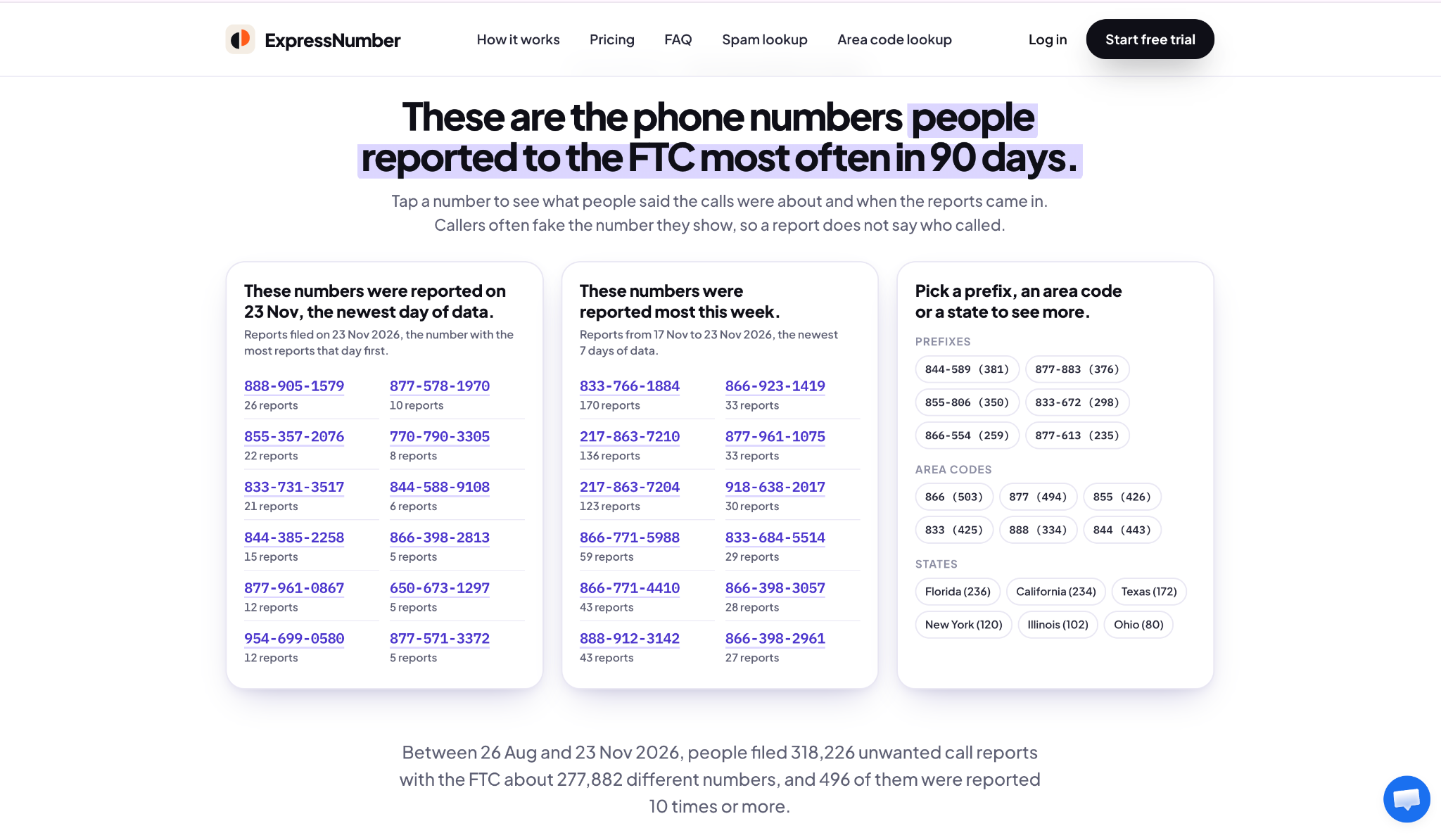
Looking closely at the reported numbers in that 90-day FTC dataset shows four clear trends:
- Recorded messages and automated robocalls made up 76% of all complaints. Real humans barely make these calls anymore.
- Outside of general "Other" complaints (39%), calls about "Reducing your debt" hit 24% of total volume. That is more than double the rate of government, business, or family impersonation scams (11%).
- Scammers burn through toll-free prefixes like 866, 877, 844, 855, and 833 nonstop. They use toll-free blocks to look legitimate and slip past basic carrier filters.
- Florida, California, Texas, and Illinois report the highest number of complaints.
These numbers also show why standard reverse phone lookups often fail. Modern VoIP dialers spoof caller IDs and rotate thousands of fresh toll-free lines every week. Static phone directories cannot keep up with spoofed lines.
Checking live complaint spikes against recent FTC reported numbers gives you a much faster answer on whether a caller is running an active scam.
IP Masking vs. Phone Canary Tokens
Protecting your internet connection and protecting your phone require different tools. Your IP address changes often. Your primary phone number stays with you for years.
| Feature | VPN / IP Masking | Email Aliases (+ / Hide My Email) | Phone Canary Numbers (Receive-Only) |
|---|---|---|---|
| Lifespan | Changes on reconnect | Per account | Burned in one tap |
| Catches the Leaker? | No | Yes (unique alias) | Yes (labeled line) |
| Speed to Stop a Leak | Instant (switch server) | Instant (kill alias) | Instant (stop forwarding) |
| Stops Ping-Post Calls? | No | Email only | Yes (blocks voice and SMS) |
How to Build a Silent Breach Detector Using Phone Canaries
Security teams use canary tokens to catch hackers early. A canary token is a fake file or contact planted inside a database. Nobody has a real reason to touch it. If someone opens it, the team gets an instant alert with zero false alarms.
You can use the same setup for your phone with labeled, receive-only disposable numbers:
- Stop giving out your real SIM number. Keep your primary number strictly for family, close friends, and banks. Never type it into insurance forms, car dealer sites, rental apps, or retail loyalty sign-ups.
- Give each vendor a unique line. Set up a fresh temporary number for each form. Label it with the exact site name and date, like AutoQuote-Nov or MapleSt-Rental.
- Watch for unexpected calls. Suppose a number you only gave to one local business sits quiet for four months. Then, out of nowhere, it gets a debt-relief robocall. You just caught a silent data breach or an unauthorized resale long before that company ever admits it.
- Burn the line and save the proof. Cut off call forwarding right away. Your real phone stays quiet, and your inbox still holds the call and text logs showing which vendor leaked your data.
How to Handle Reported Numbers When Your Canary Triggers
When a labeled canary line starts ringing with spam, how you react matters. Stick to four simple rules:
- Look up the caller before you dial back. Run the unfamiliar number against live FTC reported numbers to see if other people flagged that same prefix in the last 24 hours.
- Do not press buttons or reply "STOP" to random texts. Automated dialers track every reaction. Pressing "2 to opt out" only proves a real human answered the line, which makes your number worth more money to brokers.
- File a quick FTC complaint with the exact timestamp. Even when a caller spoofs their ID, your report feeds into daily federal logs. Telecom carriers use those logs to build network-wide spam blocks.
- Kill the leaked canary right away. Shutting down a compromised number cuts off the spam cold and makes the broker's lead profile useless.
Treat Your Phone Number Like Your IP Address
You would not log into your bank on public Wi-Fi without hiding your IP. Stop feeding your real cell phone number into ping-post lead auctions. Put a labeled canary number on every web form, check suspicious callers against live reported numbers, and kill data leaks the second they start.
Comments
Comments are available to signed-in users and are moderated to keep the discussion useful and respectful. Spam, automated submissions, and low-value promotional comments are removed. Outbound links may be approved when they are relevant and genuinely helpful to readers, but they are displayed as plain text rather than clickable hyperlinks.
No comments have been published yet.
Please sign in to submit a comment.