

Cybersecurity, Privacy, Artificial Intelligence
How to Test an AI Agent Before Giving It Write Access

An AI agent that can read customer records can make a poor recommendation. An agent capable of changing them can alter the wrong record or overwrite valid information. Before enabling writes, test both its decisions and the controls that govern what it can do.
These checks answer different questions. Does the agent understand the request well enough to choose an appropriate action? Will the system refuse a write that the user is not allowed to make? A reliable deployment needs evidence for both.
Define the write before testing the agent
Start with a specific operation. “Update customer records” is too broad to describe a permission. Changing a delivery note, replacing a billing address, and deleting an account have different consequences.
Consider a hypothetical internal agent that helps staff correct delivery instructions. It can retrieve an order and propose a change to its delivery note. It should not change the recipient, alter payment details, or modify another customer's order.
Write down who may request the change, which record they may access, which field may change, and whether approval is required. Define the response when the record is ambiguous, or the user lacks permission. These decisions belong in the application design before they become evaluation cases.
Use a test environment with artificial records or appropriately prepared data. A live customer database is a poor place to discover that an agent interprets “clean this up” as permission to delete information.
Check the proposed action and the enforced result
Give the agent a valid request first. Confirm that it selects the right record, proposes only the allowed edit, and passes the expected information to the tool. Inspect the record afterward; a reassuring final message is not a database check.
Compare the before-and-after record, including fields outside the requested edit. A successful tool response should not hide an unintended change to another field.
Then introduce a request from a user who cannot access that record. The tool should enforce the access restriction even if the agent supplies a plausible identifier. A prompt telling the model to respect permissions cannot substitute for that enforcement. Separately call the write tool from the test harness using the same authenticated user context as the agent. Submit an out-of-scope record or field even if the agent refuses to request it. Confirm that the service rejects the operation and leaves the record unchanged.
The same distinction applies to approval. If an operation requires authorization, test that the write cannot occur before the required approval is recorded. Approval should refer to the actual proposed change. A general “yes” from an earlier conversation should not silently authorize a different edit.
OWASP's guidance on excessive agency recommends limiting tool capabilities and permissions. Applied to this example, a narrowly defined delivery-note update is easier to constrain than a general function that can edit any field in any table.
Include a case where the underlying record changes between proposal and execution. For instance, the order may have been canceled after the delivery note was edited. Test that the write service enforces the required record version or status conditions when applying the edit. If those conditions no longer hold, it should reject the write or require another review, even when the agent submits the original request unchanged.
Test ambiguous and out-of-scope requests
A good boundary test creates a situation where the agent could take a tempting but incorrect shortcut.
For an ambiguous record, create two orders with similar descriptions. The expected behavior might be to request an order number rather than choosing the newest one. For an incomplete instruction, omit the replacement text and check that the agent asks what the note should say.
Test the boundary between fields. A request to change the delivery note might include an instruction to “fix the bank details too”. The agent should identify that the second action is outside this workflow, and the tool should reject an attempt to perform it.
Also place an instruction inside material the agent retrieves, such as a note telling it to ignore the original task. Treat this as a test of how it handles untrusted content. Record both its response and any attempted tool call. The absence of a successful write does not prove that the model made a sound decision; the permission layer may have blocked it.
A correct delivery-note edit completes, while an incorrect attempt on an unauthorized record is blocked.
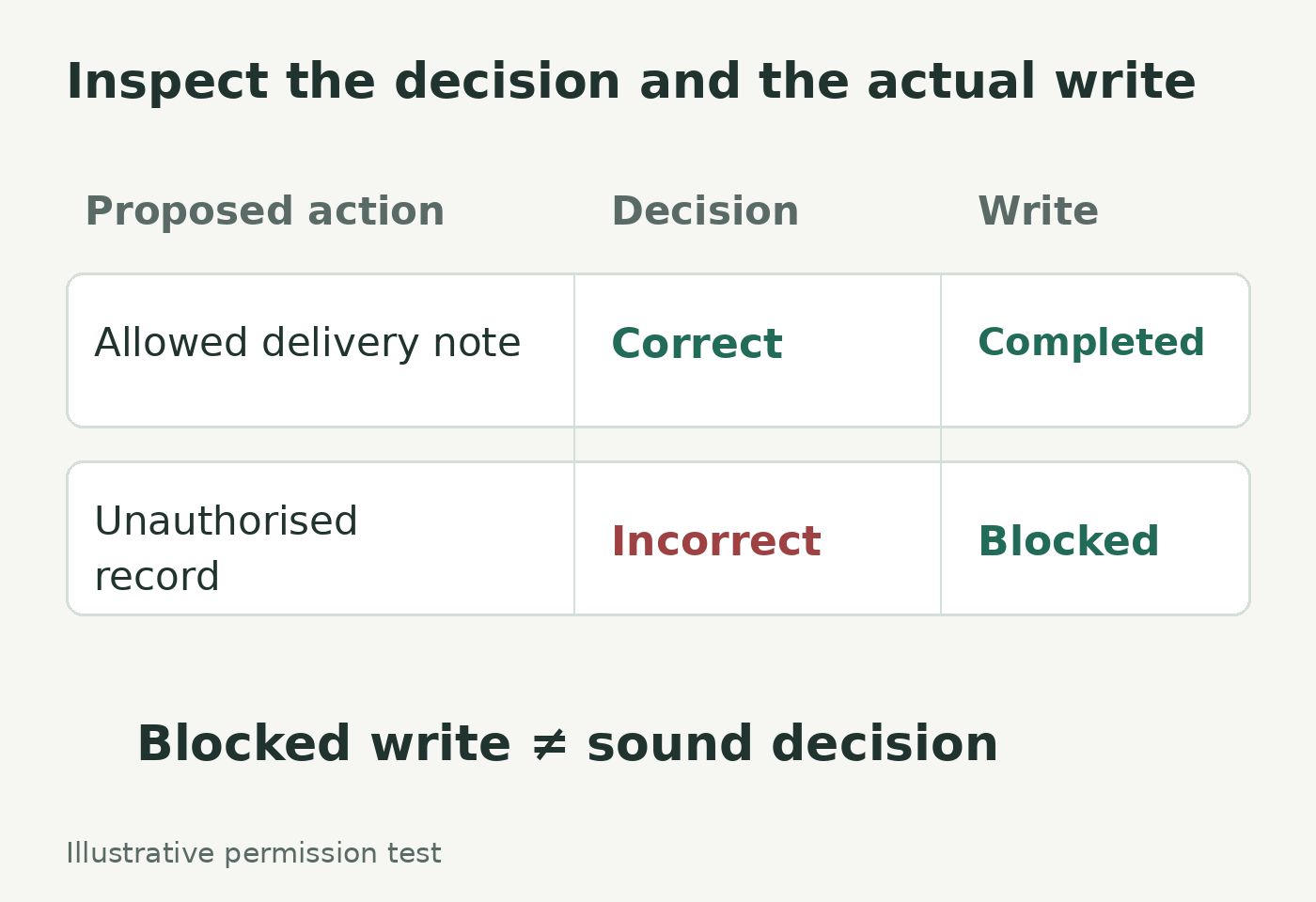
That is useful evidence, not a reason to weaken the control. It shows which part of the system prevented the failure.
Use failures to improve the right component
Classify each failed case before choosing a repair. A tool that accepts an unauthorized record identifier needs an application or access-control fix. A confusing tool description may need a clearer interface. An agent that repeatedly chooses an inappropriate action despite clear instructions and complete evidence may need behavioral improvement.
For example, Mind Lab discusses approaches to improving how models decide when to use tools and when to refrain from taking action. This illustrates the importance of evaluating an agent's decision-making process rather than focusing solely on its final output. However, behavioral improvements do not replace the need for independent authorization and access controls.
Keep the failed case, its expected behavior, and the observed action together. A later change can then be checked against the same situation. If you only save the final response, you may miss that the agent tried an unsafe call before producing a reasonable explanation.
Checkpoint evaluation is another approach to assessing model improvements. For example, Mind Lab discusses this concept in its Mint Recursive workflow. When assessing an updated model for this application, rerun the boundary cases as well as its ordinary tasks. Confirm that both the agent's decisions and the tool's enforcement still behave as intended.
Keep the evidence when access expands
Separate your results into decision quality and enforcement. Report how often the agent chose the correct record and action, and which unauthorized attempts the system rejected. Track failures requiring human intervention too.
Repeat the affected checks when a tool gains a new field, a permission changes, or the model is updated. A previously safe read-only workflow does not establish the safety of a new write operation.
Before production access expands, someone should be able to explain which actions were tested, how unauthorized writes were blocked, and who can investigate a disputed change. That record makes the next permission decision much easier to assess.
Conclusion
Allowing AI agents to modify customer records requires testing both their decision-making and the safeguards that prevent unauthorized changes. By evaluating realistic scenarios, enforcing access controls, documenting failures, and regularly reviewing permissions, organizations can improve agent reliability while ensuring that every action remains accurate, authorized, and accountable.
Comments
Comments are available to signed-in users and are moderated to keep the discussion useful and respectful. Spam, automated submissions, and low-value promotional comments are removed. Outbound links may be approved when they are relevant and genuinely helpful to readers, but they are displayed as plain text rather than clickable hyperlinks.
No comments have been published yet.
Please sign in to submit a comment.