

IP Address, Search Engine Optimization, Geolocation
How Google Knows Where You Are — and How That Decides Which Businesses You See
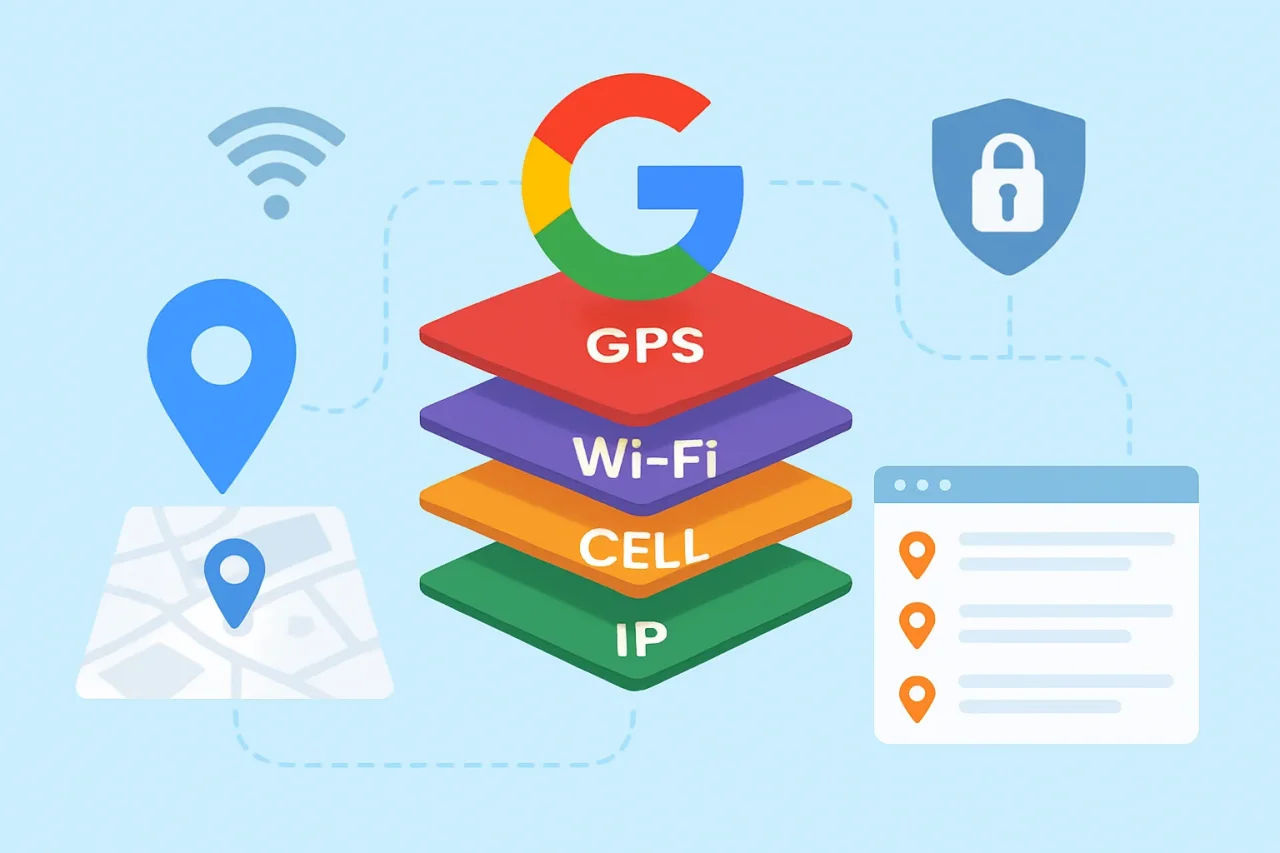
Every "near me" search rests on a question most users never think about: how does Google know where "me" is? The answer — a layered stack of GPS, Wi-Fi triangulation, cell data and IP geolocation — quietly determines which restaurants, plumbers and clinics appear on the results page, and in what order. For businesses, that location stack is not trivia; it is the invisible machinery behind local rankings, and misunderstanding it leads to expensive mistakes. "Half the local SEO confusion we untangle starts with location detection," says Mike Chrest, founder of MRC SEO Consulting, a Canadian agency specializing in local search. "A business owner checks their ranking from a VPN endpoint or a desktop across town, sees a different result than their customer sees, and concludes the algorithm is random. It isn't random. It's geographic — and the geography starts with how the searcher's device resolves its own position."
This article unpacks the location stack behind local search: how each layer works, where it fails, and what businesses and SEO practitioners should do about it.
The location stack: four layers of "where"
Modern devices resolve location through a hierarchy of signals, ordered roughly by precision.
GPS sits at the top. When location services are enabled, a smartphone fixes its position to within a few meters. Wi-Fi positioning comes next: devices compare visible Wi-Fi access points against enormous databases of known networks, delivering accuracy of tens of meters — often indoors, where GPS struggles. Cell tower triangulation offers coarser positioning, useful as a fallback, accurate to hundreds of meters or worse depending on tower density.
And underneath everything sits IP geolocation — the method of last resort and, on desktop, frequently the method of only resort. Every connection carries an IP address, and geolocation databases map address blocks to physical regions. When a desktop user without location permissions searches "dentist near me," it is largely the IP address doing the work of "near."
Sitting alongside the stack is the browser's Geolocation API — the permission prompt every user has seen. When granted, it hands websites the device's best available fix, blending GPS, Wi-Fi and cell data; when declined, the site falls back to the IP address, with the accuracy cliff that implies. Permission grant rates have been sliding for years as privacy awareness grows, which means the fraction of local searches resolved by IP alone is larger than most marketers assume — and largest of all on desktop, where roughly a third of searches still happen and where GPS does not exist at all.
Search engines blend these signals with behavioral context — a signed-in user's location history, a manually set home address, the location parameter in the search itself ("dentist calgary" versus "dentist near me") — into a single working assumption about where the searcher is standing.
IP geolocation: powerful, ubiquitous and imperfect
IP-based location deserves particular attention because it is both the most widely used fallback and the least understood. Its accuracy is real but uneven: country-level identification is close to perfect, city-level accuracy is generally good in dense urban areas, but the error bars widen fast at the edges.
The failure modes matter for search. Residential broadband IPs usually geolocate to the right city, though sometimes to the ISP's regional hub rather than the user's suburb. Mobile carrier IPs are worse — carrier-grade NAT can place a phone browsing over cellular data in a city hundreds of kilometers away, which is why the same search over Wi-Fi and over cellular can return visibly different local results. Corporate networks route traffic through central offices, placing a branch-office employee digitally at headquarters. And VPNs relocate users entirely, by design.
For local search, these errors translate directly into result variation. A searcher whose connection resolves to the wrong side of a metro area is served a Map Pack built around the wrong point. Businesses see the mirror image of this problem: customers report "you don't show up," when what has actually happened is that the customer's IP placed them outside the business's effective ranking radius.
Location is the algorithm's first input
Google's local ranking model weighs proximity, relevance and prominence — and proximity is computed from precisely the location stack described above. Before any judgment about which business is best, the algorithm decides which businesses are plausibly near, and that candidate set is anchored to the coordinates the device reported.
The consequence is a truth many business owners resist: there is no such thing as a single local ranking. A business is not "position 3 for emergency plumber." It is position 1 from two blocks away, position 4 from the mall, position 12 from the far side of the river, and absent entirely from the neighboring town — a continuous ranking surface draped over the map, with the business's location at its peak. Every factor a business optimizes — profile quality, reviews, on-page relevance, links — reshapes that surface, raising it here, extending it there. But the surface is always evaluated from the searcher's point, not the business's.
Why your rankings look different from everywhere else
This geography explains the most common self-diagnosis error in local SEO: the owner's-chair rank check. Checking rankings from the business's own address samples the single most flattering point on the entire surface. Checking from home samples another arbitrary point. Checking through a VPN samples a point that may not even be in the right country, filtered through an IP that Google may treat with suspicion besides.
Professional practice has converged on grid-based measurement instead: querying rankings from a lattice of simulated points across the trade area and mapping the results. The technique works precisely because of how location detection operates — by controlling the location signal explicitly (through geolocation parameters in the search, not through IP tricks), each query samples one defined point on the ranking surface. The output is a map, not a number: here is where you win, here is where you fade, here is the competitor eating your eastern flank.
"The grid map ends arguments," notes Mike Chrest, who has run local campaigns across Canadian metro markets since the early 2010s. "An owner can dismiss a ranking number, but when they see their visibility stop dead at a highway their customers cross every day, the conversation changes from whether local SEO matters to how fast the radius can be extended."
What businesses can actually do about geography
Proximity cannot be optimized directly — a business cannot move the searcher — but the practical playbook works the edges of the constraint.
The first move is honest configuration: an accurate address, correctly placed map pin, and service-area settings that match operational reality, because misconfigured geography suppresses the whole surface. The second is relevance reinforcement at the fringe: dedicated, substantive pages for the neighborhoods and suburbs at the edge of the current radius, giving the algorithm textual evidence to extend plausibility beyond raw distance. The third is prominence, the great radius-extender: businesses with deep review corpora and strong authority consistently out-rank their distance, appearing in packs where geometry alone says they should not.
Multi-location businesses face the inverse problem — deciding where new locations should go. The more sophisticated operators now use ranking-surface data in site selection, mapping where existing visibility fades to identify trade-area gaps a new address would capture.
For SEO practitioners: test like the stack works
The location stack also sets the rules for anyone auditing or reporting local rankings. Browsing through a VPN to "check rankings from Toronto" stacks two distortions: the IP places the session imprecisely, and datacentre IP ranges themselves receive atypical treatment. Incognito mode removes personalization but not location. The defensible approach is explicit geolocation — search parameters and APIs that declare coordinates directly — which is what purpose-built rank tracking tools do under the hood.
The same discipline applies to interpreting client reports of "I searched and couldn't find us." The first diagnostic question is not about the algorithm; it is about the connection: mobile data or Wi-Fi, home or office, VPN or bare. In a meaningful fraction of cases, the mystery dissolves into carrier-grade NAT, placing the searcher in another city.
The Googlebot problem: geo-targeting your own website
The location stack cuts the other way, too: websites read visitor IPs and adapt — currency, language, inventory, redirects. Done carelessly, that adaptation quietly sabotages search visibility, because the most important visitor a site has does not browse like a customer.
Googlebot crawls overwhelmingly from IP ranges in the United States. A site that hard-redirects visitors by IP — sending every American IP to the .com and hiding the Canadian catalog behind a geo-wall — has just hidden its Canadian pages from the crawler that decides what Canadians find. Google does run locale-adaptive crawling from some non-US IPs, but coverage is partial, and no serious operator relies on it. The safe architecture has been stable for years: serve every visitor a crawlable page, use separate URLs per locale with hreflang annotations to declare the relationships, suggest rather than force — a dismissible banner ("It looks like you're in Canada — switch to CAD?") instead of an irreversible redirect — and never block or cloak by IP.
The same logic applies within a country. Businesses that swap phone numbers, addresses or service pages based on detected city should ensure every location's content exists at a stable, linkable, crawlable URL. Content that only materializes for the right IP effectively does not exist for search — and given the error rates discussed above, it often does not exist for the right humans either.
When the database is wrong: auditing your own geography
Because IP location is database lookup rather than physics, it can simply be wrong — and businesses experience those errors from both sides. On the inbound side, a mislocated IP block can cause a company's own office to see the wrong regional site, or analytics to report a phantom cluster of visitors from a city where the ISP aggregates traffic. On the outbound side, a business's server infrastructure, CDN configuration or hosting region can subtly shape performance and, for country-specific TLD strategies, perceived market focus.
The audit is straightforward and worth an hour a year: check the business's own egress IPs against the major geolocation databases; verify that the website resolves correctly from the markets it serves, using explicit location testing rather than guesswork; confirm analytics geography against known customer distribution, and treat sudden geographic anomalies as data-quality questions before treating them as marketing insights. Most geolocation providers accept correction submissions, and persistent mislocations — a common affliction for businesses on newer IP blocks or smaller regional ISPs — are usually fixable in weeks.
Privacy is tightening the stack
The location stack is not static. Growing privacy pressure — permission prompts, OS-level fuzzing of precise location, VPN adoption climbing, browsers curtailing fingerprinting — is slowly degrading the precision of passive location signals. IP geolocation is becoming more approximate as traffic concentrates behind shared egress points, and a rising share of users decline precise-location permissions altogether.
For local search, the direction of travel favours explicit signals over inferred ones: the query text itself ("plumber in Kensington"), signed-in user context, and structured business data. For businesses, that shifts even more weight onto the controllables — profiles, on-page geographic clarity, structured data, and review corpora rich with location vocabulary — because as the algorithm's confidence in where the user stands gets fuzzier, its reliance on which businesses clearly serve which places gets stronger.
The bottom line
Local search visibility is geography processed through technology. GPS, Wi-Fi positioning, cell triangulation and IP geolocation collectively answer the question every "near me" query begins with, and their answer — precise or approximate, right or wrong — becomes the origin point from which every local ranking is computed. Businesses that understand this stop chasing a single mythical ranking number and start managing what actually exists: a ranking surface across a real map, measurable from any point, expandable at its edges, and won — like most things in search — by the operators who understand the machinery one level deeper than their competitors bother to look. The location stack will keep evolving as privacy rules tighten and networks change, but its role will not: it is, and will remain, the first question every local search answers before it answers yours.
Comments
Comments are available to signed-in users and are moderated to keep the discussion useful and respectful. Spam, automated submissions, and low-value promotional comments are removed. Outbound links may be approved when they are relevant and genuinely helpful to readers, but they are displayed as plain text rather than clickable hyperlinks.
No comments have been published yet.
Please sign in to submit a comment.