

Search Engine Optimization, Digital Marketing, Technology
How Generative AI Is Changing Content Strategies for Demand Creation
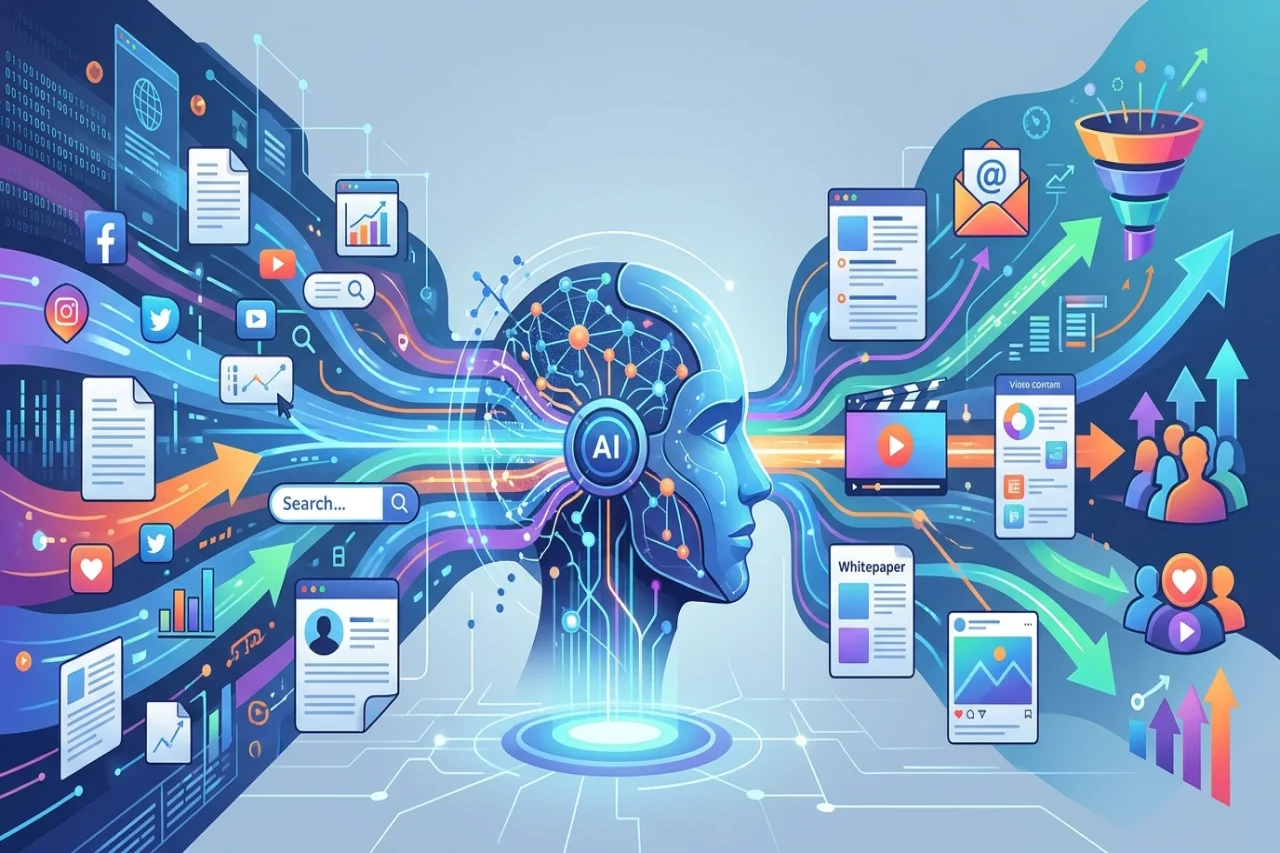
Content has always played an important role in helping businesses attract potential customers, communicate expertise, and influence purchasing decisions. However, the way companies plan, create, distribute, and optimize content is changing. Generative AI is introducing new possibilities for marketing teams, helping them understand audiences, identify content opportunities, personalize communication, and respond to changing customer interests.
For B2B businesses, these developments create opportunities to strengthen demand generation. Potential buyers consume information across multiple channels before making purchasing decisions. They read articles, compare solutions, explore industry reports, and interact with brands through digital platforms. Businesses must therefore create relevant content that addresses customer needs throughout the buying journey.
Generative AI can make this process faster and more data-informed. However, its greatest value does not come from producing more content. It comes from helping businesses create useful, relevant, and consistent experiences that develop genuine interest in their offerings.
1. AI Is Making Content Planning More Audience-Centric
Traditional content planning relies on keyword research, competitor analysis, industry trends, and brainstorming. Although these methods remain valuable, marketing teams can struggle to identify every question, concern, and information gap influencing their target audiences.
Generative AI can support this research by organizing customer insights, identifying recurring themes, and exploring potential content opportunities.
For example, a B2B software company targeting finance teams can use AI to organize research around reporting inefficiencies, data accuracy, automation, and compliance requirements. These insights can inform blog articles, educational guides, webinars, and other content formats.
The result is a content strategy that begins with customer problems rather than focusing exclusively on topics with high search volume.
However, AI-generated suggestions should be validated through customer conversations, search data, sales feedback, and industry research. AI should strengthen audience understanding, not replace it.
2. Faster Content Production Creates More Opportunities for Engagement
One of the most visible changes brought by generative AI is the speed at which marketing teams can develop initial content drafts.
Tasks such as outlining articles, summarizing research, generating headline variations, and adapting content for different platforms can now be supported by AI tools.
For example, a company publishing an industry report can use AI to develop supporting assets, including:
- Blog articles explaining the report's findings.
- Social media posts highlighting important insights.
- Email newsletters sharing relevant statistics.
- Short educational video scripts.
- Frequently asked questions based on the report.
Instead of treating every format as a separate project, teams can develop multiple useful assets from one central research resource.
Nevertheless, faster production should not encourage publishing unverified or repetitive material. Human review, original insights, and editorial standards remain essential.
3. Personalization Is Becoming More Scalable
B2B audiences are not uniform. Different industries, company sizes, decision-makers, and business requirements influence how people evaluate solutions.
A technology executive may be interested in scalability and integration, while a finance leader may prioritize cost efficiency and measurable returns. Sending identical content to both audiences can limit its relevance.
Generative AI can help businesses adapt content to different audience segments more efficiently.
For instance, marketing teams can develop different versions of an email campaign for technology companies, professional service providers, and manufacturing businesses. The central offering remains consistent, but examples and messaging reflect each audience's priorities.
AI can also support personalized content recommendations, tailored landing page messaging, and segmented email communication when connected to appropriate marketing data.
Effective personalization, however, requires accurate audience information and responsible data handling. Communication should become more useful rather than intrusive.
4. AI Is Helping Businesses Build Content Around the Entire Buying Journey
Demand creation does not happen through a single article or campaign. Potential customers move through awareness, consideration, and evaluation before making a purchase decision. Each stage requires different information.
Someone identifying a business problem may need educational content explaining its causes and impact. A prospect comparing solutions may want detailed guides, comparisons, and case studies. A buyer preparing to make a decision may look for implementation details and evidence of results.
Generative AI can help marketing teams develop content frameworks addressing these requirements.
For example, a B2B cybersecurity company could build a connected content strategy:
- Awareness: Articles explaining emerging security challenges and business vulnerabilities.
- Consideration: Guides comparing security approaches and available solutions.
- Evaluation: Case studies, implementation resources, and detailed service information.
- Decision: Consultation-focused landing pages and answers to purchasing concerns.
Coordinating these activities requires more than producing individual campaigns. Some agencies, such as Mavlers Agency, use an embedded demand-generation model that integrates research, content development, distribution, and campaign execution. This approach illustrates how different marketing functions can be coordinated within a broader demand-generation strategy.
AI can help organize content across these stages, while subject matter experts ensure that the information remains accurate and valuable.
5. Search Strategies Are Expanding Beyond Traditional SEO
Generative AI is changing how people discover information online. AI-powered search experiences and answer engines increasingly provide summarized responses to user questions, sometimes reducing the need to visit multiple websites.
For businesses, this creates an additional challenge: content must support discovery through traditional search engines as well as evolving AI-powered platforms.
This encourages marketers to focus on clear explanations, topical depth, credible information, and content that directly addresses user questions.
Generative AI can help identify related questions, organize content structures, and develop topic clusters. However, publishing AI-generated text alone does not guarantee visibility in search engines or AI-powered answers.
Businesses still need subject matter expertise, original information, trustworthy sources, technically accessible websites, and content that satisfies user intent.
6. Content Distribution Is Becoming More Efficient
Creating useful content is only one part of demand creation. Businesses must also ensure that their target audiences discover and engage with it.
Traditionally, content distribution has required separate planning for search engines, social media, email campaigns, and paid advertising. Managing these activities can become time-consuming, particularly for teams with limited resources.
Generative AI can simplify distribution by adapting existing assets into different formats and communication styles.
A detailed article, for example, can become social media posts, an email newsletter, a short video script, or discussion points for a webinar.
AI can also suggest audience-specific messaging, generate headline variations, and organize distribution calendars.
However, each channel has different audience expectations. A LinkedIn post should not simply reproduce an entire blog article, and an email campaign should give recipients a clear reason to engage.
Human editorial judgment ensures that adapted content remains relevant to its intended platform.
7. AI-Powered Insights Can Improve Content Performance
Marketing teams collect information from website analytics, search performance reports, advertising platforms, email campaigns, and CRM systems. Reviewing these sources individually can make it difficult to identify patterns and understand what influences demand.
AI-supported analysis can organize information, summarize performance trends, and highlight areas that require further investigation.
For example, a business may discover that certain educational articles attract substantial traffic but generate limited engagement with service pages. Other articles may receive fewer visits but contribute more frequently to qualified inquiries.
These insights can help marketers refine content priorities, improve internal linking, adjust calls to action, and develop relevant follow-up resources.
Measurement also requires clear ownership and strategic oversight. Some demand-generation agencies organize their teams around dedicated groups responsible for coordinating marketing activities and evaluating performance. For example, Mavlers Agency uses a team-based structure in which a senior demand generation strategist oversees the alignment of channel-level activities with broader business objectives.
As Nevilson Christian from Mavlers Agency explains:
"AI can make content production faster, but speed alone does not create demand. Marketing teams need to understand how individual content assets contribute to buyer education, influence consideration, and support the progression of qualified opportunities. That connection is what turns content activity into a measurable demand generation effort."
Structured approaches to demand generation, such as the Pipeline Engine Framework, provide examples of how businesses can organize marketing activities around pipeline development. These frameworks generally emphasize connecting content performance, audience engagement, and lead qualification with measurable business outcomes.
8. Why Human Expertise Still Matters in AI-Driven Content Strategies
Despite its advantages, generative AI has important limitations. AI-generated content can contain inaccurate information, generic explanations, unsupported claims, or outdated details. It may also struggle to reflect the practical experience and nuanced understanding that distinguish one business from another.
This is particularly important in B2B marketing, where buyers evaluate complex solutions and expect credible, detailed information.
Businesses should therefore use AI as a supporting capability rather than treating it as a replacement for experienced marketers and subject matter experts.
Human involvement remains essential for:
- Validating facts, statistics, and industry claims.
- Adding original insights and practical examples.
- Maintaining brand voice and communication standards.
- Understanding customer concerns and business context.
- Reviewing content for accuracy, clarity, and relevance.
- Ensuring responsible use of customer and business data.
The strongest content strategies combine AI's ability to accelerate research and production with human expertise that provides originality, credibility, and strategic direction.
How Businesses Can Build More Connected Demand Generation Strategies
As generative AI changes content creation and digital discovery, businesses need to connect content development with broader marketing objectives.
Developing an effective demand generation strategy requires a coordinated approach to content, distribution, audience understanding, and performance measurement. Whether these activities are managed internally or supported by a demand generation marketing agency, individual campaigns and content assets should contribute to a broader strategy rather than operate independently.
Coordinated digital marketing often involves multiple disciplines, including content marketing, SEO, paid media, email marketing, creative services, and web development. Integrating these functions can help align marketing activities with broader business objectives and maintain consistency across different channels.
This approach helps businesses identify relevant content opportunities, strengthen online visibility, distribute useful information across channels, and create consistent experiences for potential customers.
Rather than using AI simply to increase publishing volume, organizations can focus on applying technology where it improves research, efficiency, personalization, and campaign performance.
Conclusion
Generative AI is changing content strategies for demand creation by making research, production, personalization, distribution, and performance analysis more efficient. It gives marketing teams new ways to understand audiences, respond to customer questions, and maintain consistent communication across multiple channels.
However, producing more content does not automatically create more demand. The real value of AI lies in helping businesses deliver relevant information, address customer challenges, and support potential buyers throughout their decision-making process.
Organizations that combine AI-driven efficiency with human expertise, original thinking, and a clear marketing strategy will be better positioned to build trust and develop meaningful customer relationships.
Ultimately, successful demand creation is not about allowing technology to produce content at scale. It is about using technology effectively to make every piece of content more useful, relevant, and aligned with business growth.
Comments
Comments are available to signed-in users and are moderated to keep the discussion useful and respectful. Spam, automated submissions, and low-value promotional comments are removed. Outbound links may be approved when they are relevant and genuinely helpful to readers, but they are displayed as plain text rather than clickable hyperlinks.
No comments have been published yet.
Please sign in to submit a comment.