

How Custom Plastic Parts Move From Design to Production
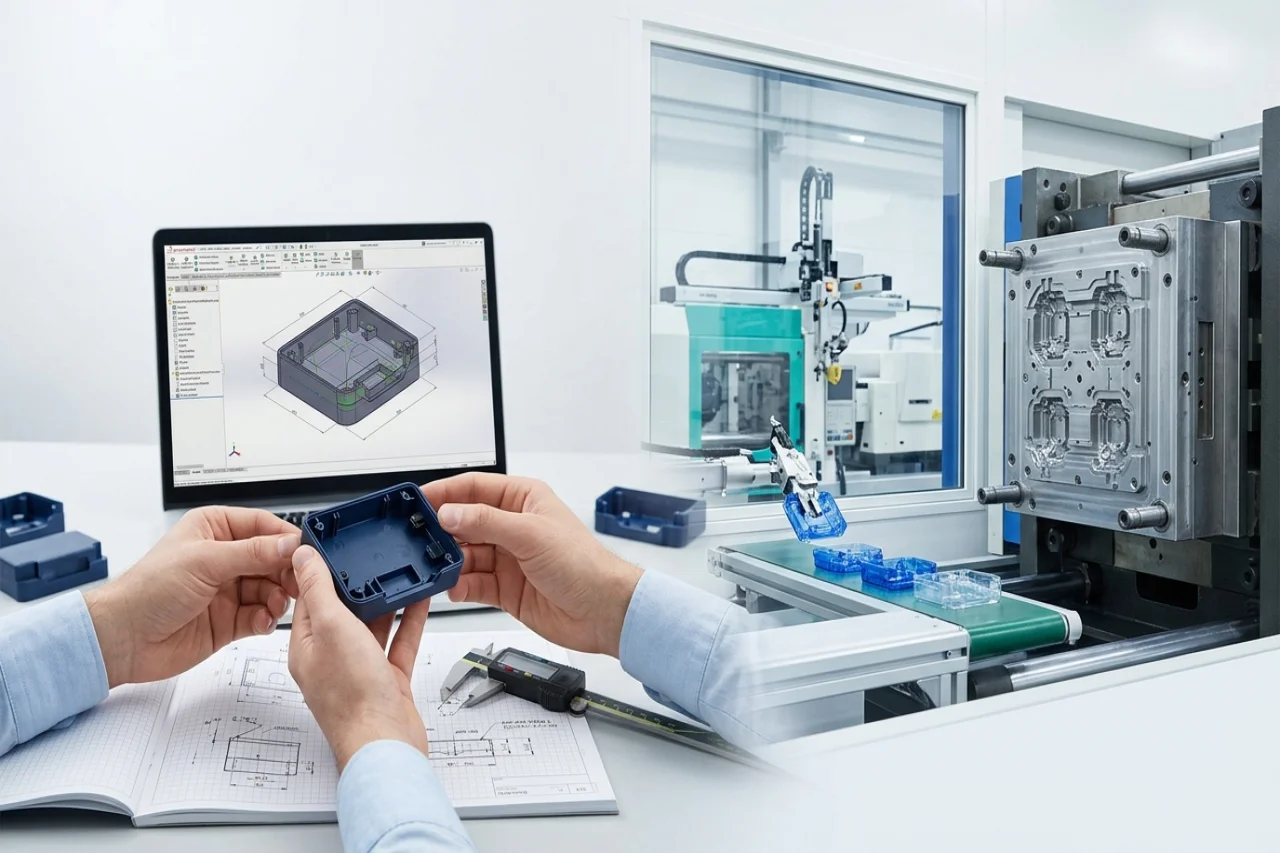
Producing a custom plastic part is different from buying a standard plastic component. A specific design has to be translated into a repeatable manufacturing process while accounting for material behavior, tooling, dimensions, appearance, production volume, and downstream assembly.
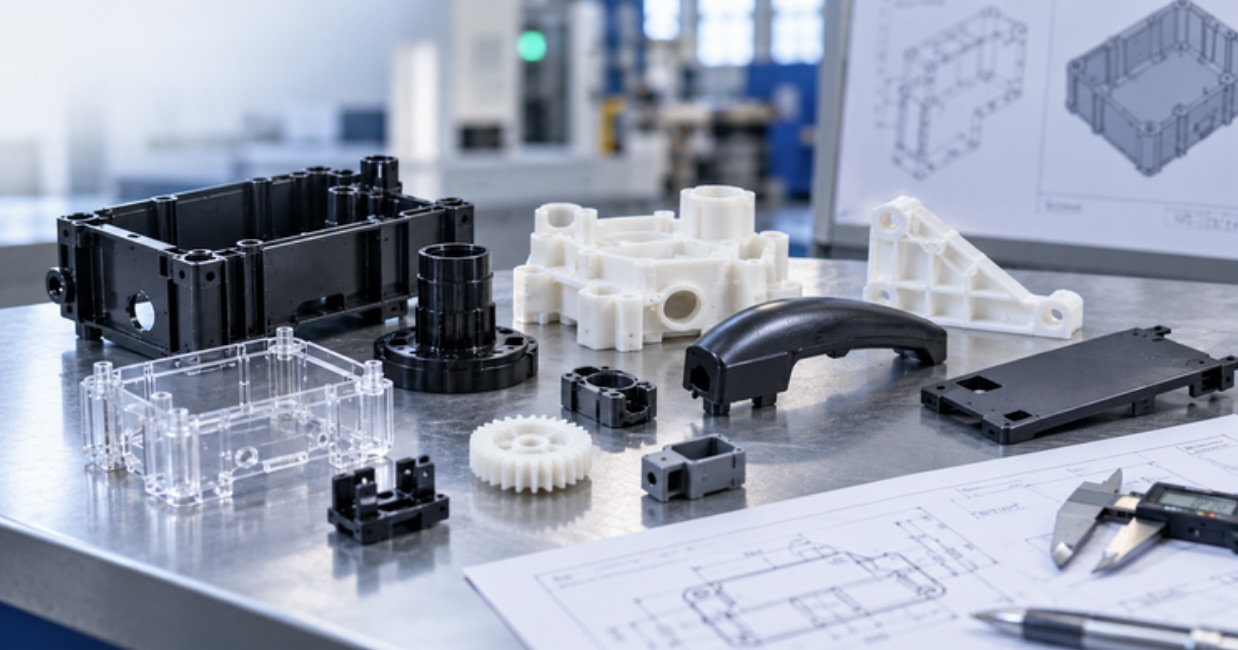
The best place to start is the part itself: what must it do, which dimensions actually matter, what conditions will the material face, and how many parts need to be produced consistently? Answering these questions early can help prevent problems later in tooling and production. For example, HingTung reviews these types of inputs during DFM before mold manufacturing, illustrating how part requirements can inform tooling decisions early in the process.
Define the Part Before Production
A CAD model alone rarely contains enough information to plan production reliably. Both the geometry and the manufacturing requirements need to be understood before tooling begins.
A useful project package should include:
- 3D CAD data
- 2D drawings for controlled dimensions
- Resin and grade requirements
- Annual and order quantities
- Color and surface requirements
- Mating components
- Inserts or overmolding requirements
- Secondary operations
- Inspection requirements
- Packaging expectations
Production volume is particularly important. A project requiring 2,000 parts per year may justify a different cavity count and tooling strategy than one requiring 500,000 parts per year. Reviewing these inputs during design for manufacturability (DFM) allows tooling decisions to be based on the expected production program rather than simply the shape of the CAD model.
Match the Material to the Real Operating Conditions
One of the easiest ways to create future problems is to select plastic by a generic property such as "strong," "flexible," or "heat resistant."
The more useful question is what the component will actually experience. Temperature, impact, chemicals, moisture, UV exposure, dimensional requirements, and assembly loads can all change the material decision.
| Material | Typical Engineering Consideration |
|---|---|
| ABS | Good general-purpose balance and surface appearance |
| PC | Higher impact resistance and heat capability |
| PC/ABS | Balance of toughness, processability, and appearance |
| PA6/PA66 | Strength and wear resistance, but moisture must be considered |
| POM | Low friction and good dimensional characteristics |
| PP | Low density, chemical resistance, and living-hinge potential |
| HDPE | Chemical resistance and toughness |
Material selection also affects mold design. Shrinkage differs between resins, and glass-filled grades can introduce directional shrinkage. A mold developed around one resin should not be automatically expected to produce identical dimensions when switched to another. As one example, the HingTung injection molding manufacturer team considers material behavior during DFM rather than waiting until the first molding trial.
Review Wall Thickness Before Tooling
Wall thickness is one of the first features to examine on a new injection-molded component.
Very thick areas cool more slowly and can create sink or internal voids. Abrupt changes in thickness can also produce uneven shrinkage. Making every wall extremely thin is not the answer either, because thin sections increase flow resistance and can make filling more difficult.
Instead, aim for relatively uniform walls wherever the function allows.
For ribs attached to a nominal wall thickness T, a common starting guideline is approximately 0.5–0.6T rib thickness. This can help add stiffness without creating an unnecessarily heavy material concentration at the rib base.
The exact geometry still depends on material, part size, flow length, and structural requirements. Design rules should therefore be treated as starting points rather than universal dimensions.
Separate Critical Dimensions From General Dimensions
A common design mistake is applying the same tight tolerance across an entire drawing.
Injection-molded plastics shrink as they cool. Final dimensions can also be affected by gate location, packing, cooling, material variation, fiber orientation, and moisture absorption. Tight tolerances therefore need a functional reason.
During DFM, dimensions can be classified into practical groups:
- Critical: Sealing, mating, alignment, bearing, or functional dimensions.
- Important: Performance-related dimensions with some allowable variation.
- Reference: Dimensions that do not justify intensive process control.
This approach allows mold correction and inspection resources to focus on the features that actually affect product performance. A critical mating dimension, for example, may require a different tooling and inspection strategy from a nonfunctional exterior dimension.
Evaluate the Mold Through the Finished Part
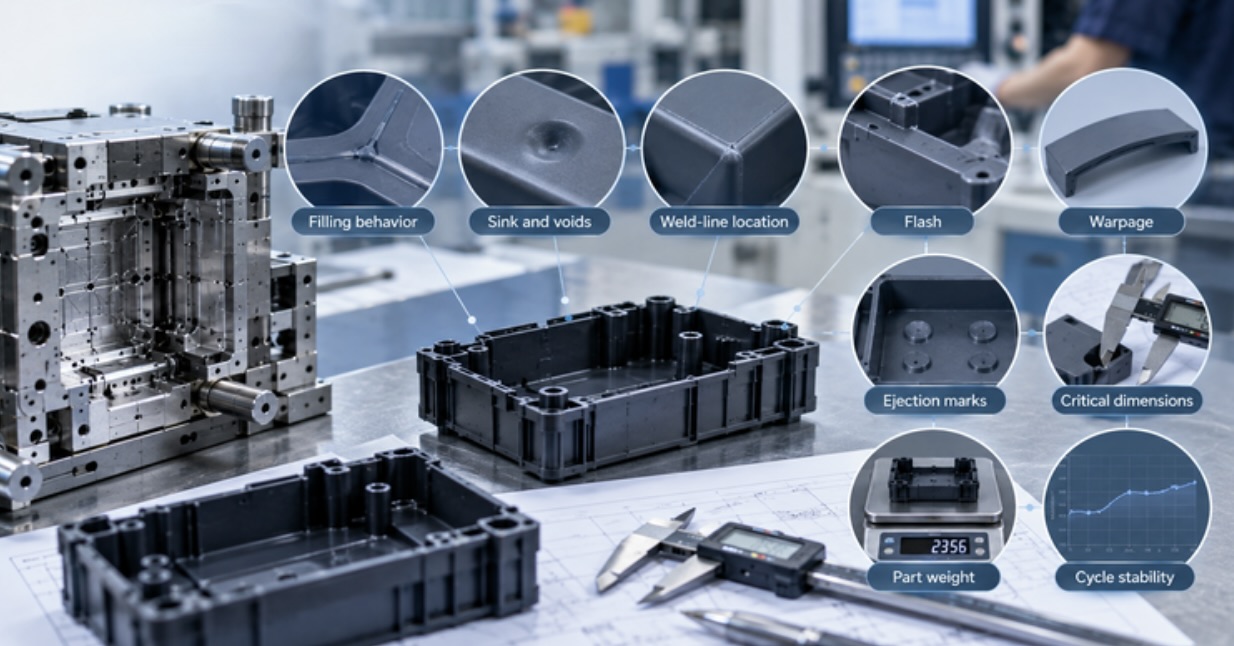
A polished mold is not evidence of a stable molded component.
For custom plastic parts, the tool should ultimately be judged by what happens during molding. Gate location, cooling balance, venting, ejection, cavity dimensions, and process settings all influence the finished part.
During early mold trials, useful checks include:
- Filling behavior
- Sink and voids
- Weld-line location
- Flash
- Warpage
- Ejection marks
- Critical dimensions
- Part weight
- Cycle stability
If a dimension fails after the first tooling trial, immediately machining the cavity is not always the correct response. The cause should first be investigated to determine whether the issue comes from steel geometry, shrinkage, packing, cooling, or another process variable.
Keeping DFM, mold trials, and injection-molding feedback connected can make it easier to evaluate trial results before deciding whether mold corrections are necessary.
Match Production Equipment to the Part
Production equipment needs to suit the specific mold and component rather than simply provide as much capacity as possible. A molding machine should be selected according to factors such as mold dimensions, shot requirements, projected area, resin, and required clamping force.
Equipment availability also matters for production continuity. If a component depends on one particular machine, there should be a plan for what happens if that equipment becomes unavailable. Considering both technical suitability and backup capacity can reduce disruption during subsequent production runs.
Include Secondary Operations in Production Planning
A molded part is not always a finished part.
Custom components may still require machining, printing, welding, hardware insertion, assembly, inspection, or packaging. When these processes are distributed across several stages or facilities, every transfer creates another scheduling and quality-control interface.
For products containing several manufactured components, coordinating injection molding with processes such as silicone processing, CNC machining, sheet-metal work, secondary processing, assembly, and quality assurance can simplify the overall workflow.
The value is not simply having more processes available. It is being able to define responsibility for the finished component clearly and ensure that requirements remain consistent from molding through final inspection.
Validate Repeatability Before Full Production
Five good samples do not prove that 50,000 parts will behave the same way.
Before scaling a custom component, the mold should be run under representative production conditions. Once it reaches thermal stability, parts from the ongoing run can be inspected rather than relying only on carefully selected samples.
For multi-cavity tooling, samples should also retain cavity identification. If cavity 3 consistently produces a different critical dimension from cavities 1, 2, and 4, mixed inspection data can hide the problem.
A production validation should consider:
- Critical dimensions
- Cavity-to-cavity variation
- Part weight
- Cosmetic defects
- Assembly fit
- Process stability
- Cycle time
- Scrap rate
If a problem appears during validation, the next step is to determine whether the appropriate response is a process adjustment, mold correction, or part-design review. Keeping inspection and production feedback connected to the tooling process can make that diagnosis easier.
Plan for Engineering Changes
Custom parts rarely remain unchanged throughout a product's entire life.
A connector may move. A snap may need reinforcement. A resin may change. Production volume may increase. Even a small geometry revision can affect the mold.
Engineering changes therefore need to be controlled throughout production. The current drawing revision should be identifiable, tooling impacts should be evaluated, molds should be modified where necessary, and new samples should be validated before production resumes. Controls are also needed to prevent old and new revisions from becoming mixed.
For long-running OEM programs, this change-control process becomes increasingly important as products, volumes, and requirements evolve.
Final Thoughts
Successful custom plastic parts depend on much more than whether a particular geometry can be molded. Material behavior, DFM, wall thickness, tolerances, tooling, process control, inspection, secondary operations, and engineering changes all influence whether a component remains stable in repeat production.
The goal is not simply to produce a successful first sample. The broader challenge is creating a manufacturing process that can consistently produce the required part as volumes, revisions, materials, and other production requirements evolve.
FAQ
FAQ
01Should Color Requirements Include a Physical Sample?
For appearance-sensitive components, a physical color standard can be useful in addition to digital color information. The acceptance method should also be agreed in advance because resin, texture, wall thickness, and lighting conditions can influence perceived color.
02When Are Metal Inserts Added to Plastic Parts?
Metal inserts can be used when the component requires durable threads, electrical conductivity, local reinforcement, or another function that the molded polymer alone cannot provide. Depending on the design, inserts may be placed into the mold before molding or installed afterward.
03Should Packaging Be Discussed Before Mass Production?
Yes. Cosmetic surfaces, delicate clips, polished components, and dimensionally sensitive parts can be damaged after successful molding. Tray design, protective films, bags, dividers, carton quantity, and transport conditions should therefore be considered part of the production plan.
Comments
Comments are available to signed-in users and are moderated to keep the discussion useful and respectful. Spam, automated submissions, and low-value promotional comments are removed. Outbound links may be approved when they are relevant and genuinely helpful to readers, but they are displayed as plain text rather than clickable hyperlinks.
No comments have been published yet.
Please sign in to submit a comment.