

How AI-Powered OCR Is Changing Digital Document Management
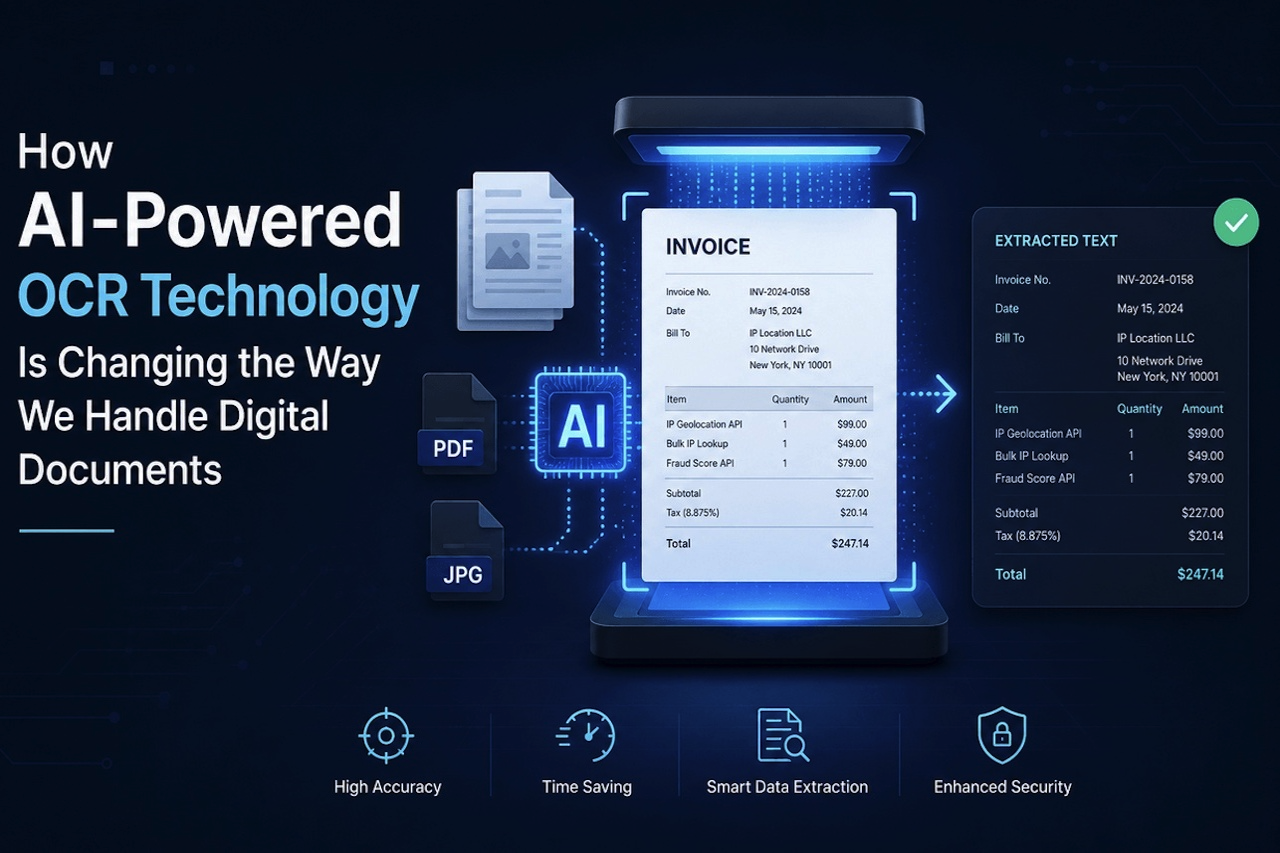
Document processing is a vital part of modern business operations. Nowadays, most organizations work with both digital and physical formats.
Often, the flow starts on the physical side and then moves to the digital side. Other times, the flow starts from the opposite side, i.e., a digital startup that ends up in the physical side.
The latter is easy to handle; you use a printer, and you are done, but the former often requires Optical Character Recognition (OCR). This technology has become an important tool for converting printed or image-based content into editable digital text and improving information workflows.
In this article, we will look at how this technology differs from traditional approaches and the benefits it offers.
Understanding AI-Powered OCR
OCR, at its core, is an AI-related technology. It uses machine-learning-based computer vision algorithms to recognize characters in images and extract them.
So, why is there a distinction between AI-powered and traditional approaches? Conventional systems are quite limited and work best with well-defined characters, such as those produced by a typewriter. As soon as handwriting or less uniform text is introduced, accuracy can decline significantly.
Advanced systems use more sophisticated models to offset those problems. For example, it uses a more advanced machine learning model that can recognize even handwriting. It also has NLP algorithms that perform error correction based on the extracted text's grammatical correctness. But sometimes, due to artistic vision, there may be deliberate mistakes, so the algorithm has to be selective about error correction.
Overall, these systems are better at understanding layouts, identifying text with greater accuracy, and adapting to various formatting styles. As a result, users can extract information from scanned content more reliably and with fewer errors.
So, how has this technology changed the way we handle digital information? Let’s take a look.
1. Faster Processing
One of the biggest advantages of modern OCR systems is speed. One would think that a more advanced algorithm might take longer due to complexity, but that’s not the case. The algorithms are smarter, too, so overall, the text extraction is much faster.
Organizations that deal with large volumes of invoices, contracts, forms, and reports used to do data extraction and entry manually. Manually entering data from these documents can be time-consuming and error-prone.
Traditional OCR could only process certain types of content. With AI-powered OCR, much of the workflow can be automated. Tools such as image to text converters can convert scanned files and images into editable content while preserving much of the original formatting. The output can then be searched, edited, or reused in other applications.
This reduces administrative workloads and enables employees to focus on higher-value tasks.
2. Improved Accuracy And Fewer Errors
One of the major benefits of AI OCR is its 95%+ accuracy rate. It makes very few errors, thereby reducing the time required to proofread and correct the extracted text.
The accuracy is good enough that it can recognize text more effectively, even when dealing with low-quality scans and blurry images. This is possible because AI models are always improving. By continuously learning from new data, AI models improve their recognition capabilities over time.
This helps minimize manual corrections and increases confidence in extracted information. This kind of accuracy is essential when handling important business records.
3. Better Searchability and Accessibility
Digital records become significantly more useful when their contents are searchable. Scanned files and images do not offer this capability, making them less practical for storing information that needs to be accessed frequently.
This technology can convert image-based files into searchable content. The extracted information can then be saved in a format that makes it easier to locate and retrieve later.
For example, organizations can search thousands of archived records for specific names, dates, or keywords without manually reviewing each item. This improves productivity and makes information retrieval more efficient.
And that’s how the technology improves information workflows.
Common Use Cases of AI OCR
While this technology is commonly associated with business record management, its applications extend far beyond the corporate world. It is used across a wide range of industries and activities where information needs to be extracted, digitized, and reused efficiently.
Here are some common examples of how it is applied across different workflows and use cases.
- Educational Institutions: Converting printed books, notes, and study materials into editable digital formats that are easier to distribute and update.
- Researchers: Extracting text from scanned papers, journals, and other reference materials for analysis and citation.
- Content Creators: Turning screenshots, images, and visual content into usable text without the need for manual typing.
- Translation Projects: Extracting text from documents and images so that it can be translated into other languages using translation tools or human translators.
- Historical Preservation: Digitizing old manuscripts, newspapers, records, and other historical materials to preserve their contents and make them searchable for future generations.
These examples demonstrate how widely applicable the technology has become. As OCR tools have grown more accessible and easier to use, they are now available to individuals, businesses, researchers, and educational institutions alike.
Conclusion
Modern optical character recognition technology has significantly improved the way we handle digital information. Compared to earlier approaches, it offers faster processing, higher accuracy, and the ability to work with a much wider range of content, including handwritten and low-quality text.
These improvements have made it useful in many different workflows, from business record management and academic research to translation projects and historical preservation. As related tools have become more widely available and easier to use, the technology has become more accessible than ever before.
As a result, it is no longer a specialized capability used only by large organizations. Instead, it has become a practical solution that helps individuals and businesses convert physical and image-based content into searchable, editable, and reusable digital text.
Related Articles
May 15, 2026
How AI-Powered Web Applications Are Personalizing Digital Experiences
As more business solutions move to web-based platforms, the use of AI-powered web applications is growing rapidly. The evolution of the internet is increasingly driven by systems p...
Read More
April 16, 2026
How AI-Powered Online Tools Are Changing Digital Creativity
The creative process is now transforming rapidly. It's much determined and bolstered by the broader application of Artificial Intelligence (AI). Even though creativity previously r...
Read More
March 20, 2026
Breathing Life Into Stills: How AI Animation is Redefining Digital Art
For over a century, the line between still photography and moving pictures was sharp and definitive. A photograph captured a single, immutable slice of time—a frozen expression...
Read More
Comments
Comments are available to signed-in users and are moderated to keep the discussion useful and respectful. Spam, automated submissions, and low-value promotional comments are removed. Outbound links may be approved when they are relevant and genuinely helpful to readers, but they are displayed as plain text rather than clickable hyperlinks.
No comments have been published yet.
Please sign in to submit a comment.