

Geekflare DNS Lookup API Review
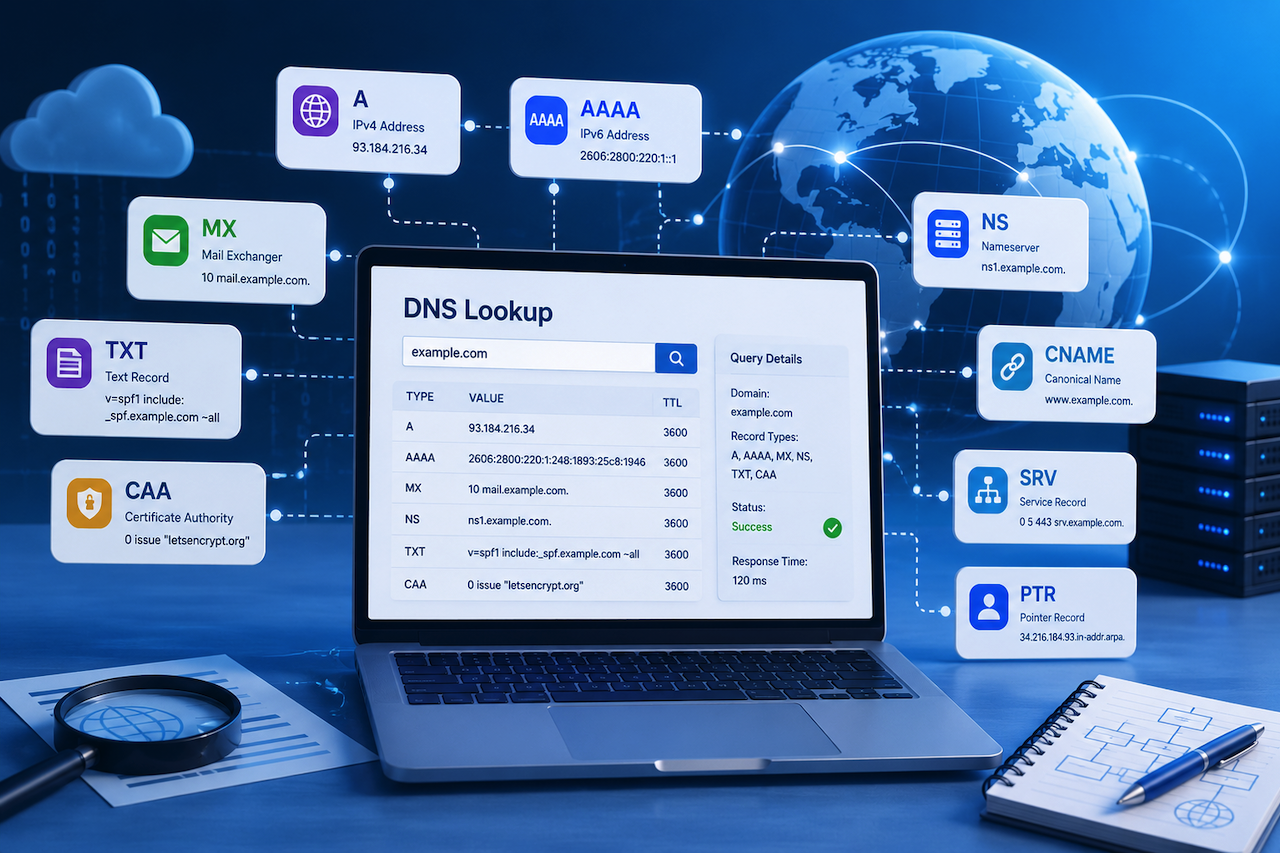
The Geekflare DNS Lookup API is a REST API that lets you query DNS records for any domain programmatically. You send a POST request with a domain and the record types you want, and it returns a structured JSON response with live data pulled from authoritative nameservers. It supports A, AAAA, CNAME, MX, NS, TXT, SOA, CAA, SRV, and PTR records, everything you'd need for standard DNS operations, email verification, or domain investigation.
Who Is It For?
- Developers who are building domain-aware SaaS products, internal dashboards, or backend workflows that need DNS data
- Security teams that run OSINT research, investigate domain infrastructure, or audit DNS configurations.
- Network administrators who want to automate DNS change detection across large sets of domains
- SaaS builders who are verifying customer domains via CNAME or TXT records as part of onboarding flows
Geekflare DNS Lookup API Overview
The DNS Lookup API is part of Geekflare's broader API platform, which covers over 13 different tools, such as web scraping, screenshot capture, TLS scanning, and load time checks. You access all of them under a single account with a single credit pool. The problem the DNS Lookup API solves is straightforward: querying DNS records manually works fine for one-off checks, but doesn't scale. If you're building a monitoring tool, need domain verification at signup, or want to track DNS propagation across hundreds of domains, you need a programmatic solution. Rolling your own DNS resolver may introduce additional development, maintenance, and infrastructure considerations. Third-party APIs provide an alternative approach for accessing DNS data programmatically. The API queries authoritative nameservers directly on each request, without caching, so the data you get reflects the current state of the DNS record.
Key Features of Geekflare DNS Lookup API
The API includes support for multiple DNS record types, live nameserver queries, SDKs for Python and Node.js, and integrations with automation platforms such as Zapier and Make.
1. DNS Record Lookup
The API covers every major DNS record type you're likely to need:
- A record: Maps a domain to an IPv4 address. Used for basic domain-to-IP resolution.
- AAAA record: Same as A, but for IPv6 addresses.
- CNAME record: Aliases one domain to another. Common for SaaS custom domain verification and CDN routing.
- MX record: Identifies the mail servers responsible for accepting email for a domain. Includes priority values.
- NS record: Lists the authoritative nameservers for a domain.
- TXT record: Free-form text records. Used for SPF, DKIM, DMARC, domain ownership verification, and more.
- SOA record: Contains administrative data about the zone, such as the primary nameserver, responsible email, and TTL settings.
- CAA record: Specifies which certificate authorities can issue SSL/TLS certificates for the domain.
You can query a single record type or multiple types in a single request, reducing round-trip requests for applications that need a complete DNS picture of a domain.
2. Developer-Friendly REST API
The integration path is standard REST with a JSON body. Geekflare supports several ways to connect:
- REST API: Supports direct HTTPS requests and can be integrated with a wide range of programming languages and applications.
- Python SDK: Provides a Python-based integration option for developers.
- Node.js SDK: Provides a Node.js-based integration option for developers.
- Zapier Integration: Supports no-code workflow automation across multiple applications.
- Make Integration: Enables visual automation scenarios using DNS lookup data.
- MCP Server: Supports AI agents and automated workflows that require DNS data.
Responses come back as structured JSON with records grouped by type, which maps cleanly to most application data models.
3. Fast DNS Records Data
The API queries authoritative nameservers directly rather than relying on cached DNS data. This approach can be useful for scenarios such as DNS propagation monitoring, domain verification, and infrastructure analysis, where current record information is important. The service is hosted on cloud infrastructure and is designed to support automated DNS lookup workflows and applications that require programmatic access to DNS records.
4. Use Cases
- DNS configuration analysis: Identify MX, CNAME, SPF, and other DNS records as part of configuration reviews and troubleshooting workflows.
- DNS change validation: Check DNS records after updates to monitor propagation and confirm that changes have been published.
- Email infrastructure verification: Review TXT records associated with SPF, DKIM, and DMARC configurations.
- Domain intelligence and analysis: Aggregate DNS record data across domains for research, reporting, or analytical purposes.
- Security research: Examine a domain's DNS footprint to better understand its infrastructure.
- OSINT workflows: Analyze NS, MX, TXT, and other DNS records to explore publicly available domain relationships and infrastructure information.
API Request and Response Structure
The DNS Lookup API accepts HTTPS requests and returns DNS data in JSON format. Users can specify a domain and one or more DNS record types to retrieve the corresponding records.
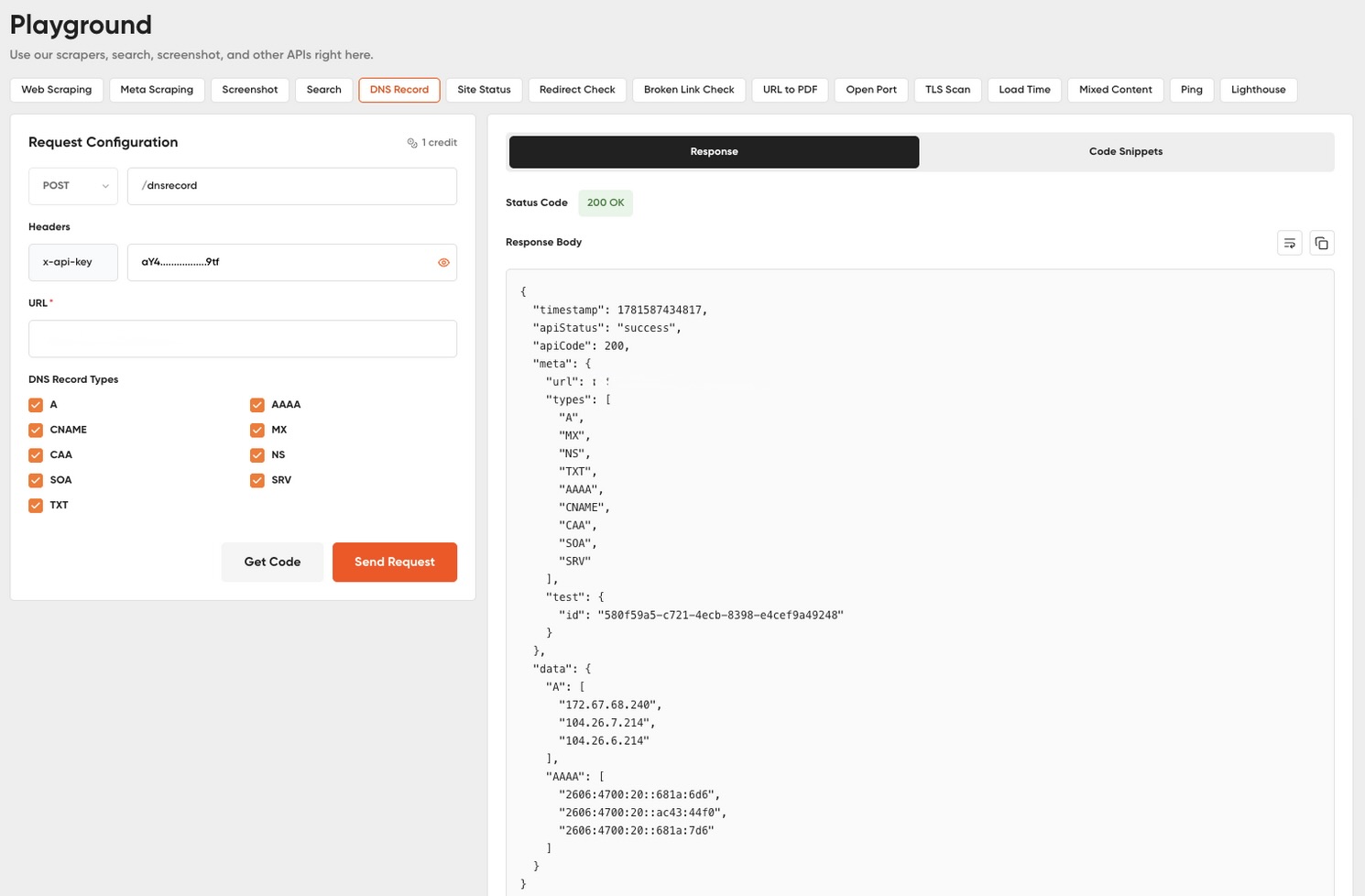
Here's what a basic cURL request looks like:
curl --request POST \
--url https://api.geekflare.com/dnsrecord \
--header 'Content-Type: application/json' \
--header 'x-api-key: YOUR_API_KEY' \
--data '{
"url": "www.iplocation.net",
"types": ["A", "MX", "NS", "TXT"]
}'
The API returns a JSON object with three primary fields:
- apiStatus: Indicates whether the request was successful.
- meta: Contains information about the requested domain and record types.
- data: Contains the DNS records returned by the query.
Depending on the request, the response may include A, AAAA, MX, NS, TXT, CNAME, CAA, SOA, and other supported DNS records.
For example, querying a domain for A and AAAA records returns the corresponding IPv4 and IPv6 addresses associated with that domain.
Geekflare DNS Lookup API Pricing
Geekflare uses a shared credit system across its API platform. DNS lookup requests consume one credit per request, with credits also used by other APIs available through the platform.
| Plan | Monthly Cost | Credits/Month | Rate Limit |
|---|---|---|---|
| Free | $0 | 500 | 1 req/sec |
| Starter | $9 | 5,000 | 5 req/sec |
| Growth | $49 | 100,000 | 25 req/sec |
| Business | $249 | 1,000,000 | 50 req/sec |
Geekflare's pricing is based on a shared credit system, with DNS lookup requests consuming one credit per query. Plans vary by monthly credit allocation and rate limits, and credits can be used across multiple APIs offered through the platform. Credits reset at the beginning of each billing cycle, and additional credits may be purchased separately when needed.
Pros and Cons
The integration is clean, and the record coverage is solid, but the read-only scope rules out a few common DNS workflows.
Pros
- Simple API integration: Uses a REST-based interface with JSON request and response formats.
- Support for common DNS record types: Includes A, AAAA, CNAME, MX, NS, TXT, SOA, CAA, SRV, and PTR records.
- Developer tooling and integrations: Supports SDKs and integrations that can be incorporated into a variety of workflows.
- Automation support: Can be incorporated into monitoring, validation, and DNS-related automation processes.
Cons
- Read-only functionality: The API is designed for DNS record lookups and does not provide capabilities for creating, modifying, or deleting DNS records.
- Limited historical and intelligence data: Features such as historical DNS records, passive DNS datasets, and threat intelligence enrichment may require additional tools or specialized services.
Who Should Use It?
A good fit for teams that need DNS data as an input to something else: verification, monitoring, enrichment. A poor fit for anyone who needs to manage DNS records, beyond just reading them.
Best For
- SaaS applications that need to verify customer domains as part of onboarding or custom domain setup
- Monitoring tools that track DNS changes across a set of domains and alert on unexpected modifications
- Security products that enrich domain data with DNS records as part of threat investigation pipelines
- Email marketing platforms that validate MX, SPF, and DMARC before sending to a domain
- Domain analysis platforms that need DNS data as an input to broader domain intelligence workflows
Not Ideal For
- Teams that need to manage or host authoritative DNS (use Cloudflare, Route 53, or similar)
- Enterprise DNS management with audit trails, role-based access, and change approvals
Real-World Use Cases
DNS lookup becomes useful when it's integrated into an automated system. Here's where teams are actually putting it to work.
Domain Monitoring
Poll DNS records for a set of domains on a schedule and compare against known-good baselines. When an NS record changes unexpectedly, or a CAA entry disappears, trigger an alert. At 1 credit per request, monitoring 1,000 domains every hour costs about 720,000 credits per month, covered by the Business plan.
Track:
- NS changes that might indicate a domain transfer or hijack.
- MX record modifications that could affect email routing.
- TXT record removals that invalidate SPF policies.
Email Verification
Before sending an email to a new domain, pull its MX, TXT, and any _dmarc subdomain records. An absent MX record means the domain doesn't accept email. A missing SPF record is a deliverability risk on your end. The absence of DMARC tells you the domain hasn't set up rejection policies. You can build this check directly into a signup or contact form validation flow.
Check:
- MX records to confirm whether a domain is configured to receive email.
- SPF records published through TXT records on the root domain.
- DKIM records published through TXT records on the
_domainkeysubdomain. - DMARC records published through TXT records on the
_dmarcsubdomain.
Security Research
Map the DNS infrastructure of a domain as part of an OSINT or threat intelligence workflow. NS records reveal the hosting provider. MX records show the email infrastructure. CAA records indicate which CAs the domain trusts for TLS certificates. Combined with other signals, DNS data helps build a picture of an organization's tech stack without touching their systems.
Analyze:
- Domain infrastructure using NS and A records.
- Email infrastructure and mail routing providers using MX records.
- Certificate authority authorization policies using CAA records.
Internal Tools
Build DNS dashboards or network utilities for internal teams. Query multiple domains and record types in batch, display propagation status after DNS changes, or surface configuration issues before they affect production. The API Playground already generates SDK snippets, which shortens the time from idea to working prototype.
Build:
- DNS configuration dashboards for network teams.
- Propagation monitoring tools for deployments.
- Domain health checks for DevOps pipelines.
Final Verdict
Geekflare DNS Lookup API provides programmatic access to DNS record data through a REST-based interface. The service supports multiple DNS record types and can be incorporated into workflows involving domain verification, DNS monitoring, infrastructure analysis, and security research. As with any DNS lookup service, users should evaluate available features, pricing models, integration requirements, and operational limitations to determine whether the platform aligns with their technical and business needs.
Featured Image generated by ChatGPT.
Related Articles

May 3, 2025
Driving IT Performance Through Unified Network Infrastructure
Are your IT systems struggling to keep up with demand? Many businesses face slow networks, scattered systems, and endless headaches trying to make everything work together. It’s fr...
Read More
May 24, 2019
Public DNS
To first understand what a Public DNS is, we must first recognize what DNS means to begin with. In its simplest definition, the DNS (or the Domain Name System), is basically an Int...
Read More
September 17, 2017
What is the DNS?
The Domain Name System (DNS) is a decentralized naming schema of resolving domain (host) names into numerical IP Addresses. The IP Addresses are assigned to various computing devic...
Read More
Comments
Comments are available to signed-in users and are moderated to keep the discussion useful and respectful. Spam, automated submissions, and low-value promotional comments are removed. Outbound links may be approved when they are relevant and genuinely helpful to readers, but they are displayed as plain text rather than clickable hyperlinks.
No comments have been published yet.
Please sign in to submit a comment.