

IP Address, Cybersecurity, Geolocation
First-Party Fraud in Ecommerce: How IP Address Evidence Helps Merchants Win Disputes
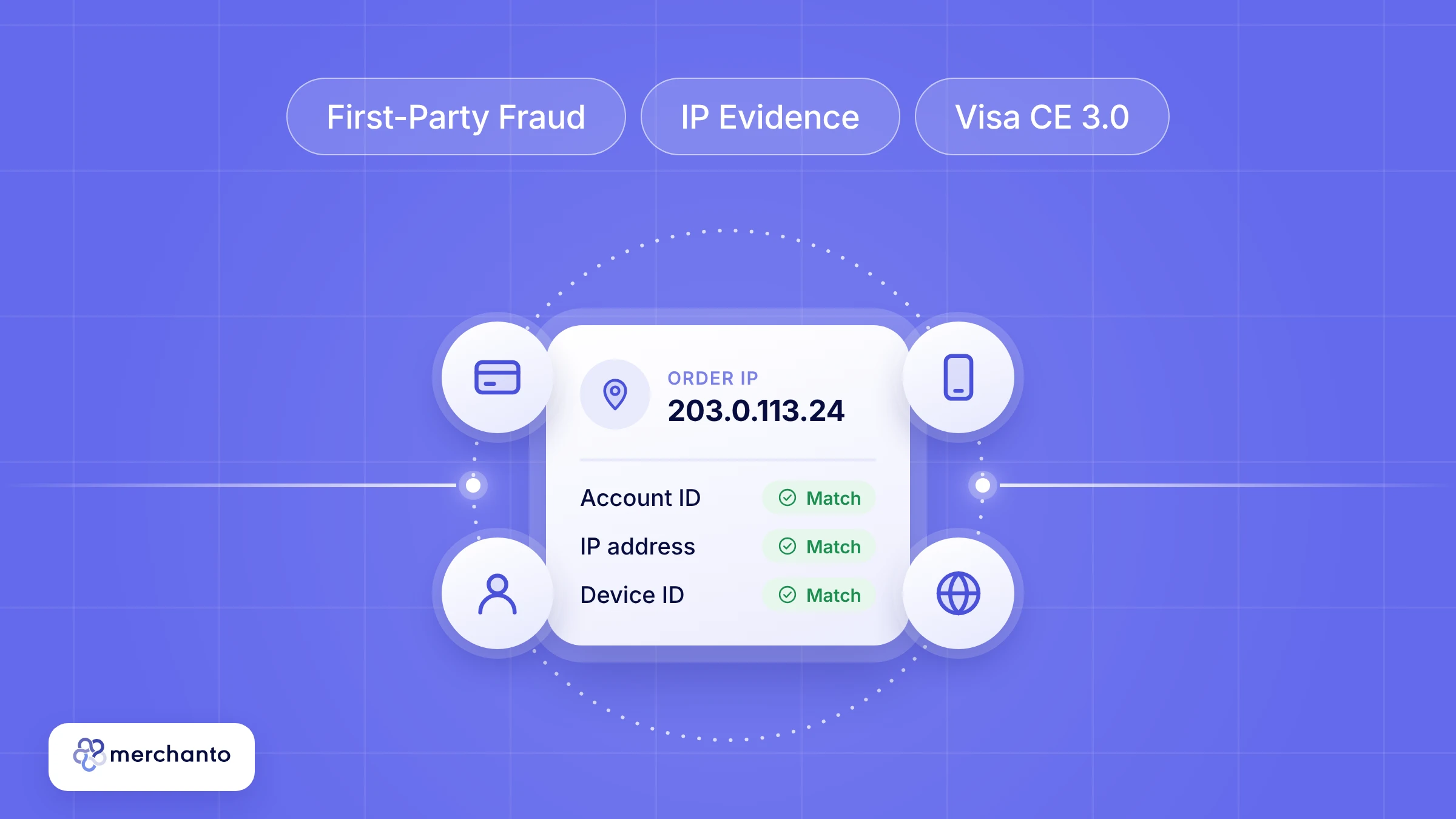
A customer buys a pair of headphones, the package arrives, and three weeks later their bank tells you the purchase was fraudulent. The card was never stolen. The person who disputes the charge is the same person who placed the order.
This is first-party fraud, also called friendly fraud, and for online merchants it is one of the hardest kinds of fraud to fight. The good news is that Visa and Mastercard now let merchants answer these claims with data. The most important piece of that data is something most stores already collect: the customer's IP address.
What is first-party fraud?
First-party fraud happens when the real cardholder makes a purchase and later disputes it as unauthorized. In third-party fraud, a criminal uses stolen card details. In first-party fraud, the card, the device, and the account all belong to the person who files the dispute.
Not every case is deliberate. A family member may have used the card, the customer may not recognize the name on the statement, or a subscription renewal may have been forgotten. Some cases are plain abuse: the customer keeps the goods and claims the purchase never happened. To the bank, they all look the same: a cardholder saying "this wasn't me."
The problem is large. Mastercard, citing Datos Insights, has said that about 75% of the card-not-present fraud experienced by digital goods merchants is first-party fraud. In later research by Mastercard and Datos Insights, 48% of consumers said they had disputed a charge they later realized was legitimate.
First-party vs. third-party fraud
- Who buys. In first-party fraud, the real cardholder. In third-party fraud, a criminal with stolen card details.
- Who disputes. In first-party fraud, the same person who bought. In third-party fraud, the real cardholder, who never made the purchase.
- What the order data shows. First-party fraud usually matches the customer's earlier orders: the same device, the same IP address, the same shipping address. Third-party fraud often comes from a new device and an IP address far from the billing address.
- What works against it. For first-party fraud, evidence from earlier orders (Visa CE 3.0 and Mastercard First-Party Trust, below). For third-party fraud, screening at checkout and 3-D Secure.
Some fraud teams also use the term second-party fraud for purchases made by someone the cardholder knows, such as a family member. In banking, first-party fraud also covers loans and credit lines opened with no intention to repay. This article focuses on card payments in online stores.
Why it costs more in 2026
Every fraud claim has two costs. The first is the chargeback itself: the refund, the fee and the lost goods. The second is your standing with the card networks.
Since June 2025, the Visa Acquirer Monitoring Program (VAMP) has counted fraud reports (TC40) and disputes (TC15) together and divided them by settled transactions. On April 1, 2026, the limit for an "Excessive" merchant in the US, Canada, Europe and Asia-Pacific dropped from 2.2% to 1.5%, for merchants with at least 1,500 fraud reports and disputes in a month, according to Visa's VAMP fact sheet.
That means a single fraud claim can show up in your ratio twice: once as a fraud report and again if the bank also files a dispute. It counts even when the "fraudster" is a loyal customer.
Signs that a dispute is first-party fraud
A fraud claim does not tell you which kind of fraud you are dealing with. These patterns point to the cardholder:
- The order was delivered, with confirmed delivery, before the dispute arrived.
- The customer kept using their account after the "unauthorized" purchase, from the same device or IP address.
- The same card paid you before without any problems.
- The dispute follows a subscription renewal or a free trial that turned into a paid plan.
- The customer has disputed purchases with you before.
None of these is proof on its own. Together, they tell you which disputes are worth fighting and what evidence to collect.
How Visa Compelling Evidence 3.0 uses IP data
Visa's Compelling Evidence 3.0 rule, usually shortened to CE 3.0, was built for this situation. It applies to fraud disputes on card-not-present purchases (Visa dispute condition 10.4). The logic is simple: if the same card paid you before, from the same device or IP address, with no fraud claim, the disputed purchase was most likely made by the cardholder too.
To qualify, Visa looks at the customer's history with you:
- At least two earlier transactions on the same card, made 120 to 365 days before the disputed one.
- Neither earlier transaction was reported or disputed as fraud.
- The disputed transaction matches the earlier ones on at least two of four data elements: account or login ID, IP address, device ID or fingerprint, and shipping address.
- One of the two matching elements must be the IP address or the device ID.
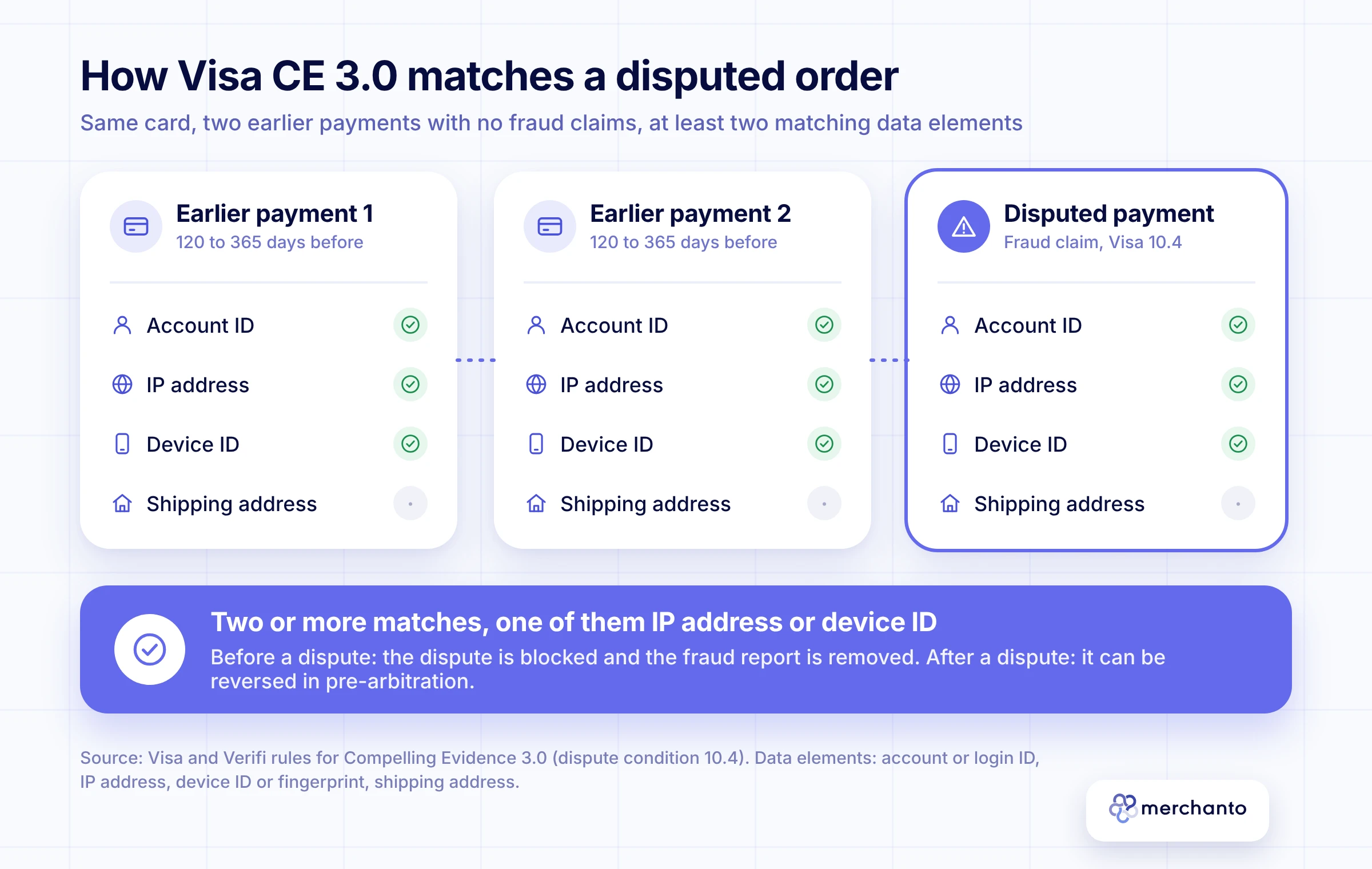
The evidence can work at two points. Before a dispute is filed, Visa's Order Insight service checks your data when the issuer starts a fraud claim. If the criteria are met, the dispute is blocked, liability stays with the issuer, and the fraud report is deleted from Visa's system, according to Verifi, Visa's dispute management company. If a dispute has already been filed, your acquirer can submit the same evidence at the pre-arbitration stage, and a qualifying dispute is reversed.
CE 3.0 is not an automatic win in every case. As Stripe notes in its documentation, issuing banks still have discretion. But it turns a "your word against theirs" argument into a data match, and data matches are much harder to reject.
Mastercard's version: First-Party Trust
Mastercard has its own program. Under First-Party Trust, merchants can share enhanced data at the time of purchase or later, during a dispute. To qualify for liability protection, the data must include:
- One device signal: IP address, device ID or fingerprint.
- One delivery signal: shipping address, email or phone number.
- One more identity signal, such as an account login ID or a billing address.
The program launched in the US in 2024, and in 2025 Mastercard expanded it to Canada, Latin America, the Caribbean and Asia-Pacific.
Two networks, two rulebooks, one common thread: the IP address you record at checkout.
What to record with every order
CE 3.0 and First-Party Trust both compare orders over time, so the data has to be saved with each order, not just at login. A practical checklist:
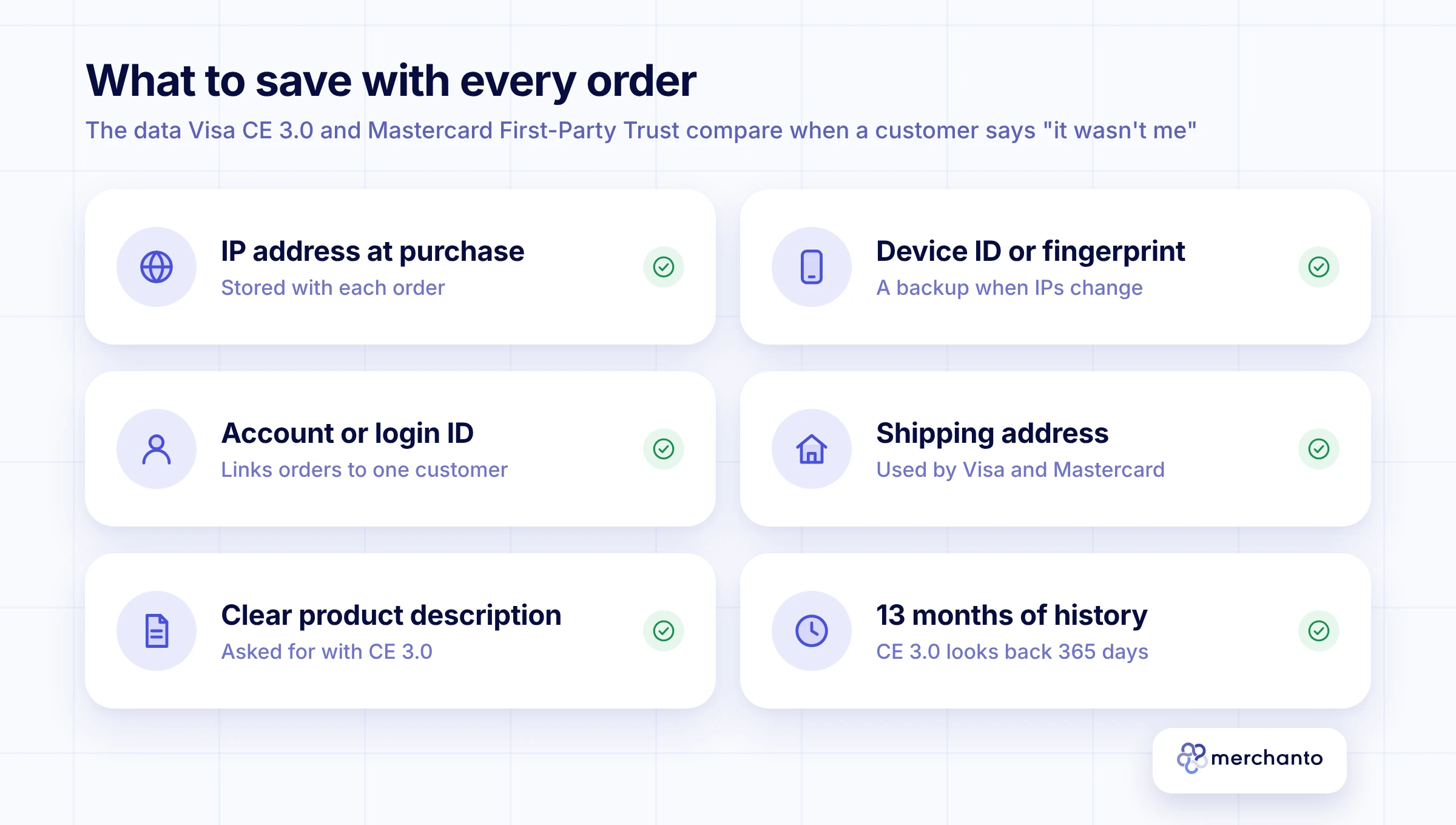
- IP address at the moment of purchase. Store it on the order record itself.
- Device ID or fingerprint. Many customers shop on mobile networks, where IP addresses change often and many users can share one address. A stable device ID gives you a second way to match.
- Account or login ID and shipping address, on the same order record.
- A clear product description for every order. Visa and payment providers ask for it with CE 3.0 evidence.
- At least 13 months of history. CE 3.0 looks back up to 365 days, and the dispute itself arrives weeks after the purchase.
- Consistent billing descriptors and merchant IDs, so the network can link a customer's past purchases to you.
Where IP geolocation helps beyond matching
Matching is about the past. Geolocation helps you judge the purchase in front of you:
- Location consistency. Compare where the IP address points with the billing and shipping addresses. A mismatch is not proof of fraud, but it is worth a second look.
- Proxy and VPN detection. Anonymized traffic hides the real location, and it can also make a CE 3.0 match impossible later.
- Velocity. Many orders from one IP address, or one card used from many addresses in a short time, is a classic sign of stolen cards.
Iplocation.net covers these checks in more detail in its guide on how IP geolocation enhances fraud detection. For chargebacks, the point is this: the same IP data that helps you stop a stolen card at checkout becomes your evidence when a real customer later denies a purchase.
Keep the limits in mind. IP geolocation is not always accurate at the city level, and many honest customers use VPNs. Treat IP data as one signal among several, never as the only reason to decline an order.
Keep it lawful
In the EU, IP addresses can be personal data: the EU Court of Justice confirmed this for dynamic IP addresses in the 2016 Breyer case. The GDPR also names fraud prevention as a legitimate interest in Recital 47. In practice, say in your privacy notice that you collect IP and device data to prevent fraud, keep it only as long as you need it for disputes, and limit who can access it.
A worked example
A customer has subscribed to a meal kit service since January. In November, they dispute a $96 charge as unauthorized. The merchant's records show two earlier payments on the same card, in March and June, with no fraud claims. All three orders came from the same customer account and the same device ID, and they were shipped to the same address.
Both earlier payments fall inside the 120 to 365 day window, and the orders match on more than two elements, including the device ID. Under CE 3.0, the claim qualifies. If the merchant is connected to Order Insight, the dispute is blocked before it is filed and the fraud report is removed. Without that connection, the merchant can still use the same evidence in pre-arbitration, but only after the dispute has been filed, which means more work and a longer wait for the money.
Where alerts and dispute tools fit
CE 3.0 only helps with returning customers. A first-time buyer has no history to match. That is where other tools come in: pre-dispute alerts let you refund a customer before the bank files a dispute, and representment lets you contest the chargebacks that still get through. A complete process uses all three, and this guide on how to manage chargebacks walks through the full workflow.
Merchanto, a chargeback prevention platform, integrates with Visa Order Insight, including Compelling Evidence 3.0, and with Mastercard Consumer Clarity to send transaction details to card issuers before a dispute starts. It also connects merchants to Visa's CDRN and RDR and to Mastercard alerts, so disputes that CE 3.0 cannot block can still be resolved before they become chargebacks.
Key Takeaways
- First-party fraud is a real customer disputing a real purchase. It is common, and it counts against you in Visa's monitoring program.
- Visa CE 3.0 can block a fraud dispute when the customer has two earlier undisputed payments that match on the IP address or device ID plus one more element.
- Mastercard First-Party Trust offers liability protection when you share device, delivery and identity data.
- Record the IP address, device ID, account ID and shipping address with every order, and keep that history for at least 13 months.
- Use IP geolocation to spot risky orders at checkout, but treat it as one signal, not a verdict.
FAQ
Frequently asked questions
01What is another name for first-party fraud?
It is often called friendly fraud. When it ends in a chargeback, merchants also call it chargeback fraud.
02Can a merchant win a first-party fraud dispute?
Often, yes, if the customer has bought before. Visa CE 3.0 and Mastercard First-Party Trust let you prove the purchase with matching IP, device and account data from earlier orders.
03Does a refund stop a fraud claim from counting against me?
A refund made before the dispute prevents the chargeback. The fraud report can still count in Visa's monitoring program unless it is removed, for example through CE 3.0 and Order Insight.
Comments
Comments are available to signed-in users and are moderated to keep the discussion useful and respectful. Spam, automated submissions, and low-value promotional comments are removed. Outbound links may be approved when they are relevant and genuinely helpful to readers, but they are displayed as plain text rather than clickable hyperlinks.
No comments have been published yet.
Please sign in to submit a comment.