

Cookieless Tracking: Why Coupon Codes Still Work When Cookies, IPs and Clicks Don't
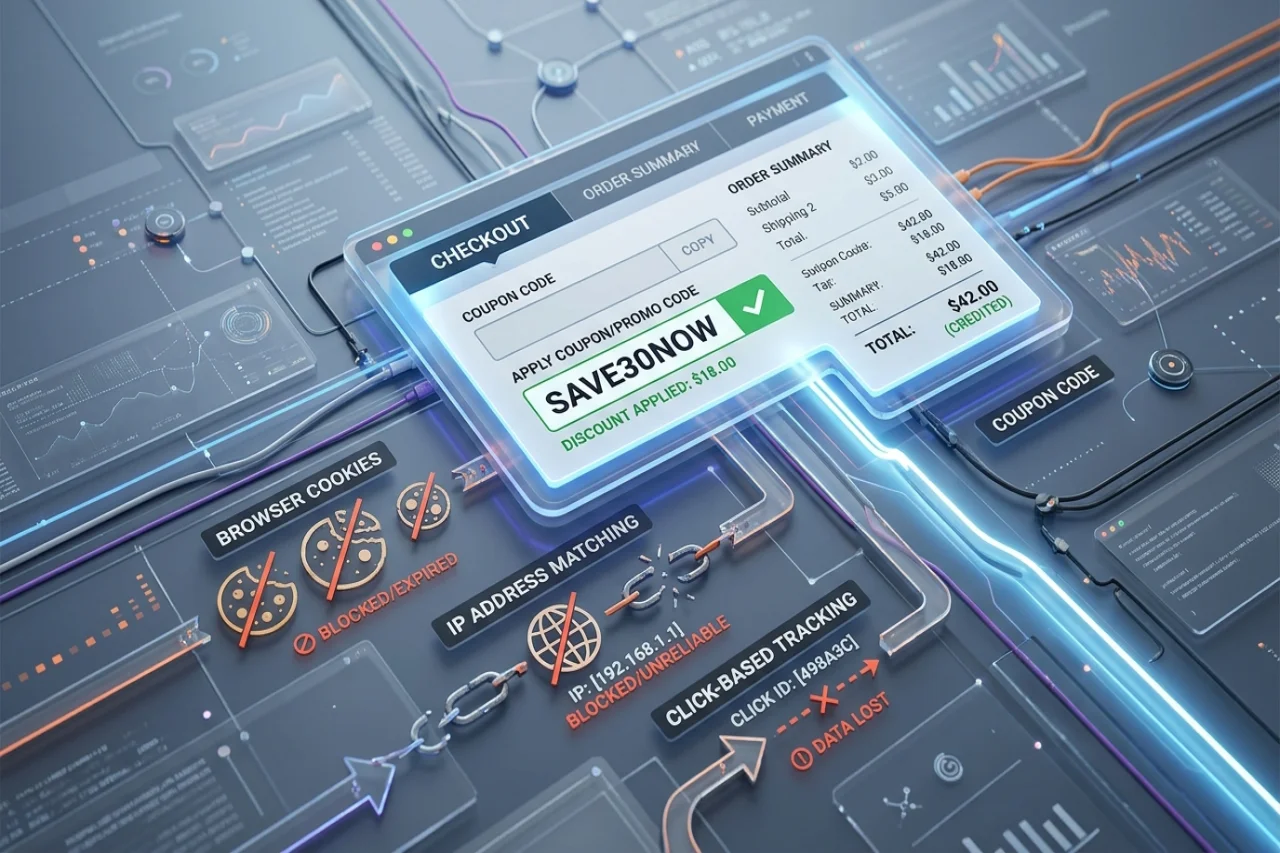
Cookieless tracking is any method of connecting an online action to its source without storing an identifier in the visitor's browser. It became a mainstream topic once browsers started limiting cookies by default and privacy tools became a standard kit for ordinary users. For marketers who pay partners based on the sales they bring in, the question is practical: if the browser forgets where a customer came from, how do you know who to credit?
One of the oldest answers is also one of the most reliable. A coupon code does not depend on cookies, IP addresses, or clicks. This article looks at why browser-based tracking keeps losing data, and why codes redeemed at checkout hold up so well.
How Does Traditional Referral Tracking Work?
Most referral and affiliate tracking follows the same pattern. A partner shares a link that contains a unique ID. When a visitor clicks it, the destination site reads that ID and saves it in a first-party cookie, often for 30 to 90 days. If the visitor buys within that window, the sale is matched to the partner whose ID sits in the cookie.
Some systems add a second layer: the visitor's IP address and device characteristics are logged at the click, so a later purchase from the same connection can be matched even if the cookie is gone. On paper, this covers most cases. In practice, each layer has gaps.
Why Are Cookies Less Reliable Than They Used to Be?
An HTTP cookie is a small piece of data a website asks the browser to keep. The browser decides how long it keeps it, and browsers have become much stricter about that decision.
- Browser limits: Safari's Intelligent Tracking Prevention caps the lifetime of some script-set cookies at seven days, and in certain cases after a click from a known tracking domain, as short as 24 hours. The rules are documented on WebKit's tracking prevention page. Firefox and Brave apply their own restrictions.
- Consent banners: Under GDPR and similar laws, many visitors decline non-essential cookies. If the tracking cookie counts as non-essential, it never gets written.
- Private browsing and cleanup: Incognito windows discard cookies when closed, and plenty of users clear their history regularly.
- Device switching: A visitor who clicks a link on their phone and buys on their laptop two days later has two separate cookie jars. Neither knows about the other.
None of these are edge cases anymore. Together they mean a meaningful share of referred sales arrive at checkout with no record of where they came from.
Can IP Address Matching Fill the Gap?
IP matching sounds like a neat backup, and readers of this site will already know its weak spots. An IP address identifies a network connection, not a person, and plenty of everyday things break the link between the two. A VPN or proxy replaces the visitor's real address with the server's, which may be shared by thousands of people. Carrier-grade NAT routes many mobile users behind a single public IP, so a match can credit the wrong partner entirely.
Home connections are not much better. Dynamic addresses change over time, and an IP that belongs to one household on Monday may belong to a neighbor by Friday. On top of that, privacy features such as Apple's iCloud Private Relay route Safari traffic through relays that hide the user's IP from the site altogether.
IP data is useful for spotting fraud patterns, like dozens of "different" referrals from one address. As a primary way to assign credit for a sale, it is too noisy to trust on its own.
What Makes a Coupon Code Different?
A coupon code moves the tracking event from the browser to the payment. The customer types the code at checkout, the payment or billing system records it against the order, and that record is what matters. There is nothing to block, expire, or clear on the visitor's device.
Codes also survive device changes, because the code travels in the customer's head or notes rather than in a cookie. They work offline too: a code read out on a podcast, printed on packaging or mentioned in a YouTube video can be tracked even though nobody clicked anything. VPNs and ad blockers make no difference, since changing an IP address does nothing to a code typed into a payment form.
There is a quieter advantage as well. A discount gives the buyer a reason to enter the code, so the attribution data is generated by the customer voluntarily rather than inferred from their browser.
How Does Server-Side Coupon Attribution Work?
The mechanics are simple once you see where the data lives. Each partner gets a unique code, which is generated in the billing system (Stripe, Paddle, Chargebee, Recurly, and similar). Stripe's own documentation on coupons and promotion codes shows how a single discount can be issued under many customer-facing codes, which is exactly what makes per-partner codes possible.
When a customer redeems a code, the billing provider stores the redemption as part of the transaction.
Tracking software then reads that event on the server side and credits the partner linked to the code. You can see this approach in the coupon tracking setup many subscription businesses use, where the redemption record from the billing system, rather than anything in the browser, decides who earned the commission. For recurring subscriptions, the same code keeps the customer tied to the partner on later renewals.
Because the data comes from the payment itself, it is also harder to fake. A fraudster can generate fake clicks from rotating IPs, but generating fake paid orders costs real money.
Where Do Coupon Codes Fall Short?
Codes are not perfect, and it helps to be honest about their weaknesses. The biggest one is leakage. Codes get posted on coupon aggregator sites, where shoppers who never saw the partner's content find and use them, and the partner collects credit for a sale they did not influence.
There is also a margin cost, since every tracked sale comes with a discount attached, while a link tracks at full price. And a customer who meant to use a code but forgot it at checkout generates no attribution at all.
Most of these can be managed. Unique codes per partner make leaks easy to trace, expiry dates limit how long a leaked code remains useful, and discounts can be sized to the margin.
Should You Replace Link Tracking with Codes?
Usually not. The strongest setups run both. Links capture customers who click through and buy straight away, and codes capture those who switch devices, block cookies, browse behind a VPN, or hear about the product somewhere a link cannot be followed. When both signals exist for the same sale, a clear rule (such as "a redeemed code overrides the cookie") prevents two partners from claiming one order.
As browsers keep tightening their privacy defaults, the direction is clear. Tracking that depends on the visitor's device will keep losing ground, and tracking tied to the transaction will keep gaining it.
Conclusion
Cookieless attribution does not require abandoning referral tracking. It requires using signals that are less dependent on the visitor's browser. Coupon codes provide a durable way to connect purchases to partners because attribution happens at checkout rather than through a cookie, IP address, or device identifier.
For most businesses, the practical approach is to combine referral links with unique partner codes. Links preserve a convenient customer journey, while codes provide an additional attribution signal when browser-based tracking falls short.
Comments
Comments are available to signed-in users and are moderated to keep the discussion useful and respectful. Spam, automated submissions, and low-value promotional comments are removed. Outbound links may be approved when they are relevant and genuinely helpful to readers, but they are displayed as plain text rather than clickable hyperlinks.
No comments have been published yet.
Please sign in to submit a comment.