

Cloud Services, Artificial Intelligence, Web Hosting
Cinematic Quality, Speed, or Control? Picking the Right AI Video Generator
Three flagship AI video models from three different labs reached the public within a single week at the turn of July and August 2026. ByteDance rolled out Seedance 2.5 on July 31, following its announcement at the Volcano Engine FORCE conference in June. MiniMax launched H3, widely known as Hailuo 3.0, on the same day, with a live API from hour one. Alibaba's Tongyi Lab followed on August 6 with the public beta of Wan 3.0. All three sit under the same "AI video model" label, yet they do not solve the same production problem equally well.
A filmmaker chasing a continuous 30-second cinematic take, an ecommerce team producing fifty product clips a week, and a developer wiring video generation into an application should not automatically pick the same model. The differences that matter are rarely the headline demo clips. They are clip length ceilings, reference-input limits, billing units, API maturity, editing tools, licensing terms, and whether the model can ever leave someone else's cloud. This guide compares the three models by workflow rather than by hype, so that each type of professional can find the model that actually fits the job.
This comparison is based on published specifications, official demonstrations, available technical documentation, pricing information, and documented workflows rather than a controlled hands-on benchmark. All three models were launched without full technical reports, so where a figure cannot be traced to an official source, the article says so rather than inventing one.
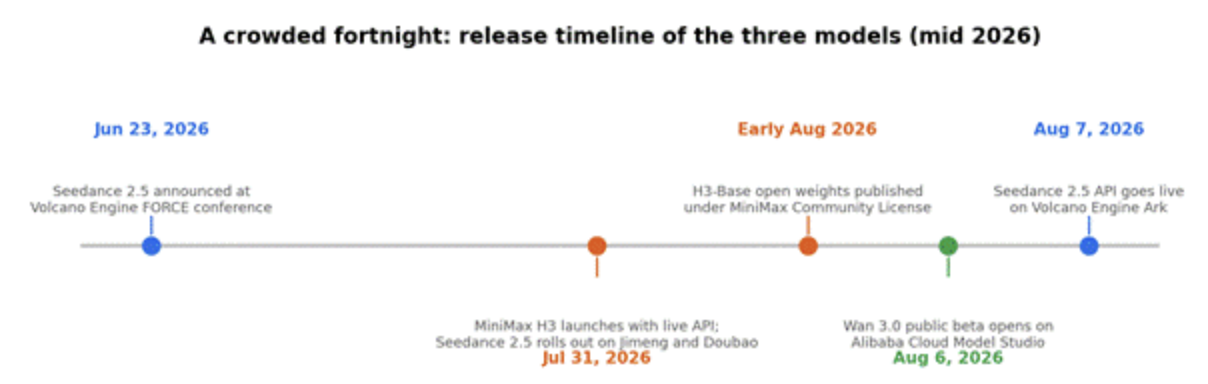
Figure 1. Release timeline, mid 2026. Seedance 2.5 was announced in June and rolled out at the end of July; MiniMax H3 launched July 31 with an immediately callable API; Wan 3.0 entered application-gated public beta on August 6.
The Short Version: Which Model Should You Choose?
For readers who need the answer before the analysis, the quick map below summarizes where each model currently fits best. The rest of the article explains the reasoning, the exceptions, and the cases where the obvious pick is wrong.
| If the priority is | Best fit | Why |
|---|---|---|
| Cinematic storytelling | Seedance 2.5 | 30-second native takes, up to 4K claimed at launch, and 50 reference inputs for shot control |
| Character consistency | Seedance 2.5 | 30 image plus 10 video plus 10 audio references lock identity far more tightly than rivals |
| Advertising concepts | Seedance 2.5 / H3, depends on workflow | Seedance for polish and product control; H3 for cheap, fast variation testing |
| Social media volume | MiniMax H3 | About $1 to $2 per clip, native stereo audio, live API, 2K output |
| Product visualization | Seedance 2.5 | White-model blocking, green-screen editing, and dense reference support |
| Developer / API use | MiniMax H3 | Callable from day one, flat per-second pricing, listed on OpenRouter and major hosts |
| Local / open workflows | MiniMax H3 (H3-Base) | Only current flagship-class open weights, with major license caveats covered below |
| Low-cost experimentation | Wan 3.0 | $0.05 per second at 480p is the lowest published entry rate of the three |
| Audio-first video | MiniMax H3 / Seedance 2.5, depends on length | H3 for stereo audio and voice transfer in shorts; Seedance for multilingual dialogue in long takes |
| Maximum creative control | Seedance 2.5 | Region-level edits, structured motion paths, and the largest reference budget |
| Document-driven video | Wan 3.0 | The only model that accepts PDFs, decks, spreadsheets, and webpage URLs as input |
Table 1. Quick recommendations by priority. Where two models are listed, the deciding factor is explained in the relevant use-case section.
Seedance 2.5 vs MiniMax H3 vs Wan 3.0 at a Glance
The specification table below contains only figures that trace to official announcements, first-party product pages, published API references, or consistent multi-source reporting. None of the three vendors has released a full technical report as of mid-August 2026, so architecture details and parameter counts are deliberately absent.
| Capability | Seedance 2.5 | MiniMax H3 | Wan 3.0 |
|---|---|---|---|
| Developer | ByteDance | MiniMax | Alibaba Tongyi Lab |
| Public availability | Jul 31, 2026 (apps); API Aug 7, 2026 | Jul 31, 2026, API live at launch | Aug 6, 2026, application-gated public beta |
| Text-to-video | Yes | Yes | Yes |
| Image-to-video | Yes, reference driven | Yes, incl. first and last frame | Yes, incl. first-and-last-frame control |
| Reference inputs | Up to 50 files: 30 images, 10 videos, 10 audio | Up to 12 files: 9 images, 3 videos, 3 audio | Omni-Reference incl. documents and webpages; media limits in API reference |
| Document-to-video | No | No | Yes: pdf, doc, xls, ppt, txt, md, webpage URLs |
| Native audio | Yes, dialogue in 10+ languages | Yes, stereo, same pass | Yes, same pass |
| Max resolution | Up to 4K claimed at launch; channel dependent | 2K (2560 x 1440) hosted; 768p local base | 1080p; no 4K tier published |
| Max clip length | 30 s native; 180 s beta on Jimeng | 15 s; ~30 s via extend tools | 2 to 30 s, single pass |
| Frame rate | Not officially published | 24 fps | Not officially published |
| Editing | Region-level edits, green screen, white-model control | Instruction-based editing; ranked #1 on Artificial Analysis Video Editing | Interval regeneration, instruction and reference edits |
| Multi-shot | Yes, plus multi-turn extension | Yes, multiple shots in one clip | Yes, linked shots via Omni-Reference |
| API | Volcano Engine Ark; BytePlus ModelArk intl.; third-party hosts | MiniMax platform, OpenRouter, Fal and other hosts | Alibaba Cloud Model Studio, Qwen Cloud; full access still rolling out |
| Open weights | No | Partial: H3-Base under Community License | No; last fully open Wan flagship is Wan 2.2 |
| Published pricing | Token billing; official examples ~CNY 3.36 per 5 s 480p, ~CNY 7.56 per 5 s 720p | CNY 0.8 per s (~$0.11); $0.13 per s on OpenRouter | $0.05 / $0.10 / $0.20 per s at 480p / 720p / 1080p |
| Generation speed | Not officially published | Not officially published | Not officially published |
Table 2. Core specifications, verified August 2026. Third-party hosting platforms sometimes advertise capabilities, such as 4K Wan output, that the underlying model documentation does not support; this table reflects model-level documentation only.
Two footnotes matter here.
First, Seedance 2.5 resolution and rates differ noticeably by channel: the Dreamina and Jimeng consumer apps advertise 4K output, while several API resellers list per-second rates between $0.10 and $0.43 depending on resolution and whether the request includes video input. Second, MiniMax H3's "open weights" are real but partial: the released H3-Base checkpoints generate at 768p, and the 2K output that the hosted product advertises comes from a regeneration module that MiniMax kept server-side. Both nuances change recommendations later in this guide.
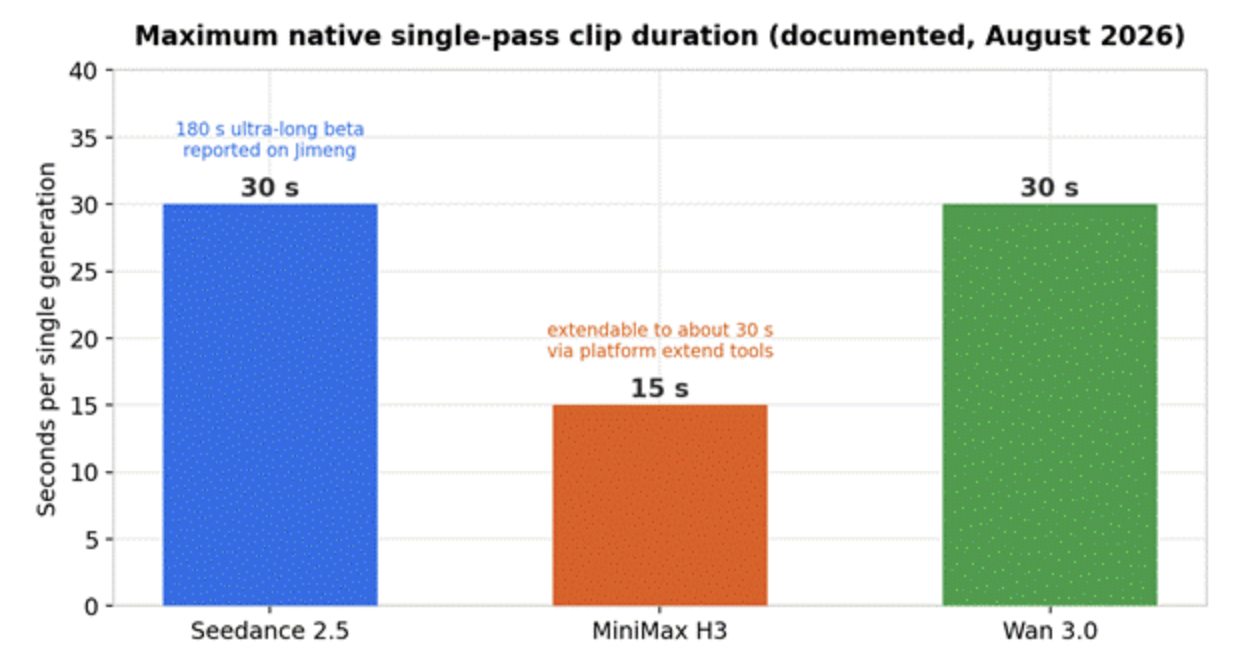
Figure 2. Maximum native single-pass clip duration. Seedance 2.5 and Wan 3.0 both generate 30 seconds in one run; H3 tops out at 15 seconds, with extension available through platform tools rather than a single pass.
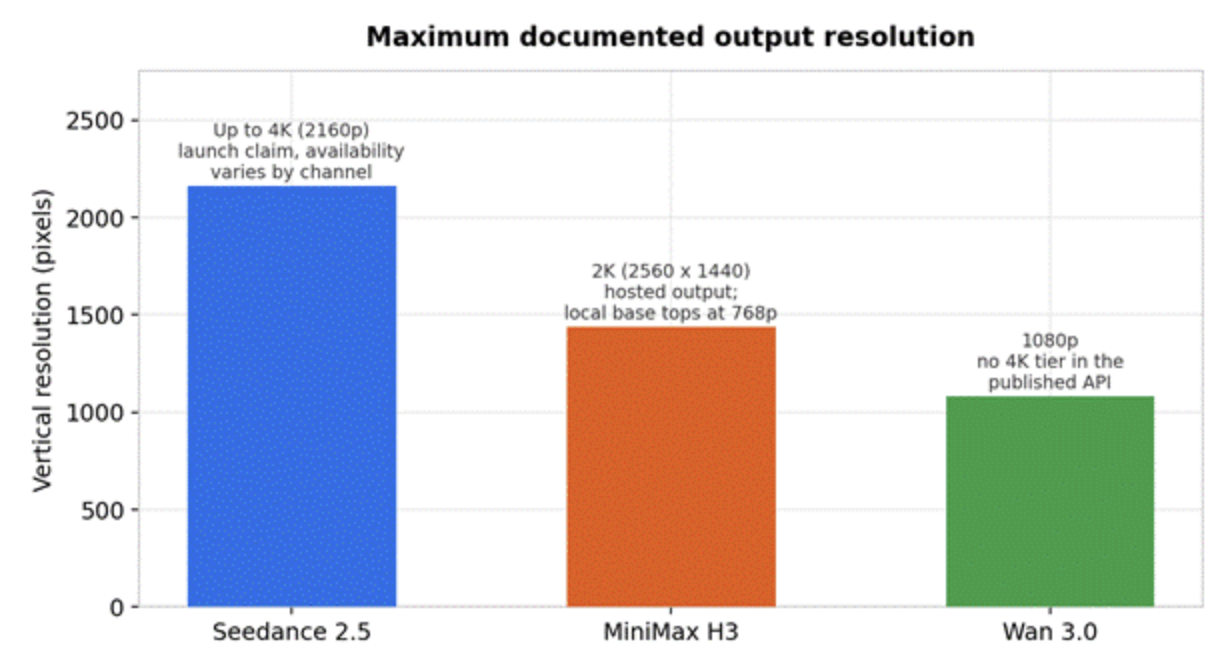
Figure 3. Maximum documented output resolution. The Seedance 2.5 figure is ByteDance's launch claim for its consumer surfaces; several API channels currently expose lower tiers. Wan 3.0's published API stops at 1080p despite widespread 4K rumors.
Use Case 1: Filmmakers and Cinematic Storytelling
A director building six concept shots for a pitch deck has a very different requirement from a creator trying to hold the same protagonist across a two-minute narrative. Both, however, care about the same fundamentals: camera language, temporal consistency, believable physics, and the ability to keep faces, wardrobe, and lighting stable across shots.
This is the territory Seedance 2.5 was built for. A native 30-second single-take removes the most painful part of AI filmmaking: stitching together 5-second fragments and hiding the seams.
The 50-slot reference system, with up to 30 images, 10 video clips, and 10 audio tracks, lets a filmmaker pin down a protagonist, a location, a lighting mood, and a musical pace inside one generation. The white-model control introduced with 2.5 is particularly interesting for previsualization: a shot can be blocked with untextured 3D geometry before the model lights and textures it, which is far closer to how a real previz team works than pure text prompting. The reported 180-second ultra-long beta on Jimeng points at where long-form is heading, though it remains a beta feature rather than a production guarantee.
MiniMax H3 is not far behind on look. It generates at a fixed 24 fps, the cadence film timelines are cut at, and its multi-shot generation can place several cuts inside one 15-second clip, which suits trailers and music-video rhythm.
Where H3 pulls ahead is revision: it ranks first in Video Editing on the Artificial Analysis leaderboard, and a director can request a lighting change or object removal in a sentence instead of re-rolling the whole shot. Wan 3.0 handles 30-second continuous takes at a fraction of the price, and for previsualization at 720p that trade is often worth taking, but its 1080p ceiling makes it harder to justify for finished cinematic deliverables.
Best fit: Seedance 2.5 for directors, cinematographers, and previz teams whose priority is the final image. Wan 3.0 becomes the better choice when a production needs dozens of long draft shots, and the budget matters more than the last 20 percent of polish; H3 becomes preferable when the edit-and-revise loop dominates the work.
Use Case 2: Advertising and Creative Agencies
Agency work lives or dies on two numbers: cost per usable concept and turnaround time. A campaign rarely fails because the model could not render a beautiful frame; it fails because the product label warped, the brand color drifted between variations, or the review cycle ate the deadline.
Seedance 2.5 offers the strongest control surface of the three. Structured motion paths, green-screen background swaps, region-level editing that changes parts of a frame without regenerating the clip, and a reference budget large enough to include the full product shot list all reduce the gap between the storyboard and the approved cut.
Dreamina positions the model explicitly at cinematic-grade advertising, and the capability set backs that up. The cost side is the catch: Volcano Engine's own examples put 720p output at roughly CNY 7.56 per 5 seconds, and reseller rates for higher tiers climb well past $0.40 per second, so a hundred-variation test matrix gets expensive quickly.
That is exactly the matrix where MiniMax H3 shines. At roughly $1 to $2 per 15-second 2K clip, a performance-marketing team can generate dozens of hook variations for the price of a single high-tier Seedance render, and instruction-based editing means a near-miss becomes a usable asset rather than a discarded generation.
UGC-style creative, which tolerates a rawer look, suits H3 particularly well. Wan 3.0 occupies a third position: a full 30-second broadcast-length spot in one generation for about $6 at 1080p, plus the unusual ability to turn a campaign brief or product deck directly into a first-draft video.
Best fit: Seedance 2.5 for hero assets, luxury, food, and automotive concepts where product fidelity is non-negotiable; H3 for variation-heavy performance and social advertising; Wan 3.0 for long-format spots on a budget. Most agencies will realistically pair two of them.
Use Case 3: Social Media Creators
A creator publishing 30 clips a week across Reels, TikTok, and Shorts needs a different metric from a filmmaker: not quality per generation, but usable output per hour and per dollar. A model that produces a slightly better frame while costing three times more and requiring a separate audio pass loses that contest.
MiniMax H3 is currently the strongest package for this rhythm. Sound effects, ambiance, and dialogue are rendered in the same pass as the picture, removing the editing step that normally sits between generation and publishing. Voice transfer and audio references support talking-style content, 2K output comfortably exceeds platform requirements, vertical formats are supported across its hosted surfaces, and the flat per-second rate keeps budgeting trivial. Seedance 2.5 produces the more spectacular clip and its multilingual dialogue is a real asset for localized content, but per-clip cost and the still-maturing access outside ByteDance's own apps make it a heavier daily driver.
Wan 3.0's $0.05 per second 480p tier is the cheapest sketching tool of the three, useful for testing ten ideas before spending on the winner, though 480p drafts are for deciding, not posting.
Best fit: MiniMax H3 for daily-volume creators. Seedance 2.5 earns its cost for flagship clips and channel trailers, and Wan 3.0 works as the cheap ideation layer underneath either.
Use Case 4: YouTubers and Longer-Form Content
As a purely illustrative example, a 10-minute documentary-style video may only need 40 to 60 seconds of generated footage, but that footage may consist of 10 to 20 separate establishing shots, historical recreations, and transitions. The constraints that matter here are cost per shot, consistency across batches generated on different days, and the editing overhead each clip adds.
Wan 3.0 is quietly excellent for this job. B-roll rarely needs more than 720p inside a 1080p edit once it is graded and cropped, and at $0.10 per second, a 20-shot batch of 8-second clips costs about $16.
The 30-second ceiling also allows slow atmospheric shots, the kind that hold under narration, without stitching. Its document input is a genuine workflow shortcut for faceless and explainer channels: a research document or script section can seed the visual sequence directly. H3 suits channels whose content leans on people, dialogue, or sound design, since its native stereo audio and editing loop reduce timeline work.
Seedance 2.5 is the pick for the moments that carry a video, such as a cinematic cold open, but using it for every cutaway inflates cost with little audience-visible return.
Best fit: Wan 3.0 for volume B-roll and explainer visuals, with Seedance 2.5 reserved for hero moments and H3 for audio-led segments.
Use Case 5: Ecommerce and Product Marketing
Product video is the least forgiving AI video category. A landscape can hallucinate a tree, and nobody notices; a sneaker with a warped logo or a serum bottle with garbled label text is commercially unusable. The capabilities that matter are object fidelity, reference-image support, controlled camera movement, and the ability to fix a detail without regenerating the whole clip.
Seedance 2.5's reference system is the strongest tool available for this problem: a seller can load multiple angles of the product, a lifestyle scene, and a pacing track into one generation, then use region-level editing to correct a detail while the rest of the clip holds. Green-screen editing, which swaps a background while the subject stays fixed, maps directly onto the hero-shot, in-use shot, and close-up structure of a product page.
H3 handles image-to-video product animation quickly and cheaply, and early creator reports specifically note clean on-screen text handling, which matters for packaging, though its 12-file reference budget is tighter. Wan 3.0's document-to-video is a curiosity here with real potential: a product spec sheet or listing page URL becoming a first-draft video is a workflow no other model offers. For all three, label text and product geometry still demand human review before anything ships to a storefront.
Best fit: Seedance 2.5 for Amazon sellers, DTC brands, and ecommerce agencies where the product must look exactly right; Wan 3.0 for catalog-scale volume where each listing gets one inexpensive clip.
Use Case 6: Influencers, Digital Humans and Character Content
Recurring characters are a compounding asset: an audience returns for a face it recognizes. That makes identity preservation, clothing continuity, expression range, and lip-sync the deciding capabilities, and it makes reference volume a proxy for how tightly an identity can be locked.
Seedance 2.5's 30-image identity budget, audio-driven lip-sync, and dialogue in more than ten languages make it the most complete option for building a virtual influencer or brand mascot that stays the same person across a campaign. H3 holds face, styling, motion, and voice across shots from its 9-image reference set, and several hosted platforms pair it with saved-character systems, which suits shorter serialized content well.
Wan 3.0's Omni-Reference holds a character across linked shots inside one generation, though cross-generation identity tooling is less documented at this stage of the beta. One honest caveat applies to all three: for pure talking-head content, dedicated avatar platforms still deliver more reliable frame-accurate lip-sync than any general video model, so a character channel built entirely on speech should test both categories before committing.
Best fit: Seedance 2.5 for persistent digital humans and multilingual character brands; H3 for fast serialized character shorts.
Use Case 7: Animation, Anime and Stylized Content
Stylized work changes the evaluation because photorealism benchmarks stop mattering. What counts is whether a model can hold an illustration's line weight and palette in motion, and whether an artist can iterate cheaply enough to explore.
All three vendors show stylized output in launch material, but none has published style-specific benchmarks, so recommendations here are more editorial than elsewhere in this guide. H3's economics and editing loop make it the natural experimentation tool for independent artists animating their own illustrations: at around a dollar per clip, exploring ten motion interpretations of one artwork is affordable, and instruction edits preserve a good result instead of gambling on a re-roll.
Seedance 2.5's reference density suits studio-style work where a character sheet, a background painting, and a soundtrack must combine into a consistent 30-second sequence, which maps onto game cinematics and comic-to-animation projects. The historically vibrant anime fine-tuning scene around the open Wan 2.x family does not carry over to Wan 3.0, since the new model is closed; artists who relied on custom-trained Wan checkpoints will find that ecosystem frozen on the older generation for now.
Best fit: MiniMax H3 for independent stylized experimentation; Seedance 2.5 for longer, reference-heavy stylized sequences.
Use Case 8: Architects, Interior Designers and Real Estate
A distinction has to come first: marketing visualization and technically accurate architectural representation are different products. None of these models is a CAD or BIM tool, none preserves dimensions to tolerance, and a generated walkthrough must never be presented to a client as a faithful rendering of an actual floor plan. Within that boundary, generative video is genuinely useful for mood, atmosphere, and property marketing.
Wan 3.0 is the surprising leader for real estate marketing specifically. Its 30-second single-take generation suits the slow push-through-a-space camera grammar of property video, its pricing keeps a per-listing clip near $3 to $6, and its webpage-URL input means a listing page can seed the video directly, which is an automation hook no competitor offers.
Seedance 2.5 takes over at the high end: image-to-video from professional photographs of a signature project, with references holding materials and lighting, produces the kind of atmosphere film architecture firms use in competition entries. H3's 15-second ceiling is the main limitation here, since interior walkthroughs want longer, calmer moves, though it remains a fine tool for short exterior mood shots.
Best fit: Wan 3.0 for real estate marketers working at listing volume; Seedance 2.5 for architecture and interior design firms presenting flagship work.
Use Case 9: Game Developers
Studios evaluate AI video differently from creators because the inputs are often confidential. Concept trailers, cutscene ideation, and environment mood pieces frequently involve unreleased characters and proprietary art, and uploading those assets to a third-party cloud is a policy question before it is a quality question.
This is where H3's partial open-weight release changes the equation. A studio outside the excluded territories and under the license's revenue ceiling can run H3-Base entirely on its own hardware, meaning that unreleased assets never leave the building.
The 768p local ceiling is acceptable for ideation and pitch material even if it rules out final marketing renders. For studios that cannot use the H3 license, the older Apache 2.0 Wan 2.x models remain the fallback for private workflows, at a visible quality cost against the 2026 flagships. When confidentiality is not the constraint, Seedance 2.5 is the strongest tool for public-facing game trailers: reference support can hold key art and character designs across a 30-second cinematic, which is most of what a concept trailer is.
Best fit: MiniMax H3 for IP-sensitive internal prototyping where the license fits; Seedance 2.5 for public marketing cinematics built from approved assets.
Use Case 10: Developers and AI Startups
For a developer, the best model output and the best model to build a business around are not the same question. A product needs an API that exists today, pricing that can be forecast, rate limits that can be engineered around, and a vendor unlikely to strand the roadmap.
MiniMax H3 is the clear operational winner as of August 2026. Its API was live at launch; it is listed on OpenRouter at a flat $0.13 per second and on other major hosts; generation runs as asynchronous tasks; and the flat rate makes unit economics a spreadsheet cell rather than a research project. Two engineering details from documented integrations are worth noting: credit checks reserve against an average generation cost rather than the specific request, so balances need headroom, and rate limits punish naive fan-out, so job queues should be sequential-friendly.
The open-weight track also gives H3 something unique: a startup can prototype on the API and hold self-hosting as a future cost lever, license permitting. Seedance 2.5's API reached Volcano Engine Ark on August 7 via BytePlus ModelArk as the international enterprise route, but business verification requirements and channel-dependent pricing make it a slower path to production for a small team, even though the argument for output quality is real. Wan 3.0's economics look excellent, particularly the $ 0.05-per-second 480p tier for preview-heavy products, but the API is an application-gated beta with full access still rolling out, which is not a foundation to ship on this month.
Best fit: MiniMax H3 for SaaS products, automation tools, and startups shipping now, with Wan 3.0 worth re-evaluating the moment its API access becomes generally available.
Use Case 11: Enterprise and Private Workflows
Enterprise adoption turns on questions that never appear in demo reels: where does uploaded material go, what do the commercial terms actually say, can the tool run inside existing cloud governance, and what is the vendor's legal posture? All three models come from China-based labs, so organizations with data residency or regulatory constraints need to evaluate the hosting jurisdiction of any channel they use, including third-party hosts that may run inference elsewhere.
Within that frame, each model offers a different enterprise story. Wan 3.0 lives inside Alibaba Cloud Model Studio, which means a company already standardized on that cloud gets video generation under existing agreements and billing rather than a new vendor relationship. Seedance 2.5's BytePlus ModelArk route is explicitly the international enterprise channel, with the business verification that implies.
H3 offers the only path where confidential material can avoid third-party servers entirely, via local H3-Base, but the Community License excludes deployment in the US, EU, UK, and South Korea and requires written authorization above $20 million in revenue, which excludes many of the enterprises most interested in self-hosting. Due diligence should also note publicly reported copyright litigation involving MiniMax brought by major studios; that is a documented legal proceeding, not a verdict, but procurement teams will ask. No unsupported security claims are made here for any vendor: none of the three has published an independent security audit of these specific models.
Best fit: Wan 3.0 for Alibaba Cloud shops, Seedance 2.5 via BytePlus for enterprises buying managed capability, and local H3-Base only where the license and jurisdiction genuinely permit it.
Use Case 12: Researchers and Open-Source Developers
For research, downloadable weights are not a preference but a requirement, and the 2026 flagship generation has narrowed rather than widened that door. Seedance 2.5 is fully closed. Wan 3.0 launched closed despite the Wan family's open heritage, with no weights on Hugging Face, GitHub, or ModelScope and the last fully open Wan flagship remaining Wan 2.2 under Apache 2.0 from 2025.
That leaves H3-Base as the only flagship-class checkpoint a researcher can actually download from this generation, and it comes with unusually sharp asterisks. The release covers two base checkpoints, one for text- and frame-conditioned generation and one for reference-driven generation, at 768p output, without the hosted 2K regeneration stage and initially without the sparse-attention inference path.
The Community License permits commercial use only under $20 million in revenue with prominent attribution, and excludes the US, EU, UK, and South Korea, which for many academic labs makes the weights studyable in principle but undeployable in practice depending on institution and jurisdiction. Purely open experimentation, fine-tuning, and LoRA work therefore still route through the older Apache 2.0 Wan 2.x ecosystem, which remains the most freely licensed video stack available even though it now trails the flagships on raw capability. Reproducibility across the board is poor: no 2026 flagship shipped a technical report.
Best fit: H3-Base for capability research where the license allows; the legacy open Wan 2.x line for unrestricted academic and community work.
Use Case 13: Small Businesses and Solo Creators
Someone running a bakery's Instagram or a one-person consultancy does not want GPUs, API keys, or token calculators. The relevant questions collapse to three: can access be obtained today, does a clip cost pocket change, and does the output need extra software before it is postable.
MiniMax H3 answers all three most cleanly right now. Access is available through hosted platforms without applications or business verification. A finished clip with sound costs about $1 to $2, and because audio arrives with the picture, the output is publishable without an editor. Seedance 2.5 through Dreamina is the strongest consumer experience for occasional showpiece content, though credit systems make effective per-clip costs harder to predict, and community reports put a 30-second 720p generation at several hundred credits.
Wan 3.0's application-gated beta and cloud-console access make it the least beginner-shaped of the three at this moment, whatever its pricing merits.
Best fit: MiniMax H3, with Dreamina-hosted Seedance 2.5 as the upgrade path when a special clip justifies the spend.
Use Case 14: High-Volume Video Production
At content-farm and localization scale, a slightly weaker model frequently creates more business value than the prettiest one, provided it offers lower generation cost, reliable APIs, and easy automation. Throughput economics reward boring dependability.
The published numbers frame the choice well. Generating 1,000 six-second clips costs roughly $300 at Wan 3.0's 480p tier, $600 at its 720p tier, and $780 on H3 at 2K, against an estimated $1,260 at Seedance 2.5's official 720p example rate. Wan 3.0 wins the pure cost race, and its 30-second ceiling reduces per-asset API calls for longer formats, but its beta-gated API cannot yet anchor a production pipeline.
H3 offers the workable combination today: live API, flat pricing, asynchronous tasks, and an editing endpoint that can salvage near-misses instead of paying for regeneration, which quietly improves cost per usable clip, a metric that matters more than cost per generation once rejection rates enter the spreadsheet. Seedance 2.5 at volume makes sense only where the premium output is the product itself, as in localized advertising where its multilingual dialogue removes a dubbing stage.
Best fit: MiniMax H3 for automated volume today, with Wan 3.0 positioned to take the crown for draft-quality volume once its API opens fully.
Pricing: Which Model Makes Economic Sense?
Pricing across the three models cannot be flattened into one clean number because the billing units differ: Alibaba publishes flat per-second tiers, MiniMax uses a flat per-second rate with surcharges for heavy reference inputs, and ByteDance bills API usage in tokens while its consumer apps use credits. These prices are not perfectly comparable, and any table pretending otherwise is misleading. The table below therefore preserves the actual billing units. All figures were checked in August 2026 and, this early in each model's life, should be re-verified before budgeting real spend.
| Model | Billing model | Published figures (Aug 2026) | Practical notes |
|---|---|---|---|
| Seedance 2.5 | API: token-based on Volcano Engine Ark; apps: Dreamina / Jimeng credits | Official examples: ~CNY 3.36 per 5 s at 480p; ~CNY 7.56 per 5 s at 720p (~$0.21 per s). Reseller per-second rates ~$0.10 to $0.43 | Costs scale with resolution and reference inputs; a 30 s high-tier clip with audio can run $8 to $16 per developer reports |
| MiniMax H3 | Flat per second | CNY 0.8 per s (~$0.11) first party; $0.13 per s on OpenRouter; ~$1.95 per 15 s 2K clip, ~$1.20 at 768p | Reference videos, extra images, and context tokens bill on top; pay-as-you-go, no subscription tier at launch |
| Wan 3.0 | Flat per second by resolution tier | $0.05 / $0.10 / $0.20 per s at 480p / 720p / 1080p (CNY 0.3 / 0.6 / 1.2, Beijing region); Singapore rates ~25% higher | Beta is application-gated and metered; ~$6.00 for a 30 s 1080p clip; no 4K tier exists |
Table 5. Published pricing in native billing units, checked August 2026. USD conversions assume roughly CNY 7.2 per USD and are budgeting aids, not quoted prices.
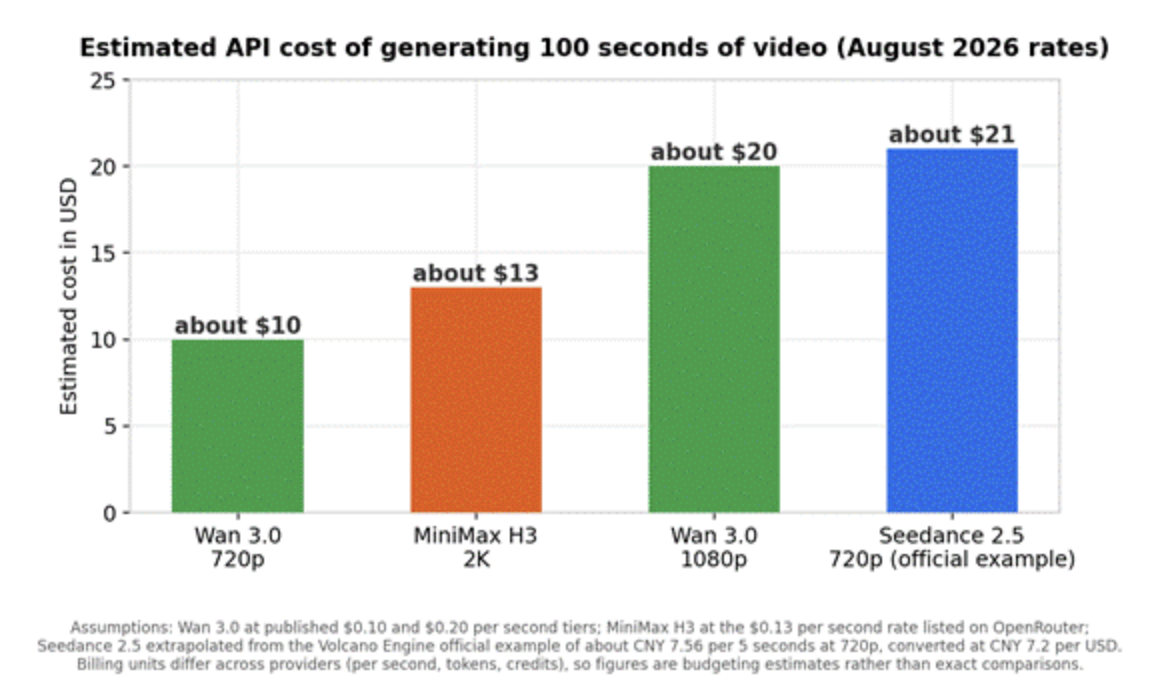
Figure 4. Estimated cost of generating 100 seconds of video through each API at comparable working tiers. Assumptions and the non-comparability of billing units are stated below the chart; treat these as budgeting estimates.
Real-World Cost Scenarios
The scenarios below are estimates built on the published rates above, with the arithmetic shown so the assumptions are auditable. Real spend will run higher once failed generations, retries, and reference-input surcharges are included; a planning buffer of 30 to 50 percent over these figures is realistic for new adopters.
- Scenario A, solo creator, 20 clips of 10 s per month. H3 at 2K: 20 x 10 s x $0.13 = $26. Wan 3.0 at 720p: 20 x 10 s x $0.10 = $20. Seedance 2.5 at the official 720p example rate: 20 x 10 s x ~$0.21 = ~$42.
- Scenario B, agency, 100 ad variations of 8 s. H3: 100 x 8 s x $0.13 = $104. Wan 3.0 at 1080p: 100 x 8 s x $0.20 = $160. Seedance 2.5 at ~$0.21 per s = ~$168, before the higher-resolution tiers a hero asset would actually use.
- Scenario C, developer, 1,000 clips of 6 s via API. Wan 3.0 at 480p: 1,000 x 6 s x $0.05 = $300; at 720p, $600. H3 at 2K: $780. Seedance 2.5 at ~$0.21 per s: ~$1,260.
- Scenario D, local H3-Base deployment. No per-clip fee, but the documented lossless recipe calls for two RTX 5090-class GPUs and a very large-memory host; output tops out at 768p, and the Community License must actually apply to the organization and territory. Local economics only beat Scenario C-style API spend at sustained high volume.
When Seedance 2.5 Is Probably Not the Best Choice
Anyone who needs a callable API this week with predictable flat pricing, anyone publishing high volumes where per-clip cost dominates, and anyone requiring local deployment should look elsewhere. Access friction is real: the first-party channels are China-first, the international enterprise route requires business verification, and effective pricing varies enough by channel to complicate budgeting. A solo creator on a modest budget will find the credit burn discouraging for daily use.
When MiniMax H3 Is Probably Not the Best Choice
A workflow built around continuous takes longer than 15 seconds fights the model's ceiling, and stitching or extending is a workaround rather than a native strength. Organizations in the US, EU, UK, or South Korea cannot rely on the open weights, and enterprises above the license's revenue threshold need written authorization, so any plan whose core premise is self-hosted H3 in those jurisdictions is not currently executable. Teams whose deliverable is a single flawless hero asset will often find Seedance 2.5's control worth its premium. Procurement processes sensitive to pending litigation may also move slowly here.
When Wan 3.0 Is Probably Not the Best Choice
A deliverable above 1080p rules out the model today, since no 4K tier exists, regardless of what reseller pages claim. Production systems cannot yet rely on an application-gated beta, and researchers get nothing from a closed model whose famous open heritage ends with earlier versions. Character-brand builders needing tight cross-generation identity tooling will find the current documentation thinner than either rival's.
Which One Should You Choose? A Short Decision Tree
- Is local or self-hosted deployment mandatory? Yes: H3-Base where the Community License and territory permit; otherwise the legacy Apache 2.0 Wan 2.x models. Neither Seedance 2.5 nor Wan 3.0 runs locally. No: continue.
- Do shots need to run longer than 15 seconds in one take? Yes: Seedance 2.5 when fidelity and reference control lead; Wan 3.0 when budget leads, or the source material is a document. No: continue.
- Is a production-ready API needed this month? Yes: MiniMax H3. No: continue.
- Is the raw input a deck, spreadsheet, PDF, or webpage? Yes: Wan 3.0. No: continue.
- Does the project demand maximum control: dense references, region edits, multilingual dialogue? Yes: Seedance 2.5. No: MiniMax H3 is the sensible default for everything shorter than 15 seconds.
Final Verdict
Seedance 2.5, MiniMax H3, and Wan 3.0 each emphasize different parts of the AI video workflow. Seedance 2.5 focuses on longer cinematic generation, dense reference control, and detailed editing options. MiniMax H3 places more emphasis on API accessibility, predictable per-second pricing, native audio, and editing workflows. Wan 3.0 combines longer single-pass generation with lower-cost tiers and document-driven inputs.
The most suitable option depends on the requirements of the project rather than on a single overall ranking. Factors such as clip length, output resolution, reference support, pricing structure, API availability, licensing terms, and deployment needs can all affect which model is practical for a particular workflow.
Because these platforms are still evolving, capabilities, pricing, access conditions, and licensing terms may change. Teams evaluating them should review the latest official documentation and test the models against their own production requirements before making a long-term decision.
Comments
Comments are available to signed-in users and are moderated to keep the discussion useful and respectful. Spam, automated submissions, and low-value promotional comments are removed. Outbound links may be approved when they are relevant and genuinely helpful to readers, but they are displayed as plain text rather than clickable hyperlinks.
No comments have been published yet.
Please sign in to submit a comment.