

Network, Technology, Information Technology
How to Choose a Cable Certifier for Cat6 and Cat6A Installations
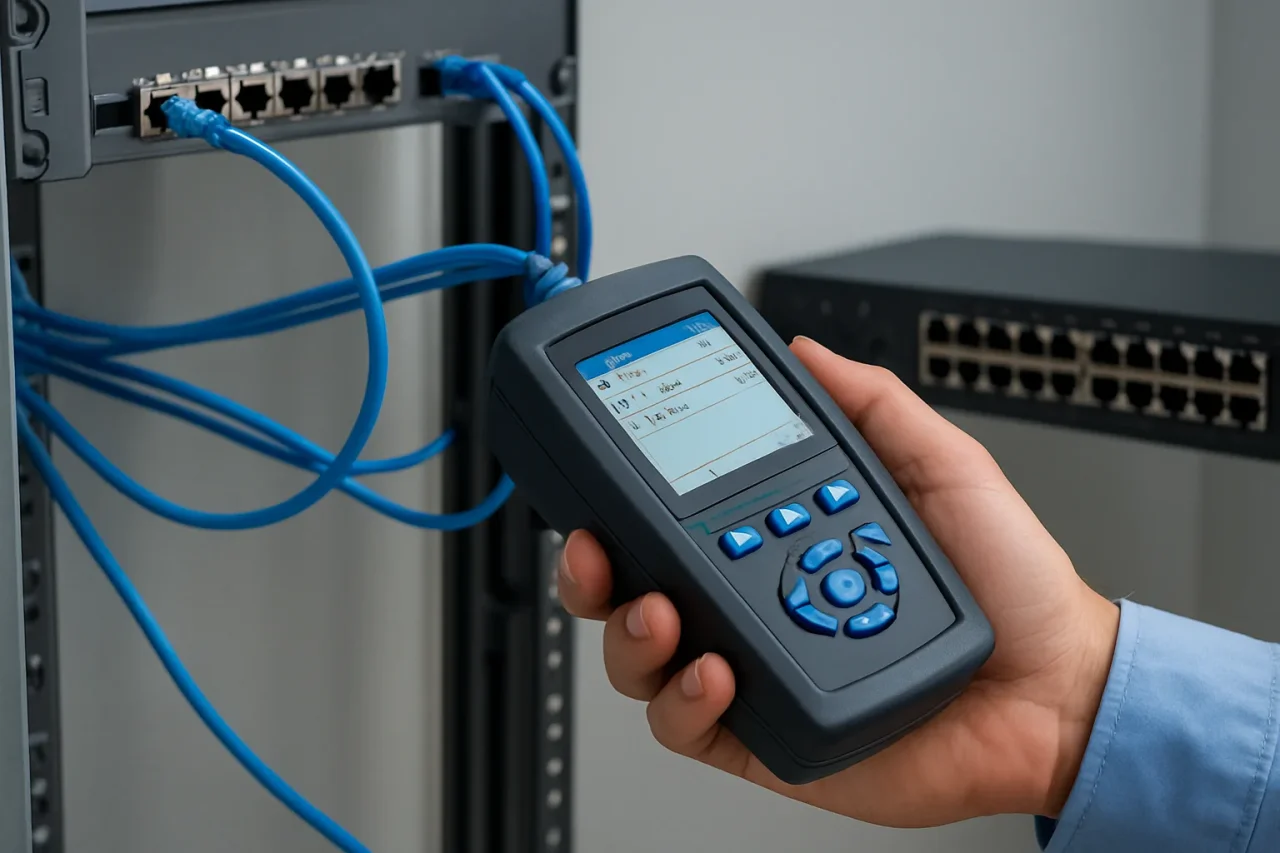
Selecting the right Cat6/Cat6A cable certifier can feel like navigating a maze of technical specifications, test standards, and performance claims. The choice you make directly affects whether your installation meets industry requirements, qualifies for manufacturer warranties, and delivers the network performance your client expects.
The stakes are high, and the differences between models are not always obvious. A wrong decision can lead to rework, disputed test results, or voided warranties. This article focuses on what actually matters when comparing certifiers, so you can choose with confidence rather than guesswork.
What Cable Certification Proves About an Installed Link
Cable certification is the most rigorous level of testing for structured cabling. It confirms whether a link meets TIA or ISO performance requirements. But its real value lies in understanding what the results actually mean — and how certification differs from simpler test methods.
The Difference Between Verification, Qualification, and Certification
These three terms are often confused, yet they represent very different levels of testing. Before looking at what a cable certification tester offers, it helps to see how each approach fits into the broader picture of structured cabling testing:
- Verification confirms basic connectivity — wire mapping, continuity, and proper pin-to-pin termination. It does not test whether the link supports high-speed data.
- Qualification checks if the link can support specific applications like Gigabit Ethernet. However, it lacks standardized test procedures and accuracy requirements, so results are not comparable across brands or accepted for manufacturer warranties.
- Certification is the only method that fully complies with TIA and ISO standards. It measures multiple parameters across the full frequency range and determines whether the link meets the requirements for its designated category.
How a Certifier Compares Measurements with a Selected Test Limit
You select the performance standard and test configuration, and the certifier measures parameters like wire map, insertion loss, return loss, and NEXT across the required frequency range. Each result is compared against stored pass/fail limits — for example, Cat 6A sweeps from 1 to 500 MHz, while Cat 8 goes to 2000 MHz.
What a Pass or Fail Result Does and Does Not Confirm
A passing certification result confirms the link meets the selected standard — the evidence manufacturers require for warranty coverage. However, it does not guarantee support for every possible application; a Cat 6A link works with current 10GBASE-T networks, but future standards may demand more.
A failing result does not always mean the cable is unusable. A link that fails Class EA certification may still handle 1000BASE-T without issue, since that application requires less bandwidth than the standard tests. The practical impact depends on the actual network in use.
Define the Project Requirements Before Comparing Certifiers
Before you start comparing models, take a step back and define what the project actually demands. Doing so prevents investing in a Cat6A cable testing solution that is either insufficient or overpowered for the job. Getting the requirements right means knowing what you need to test against and how much testing lies ahead.
Confirming the Required Category, Test Standard, Project Specification, and Warranty Requirements
Before choosing a cable certification tester, confirm the key requirements that will shape your decision:
- Cabling category — Cat 6 or Cat 6A? Each has different frequency requirements and test limits.
- Test standard — TIA or ISO? Most certifiers support both, but verify before purchase.
- Project specifications — Some clients require additional parameters like resistance unbalance for PoE support.
- Warranty requirements — Most manufacturers require certification with a Level IV (or higher) tester to validate system warranties. Endorsed models should carry extra weight.
Estimating the Number of Links, Testing Schedule, and Team Workload
The number of links and the available testing window determine how much throughput you need from a certifier. For large installations, faster autotest times and durable hardware become practical necessities. Smaller projects can be managed with more basic instruments.
The testing schedule also matters — tight deadlines demand speed, efficient data handling, and minimal downtime between tests. Team workload is equally important: if multiple technicians work in parallel, consider whether a single certifier per team suffices or whether remote monitoring and coordination across several units would improve workflow and reduce bottlenecks.
Choose the Correct Certification Test Configuration
Cable certification standards define several test configurations, and each applies to different scenarios. Understanding these distinctions ensures you select the right adapters and test limits for the job. Here, the choice comes down to where the test begins and ends — and which part of the installed system you actually need to validate.
Determining When Permanent Link Testing Applies
Permanent link testing covers the fixed infrastructure — cable, patch panels, and outlets — excluding the patch cords to equipment. It verifies the installer’s work and isolates results from variables like patch cord quality. This configuration requires specific adapters, so the instrument must support permanent link interfaces.
Determining When Channel Testing Applies
Channel testing covers the permanent link plus the patch cords to devices, representing the complete end-to-end path. It helps verify the entire system, especially when customers supply their own cords. However, this configuration offers more headroom and can mask faults in the fixed infrastructure, which is why permanent link testing remains the standard for new installations.
Determining When MPTL or Patch Cord Testing Applies
MPTL (Modular Plug Terminated Link) testing applies when cables end with modular plugs instead of jacks — common in PoE lighting and industrial settings. Patch cord testing verifies the short cables between devices and outlets, ensuring these replaceable components do not degrade performance. Some certifiers offer dedicated adapters for this purpose.
Matching Test Adapters and Test Limits to the Installed Link
The test adapters you use must match the connectors on the installed cabling. For most installations, standard RJ45 adapters suffice. However, some scenarios require other connector types such as Tera, GG45, or ARJ45.
Also, ensure that the cable certifier calibration and test limits align with the installed category. Testing Cat 6A requires a certifier that supports frequencies up to 500 MHz. Testing Cat 8 demands support up to 2000 MHz.
Compare Measurement and Diagnostic Capabilities
Not all Cat6 cable testing instruments offer the same capabilities. The right choice depends on what the certifier supports, how accurately it measures, and whether it helps you locate faults when failures occur.
Checking Supported Categories and Test Frequency
The supported categories and maximum test frequency determine which cabling systems the certifier can handle. Entry-level certifiers might only support Cat 6. High-end models extend to Cat 8 and frequencies up to 2000 MHz.
For Cat 6A installations, the certifier must support testing up to at least 500 MHz. Some instruments go further, providing additional confidence for higher-frequency measurements.
Confirming the Required Field Tester Accuracy
Accuracy is critical for any cable certification tester, defined by standards like TIA-1152-A and IEC 61935. Look for Level IV or higher — Level 2G or VI delivers the most reliable results, especially for high-performance systems, with independent testing from organizations like Intertek (ETL).
Understanding Which Cable Parameters the Certifier Tests
A cable certification tester measures wire map, length, delay, resistance, insertion loss, return loss, NEXT, and derived values like ELFEXT and power sum. Additional tests for PoE (resistance unbalance), 40GBASE-T (alien crosstalk), and EMI immunity (TCL/ELTCTL) may also apply.
Reviewing Margin-to-Limit Results
Margin-to-limit — how far a measurement sits from the pass/fail boundary — reveals more than a simple pass or fail. A link with a wide margin is likely to perform reliably over time, while one that barely passes may be vulnerable to degradation.
Using Diagnostics to Identify the Location and Possible Cause of a Failure
When a link fails certification, the next step is to find out why. Advanced certifiers offer diagnostic capabilities that locate the source of the problem. For example, HD TDR and HD TDX diagnostics can pinpoint the distance to a return loss fault or a NEXT failure.
Evaluate Testing Speed and Field Usability
Certification testing happens in the field, often under tough conditions. Speed and usability directly affect how much you get done and how reliable the results are. That means looking at autotest time, battery life, durability, and how easy the device is to operate on site.
Comparing Autotest Time and Practical Daily Testing Capacity
Autotest time is the duration required to complete a full set of measurements for a single link. Manufacturers often highlight this specification because faster tests mean higher daily throughput.
Modern certifiers can complete a Cat 6A autotest in 8 to 10 seconds. However, real-world testing involves more than just the autotest. Setting up the tester, connecting to the link, and managing results add to the total time per link. Instruments that streamline these ancillary tasks can have a greater impact on daily capacity than the autotest time alone.
Considering Battery Life, Durability, and Working Conditions
Field testing can involve long hours on construction sites or in server rooms. Battery life should comfortably cover a full working day — typically around 8 hours. Consider whether spare batteries or rapid charging options are available.
Durability matters for equipment that gets handled frequently and transported between sites. Look for instruments with rugged cases, drop protection, and environmental specifications that match the working conditions.
Assessing the Interface, Main and Remote Unit Workflow, and Ease of Test Setup
The user interface influences both the speed of testing and the likelihood of errors. Touchscreen interfaces and intuitive menus help technicians of varying skill levels set up the instrument correctly.
Look for project management features that allow you to define the job requirements once and then apply them consistently across all tests. This reduces the chance of misconfiguration and ensures that every link is tested against the same criteria.
The remote unit workflow also matters. Testers that display results on the remote unit can help with troubleshooting and verification.
Review Reporting and Test Result Management
Certification testing generates a significant amount of data. Managing that data effectively is essential for project handover, warranty claims, and future reference. Three aspects deserve attention here: recording, sharing, and traceability.
Recording Cable IDs, Test Limits, and Complete Measurement Results
Each certified link needs to be properly identified. The certifier should allow you to record cable IDs that match the installation documentation. This traceability is essential for identifying specific links in the event of future issues. The certifier should also record the test limits applied to each link.
Exporting and Sharing Certification Reports with Clients and Project Teams
Certification reports are often required as part of project handover. The software that accompanies the certifier should allow you to generate professional reports that include all measurement data. Some platforms offer cloud-based access to results, enabling project managers to monitor progress in real time.
Maintaining Traceability for Failed Links, Repairs, and Retesting
When a link fails, the certifier should record the failure details. After the repair, the retest should be traceable to the original test. This documentation provides a complete history of the link’s performance and helps confirm that all issues have been resolved.
Consider Calibration, Support, and Long-Term Ownership
The purchase price of a cable certifier, calibration, and ongoing support is an important factor in the total cost of ownership. Beyond the initial investment, three areas deserve attention: calibration, ongoing support, and future readiness.
Checking Calibration Status and the Manufacturer’s Recommended Service Interval
Certifiers require regular calibration to maintain their accuracy. The manufacturer’s recommended service interval is typically one year. Check the calibration status of any used or rented instrument, and budget for periodic recalibration.
Some manufacturers offer service contracts that include calibration, repairs, and software updates. These can simplify ownership and ensure the instrument remains compliant.
Evaluating Adapter, Accessory, and Software Availability
As cabling standards evolve, your testing needs may change. Instruments with modular designs allow you to add capabilities — such as fiber testing modules — without replacing the entire system.
Consider whether the manufacturer offers the adapters you need today and whether they are likely to support future connectors. Similarly, check that software updates are available to support new standards and features.
Reviewing Training, Technical Support, and Future Testing Needs
Technical support can be a differentiator, especially for large projects. Ensure the manufacturer or distributor offers responsive support and clear documentation.
Training is also worth considering. Some certifiers offer online resources, videos, or certification programs to help teams get the most out of their investment. The easier the instrument is to use, the less training is required — but even the best interface benefits from some familiarization.
Making the Right Call for Your Installation
Choosing the right copper cabling instrument isn’t about picking the priciest model. The real value lies in matching capabilities to project demands — the category, scale, field conditions, and team that will use it. A Cat6/Cat6A cable certifier that fits the job reduces rework and supports warranty claims.
Cable test reports and long-term reliability depend on using the correct tool correctly — verifying compliance, maintaining calibration, and training the team. Ultimately, the right certifier is the one that helps you deliver a passing result on every link, on time, with no surprises.
Comments
Comments are available to signed-in users and are moderated to keep the discussion useful and respectful. Spam, automated submissions, and low-value promotional comments are removed. Outbound links may be approved when they are relevant and genuinely helpful to readers, but they are displayed as plain text rather than clickable hyperlinks.
No comments have been published yet.
Please sign in to submit a comment.