

Internet of Things, Real Estate, Sustainability
Building Automation Software: Where Real Estate and Energy Management Meet
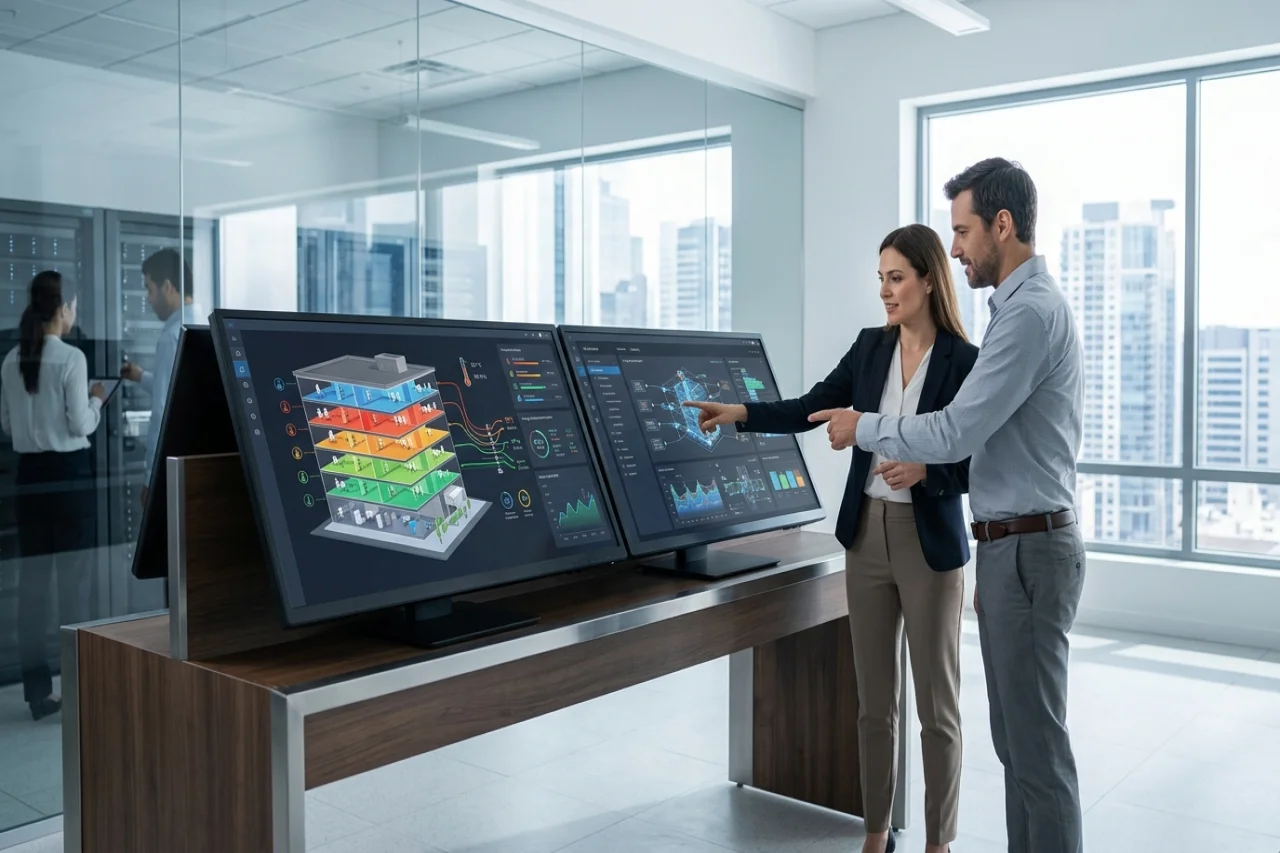
Building automation software was once mainly used by facility teams. It was mostly about controlling things like heating, cooling, and other building systems. But now, it has become much more important.
Today, this software helps real estate teams run buildings better and helps energy teams reduce energy use. Both teams often use the same software to manage the building and save energy. This article explains what building automation software does, what problems remain, and how real estate and energy systems can work together effectively.
What Building Automation Software Actually Does
A building automation system, usually shortened to BAS or sometimes called a building management system (BMS), is the software layer that connects and controls a building's mechanical and electrical systems from one place. HVAC, lighting, security access, fire alarms, and ventilation all report to it, rather than running as separate, manually adjusted systems.
Most BAS platforms are built on three layers. At the bottom sits the field level, the sensors and actuators physically reading temperature, occupancy and airflow. Above that is the automation level, the controllers that act on that data in real time. On top is the management level, the dashboard where a facilities or energy manager actually sees and adjusts what's happening across the building.
Those layers talk to each other through communication protocols like BACnet, Modbus and, in older installations, LonWorks. This part usually gets a single sentence in most guides to the topic, but it matters more than that treatment suggests. It's the reason a five-year-old lighting system often can't talk cleanly to a new energy monitoring platform without a costly integration project, and it's the single biggest hidden cost in most automation upgrades.
The Real Estate Side: PropTech, Digital Twins, and What Buyers Want
Building automation software has become an important part of real estate technology. Developers and property managers use it to create digital twins, understand how people use a building before renting it, and give tenants an app to control their own space.
This means tenants can make changes themselves instead of calling the front desk.
That shift changes who owns the problem. A building's automation platform increasingly has to communicate with leasing systems, tenant experience apps, and property management software, none of which a controls contractor or hardware vendor typically builds. Connecting these systems may require real estate software development services alongside traditional controls integration, particularly when existing property software lacks the necessary integrations or APIs. This is where many automation projects can stall: the hardware may be installed correctly, but the software layer still needs to connect it to the rest of the property's technology stack.
The Energy Side: What an EMS Saves and Why It Is More Complex
An Energy Management System (EMS) is usually a section of a larger Building Automation System (BAS). Its main job is to track energy use and help reduce it. BAS focuses more on comfort, safety, and overall building control. Many companies say that a well-managed EMS can reduce a building's energy costs by almost half. Most of these savings come from using smart lighting and HVAC schedules, not from buying new hardware.
What's changing that math further is what's now sitting behind the meter. As buildings add solar, battery storage, and EV charging, the EMS isn't just tracking fixed consumption anymore; it's managing variable generation and storage decisions in near real time. These requirements can go beyond the HVAC scheduling logic that many legacy EMS platforms were originally designed to handle. In some cases, custom energy software solutions may be used to address specific integration, monitoring, analytics, or energy management requirements that are not supported by existing systems.
Why So Many Buildings Are Still Stuck with Siloed Systems
Ask most building owners why their automation setup feels disjointed, and the answer usually traces back to the protocol layer mentioned earlier. HVAC, lighting, and security were automated at different times, by different vendors, on different standards. Every guide to this topic notes that BACnet, Modbus and LonWorks exist. Fewer point out that property and energy teams pay for that fragmentation every time they add a new vendor or try to pull unified data across their portfolios.
Retrofitting older buildings compounds the problem. A system installed a decade ago on a proprietary protocol often can't be opened up cheaply, which is why so many BAS projects turn into either an expensive rip-and-replace or a permanent patchwork of point solutions that never quite talk to each other.
Build versus Buy: The Question Most Vendor Comparisons Skip
Search around this topic, and you'll mostly find two kinds of content: vendor comparison lists (Johnson Controls, Siemens, Honeywell, Schneider Electric and the rest) or general explainers on what a BAS is. What can receive less attention is the software layer that sits above traditional building controls.
Custom dashboards built around how a specific portfolio actually operates, integration between the BAS and existing leasing or property management software, digital twin overlays, and predictive maintenance models trained on a building's own equipment history all extend beyond basic building controls. These capabilities may require additional software integration, depending on what the existing BAS and property systems already support.
This is usually the point where the real estate platform layer and the energy management layer need to be considered together rather than treated as separate systems. Connecting the two can help create a more unified software environment for building operations, property management, and energy data.
What to Look for in Building Automation Software
- Open protocol support: Compatibility with protocols such as BACnet and Modbus can make it easier to integrate equipment from different manufacturers.
- APIs and integrations: The software should be able to exchange data with relevant leasing, property management, tenant, and energy systems.
- Detailed energy data: Useful analytics can help teams understand consumption patterns and identify opportunities to reduce energy use.
- Scalability: Organizations managing multiple properties should consider whether the software can support additional buildings and systems over time.
- Security and data protection: Appropriate safeguards are particularly important when systems collect information about occupants, building access, or operational activity.
The Bottom Line
Building automation software is no longer only for facility teams. It is now an important part of both real estate and energy management. The buildings that get the most value from it use software that connects both areas. It is not just about installing hardware and having a dashboard that only the facility team uses.
FAQ
Frequently Asked Questions
01What's the difference between a BMS and a BAS?
In practice, the terms are used interchangeably. Where a distinction is drawn, BMS usually refers to the broader building-wide platform, while BAS can refer more narrowly to the automated control logic within it. Most vendors and buyers don't separate the two in everyday use.
02How much does a building automation system cost?
It depends heavily on building size, how many systems are being integrated, and whether the project is new construction or a retrofit of legacy controls. Retrofits typically cost more per square foot than new builds, largely because of the protocol and integration issues covered above.
03What should you look for in building automation software?
Important considerations include compatibility with existing building systems, support for open protocols, APIs, and integration options, energy monitoring and analytics, scalability, remote management, and security. The right combination of features depends on the building's existing infrastructure and operational requirements.
Comments
Comments are available to signed-in users and are moderated to keep the discussion useful and respectful. Spam, automated submissions, and low-value promotional comments are removed. Outbound links may be approved when they are relevant and genuinely helpful to readers, but they are displayed as plain text rather than clickable hyperlinks.
No comments have been published yet.
Please sign in to submit a comment.