

Best Automated Vial and Syringe Inspection Machines: 2026 Review
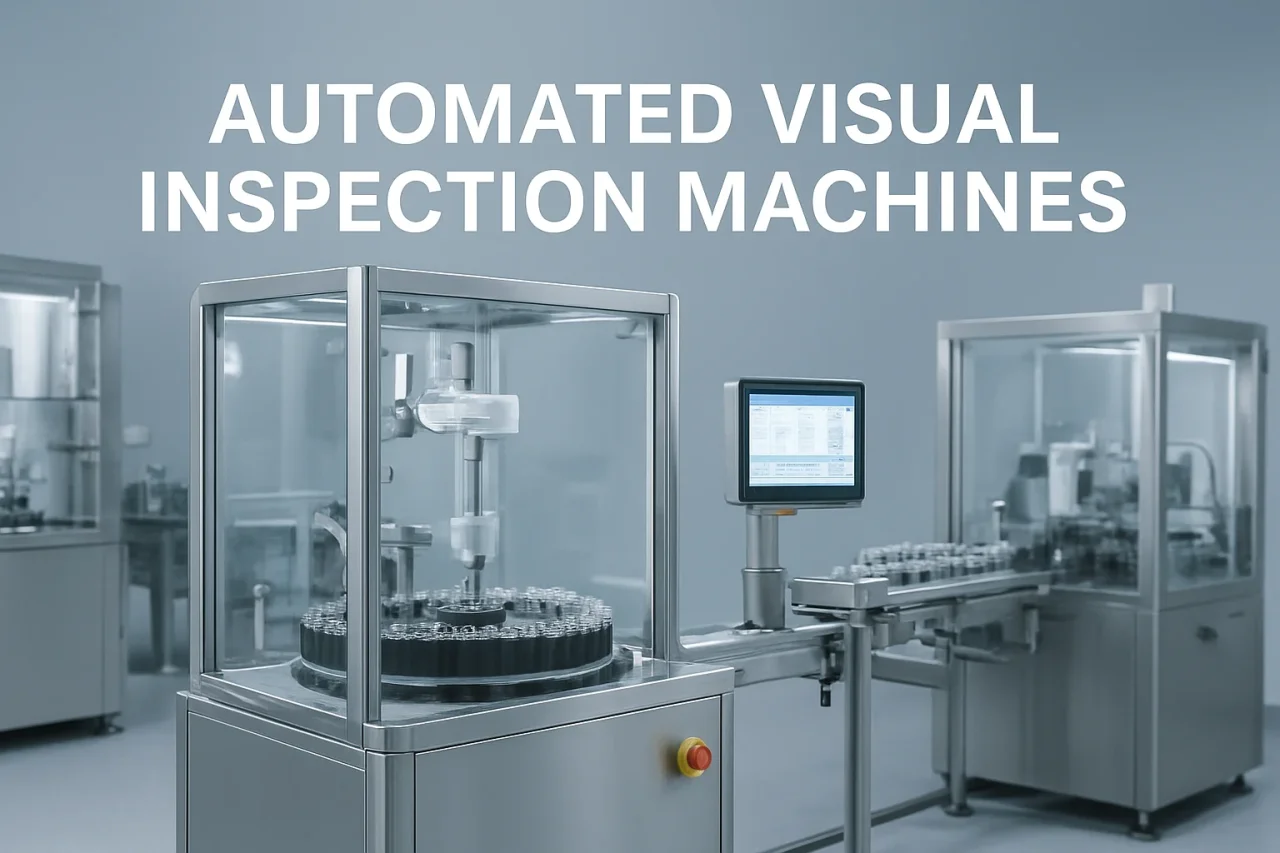
Automated visual inspection (AVI) is the last check between a filling line and a patient, and in 2026 the market has split into two camps. High-speed carousel platforms from Syntegon, Körber, Brevetti CEA and Antares Vision inspect 300 to 600 or more containers a minute and suit large runs of uniform product. AI-first platforms such as Dabrico's DAI-50 trade raw speed for fast setup and high accuracy on difficult-to-inspect products: lyophilized cakes, powders, suspensions, molded glass and translucent syringes.
We reviewed each provider's flagship machines, pricing guidance and published results. All figures come from vendor product pages, press releases and case studies, current as of October 2026.
| # | Provider | Flagship machines | Top speed | Best for |
|---|---|---|---|---|
| 1 | Dabrico (USA) | DAI-50 | 50 units/min | Difficult-to-inspect products; small and mid-size batches; vials, syringes and ampoules on one machine |
| 2 | Syntegon (Germany) | AIM 9, AIM 5, AIM DIRect | 600 vials/min | High-volume vial lines; nested syringe lines |
| 3 | Körber (Germany) | Seidenader VI, VI-S, Switch | 600 units/min | High-volume lines that need many inspection stations and leak detection |
| 4 | Brevetti CEA (Italy) | K32S, K15 DR | 600 units/min | High-speed syringe lines with zero-contact handling |
| 5 | Antares Vision (Italy) | VRI, Convel Tech | 400 units/min | Inspection combined with serialization and traceability |
1. Dabrico
Intro and background
Dabrico has built visual inspection equipment for injectable products for 47 years from its base in Bradley, Illinois. Its range runs from manual inspection hoods and semi-automated machines to fully automated AI inspection, with more than 900 systems installed for over 100 customers worldwide. The company focuses on difficult-to-inspect products, the ones high-speed carousel machines struggle with.
Machine: DAI-50
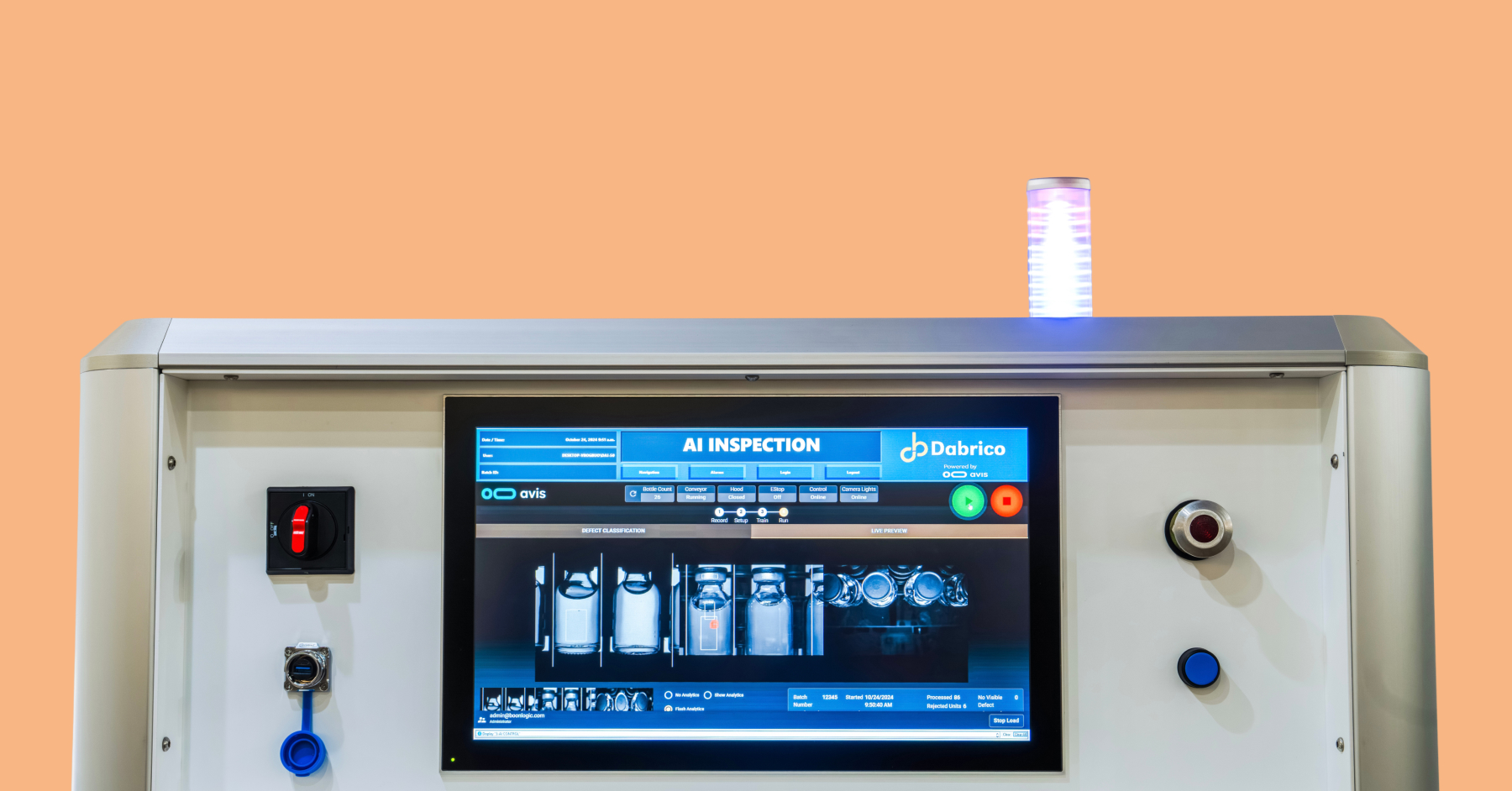
The DAI-50 is a fully automated visual inspection machine powered by Boon Logic's AVIS platform. Instead of learning from a library of defect images, AVIS uses unsupervised machine learning to model the normal variation in compliant units, then flags anything that falls outside it. That lets it catch known and previously unseen defects without labeled training data.
- Speed: 50 units per minute, about 3X the speed of semi-automated inspection.
- Containers: vials (molded and tubular glass), prefilled syringes and ampoules from 1 mL to 1,000 mL.
- Products: clear liquids, suspensions, milky or opaque liquids, bubble-prone protein formulations, lyophilized cakes and powders.
- Optics: five cameras at 60 frames per second (backlit sidewall, side-lit sidewall, overhead, oblique, and one configurable camera), with a controlled pre-spin and 360° rotation.
- Recipe setup: trains on 500 pre-inspected compliant units in less than 60 minutes; no computer vision expertise needed.
- False ejects: <1% on standard products and <3% on difficult-to-inspect products.
- Qualification: follows standard IQ, OQ, PQ, with sites reaching GMP readiness in under six weeks on average.
Pricing
The DAI-50 starts at $500,000. Final pricing depends on the container formats, change parts, license duration and integration requirements.
Verified results
Powder-filled molded glass vials. A contract manufacturer kept failing AQLs on its semi-automated inspection of 20 mL powder-filled molded glass vials, where uneven powder and natural glass variation hid real defects. Traditional AVI was ruled out as too complex for the product. Dabrico's automated vial inspection case study walks through the on-site evaluation that followed: the DAI-50 built its recipe from 500 compliant vials within hours, then inspected a customer-defined defect set and a holdback set of unseen compliant vials. It reached 98% detection with a 2.7% false reject rate, and the CMO used the results to secure funding for the system.
Prefilled syringes. A major pharmaceutical manufacturer had about 10 million prefilled syringes, worth around $3.2 million, held in quarantine after a short-shot defect in the protective cap slipped past its semi-automated inspection for weeks. The caps wobbled as they rotated, which defeats rule-based machine vision, and an earlier attempt with traditional AVI had produced too many false rejects. Moving to automatic inspection of prefilled syringes with the DAI-50 solved it: the machine learned how the caps normally move and detected the short-shot defect 100% of the time, so the manufacturer could reinspect the held product and resume production. In wider syringe feasibility testing, it detected plunger defects at 100%, needle assembly defects at 97.5%, cap and seal defects at 97% and particulates at 93%.
2. Syntegon
Intro and background
Syntegon began in 1969 as Robert Bosch Apparatebau, later Bosch Packaging Technology, and has operated independently under the Syntegon name since leaving the Bosch Group in 2020. The company is headquartered in Waiblingen, Germany, and employs about 6,300 people across pharma and food. Its inspection line draws on more than 50 years of experience and a Japanese heritage through Eisai Machinery, with more than 1,500 inspection machines in the field.
Machines: AIM series
Syntegon's AIM machines are built for high-speed lines and use its patented Static Division (SD) technology, plus area-scan and line-scan cameras, to find particles and cosmetic defects.
- AIM 9: up to 600 vials per minute, with optional HVLD or headspace analysis (HSA) leak detection and built-in reinspection.
- AIM 8+: up to 450 containers per minute, built for customization and difficult products, with optional AI.
- AIM 2|5: up to 400 containers per minute across a wide range of containers, with optional AI and leak detection.
- AIM DIRect: de-nests, inspects and re-nests ready-to-use prefilled syringes at up to 400 per minute, with no glass-to-glass contact.
- AIM PREP: an offline unit that replicates an AIM setup so teams can build recipes without stopping production.
Pricing
Syntegon doesn't publish pricing; machines are quoted per project. Industry guides put high-speed AVI machines at $1 million to $4 million, plus ongoing maintenance plans.
Verified results
AI syringe inspection at Amgen. Syntegon installed what it calls the first fully validated AI visual inspection system in a customer's automated production line, a syringe inspection machine at Amgen. At one inspection station, the deep learning system raised the particle detection rate by 70% and cut false rejects by 60% on average. Syntegon has since made AI selectable by default on its integrated AIM 5 syringe line, which inspects up to 18,000 syringes per hour.
3. Körber
Intro and background
Körber's inspection business is the former Seidenader Maschinenbau of Markt Schwaben, near Munich, which the Hamburg-based Körber Group bought in 2011. Körber traces its pharmaceutical inspection work back to 1895. Today the machines sit inside Körber's Business Area Pharma, alongside aseptic processing, packaging and MES software, so buyers can source a whole line from one supplier.
Machines: Seidenader platforms
Körber builds modular carousel platforms and adds inspection stations, leak detection and AI to suit each product.
- Seidenader VI, MS and CS: the core platforms, inspecting vials, ampoules, cartridges and syringes, including lyophilized product, at up to 600 containers per minute. They differ mainly in footprint and the number of inspection stations.
- VI-S and MS-S: syringe versions that pair with the DE.SY.RE de-nester and re-nester; nested syringes and cartridges can run at up to 1,000 per minute.
- Switch: a flexible platform for small batches that inspects syringes and vials on the same machine.
- Leak detection: HVLD modules for liquid products, built into the carousel or standalone.
- B.R.AI.N: supervised deep learning models that run on the inspection machine and can be retrofitted to existing systems.
Pricing
Körber doesn't publish pricing. Each line is configured and quoted per project, and high-speed platforms generally sit in the $1 million to $4 million range.
Verified results
AI false-reject reduction. Körber reports that B.R.AI.N cuts false rejects by up to 90% compared with conventional inspection, and a recent Körber press release cites up to 95%. Its gated AI case study reports false reject rates down by up to 81% and detection rates up by up to 35%. Körber hasn't published a named customer result with these figures.
4. Brevetti CEA
Intro and background
Brevetti CEA has built inspection machines for injectable products since the late 1950s from its headquarters in Sovizzo, near Vicenza, Italy. It focuses entirely on inspection and leak detection, with about 240 employees, 60 of them R&D and vision engineers, and branch offices in New Jersey and Mumbai. In 2025, it completed its acquisition of Brevetti AI, a Danish deep learning company formerly called Criterion AI.
Machines: K and A series
Brevetti's machines run on its Intelligent Vision Framework, which combines high-frame-rate cameras with proprietary vision software.
- K32S: vials, ampoules and cartridges up to 32 mm in diameter at 400 to 600 per minute. It handles water-like, oily, suspension and freeze-dried products, with three particle stations as standard and a hollow-spindle bottom view suited to vaccines and suspensions.
- K32S LD: adds high-voltage leak detection for liquids; headspace gas analysis covers freeze-dried product.
- K15 DR: de-nests, inspects and re-nests glass and plastic prefilled syringes at 600 per minute, with integrated leak detection and no worm screws in the handling.
- A30, A35 and A50: compact machines for vials, ampoules and cartridges at 150 to 300 per minute.
Pricing
Brevetti doesn't publish pricing. Machines are configured per customer and quoted per project; its high-speed K-series lines compete in the same $1 million to $4 million range as other carousel platforms.
Verified results
Installed base. Brevetti reports about 2,600 inspection machines installed for more than 2,000 customers, served through 35 sales agents and 15 certified service centers. It doesn't publish customer case studies with detection or false reject figures, so buyers should ask for reference sites and feasibility data on their own product.
5. Antares Vision
Intro and background
Antares Vision was founded in 2007 in Travagliato, near Brescia, Italy, and built its name on serialization and track-and-trace before expanding into inspection machines. In April 2026 the US industrial technology company Crane NXT completed its acquisition of Antares Vision for about €362 million and delisted it from Euronext Milan. It now sits in Crane NXT's Detection and Traceability Technologies segment.
Machines: VRI and Convel Tech
Antares Vision's distinguishing feature is pairing visual inspection with leak detection and serialization on one machine.
- VRI VI for vials: up to 400 vials per minute, with top handling for a clearer view of the vial heel.
- VRI Combined: adds high-voltage leak detection, vacuum decay or pressure decay at the same 400 per minute.
- VRI with Serialization: combines vial inspection with primary-pack serialization for full traceability.
- VRI VI for prefilled syringes: glass and plastic syringes up to 24 mm in diameter at up to 400 per minute, for water-like, oily, suspension, emulsion and gel products, with a secondary carousel for the barrel's dry zone and optional AI.
- Convel Tech (CM, C2, C3): visual inspection with high-voltage leak detection at 200 to 350 per minute.
Pricing
Antares Vision doesn't publish pricing. Lines are quoted per project, and machines that add leak detection or serialization cost more than inspection-only configurations.
Verified results
Blow-fill-seal inspection line. Antares Vision won the 2022 Central Eastern European Pharmaceutical Manufacturing Excellence Award for a VRI line it built for a Polish pharmaceutical company. The machine inspects four large-volume blow-fill-seal formats for free-moving, heavy and floating particles and uses vacuum decay to find leaks. Its published case histories focus on service and track-and-trace projects, and it hasn't published detection or false reject figures for its inspection machines.
Choosing the Right Automated Visual Inspection Machine
The right machine depends on what you are inspecting, how fast you need to inspect it, and how much variation your product introduces.
For high-volume lines running uniform liquid-filled vials or nested syringes, the carousel platforms from Syntegon, Körber and Brevetti CEA are purpose-built for that workload. For difficult-to-inspect products — lyophilized cakes, powders, suspensions, molded glass, or translucent prefilled syringes — Dabrico's DAI-50 addresses the accuracy problem directly with unsupervised AI that trains on compliant units rather than defect libraries. If traceability and serialization matter as much as inspection, Antares Vision is the only provider on this list that combines both on a single platform.
All five providers offer feasibility testing before purchase. Given the cost of qualification and the consequences of a missed defect or excessive false rejects, running your actual product through a candidate machine before committing is the most important step any buyer can take.
Comments
Comments are available to signed-in users and are moderated to keep the discussion useful and respectful. Spam, automated submissions, and low-value promotional comments are removed. Outbound links may be approved when they are relevant and genuinely helpful to readers, but they are displayed as plain text rather than clickable hyperlinks.
No comments have been published yet.
Please sign in to submit a comment.