

Search Engine Optimization, Digital Marketing, Artificial Intelligence
Are Brand Mentions Replacing Backlinks in AI Search?
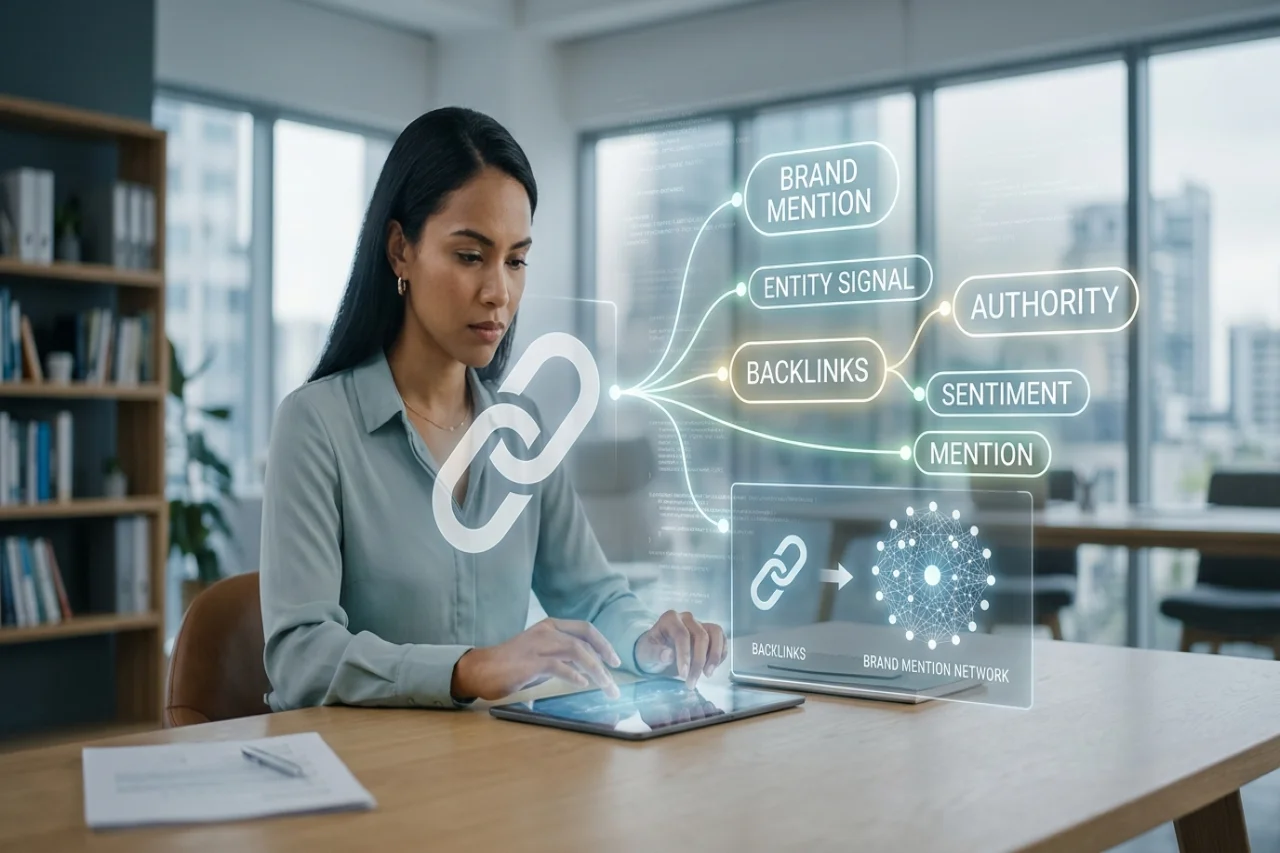
Type a question into Google now, and there's a chance you get an answer before clicking a blue link. Ask ChatGPT or Perplexity the same question, and you get a comprehensive answer with a citation. SEO strategy revolved around one core asset: the backlink. Now a quieter signal is showing up everywhere AI touches search, from Google's AI Overviews to chatbot answers to Knowledge Graph cards: brand mention.
What Are Brand Mentions?
A brand mention is any place online where your company, product, or domain name shows up, whether or not it comes with a clickable link. It could be a Reddit thread recommending your SaaS tool, a journalist naming you in an industry roundup, a G2 review, or a passing reference in a podcast transcript.
The 3 Types of Brand Mentions
Not all mentions look the same, and the distinction matters for how search engines and AI models treat them:
- Linked mentions: Your brand is named and hyperlinked. These pass the most direct SEO value, functioning like a standard backlink.
- Unlinked mentions: Your brand name appears in plain text with no hyperlink, sometimes called an implied link. No link equity is passed, but the citation is still there for search engines and AI models to read.
- Implied mentions: Nobody types your brand name at all, but the description is specific enough that readers (and increasingly, AI models) know exactly who's being referenced.
Brand Mentions vs. Backlinks
A backlink transfers link equity through its anchor text and hyperlink, directly influencing how a specific page ranks in traditional search. A brand mention works differently: it builds an entity signal that ties your brand name to a topic, a sentiment, and a level of trust, regardless of whether a hyperlink is attached. Backlinks remain the stronger lever for referral traffic and page-level ranking. Brand mentions are the stronger lever for how your brand gets recognized, summarized, and recommended across the wider web, including inside AI-generated answers.
How AI Search Processes Brand Mentions vs. Backlinks
Google's Entity-Based Approach
Google's ranking systems have moved from a purely link-based model toward one built around entities real-world people, brands, and concepts it can recognize, connect, and store inside its Knowledge Graph. Natural Language Processing (NLP) is what makes this possible. Instead of indexing words like "project management" and "collaboration" as isolated terms, Google's NLP models understand the relationships between them, as well as the sentiment behind a sentence and the context surrounding it.
When your brand is repeatedly mentioned near the same cluster of topics across credible, relevant sources, Google effectively builds a profile of who you are. That profile feeds directly into E-E-A-T (Experience, Expertise, Authoritativeness, Trustworthiness), the framework Google uses to judge whether your brand deserves to surface in search results, featured snippets, People Also Ask boxes, and the Knowledge Panel reserved for well-established entities. None of that requires a single backlink. It requires consistent, contextual brand mentions.
How LLMs Like ChatGPT, Gemini & Perplexity Read Your Brand
Large language models work differently from Google's real-time crawler. Tools like ChatGPT, Gemini, Claude, and Perplexity are trained on enormous datasets and, in the case of AI Overviews and Google AI Mode, layered with live retrieval. If your brand appears often enough, in the right context, across sources the model treats as trustworthy, it learns to associate your name with that topic.
This is the foundation of what's now called GEO (Generative Engine Optimization) and AEO (Answer Engine Optimization), optimizing not for a blue link on a results page, but for a mention inside a generated answer. It also explains why AI citations and AI mentions aren't quite the same thing. An AI citation links back to a specific source page, functioning much like a traditional referral click. An AI mention simply names your brand inside the answer, with no guarantee of a link or a visit a pattern closely tied to the broader rise of zero-click search, where users get what they need without ever leaving the results page.
Are Brand Mentions Replacing Backlinks?
What Backlinks Still Do Better
Backlinks haven't lost their job; they've just lost their monopoly. A backlink still passes link equity, a direct, page-level ranking signal search engines have relied on for over two decades. It remains one of the fastest ways to boost a page's domain authority, and it still generates measurable, trackable referral traffic via a clickable link and its anchor text. If you need one specific page to rank for one specific keyword in traditional Google search, a relevant backlink is still one of the most reliable levers you have.
What Brand Mentions Do Better (Especially in AI Answers)
Brand mentions build entity authority and brand authority at the company level rather than the page level, exactly the kind of signal AI models are trained to notice. Because mentions accumulate across dozens of independent sources (reviews, forums, roundups, social posts, podcasts), they create semantic relevance at scale: your brand becomes tied to a topic through sheer repetition and context, not a single engineered link. That repetition is also what drives AI visibility and share of voice inside tools like ChatGPT and Perplexity, where a name that shows up consistently across trusted sources is simply more likely to get named in the answer.
Why Brand Mentions Still Matter for SEO
Even with all this AI-era nuance, the brand mentions aren't a replacement strategy you switch to once backlinks stop working. They're a compounding asset that makes every other part of your SEO program work harder, including your link building.
For example, a single mention on a credible, relevant site does more than sit there looking nice. It reinforces E-E-A-T by showing that people other than you are talking about your product. It builds topical authority by tying your brand to the same handful of subjects again and again, until search engines and AI models treat that association as established fact rather than a claim you're making about yourself. It feeds branded search volume, since people who first hear about you through a mention. Unlinked mentions can usually be converted into backlinks with a short, polite outreach email; they often become the seed of your next link rather than a consolation prize for missing one.
This is exactly why a solid brand mentions and SEO strategy now sits alongside link building in any serious SEO plan. Digital PR teams already operate a mention in a respected trade publication builds entity signals whether or not the writer adds a hyperlink. Treating mentions as a monitoring and outreach channel separates brands that are merely present online from brands that algorithms have learned to trust.
Algorithms change, and Google's core updates have reshuffled entire link-based strategies overnight. Brand mentions, distributed as they are across dozens of independent sources, are far harder for any single update to erase. That makes a mentions-first authority strategy a genuine hedge against future search volatility, AI-driven or otherwise.
How to Build a Brand Mention Strategy for the AI Search Era
Earn Mentions Through Digital PR, Original Data & Guest Posts
The fastest way to earn credible brand mentions is to give people an actual reason to name you. Digital PR remains one of the most effective channels for this: pitching journalists a genuinely newsworthy angle a dataset and a survey finding. Publishing original research works when you're the source of a stat; other writers have to name you to use it, exactly the kind of citation LLMs are trained to recognize.
Guest posting earns its place here too. A well-placed, contextual mention inside a relevant, high-authority piece of content builds the same entity signal as digital PR coverage with the added benefit of a direct backlink.
Get Featured in Roundups, Reviews, and Communities
Buyers compare options long before they land on your homepage, often inside listicles, "best of" roundups, and comparison articles that AI tools frequently cite as sources. Find where your competitors already show up, then pitch a specific, genuine reason to be added. Reviews matter just as much: platforms like G2, Capterra, and Trustpilot generate detailed brand mentions in customers' own words.
Community platforms like Reddit and Quora deserve particular attention, since both are increasingly cited directly inside AI-generated answers. Genuinely useful participation in relevant threads, not forced self-promotion, earns organic mentions and user-generated content (UGC) no outreach campaign could manufacture. Micro-influencers in your niche can accelerate this further; their smaller, high-trust audiences often produce more authentic, citable mentions than a single large-reach placement.
Convert Unlinked Mentions Into Backlinks
None of this works if you're not tracking it. Start with Google Alerts for a free baseline, then move to dedicated social listening and brand monitoring tools as volume grows. For alerts, when someone adds your brand name to any online source, Google Alerts notifies you. When you spot an unlinked mention on a site worth a link, a short then you approach to author of the website y outreach email and asking them to link to the relevant page converts it into a backlink.
Final Thoughts
Brand mentions aren't replacing backlinks in AI search. Backlinks still help individual pages rank in traditional Google search. Brand mentions increasingly decide whether your brand gets recognized, summarized, and recommended when someone asks ChatGPT, Perplexity, or Google AI Mode a question in your category. Those businesses win who build both: treating every unlinked mention as a future link, every review as an authority signal, and every backlink as one part of a much wider entity profile.
Comments
Comments are available to signed-in users and are moderated to keep the discussion useful and respectful. Spam, automated submissions, and low-value promotional comments are removed. Outbound links may be approved when they are relevant and genuinely helpful to readers, but they are displayed as plain text rather than clickable hyperlinks.
No comments have been published yet.
Please sign in to submit a comment.