

AI Integration: Transforming Business Operations in 2026
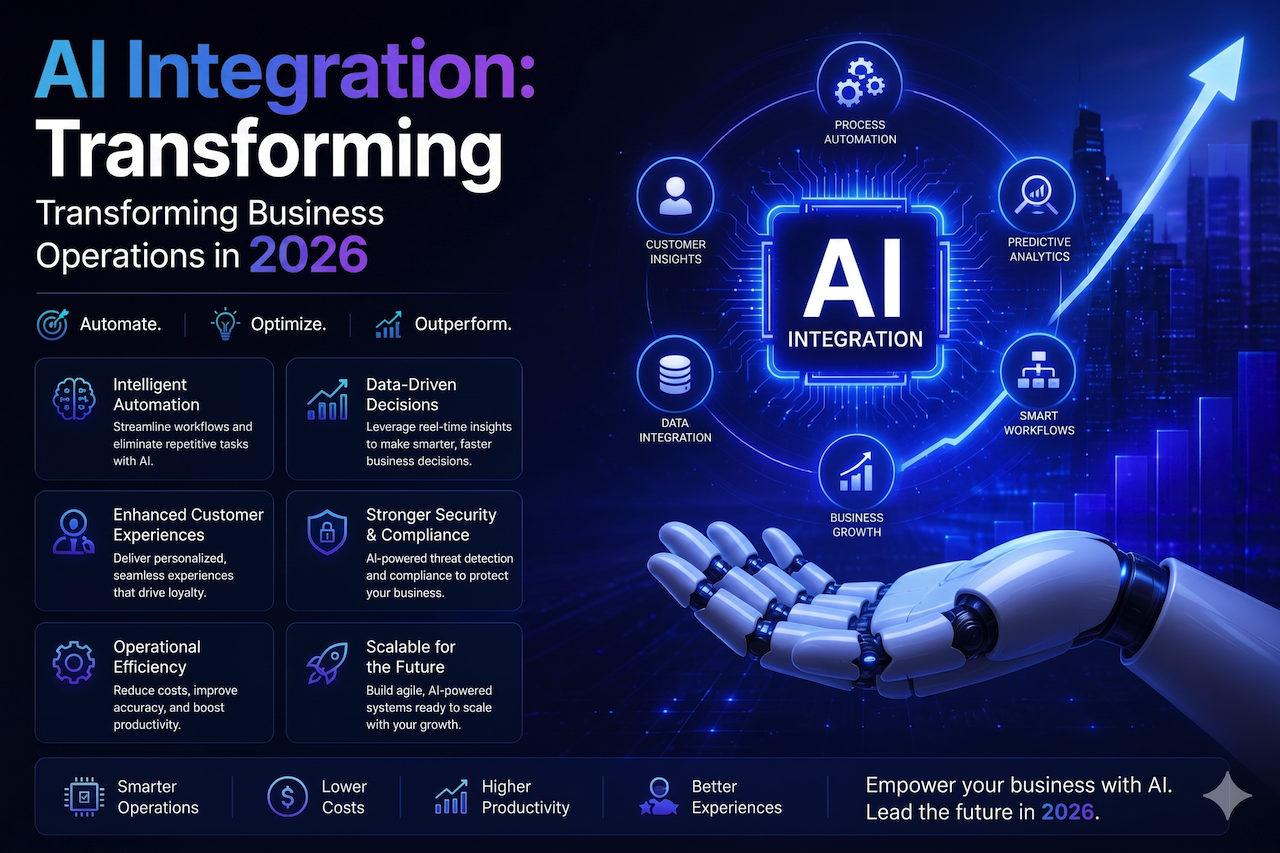
Artificial intelligence is an important asset for businesses now. It is not something that might happen in the future. In 2026, companies are using it to make their work easier, make customers happy, save money, and outperform competitors.
Artificial intelligence (AI) integration is vital. It connects these advanced tools with the systems that businesses already use. This helps companies work better and innovate. As companies try to use technology to improve their operations, they must learn how to make it a core part of their business.
This article explores how AI integration is changing business operations in 2026 and the capabilities these systems can provide.
Understanding Artificial Intelligence Integration
Artificial intelligence integration means putting smart capabilities into the software and systems that businesses already use. It does not replace existing systems but improves them by adding features that help leadership make better decisions, automate tasks, and surface useful information.
An integration strategy usually includes:
- AI strategy development
- Machine learning model integration
- Natural language processing implementation
- Predictive analytics deployment
- Chatbot and virtual assistant integration
- Workflow automation
- Data intelligence deployments
- Technology-powered customer experience enhancements
Organizations can adapt these capabilities to align with their unique business models and operational requirements.
Why AI Integration Matters in 2026
Businesses are dealing with massive amounts of data now. They generate a lot of information every day, and it is hard to get useful insights from it manually.
Integrating these systems helps with this by letting businesses:
- Look at a lot of data quickly
- Do tasks automatically
- Work better
- Make customers happy
- Reduce mistakes
- Improve business decisions
In 2026, companies that do not integrate AI into their work will fall behind competitors who use smart systems to work faster, better, and come up with new ideas.
Automating Routine Business Processes
One of the main benefits of integration is automation. Many companies still execute processes by hand, which takes a lot of time and money.
The technology can automate tasks like:
- Entering data into computers
- Processing invoices
- Scheduling appointments
- Answering customer questions
- Managing documents
- Tracking inventory
By automating repetitive tasks, employees can focus on work that requires creativity and human skills.
AI integration can help automate operational processes, improve efficiency, and reduce the time spent on repetitive tasks.
Enhancing Customer Experience
Customers expect a lot now. They want to be treated like they are special, get answers quickly, and enjoy a seamless experience on all platforms.
AI integration helps businesses achieve this by:
- Using chatbots that can answer questions and help customers at any time
- Giving customers personalized product and content suggestions
- Analyzing how customers feel about the business
AI integration can help businesses deliver more personalized customer experiences, improving satisfaction and loyalty.
Data-Driven Decision Making
In business today, companies cannot just make decisions based on what they think or feel. They need data to make strategic plans.
Integration helps with this by:
- Finding patterns in large pools of data
- Predicting what will happen in the future
- Spotting anomalies and things that are not normal
- Giving deep insights
- Helping with business forecasting
Managers can use these systems to make sharper decisions about money, daily operations, marketing, and resource allocation.
Improving Operational Efficiency
Companies want to remain competitive and sustainable. AI integration helps with this by optimizing processes across all parts of the business.
Examples include:
- Streamlining supply chains
- Managing workforce scheduling
- Improving day-to-day operations
By embedding intelligence deeply into their core systems, businesses can work faster, save money, and perform better.
Predictive Analytics for Business Growth
Predictive analytics is one of the most useful features of artificial intelligence in 2026.
Using historical and real-time data, integrated models can predict:
- What customers will do next
- What will happen in the market
- When equipment will break down
- When sales spikes or drops will happen
- Potential business risks
- Future changes in demand
This helps companies solve problems and take advantage of opportunities before others do. Organizations can also adapt predictive models to align with their industry, customers, and operational requirements.
Strengthening Cybersecurity and Risk Management
Cyber threats are getting worse, so businesses need strong security to protect their data and systems.
AI integration helps with this by:
- Finding threats in real time
- Preventing fraud
- Analyzing user behavior
- Watching networks for issues
- Responding to incidents automatically
These systems can find security problems much faster than traditional security tools. Organizations in industries such as finance, healthcare, and e-commerce use AI-powered security capabilities to strengthen protection and support regulatory compliance.
Transforming Human Resources
Human resources teams are using artificial intelligence to improve recruitment, employee engagement, and workforce planning.
System integration can help with:
- Automating the initial recruitment and screening process
- Analyzing employee data to improve retention
- Predicting future workforce needs
This helps human resources teams focus their energy on strategic work like managing and developing talent.
AI-Powered Marketing Optimization
Marketing relies heavily on data now. AI integration helps marketers achieve better results by automating and analyzing complex workflows.
Benefits include:
- Segmenting audiences automatically
- Making ad campaigns better in real time
- Analyzing customer journeys
- Delivering personalized content
- Scoring leads based on conversion probability
- Predicting future marketing performance
Businesses can integrate AI-powered tools into their marketing platforms to improve campaign performance and support more data-driven decision-making.
Industry-Specific Applications
AI integration is changing every industry in 2026.
- Healthcare: It helps with diagnoses, patient care, and personalized treatment plans.
- Retail: It is used for inventory management, recommendations, customer behavior analysis, and demand forecasting.
- Manufacturing: It is used for predictive maintenance, quality control, and supply chain management.
- Financial Services: It is used for fraud detection, risk assessment, and customer service automation.
- Logistics: It is used to optimize routes and delivery times.
These capabilities can be adapted to support the unique workflows and requirements of different industries.
Adapting AI Integration to Business Needs
Many off-the-shelf tools are available today. However, standard software might not work for every business.
Organizations often adapt AI integration strategies to better align with their operational requirements because it:
- Gives specific fixes to specific problems
- Integrates smoothly with older legacy systems
- Can grow alongside the business
- Helps companies stand out from competitors
This can help organizations maximize the long-term value of their technology investments.
Challenges in AI Integration
Integrating artificial intelligence can be difficult, presenting hurdles such as:
- Managing poor data quality
- Old legacy systems not working well with new tools
- Potential security and privacy problems
- Employees resisting organizational change
- Following strict regulatory rules
To succeed, companies need to plan their work carefully with all stakeholders and secure experienced technical help. A proper focus on the integration process helps companies overcome these problems and get the most out of their technology investment.
Future Trends in AI Integration
Several emerging trends will shape how systems are connected moving forward.
These include:
- Using generative AI to create new content and designs
- Automating entire, end-to-end business processes
- Making intelligence transparent, explainable, and fair
- Processing data closer to where it lives (Edge AI)
Companies that invest heavily in integration right now will be ready to take advantage of these new trends as they mature.
Conclusion
Artificial intelligence is no longer an emerging technology. It is actively changing how businesses operate in 2026. From automating repetitive tasks and boosting customer satisfaction to driving smarter choices and securing networks, integration makes modern businesses better.
To get the most out of it, companies need to approach the process strategically and make sure it works seamlessly with their older systems. They need setups built specifically for their unique workflows.
This is why AI integration is becoming an important part of modern business strategy. It helps companies unlock the full potential of technology, work more efficiently, and drive continuous innovation. As competition gets stronger and customers expect more, companies that master this process today will be the industry leaders of tomorrow, growing sustainably for years to come.
Featured Image generated by ChatGPT.
Related Articles
October 21, 2025
AI Agents for Business Operations
In modern business environments, teams face increasing pressure to manage information, systems, and tasks efficiently. To address these challenges, many organizations are adopt...
Read More
August 27, 2025
The Future of AI Website Builder Tools: How They Are Transforming Web Development
Creating a website has traditionally been a challenging process, requiring technical skills, significant time, and considerable effort. Today, that landscape is changing thanks to...
Read More
May 6, 2025
Emerging Trends in AI and Machine Learning for Business Solutions
Businesses today face a tough challenge: staying ahead in a fast-moving world of technology. Many struggle to keep up with tools that seem too complex or overwhelming. Partnering w...
Read More
Comments
Comments are available to signed-in users and are moderated to keep the discussion useful and respectful. Spam, automated submissions, and low-value promotional comments are removed. Outbound links may be approved when they are relevant and genuinely helpful to readers, but they are displayed as plain text rather than clickable hyperlinks.
No comments have been published yet.
Please sign in to submit a comment.