

Privacy, Artificial Intelligence, Online Tools
AI Detectors Give You a Number. Ask for the Evidence Instead

Paste a paragraph into almost any AI detector and you get the same thing back: a percentage. 87% AI. 12% AI. The number looks precise, and that is the problem. It tells you what the tool concluded and nothing about why, so you cannot check it, argue with it, or explain it to the person whose work you just scanned.
For a teacher deciding whether to raise a concern, an editor deciding whether to send a draft back, or a writer trying to work out why their own text was flagged, a bare score is the least useful output a tool can give.
Why a score alone falls short
AI detection is a statistical guess about style. Detectors look for patterns that are more common in machine-written text, such as even sentence length, predictable word choice, and stock transitions. Plenty of people write that way too, especially in formal or academic English, and especially when English is their second language. The same text can score very differently from one tool to the next, and a light edit can swing the result.
None of that makes detection worthless. It makes it a clue. A clue is only useful if you can see it.
What a useful report shows
When you evaluate a detector, look past the headline number and check whether it gives you these four things.
- The exact passages behind the result: You should be able to see which sentences or phrases triggered the finding, in context. "This paragraph repeats the same three-part structure four times" is something you can verify by reading. "74%" is not.
- Technical traces, kept separate from style: Text copied out of a chat window, a PDF or a web page often carries characters you cannot see: zero-width spaces, non-breaking and narrow spaces, directional control codes, curly quotes swapped in for straight ones. These are facts about the file, not opinions about the writing. A good report lists them separately, with counts and positions, so you do not confuse a formatting artifact with a judgment about authorship.
- Plain statements about limits: Be wary of any tool that claims to name the model that wrote a text or promises near-perfect accuracy. A tool that tells you what its findings cannot prove is usually the one worth trusting on what it can.
- Privacy you can verify: Student essays, client drafts, and unpublished manuscripts are sensitive. Check whether the text is uploaded and stored, or analyzed locally in your browser.
What this looks like in practice
A newer group of tools is built around evidence instead of verdicts. AI Dector is one example: it runs in the browser, and its report separates hidden Unicode characters, unusual spacing and typography, and AI-style writing patterns, showing each finding in the context of your text. It does not claim to identify which model produced a passage, and it describes its findings as clues, not proof. It accepts pasted text or a DOCX file, and the basic scan is free without an account.
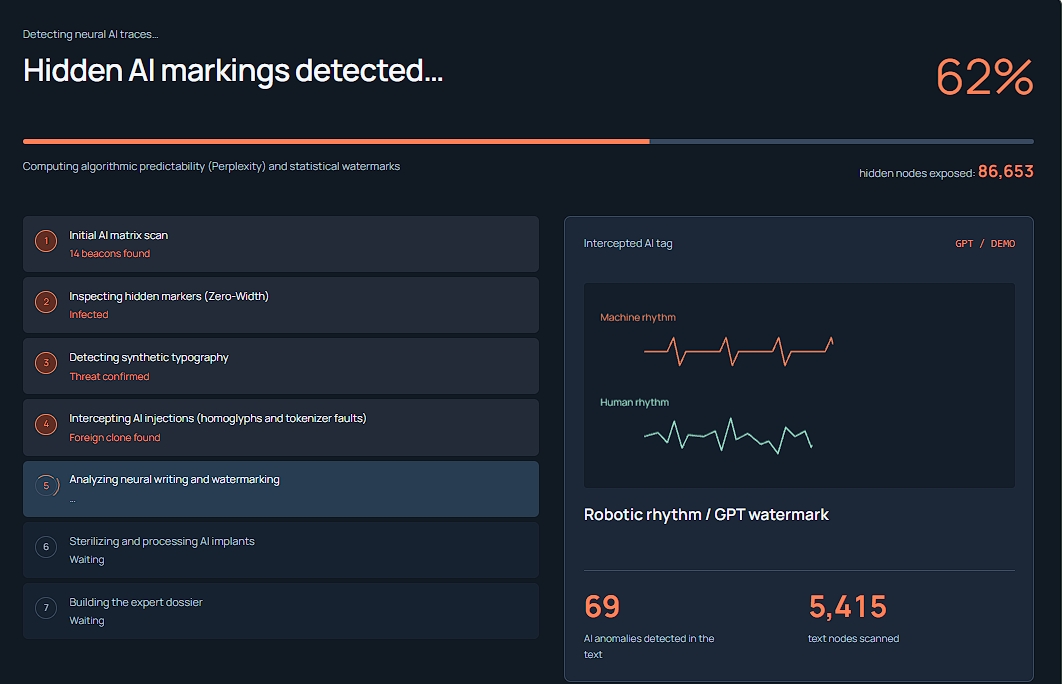
Whichever tool you use, the test is the same: after reading the report, could you explain the result to someone else without saying "the software said so"?
How to act on a report
- If you are reviewing someone else's work: treat the findings as a reason to talk, not a ruling. Ask about the drafting process, look at version history, and compare the text with earlier writing by the same person.
- If your own writing was flagged: look at the passages the tool highlights. Repetitive structure and filler transitions are worth fixing whether or not a machine was involved.
- If the report shows hidden characters: clean them before you publish or submit. Invisible characters break search, word counts and code, and they cause odd line breaks in CMS editors regardless of where they came from.
- If two tools disagree: that is normal. Compare the evidence each one shows, not the scores.
The short version
A percentage ends the conversation. Evidence starts one. Pick tools that show their work, keep technical traces apart from stylistic guesses, and never treat a detection result as the final word on who wrote something.
Comments
Comments are available to signed-in users and are moderated to keep the discussion useful and respectful. Spam, automated submissions, and low-value promotional comments are removed. Outbound links may be approved when they are relevant and genuinely helpful to readers, but they are displayed as plain text rather than clickable hyperlinks.
No comments have been published yet.
Please sign in to submit a comment.