

Cybersecurity, Software, Web Development
8 Best Enterprise AppSec Tools for Consolidating SAST, SCA, and DAST
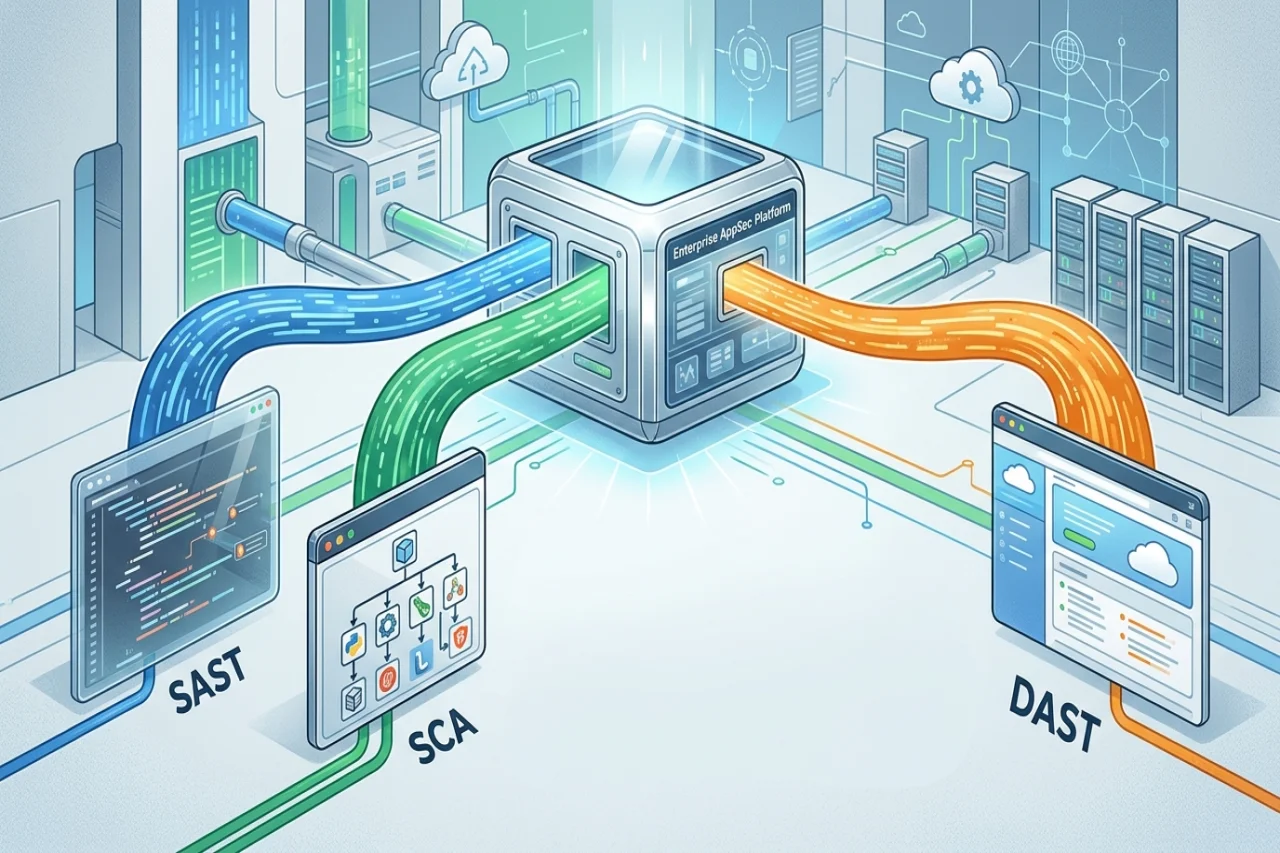
All eight tools run SAST, SCA, and DAST from one platform, so the right pick depends on how you want results joined.
- If you want to start with one scanner and add more later, look at Aikido.
- If you want one policy layer from code to runtime, look at Checkmarx One.
- If you run legacy, mobile, and cloud-native apps, look at Veracode.
- If you report program KPIs across many teams, look at Black Duck Polaris.
- If you need air-gapped or self-managed setups, look at HCL AppScan.
- If you track which apps each test covers, look at Snyk.
- If you want group security dashboards and merge request approvals based on scan results, look at GitLab Ultimate.
- If you want runtime flaws linked to source code, look at Invicti.
An enterprise can end up with one tool for code, another for open source packages, and a third for live apps. That's because each scan type covers a different risk. SAST (static application security testing) checks your own code before the app runs. SCA (software composition analysis) checks the outside packages you use for known flaws and license terms. And DAST (dynamic application security testing) sends test attacks to your live app.
So, this guide covers 8 enterprise platforms that run all three scan types in one place. You'll see how each tool covers SAST, SCA and DAST, what it does well and who it suits, plus the checks to run before you move your scans onto one platform.
How the 8 Tools Cover SAST, SCA and DAST
Here is how each platform covers the three scan types, where it runs and what else it scans.
| Tool | SAST | SCA | DAST | Deployment | Extra Scans |
|---|---|---|---|---|---|
| Aikido | Yes | Yes | Yes | Cloud; local scanner in your CI or servers | API, containers, IaC, CSPM, licenses, EOL |
| Checkmarx One | Yes | Yes | Yes | Cloud-native; separate on-premises SAST | API, IaC, secrets, containers |
| Veracode | Yes | Yes | Yes | Cloud-native | IaC, containers |
| Black Duck Polaris | Yes | Yes | Polaris fAST Dynamic | Cloud-native SaaS | IaC, secrets, API |
| HCL AppScan | Yes | Yes | Yes | SaaS, on-premises, sovereign cloud, air-gapped, hybrid | IAST, API, secrets, containers, IaC |
| Snyk | Snyk Code | Snyk Open Source | Snyk API & Web | Multi-tenant SaaS; single-tenant Snyk Private Cloud | Containers, IaC |
| GitLab Ultimate | Yes | Dependency scanning | Yes | SaaS on GitLab.com, Self-Managed or Dedicated | Secret detection, API |
| Invicti | Yes | Yes | Yes | Cloud or on-premises | IaC, secrets, containers, API |
1. Aikido
Aikido SAST checks source code against popular CVE databases, works out of the box, and supports all major languages. It also sends an alert when it detects critical issues and offers instant code-fix suggestions. Simpler fixes follow set workflows, while an agentic AI handles the harder ones.
Pros
- Lets you use each scan type on its own or combine them in one prioritized view of risk.
- DAST rates toxic combos, such as an SQL injection plus a misconfigured admin panel, as more critical.
- License Scanning checks licenses inside container images as well as in repositories, and adds copyright details for every component.
- The solution flags end-of-life (EOL) frameworks and runtimes in code and container images, and raises severity as the EOL date nears.
Why it Stands Out
- Team-scoped access: Maps repositories and cloud accounts to teams and limits each team to its own findings, reports, and alerts.
- Company login: Connects to your identity provider through SAML SSO (single sign-on).
- Scans stay in-house: Can run code and image scans inside your own CI/CD, so your source code and container images stay with you.
- Two-way Jira sync: Syncs issues and their status with Jira in both directions.
Best for: Teams starting with one scanner that plan to add more in the same risk view.
2. Checkmarx One
Checkmarx One covers code (SAST), software supply chain (SCA), and runtime (DAST) testing in one cloud-native AppSec platform.
Pros
- Joined findings: Correlates findings across its scanners into one prioritized view of application risk.
- Central control: Uses an ASPM (application security posture management) control plane to enforce enterprise policies and track fixes in every repository.
- Internal apps: DAST uses built-in tunneling to scan internal apps without firewall exceptions.
- Login flows: DAST records login flows in the browser and supports 2FA.
Best for: Enterprises that want one policy layer across code, supply chain and runtime findings.
3. Veracode
Veracode runs a risk management platform for static, dynamic and open-source testing, plus IaC and container checks. Veracode estimates that teams may add DAST to automated CI/CD pipelines within 10 minutes.
Pros
- Results side by side: DAST shows dynamic scan results next to static analysis and SCA findings.
- Shared reporting: Offers analytics, flexible policies, and unified reporting in one platform.
- Legal risk: SCA keeps vulnerability and legal risk results together, with auditable mitigation workflows.
- Wide language range: SAST supports more than 100 languages and frameworks, covering legacy, mobile and cloud-native stacks.
Best for: Large portfolios that mix legacy, mobile and cloud-native apps under one reporting layer.
4. Black Duck Polaris
Polaris is Black Duck's integrated SaaS platform for application security testing and risk management. Black Duck states that Polaris may focus teams on the 5% of issues that drive 95% of risk.
Pros
- One dashboard: Deduplicates, correlates, and adds context to all findings in a single dashboard.
- Risk score: Scores each issue using environmental, business and application risk profiles.
- Program KPIs: Reports KPIs such as the share of apps with zero critical risks.
- API test inputs: fAST Dynamic tests APIs from OpenAPI specs, Postman collections, .HAR files and GraphQL (.sdl) files.
Best for: Security leaders who report program KPIs across many teams.
5. HCL AppScan
HCL AppScan is an application security suite for developers, DevOps teams, security teams and CISOs.
Pros
- All tests hosted: Runs static, dynamic, interactive and open source testing in one hosted platform.
- Proof of exploit: Correlates DAST, SAST and IAST (interactive application security testing) findings to show proof of exploitability.
- Custom views: Shows test results, testing status, and fix progress in custom views.
- Outside reports: Imports and manages reports from other AppScan and third-party products.
Best for: Enterprises that need self-managed or air-gapped options next to a hosted edition.
6. Snyk
Snyk covers SAST with Snyk Code, SCA with Snyk Open Source, and DAST with Snyk API & Web. Snyk reports that Snyk API & Web can detect more than 30,000 potential vulnerabilities.
Pros
- Coverage checks: Snyk Essentials, part of the Snyk Enterprise plan, checks whether each application asset is scanned by Snyk tests.
- Asset classes: Sorts assets into Class A to Class D by business criticality.
- Private networks: API & Web runs a scanning agent as a Docker container or Kubernetes workload inside private networks.
- Data residency: Enterprise plans offer regional hosting and data residency.
Best for: Enterprises that track security test coverage for each application.
7. GitLab Ultimate
GitLab Ultimate brings SAST, dependency scanning (SCA), secret detection and DAST into the GitLab DevSecOps platform.
Pros
- Audit evidence: Applies controls for SOC 2, ISO 27001 and PCI DSS and collects audit-ready evidence in every pipeline.
- Trend charts: Dashboards chart vulnerability trends over 30, 60 or 90 days for a group of projects.
- Approval rules: Merge request approval policies can require approval based on security and license scan results.
- Flexible DAST runs: DAST runs in a CI/CD pipeline, on a schedule or on demand.
Best for: Organizations whose code, pipelines and reviews already live in GitLab.
8. Invicti
The Invicti AppSec Platform combines DAST, SAST, SCA, IaC, secrets, and container testing.
Pros
- Runtime to code: Correlates compatible DAST and SAST findings to link verified runtime flaws to source files and code paths.
- Two package views: SCA pairs static checks of all declared components with dynamic checks of components in use during runtime scans.
- Build rules: Let you set CI/CD rules that halt builds or escalate tickets when open source risk passes a threshold.
- Two editions: Enterprise is available as an on-demand cloud edition or an on-premises edition.
Best for: Teams that want static findings checked against runtime results from DAST.
Choosing the Right Platform
Moving SAST, SCA, and DAST into one platform gives your teams one place to read results. Plus, the eight tools differ in how they merge findings, apply policies and deploy.
All the mentioned software runs the three scan types, so compare each one against your own deployment rules, languages, and reporting needs.
Comments
Comments are available to signed-in users and are moderated to keep the discussion useful and respectful. Spam, automated submissions, and low-value promotional comments are removed. Outbound links may be approved when they are relevant and genuinely helpful to readers, but they are displayed as plain text rather than clickable hyperlinks.
No comments have been published yet.
Please sign in to submit a comment.