

IP Address, Web Hosting, Online Tools
5 Expired Domain Services With an API in 2027: What Each One Actually Returns
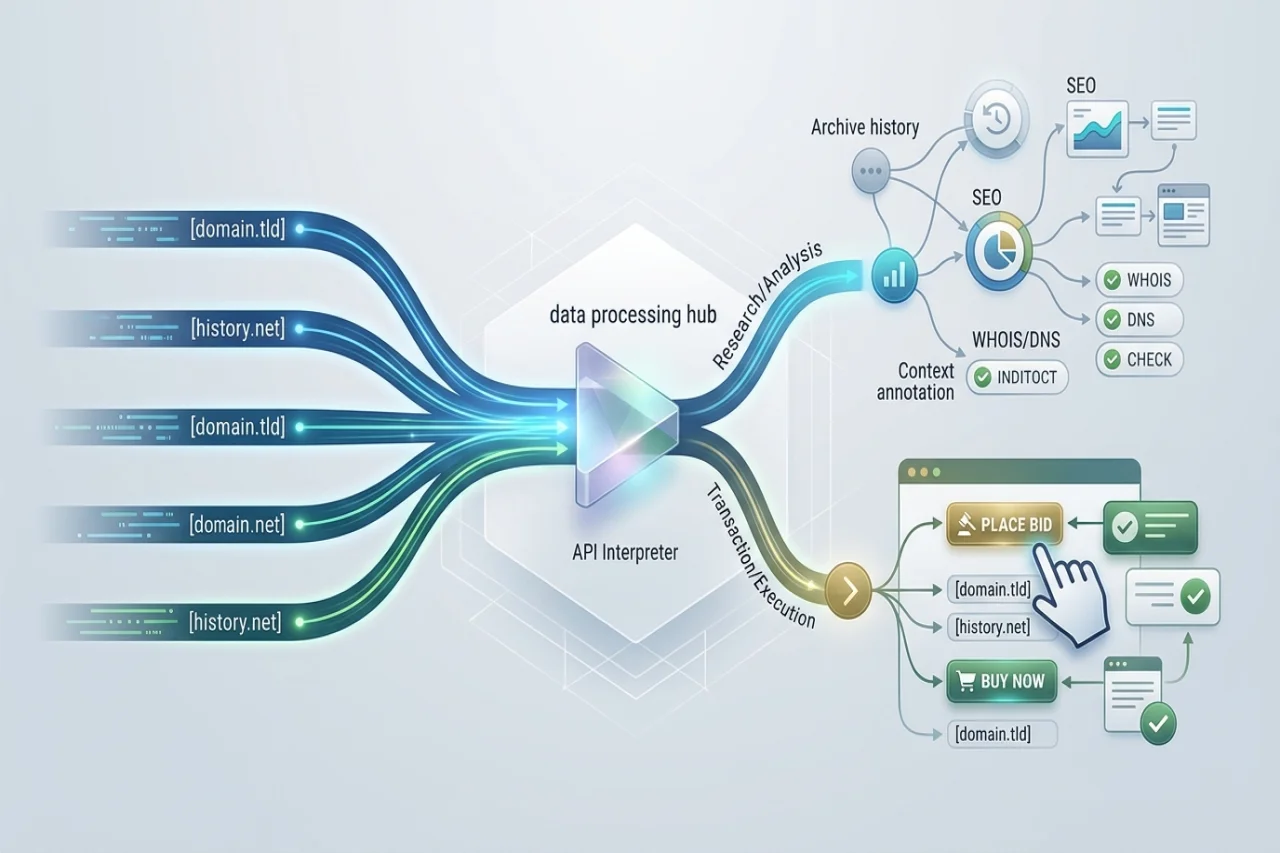
If you have wired an IP geolocation or WHOIS API into a product, you probably judged it by its response schema: which fields come back, how fresh they are, and what you can do with the result. Expired-domain APIs deserve the same test, because two of them can both return a domain name and still belong in very different parts of a system.
Some aggregate research data from many marketplaces and return SEO metrics and archive history for each name. Others run a single marketplace, return listing data, and can place a bid with your money.
I compared five services by what an integration can do with the response. Every competitor detail below comes from that company's public product or developer documentation, checked in October 2026; I did not test their paid plans. I am affiliated with Karma.Domains, which is included in this comparison.
Separate research from marketplace execution.
The useful split: research APIs and transaction APIs
| Service | API type | Inventory scope | What the response is built for | Can it bid or buy? |
|---|---|---|---|---|
| Karma.Domains | Aggregated research and workflow | Auctions, expired, backorder, buy-now; 40 auction sources | Search, archive history, SEO context, annotations, live WHOIS/DNS checks | No |
| CatchDoms | Aggregated research | Auctions and marketplaces plus plan-dependent ccTLD datasets | Search, auction state, SEO/Wayback/WHOIS context, purchase routing | No |
| UpSnatch | Aggregated research | Expired, dropped, pending-delete, auction, marketplace | Classic Search results, scores, SEO metrics, price and source | No |
| GoDaddy Auctions | Marketplace transaction | GoDaddy expiring auctions and closeouts | Discover GoDaddy inventory, verify listings, bid or purchase | Yes |
| Namecheap Auctions | Marketplace transaction | Active Namecheap Auctions listings | Retrieve auctions, track bids, place bids, receive auction events | Yes |
The last column decides where the API sits in your architecture. A research API is where you build a shortlist. A transaction API spends money, so it belongs behind approval and budget controls, with careful retry handling.
1. Karma.Domains: a report-centered research API
Karma.Domains treats the report as the primary object. Search can return domains from auction, expired, backorder, and buy-now inventory. A script can then retrieve a full report, store its ID, add notes or tags, create a share link, run live checks, and request SEO enrichment if specific report fields are missing.
The database holds 13M+ domains from 40 auction sources, grows by 400k+ new domains a day, and can be searched with 90+ filters. Reports combine data from Ahrefs, Majestic, Moz, Semrush, Similarweb, and the Wayback Machine; which fields are filled depends on the services already run for that report. The archive history is the part I would read first. A script can drop names with gambling, pharma, or parking history before anyone pays for a deeper backlink audit.
If you already call WHOIS or DNS APIs, the live-check group will look familiar: WHOIS/RDAP, DNS, registration expiry and availability, run on any name, including names that are not in the database. The Karma.Domains API reference guide puts those calls on the same Bearer key and per-minute request budget as search and the MCP server; cached results do not count against the live-check allowance. Your own Karma.Domains API key requires Pro.
Best fit: a developer or SEO team that wants discovery, archive evidence and review notes in one pipeline, keyed by stable report IDs.
Not designed for: placing bids on the source marketplace.
2. CatchDoms: auction aggregation with ccTLD depth
CatchDoms exposes a paginated domain catalog. Its public documentation lists identity fields, source and auction type, price and highest bid, end dates, a purchase URL, age, language, a quality score, Trust Flow and Citation Flow, referring domains, Wayback dates and snapshot counts, historical traffic and Google Business Profile fields. Network people will recognize the WHOIS/RDAP block: registry dates, registrar, EPP status codes, current nameservers and a nameserver category such as parked or drop catcher.
Its catalog combines live listings from 22 platforms with separate ccTLD datasets. Those datasets have different plan requirements and query rules, so an integration should not assume every token sees the same inventory.
The API is a strong fit when ccTLD research, local-business context, or routing users to the source listing matters. Check the refresh cadence, too: the documented catalog is refreshed daily, while bids are updated several times per day. Near the close of an auction, the marketplace remains the authority.
Best fit: ccTLD hunters, local lead-gen teams, and dashboards that aggregate multiple auction sources.
Not designed for: direct marketplace bidding.
3. UpSnatch: Classic Search through REST
UpSnatch's API returns the same catalog used by Classic Search: expired, dropped, pending-delete, auction, and marketplace records. Documented fields include Trust Flow, Citation Flow, backlinks, referring domains, Ahrefs DR, age, price, a quality score, spam-risk value, provider, bids, end time, and purchase URL.
Scope is the thing to plan around. The app also has Magic Search, Local Search and Projects, and the developer page says those are not available through the API yet. The API covers Classic Search and a single-domain lookup, so build around those two endpoints and do not assume the whole interface is programmable.
REST and MCP use the same key and limits, which suits a team that runs deterministic scripts and agent-driven search against the same catalog. Responses carry rate-limit and row-quota headers, so a script can pace itself.
Best fit: domain investors or SEO teams that want broad discovery and compact, structured result rows.
Not designed for: controlling every UpSnatch project or discovery mode through the API.
4. GoDaddy Auctions API: inventory plus transactions
GoDaddy's Auctions API has a narrower universe and more operational power. It covers expiring auctions and closeouts on the GoDaddy platform.
For broad discovery, GoDaddy publishes downloadable inventory files in ZIP, XML, and JSON. The API can then check listing availability and details, place bids, and make instant purchases. An availability check can optionally attach signals from GoDaddy, Estibot, Semrush, and Majestic. Amounts come back in micro-units, and multi-item calls can return 207 with a status per item, so parse each result instead of trusting the HTTP code alone.
The documentation notes that an original owner may still redeem some domains after they are listed, so a stored listing ID is not guaranteed to stay valid. Recheck availability immediately before a bid or purchase and handle partial failures explicitly.
Best fit: a buyer who has already selected GoDaddy inventory and wants to automate monitoring or controlled transactions.
Not designed for: cross-market discovery or a complete historical-risk report.
5. Namecheap Auctions API: active listings, bids, and webhooks
Namecheap separates its Auctions API from the company's regular domain API. The auction interface can retrieve one auction, list active auctions, list the authenticated user's bids, and place a bid.
It also supports webhook events for an auction closing, a higher competing bid, a win, runner-up status, and an auction ending. With those events, you do not have to poll every listing on a tight schedule, and each payload includes an HMAC-SHA256 signature that you can verify against your webhook secret.
The returned data is operational marketplace data. If the buying rule depends on historical topics, backlink quality, or cross-market comparisons, add a research layer before the bidding call.
Best fit: investors and teams that actively bid in the Namecheap marketplace.
Not designed for: aggregated expired-domain research across external sources.
A clean integration pattern
- Query a research API with the niche, TLDs, budget, timing, history, and broad SEO thresholds.
- Store stable report IDs and reject previously reviewed domains.
- Run deeper backlink and trademark checks only on the shortlist.
- Match surviving names to their marketplace listing.
- Recheck price, availability, bids, and end time.
- Require human approval before a transaction API places a bid or purchase.
- Record the final action and outcome through a webhook or audit log.
It is the same habit you would apply to an IP or WHOIS provider: choose by the fields your next step needs, and keep read-only lookups apart from calls that change state. “Which API has the most domains?” rarely settles anything. Here, the research API narrows the candidate set, the marketplace API operates on a single venue, and a buying system usually needs both, with a clear boundary between them.
Comments
Comments are available to signed-in users and are moderated to keep the discussion useful and respectful. Spam, automated submissions, and low-value promotional comments are removed. Outbound links may be approved when they are relevant and genuinely helpful to readers, but they are displayed as plain text rather than clickable hyperlinks.
No comments have been published yet.
Please sign in to submit a comment.