

Network, Cybersecurity, Cloud Services
4 Best Continuous Attack Surface Monitoring Platforms in 2026

CloudSEK BeVigil is the best continuous attack surface monitoring platform in this comparison for enterprises that need eight surfaces scanned continuously and each exposure tied to the attack path it opens. CrowdStrike Falcon Surface fits Falcon-standardized environments, Palo Alto Cortex Xpanse suits organizations whose main gap is unknown assets, and Microsoft Defender EASM consolidates external visibility inside the Microsoft stack. Each is assessed on four things: how often discovery actually runs, how many surfaces it covers, how it filters the resulting noise, and what it does with an exposure once found.
All four appear in Gartner Peer Insights' External Attack Surface Management market. CloudSEK BeVigil averages 4.7 out of 5 from 21 ratings, Falcon Surface 4.6 from 98, Cortex Xpanse 4.5 from 67, and Defender EASM 4.3 from 152. Review volumes differ by a factor of seven across that set, so the averages are read alongside their sample sizes rather than as a standings table.
Timing gives the question weight. The Verizon 2026 Data Breach Investigations Report found that vulnerability exploitation has become the most common initial access vector, appearing in 31% of breaches, up from 20% the year before. It is the first time in the report's 19-year history that credential theft has been displaced from the top spot, and the assets exploited for that first foothold are overwhelmingly the ones facing the internet.
That single shift turns the frequency of external attack surface monitoring from a hygiene question into a first-order control.
Why Did Periodic Scanning Stop Working?
An external attack surface is not a fixed inventory. Subdomains get provisioned for a campaign and never retired. Certificates expire. A team spins up a cloud instance outside the change process. An acquisition brings infrastructure nobody has mapped. The surface changes on a daily cadence, and an assessment performed quarterly is describing a system that no longer exists by the time the report is circulated.
The attacker side of that equation moved faster still. Exploitation now follows disclosure closely enough that the gap between a vulnerability becoming public and becoming usable is measured in days rather than quarters. A quarterly scan can miss an entire exposure lifecycle: asset appears, vulnerability lands, exploitation happens, asset is cleaned up, and the next scheduled scan finds nothing wrong.
Continuous monitoring is the response, but the word is doing a lot of work in vendor marketing. Almost every platform in the category claims it. The differences show up in four places.
What Separates Continuous Monitoring From Periodic Scanning?
The difference shows up in discovery cadence, surface coverage, signal filtering, and what follows a finding.
How often does discovery actually run?
Continuous asset discovery and continuous vulnerability assessment are different things, and a platform can do the first daily while doing the second monthly.
How many surfaces are covered?
An attack surface is not only web applications. Mobile apps, APIs, cloud, DNS, SSL, and network devices each fail in their own way, and a platform that covers three of those is not describing the same surface as one that covers eight.
What happens to the noise?
Continuous discovery produces continuous findings. Without classification and filtering, a team gets an always-on alert stream rather than an always-current picture.
What happens after a finding?
An exposed asset with a known CVE is one fact. Whether it chains with a leaked credential or a vendor weakness into a route to compromise is a different question, and most platforms in this category do not answer it.
Which Continuous Attack Surface Monitoring Platforms Stand Out in 2026?
1. CloudSEK BeVigil
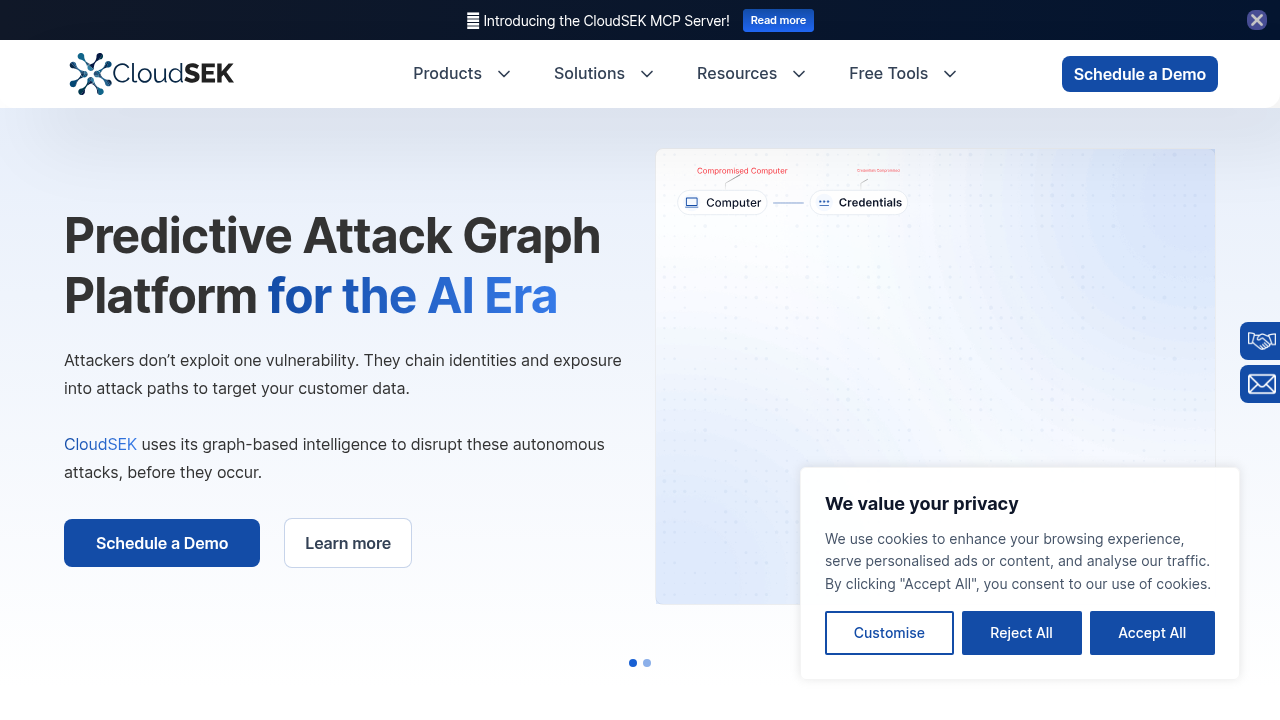
Leads on: surface breadth, signal filtering, and attack path correlation.
CloudSEK BeVigil fingerprints an organization's internet-facing infrastructure and continuously scans eight surfaces: web applications, mobile applications, APIs, cloud, CVE, DNS, SSL, and network. Discovery covers domains, subdomains, open ports, certificates, and network devices, including assets provisioned outside the change process.
Findings run from known CVEs and weak SSL configurations to DNS misconfigurations such as SPF and DMARC issues, subdomain takeovers, and credentials exposed in public code. More than 600 tag classifiers and query-language filters cut that stream to the exposures that can open an attack path, and BeVigil marks those as initial access vectors for correlation into validated attack paths by CloudSEK Nexus AI.
External validation: 4.7 out of 5 across 21 ratings on Gartner Peer Insights in the External Attack Surface Management market, the smallest review base of the four platforms here.
Not a fit if: the requirement is internal asset, endpoint, or network telemetry coverage, which sits outside BeVigil's external focus.
Best for: enterprises that want eight surfaces monitored continuously and the attack path each exposure opens.
2. CrowdStrike Falcon Surface
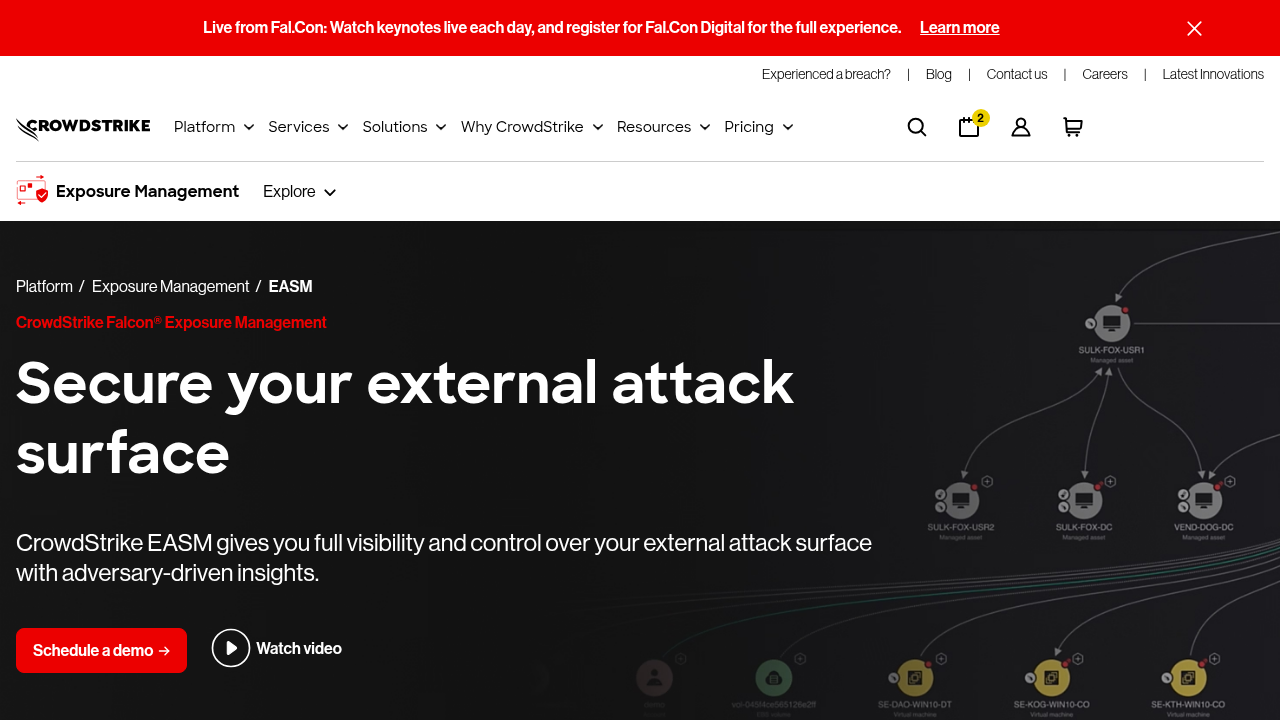
Leads on: joining external discovery to endpoint response.
Falcon Surface performs continuous discovery of internet-facing assets and applies risk scoring that combines findings with CrowdStrike's threat intelligence, so prioritization reflects what adversaries are actually exploiting rather than CVSS alone. Reviewers consistently highlight its ability to surface shadow IT and forgotten virtual machines that had fallen out of the asset inventory.
Its structural advantage is the handoff. An exposure discovered externally moves into the same Falcon console where endpoint detection and response already runs, which closes the gap between finding an asset and acting on it. The corollary is that the value concentrates for organizations already standardized on Falcon, since the workflow advantage disappears without the rest of the platform.
External validation: 4.6 out of 5 across 98 ratings on Gartner Peer Insights in the External Attack Surface Management market, and a Customers' Choice distinction in the 2025 Gartner Peer Insights Voice of the Customer report for External Attack Surface Management.
Not a fit if: the endpoint stack is not CrowdStrike, since most of the workflow advantage depends on it.
Best for: Falcon-standardized enterprises that want external discovery feeding directly into endpoint remediation.
3. Palo Alto Cortex Xpanse

Leads on: internet-scale discovery of unknown assets.
Cortex Xpanse continuously discovers, monitors, and manages internet-facing assets by scanning the global internet and attributing what it finds back to the organization. That approach is strongest at the specific problem of unknown inventory: assets from acquisitions, regional business units, and cloud accounts that never appeared in a central register. Reviewers point to cloud footprint mapping and misconfiguration detection as particular strengths.
The platform provides context for remediation and integrates with the wider Cortex ecosystem, so exposures can be routed into existing security operations workflows. Depth of assessment on discovered assets is generally lighter than dedicated scanning platforms provide, which is the usual trade for breadth at internet scale.
External validation: 4.5 out of 5 across 67 ratings on Gartner Peer Insights in the External Attack Surface Management market.
Not a fit if: deep assessment of known assets matters more than discovering unknown ones.
Best for: large or acquisitive organizations whose main problem is not knowing what they own.
4. Microsoft Defender External Attack Surface Management
Leads on: consolidation inside the Microsoft security stack.
Defender EASM provides continuous discovery of internet-exposed resources including domains, IP addresses, and cloud services, and evaluates them for vulnerabilities. Its clearest advantage is integration: findings flow into Defender for Cloud, Defender XDR, and Sentinel, so external exposure appears in the same dashboards and workflows a Microsoft-centric team already operates, without adding a console or a contract.
Reviewers describe strong visibility into assets that would otherwise go unnoticed, alongside an adjustment period spent validating which discovered assets genuinely belong to the organization. It carries the largest review base of these four and the lowest average rating, a pattern common to broadly deployed tools that ship as part of a wider suite.
External validation: 4.3 out of 5 across 152 ratings on Gartner Peer Insights in the External Attack Surface Management market.
Not a fit if: the environment is not Microsoft-centric, since the integration advantage carries most of the value.
Best for: Microsoft-centric organizations that want external attack surface visibility inside tooling they already license.
How Do the Platforms Compare at a Glance?
| Platform | Gartner Peer Insights | Surfaces covered | Signal filtering | Post-discovery correlation |
|---|---|---|---|---|
| CloudSEK BeVigil | 4.7 (21 ratings) | Eight: web, mobile, API, cloud, CVE, DNS, SSL, network | 600+ tag classifiers and query-language filters | Nexus AI validated attack paths across external, dark web, and vendor signals |
| CrowdStrike Falcon Surface | 4.6 (98 ratings) | Internet-facing assets and shadow IT | Risk scoring against CrowdStrike threat intelligence | Handoff into Falcon endpoint response |
| Palo Alto Cortex Xpanse | 4.5 (67 ratings) | Internet-facing assets, cloud footprint, misconfigurations | Attribution and prioritization at internet scale | Routing into the Cortex ecosystem |
| Microsoft Defender EASM | 4.3 (152 ratings) | Domains, IP addresses, cloud services | Dashboards and risk prioritization | Feeds Defender for Cloud, XDR, and Sentinel |
Ratings are as published on Gartner Peer Insights in the External Attack Surface Management market in August 2026. Review volumes differ substantially between products, and a rating drawn from 21 reviews carries a different weight than one drawn from 152. Other vendors in the market rate highly, so the four here were selected on category fit and evaluation criteria rather than rating alone.
How Should You Choose a Continuous Attack Surface Monitoring Platform?
Start with which of the four questions is unanswered today. Organizations that cannot list what they own have a discovery problem, which is where Cortex Xpanse is strongest. Organizations that can list their assets but cannot act on findings quickly have a workflow problem, which favors Falcon Surface or Defender EASM depending on the existing stack. Organizations whose findings arrive as an undifferentiated stream have a signal problem, and the answer there is classification depth rather than more scanning.
Organizations whose real gap is breadth and consequence, meaning surfaces that go unscanned and findings that arrive without any indication of what they chain into, land on CloudSEK BeVigil.
One question is worth putting to every vendor on a shortlist. Ask them to define continuous, specifically, in hours. Discovery cadence and assessment cadence are frequently different numbers, and the second one determines how long an exploitable exposure sits unnoticed.
FAQ
Frequently Asked Questions
01What is continuous attack surface management?
Continuous attack surface management is the ongoing discovery and assessment of an organization's internet-facing assets, as opposed to a periodic audit performed on a schedule. It maintains a current inventory of domains, subdomains, applications, APIs, cloud services, certificates, and network devices, and continuously tests them for misconfigurations and exploitable weaknesses.
02How is it different from a penetration test?
A penetration test is a point-in-time engagement, scoped to agreed targets and performed a few times a year. Continuous attack surface monitoring runs without a defined endpoint and covers the whole external estate, including assets the security team did not know existed. The two are complementary, since a test goes deeper on a narrow scope while monitoring maintains breadth over time.
03How often does an external attack surface need scanning?
Frequency is best matched to how fast the surface changes and how fast exploitation follows disclosure, which now means daily discovery at minimum for most enterprises. The more useful question to put to a vendor is the assessment cadence rather than the discovery cadence, because a platform can find a new asset today and not test it for weeks.
04What surfaces does a platform need to cover?
A complete external attack surface spans web applications, mobile applications, APIs, cloud infrastructure, known CVEs, DNS, SSL, and network devices. Each fails differently, and coverage gaps tend to sit in mobile, API, and DNS, which is where subdomain takeovers and SPF or DMARC misconfigurations go unnoticed.
05Why did vulnerability exploitation become the top initial access vector?
The Verizon 2026 DBIR recorded vulnerability exploitation in 31% of breaches, up from 20%, displacing credential abuse from the top position for the first time in the report's history. The practical reading is that unpatched, internet-facing assets are now the most reliable way in, which raises the value of knowing what is exposed at any given moment.
06What is shadow IT and why does it matter to attack surface monitoring?
Shadow IT is infrastructure provisioned outside official process or inventory, such as a cloud instance created for a project or a subdomain set up for a campaign and never retired. It matters because these assets are rarely patched or monitored, and an attacker scanning from outside sees them exactly like any managed asset.
07What is the difference between EASM and vulnerability management?
Vulnerability management assesses assets an organization already knows it owns, drawn from an internal inventory. External attack surface management discovers what is internet-facing first, including unknown and unmanaged assets, then assesses it from the attacker's outside-in view.
Sources
- Gartner Peer Insights, External Attack Surface Management market, product ratings as published August 2026.
- Verizon, "2026 Data Breach Investigations Report," May 2026.
- CloudSEK, BeVigil external attack surface monitoring platform.
- CrowdStrike, Falcon Surface product documentation.
- Palo Alto Networks, Cortex Xpanse product documentation.
- Microsoft, Defender External Attack Surface Management documentation.
Gartner Peer Insights content consists of the opinions of individual end users based on their own experiences, and should not be construed as statements of fact, nor do they represent the views of Gartner or its affiliates. Gartner does not endorse any vendor, product or service depicted in this content nor makes any warranties, expressed or implied, with respect to this content, about its accuracy or completeness, including any warranties of merchantability or fitness for a particular purpose.
Comments
Comments are available to signed-in users and are moderated to keep the discussion useful and respectful. Spam, automated submissions, and low-value promotional comments are removed. Outbound links may be approved when they are relevant and genuinely helpful to readers, but they are displayed as plain text rather than clickable hyperlinks.
No comments have been published yet.
Please sign in to submit a comment.