
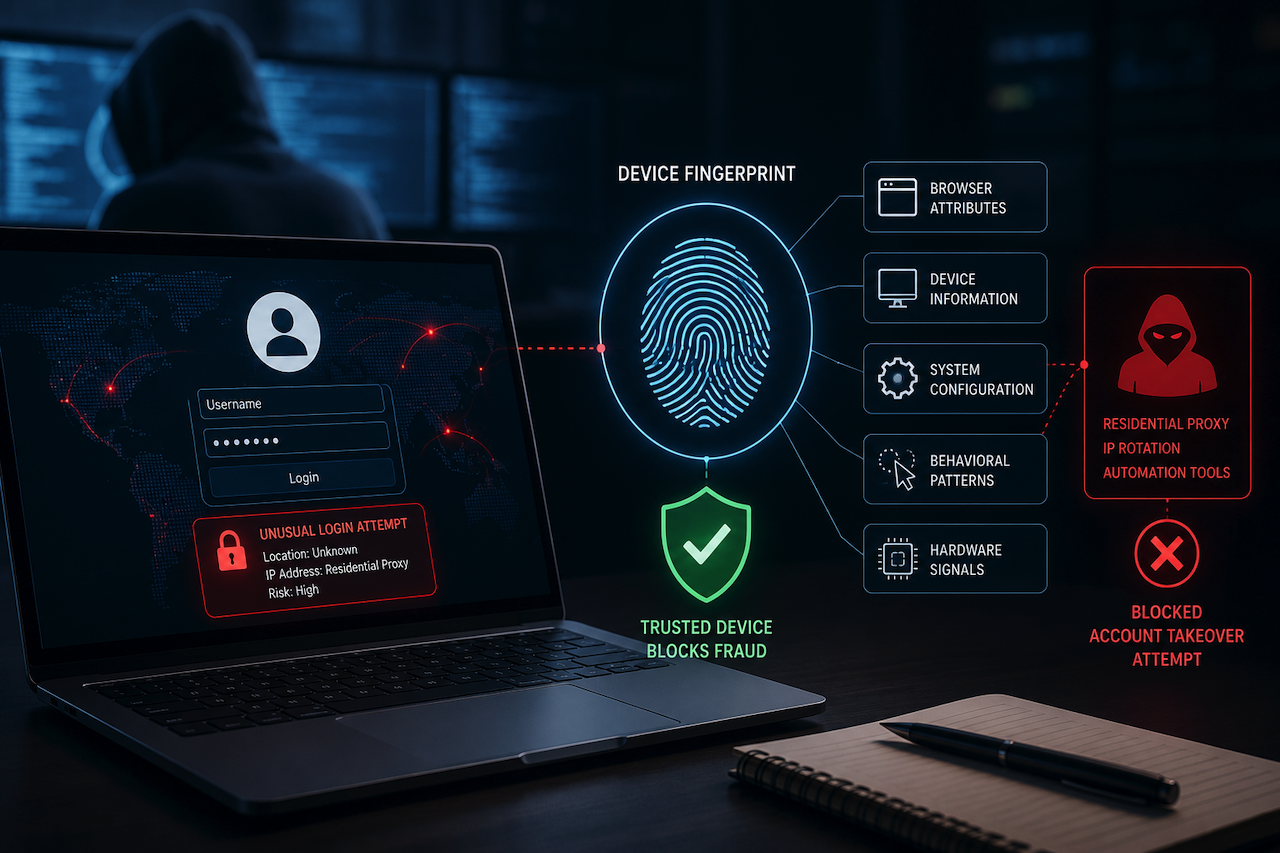
Residential proxies are hard to spot. They route traffic through real consumer IP addresses, thereby making a fraudster's connection appear identical to that of a real user. This is where account takeover fraud can occur; attackers have built infrastructure specifically to evade network detection. As a result, being able to see these malicious attacks in the browser is increasingly important.
What IP data can and can’t do
IP intelligence is generally quite useful. It can provide geolocation, ASN data, and VPN detection. Tools such as Tor exit node identification can help flag suspicious traffic before it reaches your application logic. Many fraud teams use IP reputation scores as a first pass, filtering out a sizable portion of unsophisticated attacks.
However, IP data describes the network, not the device. It can tell you that a request came from a data center IP in, say, Chicago. It cannot go beyond that and tell you more about the context of the request. In this situation, the browser making the request could be a headless automation tool or a browser profile that has appeared in previous fraud attempts. To greachthis level of visibility, a different layer must be aanalyzed.
IP addresses also change constantly. Users might be moving between home Wi-Fi, mobile data, and corporate networks. If you treat IP continuity as a strong identity signal, you risk generating false positives at scale. Worse, you might fail when attackers rotate through clean residential IPs.
What exactly are attackers looking for?
Credential stuffing operations are no longer brute-forcing their way in. Modern account takeover infrastructure uses residential proxy networks that assign each login attempt a distinct IP address. As a result, this traffic often comes from real homes, which your proxy detection won't flag.
IP rotation is built into these tools. Attackers buy access to residential proxy pools with tens of millions of addresses, then distribute attempts across time zones to avoid geographic anomaly detection. By the time an account is compromised, the attack looks like a series of unusual yet plausible login events.
Ultimately, accounts are taken over by traffic that bypasses the standard IP-based checks. The fraudster will have obtained valid credentials and a clean IP, leaving you without any signals to act on.
Where device fingerprinting comes in
Device fingerprinting operates at the browser layer, where IP rotation has no effect. Every browser exposes a distinct set of attributes. These signals combine to create a persistent device identity; it doesn't change when the IP address does.
When a device fingerprint associated with previous fraud attempts appears on a new login, you can therefore act on it (regardless of how clean the IP looks). Here, behavioral signals, such as how a user moves a mouse or fills in form fields, are another surface that automation tools consistently fail to replicate.
Fingerprinting also improves detection of account sharing, session hijacking, and synthetic identity fraud. Each of these patterns carries a distinct signature that IP data doesn’t capture.
Device fingerprinting platforms collect and analyze browser-layer signals to help identify devices across sessions. For example, Cside offers a platform built on device fingerprinting for fraud detection that uses browser and device attributes to establish a persistent device identity. Depending on the implementation, these fingerprints may remain effective across IP address changes, private browsing sessions, and certain browser-spoofing techniques, providing additional context that traditional IP-based signals cannot offer.
Combining IP intelligence and fingerprinting in a fraud stack
IP intelligence and device fingerprinting are complementary. Running both gives you coverage that neither provides on its own.
IP data catches low-sophistication attacks and provides context for interpreting device signals. A fingerprint from a device you've never seen before is more suspicious when it also connects to an unknown data center range. Conversely, a device fingerprint you recognize as legitimate can prevent a false positive when a real user's IP address triggers a proxy detection rule.
The combination also enables smarter step-up authentication decisions. Instead of challenging every login from an unusual IP address, you can reserve time and effort for sessions where both the IP signals and the device fingerprint are unfamiliar. That approach protects legitimate users from unnecessary friction while making attacks significantly harder to execute without triggering a review.
Structuring these layers across the full account lifecycle is one of the central challenges of account takeover (ATO) prevention. Organizations often combine IP intelligence, device fingerprinting, behavioral analysis, and risk scoring to evaluate activity at different stages of the user journey. For example, resources such as Cside’s practical guide on stopping account takeover fraud discuss how different signal types can be applied throughout a session and incorporated into risk-based authentication and fraud prevention strategies.
The key principle here is that no one signal should be authoritative. A clean IP doesn't mean a clean user. Risk models that weigh IP reputation, device identity, behavioral patterns, and account history together give you the confidence to act without penalizing innocent, legitimate users.
The future of IP intelligence
IP intelligence is a necessary layer in any fraud stack, but it is not sufficient on its own. Attacks today are engineered to appear clean at the network level, which means detection has to occur higher up the stack.
This is where device fingerprinting can help. It gives you a persistent device identity that survives IP rotation, provides signals that automation cannot easily fake, and adds context that makes your IP intelligence more actionable. Together, these two layers create a detection surface that is significantly harder for attackers to evade without triggering review.
Featured Image generated by ChatGPT.
Share this post
Author

Read the latest articles from Olivia
Why Percentages Are the Quiet Hero of Network Security Monitoring

June 15, 2026
Ask most people what keeps a network safe, and they'll point to firewalls, VPNs, or maybe a clever password policy—all of those matter. But spend enough time staring at server logs and traffic dashboards, and you start to realize that a huge part of the job comes down to something far less glamorous: noticing w [...]
Learn moreHow to Create AI-Powered Video Ads for Crowdfunding Campaigns in 2026

June 13, 2026
Crowdfunding lives and dies by video. Kickstarter's own data shows that campaigns with video raise 105% more money than those without. On Indiegogo, campaigns with a compelling video are 85% more likely to reach their funding goal. And once your campaign is live, paid video ads on Facebook, Instagram, YouTube, an [...]
Learn moreLeave a comment
All comments are moderated. Spammy and bot submitted comments are deleted. Please submit the comments that are helpful to others, and we'll approve your comments. A comment that includes outbound link will only be approved if the content is relevant to the topic, and has some value to our readers.


Comments (0)
No comment