
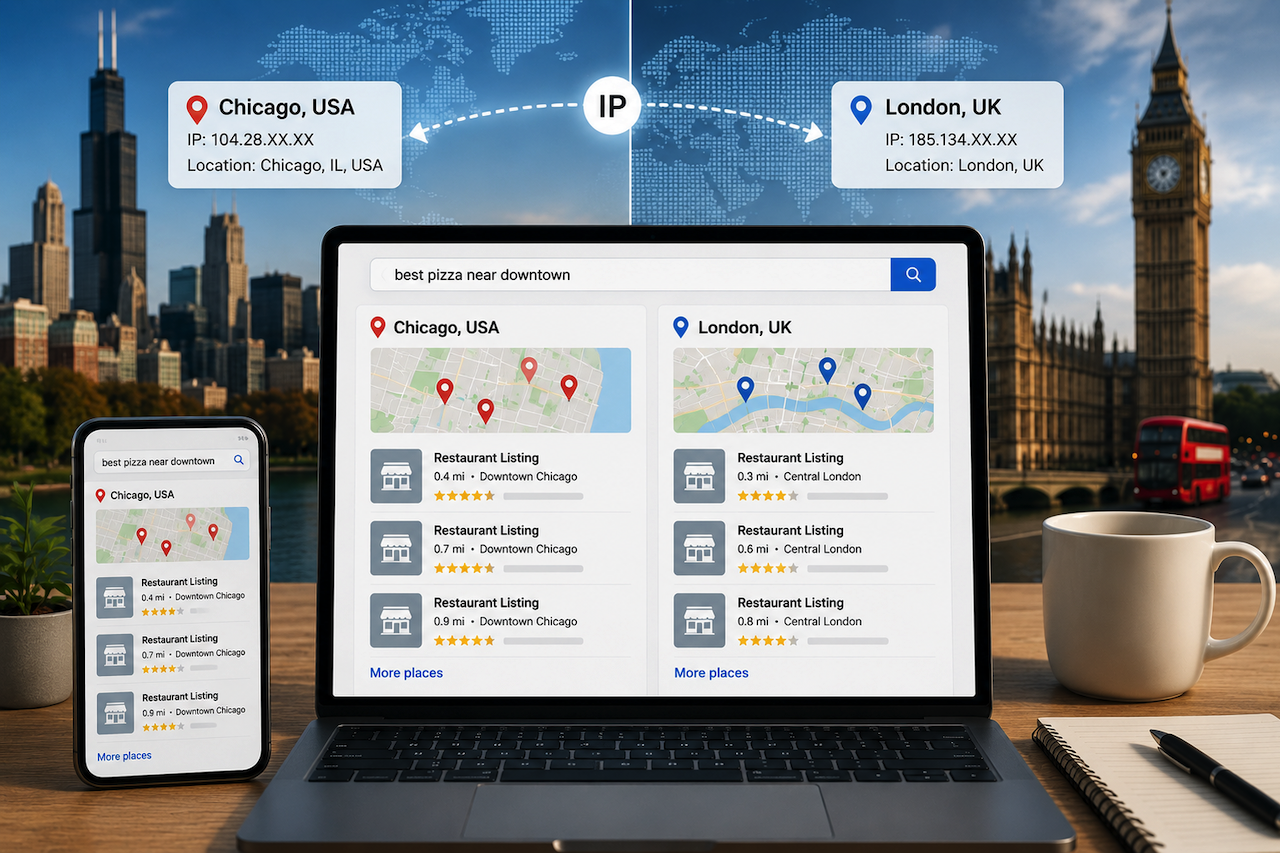
Type the same keyword into Google from two different cities, and you may get two completely different sets of results. The pages that rank in the top three in one location might not appear at all in another. This isn't a glitch. It's how Google is designed to work. And for anyone trying to understand, monitor, or compete in search rankings, it's one of the most important technical realities.
Google Uses Your IP Address to Shape What You See
Every search you run on Google is filtered through a set of signals that determine which results are most relevant to you. One of the most consistent signals is your location — derived, in most cases, directly from your IP address.
Your IP address carries geographic information, including the country, region, and often the city your connection originates from. Google uses this information to adjust search results accordingly. A search for the best pizza near downtown Chicago will typically return nearby businesses in that area, while the same query from a device in London may produce entirely different results. Even for searches that appear non-local — such as immigration lawyer, corporate tax rates, or personal loan calculator — Google still weighs results differently based on where the searcher is located.
Location-based personalization is only one part of the broader data picture tied to internet activity. IP addresses can reveal far more than many users realize, especially when combined with behavioral and contextual signals. Discussions around online tracking and data visibility have become increasingly important as search engines and AI-driven systems continue evolving.
This matters far beyond food and local services. Industries such as legal, financial, healthcare, real estate, and e-commerce all show meaningful ranking differences across geographies. A law firm that dominates search results in one state may be invisible in another. A retailer ranking on page one nationally may struggle to appear in specific metro areas where a regional competitor has stronger local signals.
Why Location Affects Rankings Beyond Just "Local" Searches
It's tempting to think geo-targeted search only matters for businesses with physical locations — restaurants, plumbers, dentists. But the location effect runs much deeper.
Google serves country-specific search indexes for most major markets. The results you see on google.co.uk differ structurally from those on google.com, even for identical queries. Within a single country, rankings can still shift substantially between cities, states, or regions based on:
- Search intent variations by geography: People in different regions use different terminology, phrase queries differently, and have different expectations from the same search. Google picks up on these patterns at a regional level and adjusts which results it considers most relevant.
- Local link authority and citations: A business with strong backlinks from regional publications, local directories, and city-specific websites tends to rank better in searches from that area. This is particularly pronounced in competitive service industries.
- The local pack and map results: For any search Google classifies as having local intent, a map pack appears above the organic results. The three businesses shown in that pack change based on the searcher's precise location, sometimes shifting block by block in dense urban areas.
- Competitor density by region: A keyword with ten strong competitors in one city may have only two in another. Google's ranking algorithm weighs the competitive landscape, which means ranking positions differ even when your own content and backlinks stay constant.
The Problem With Checking Rankings Manually
Most website owners check their own rankings the same way: open a browser, type a keyword, and see where they appear. This method has a significant blind spot.
Your browser already knows your location. Google reads it. The results you see are specific to your IP address, your search history, and your account preferences. You're not seeing what a potential customer in another city sees. You're seeing what Google thinks is most relevant to you, specifically.
To get an accurate picture of how you rank in a different location, you'd need to either physically be there, use a proxy service that routes your connection through that region, or clear your search history and personalization settings, and even then, results may not precisely reflect what a local user sees.
This is why developers and SEO professionals have moved toward programmatic solutions for location-based rank tracking. A Google Search API lets you send queries with specific location parameters, down to the city, region, or even GPS coordinates, and receive results that reflect exactly what a user in that location would see: no browser, no proxy, no guesswork.
What Geo-Targeted Search Data Reveals in Practice
When businesses start systematically pulling location-specific search data, a few patterns emerge.
- Ranking gaps between markets: A company may assume its SEO is performing well nationally based on the rankings it checks from its own office location. Pulling data from ten or twenty cities often reveals that their rankings in several key markets are significantly weaker than expected, sometimes because a regional competitor has stronger local signals in those areas.
- Different competitors in different places: The competitors you track from your own location aren't always the ones beating you in other cities. In some markets, local players dominate search results that national brands struggle to crack. Knowing who's ranking where gives you a far more accurate competitive picture.
- SERP feature differences by location: Featured snippets, knowledge panels, map packs, and People Also Ask boxes don't appear uniformly across geographies. A keyword that triggers a featured snippet in one location might return a standard organic list in another. These differences significantly affect click-through rates, and they're only visible when you pull location-specific data.
- Content gaps by region: If certain informational queries rank differently across locations, that's often a signal that searchers in one area want something slightly different from what's ranking. Geo-segmented search data makes those gaps visible.
Building a Clearer Picture of Search Visibility
The shift toward location-aware rank tracking is part of a broader change in how SEO data is collected and used. Spot-checking rankings from a single location worked well enough when search results were more uniform. They aren't anymore.
For anyone running a website that serves customers across multiple geographies, whether that's multiple cities, regions, or countries, the ranking data you generate from your own location is only a partial view. The full picture requires querying from the locations that actually matter to your business.
That's not a capability that fits comfortably into manual workflows. It works best when search data collection is automated, location parameters are set programmatically, and the results are fed into a system that can surface differences across geographies at scale.
The IP address your users connect from has always shaped what they see in search results. The question for anyone managing search visibility is whether they're measuring rankings the same way their customers experience them, or whether they're still checking from a single location and assuming the view is universal.
Featured Image generated by ChatGPT.
Share this post
Leave a comment
All comments are moderated. Spammy and bot submitted comments are deleted. Please submit the comments that are helpful to others, and we'll approve your comments. A comment that includes outbound link will only be approved if the content is relevant to the topic, and has some value to our readers.






Comments (0)
No comment