
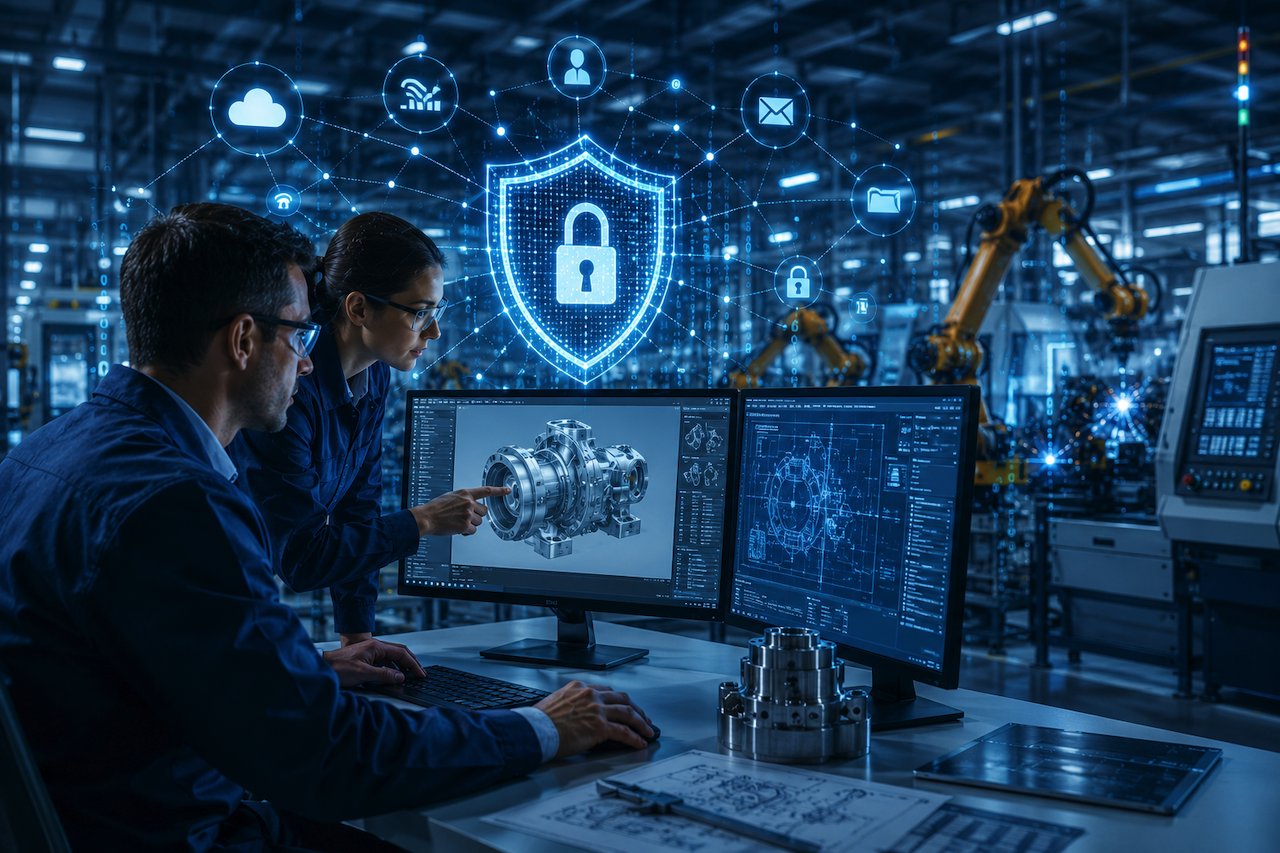
Manufacturing is becoming increasingly digital.
A decade ago, product development often involved local teams, internal servers, and limited collaboration outside the organization. Today, engineers, designers, suppliers, manufacturers, and logistics partners frequently work together across multiple locations and countries.
This shift has accelerated innovation, reduced development timelines, and improved operational efficiency. However, it has also introduced a challenge that many organizations underestimate: securing the digital information that powers modern manufacturing.
While cybersecurity discussions often focus on protecting customer data, financial records, and internal communications, manufacturing organizations face a different set of risks. The digital systems, design files, production data, and connected technologies used to create products have become valuable assets that require the same level of protection as any other business-critical information.
As manufacturing becomes more connected, cybersecurity is emerging as an essential component of operational resilience. Digital manufacturing environments increasingly rely on interconnected machines, software platforms, sensors, cloud systems, and communication networks to exchange information throughout the product lifecycle.
The Growing Value of Digital Manufacturing Data
Every physical product begins as data.
Whether a company is developing consumer electronics, industrial equipment, medical devices, or automotive components, the process typically starts with digital designs. These files contain dimensions, material specifications, engineering requirements, production instructions, and other proprietary information.
For many organizations, these digital assets represent years of research, development, and investment.
If those files are exposed, stolen, modified, or lost, the consequences can extend far beyond intellectual property concerns. Production delays, quality issues, compliance problems, and reputational damage may all follow.
The increasing value of digital manufacturing data has made cybersecurity and secure collaboration more important than ever.
Why Manufacturing Workflows Are Becoming More Complex
Modern manufacturing rarely happens within a single facility.
Product development often involves multiple stakeholders working together throughout the design and production process. Internal engineering teams collaborate with external suppliers. Manufacturing partners receive technical specifications. Quality assurance teams evaluate performance data. Logistics providers coordinate production schedules.
This interconnected environment improves efficiency but also increases exposure.
Each additional connection creates another potential entry point for unauthorized access, accidental data exposure, or cyberattacks.
Organizations must therefore balance accessibility with security.
Teams need information quickly, but they also need confidence that sensitive data remains protected throughout the development process.
Supply Chains Create New Security Challenges
Supply chain security has become a major concern across industries.
Many organizations now depend on specialized manufacturing partners for specific production capabilities. These relationships help businesses remain flexible and reduce infrastructure costs, but they also require frequent sharing of technical information.
For example, companies working with an online CNC machining service may need to exchange CAD files, engineering drawings, manufacturing specifications, and revision updates throughout a project lifecycle.
While this collaboration enables efficient production, it also highlights the importance of secure file transfer systems, access controls, cybersecurity policies, and vendor risk management practices.
A security weakness at any point in the supply chain can potentially affect every organization involved.
Cybercriminals Are Expanding Their Targets
Historically, cybercriminals focused heavily on financial institutions, consumer databases, and payment systems.
Today, manufacturing organizations are also attracting increasing attention.
The reason is straightforward.
Manufacturers possess valuable intellectual property, operational data, and proprietary designs. In some cases, disrupting production operations can create immediate financial consequences, pressuring organizations to respond quickly to incidents.
Research into digital manufacturing security has highlighted how connected production environments create new attack surfaces through communication networks, embedded systems, sensors, industrial control systems, and software platforms.
As a result, cybersecurity is no longer solely an IT issue.
It has become an operational concern that directly affects business continuity.
The Risks of Unauthorized Access
When people think about cybersecurity, they often imagine stolen passwords or compromised email accounts.
In manufacturing environments, however, unauthorized access to production systems, design files, and operational data may present unique risks.
A modified design file could potentially affect product quality. An outdated version may introduce manufacturing errors. Unauthorized distribution could expose sensitive intellectual property. Compromised systems may disrupt production or create operational downtime.
In highly regulated industries, even minor changes to technical documentation may create compliance challenges.
These risks highlight the need for version control, access management, encryption, secure collaboration practices, and continuous monitoring throughout the product development process.
Organizations cannot simply assume that connected systems are secure because they are convenient.
Best Practices for Manufacturing Cybersecurity
Protecting manufacturing data requires a layered approach.
Organizations should implement role-based access controls that limit information availability to authorized personnel. Encryption should be used when transmitting sensitive information between teams and external partners.
Multi-factor authentication adds another layer of protection against unauthorized access.
Regular audits can help identify vulnerabilities in digital workflows and ensure that security policies remain effective as operations evolve.
Equally important is employee awareness.
Many security incidents originate from human error rather than technical failures. Training employees to recognize phishing attempts, manage credentials securely, and follow established procedures can significantly reduce risk.
Why Cybersecurity and Operational Efficiency Must Work Together
Some organizations mistakenly view cybersecurity as an obstacle to productivity.
In reality, the two goals are closely connected.
Efficient collaboration depends on trust. Teams need confidence that the information they share remains accurate, protected, and accessible only to authorized individuals.
Strong cybersecurity practices help create that confidence.
When organizations implement secure workflows from the beginning, they can support collaboration without introducing unnecessary risk.
This approach becomes increasingly important as manufacturing operations continue adopting cloud platforms, automation systems, artificial intelligence, industrial IoT technologies, and connected devices.
Looking Ahead
The future of manufacturing will almost certainly be more digital than today.
Industry 4.0 technologies continue expanding the role of connected systems, real-time analytics, cloud-based collaboration, automation, and digital product development. These innovations create significant opportunities for efficiency and growth.
At the same time, they increase the importance of cybersecurity.
Organizations that invest in secure digital infrastructure will be better positioned to protect intellectual property, maintain operational continuity, reduce cyber risk, and support trusted collaboration across increasingly complex supply chains.
Conclusion
Manufacturing is no longer just about machines, materials, and production facilities. It is also about data.
The digital systems and information that drive modern product development have become valuable business assets that require careful protection. As organizations collaborate across distributed teams, connected devices, and external partners, cybersecurity is becoming a critical component of manufacturing success.
Businesses that treat cybersecurity as an integral part of product development, not merely an IT responsibility, will be better equipped to navigate the challenges of an increasingly connected manufacturing landscape.
Featured Image generated by ChatGPT.
Share this post
Leave a comment
All comments are moderated. Spammy and bot submitted comments are deleted. Please submit the comments that are helpful to others, and we'll approve your comments. A comment that includes outbound link will only be approved if the content is relevant to the topic, and has some value to our readers.


Comments (0)
No comment