
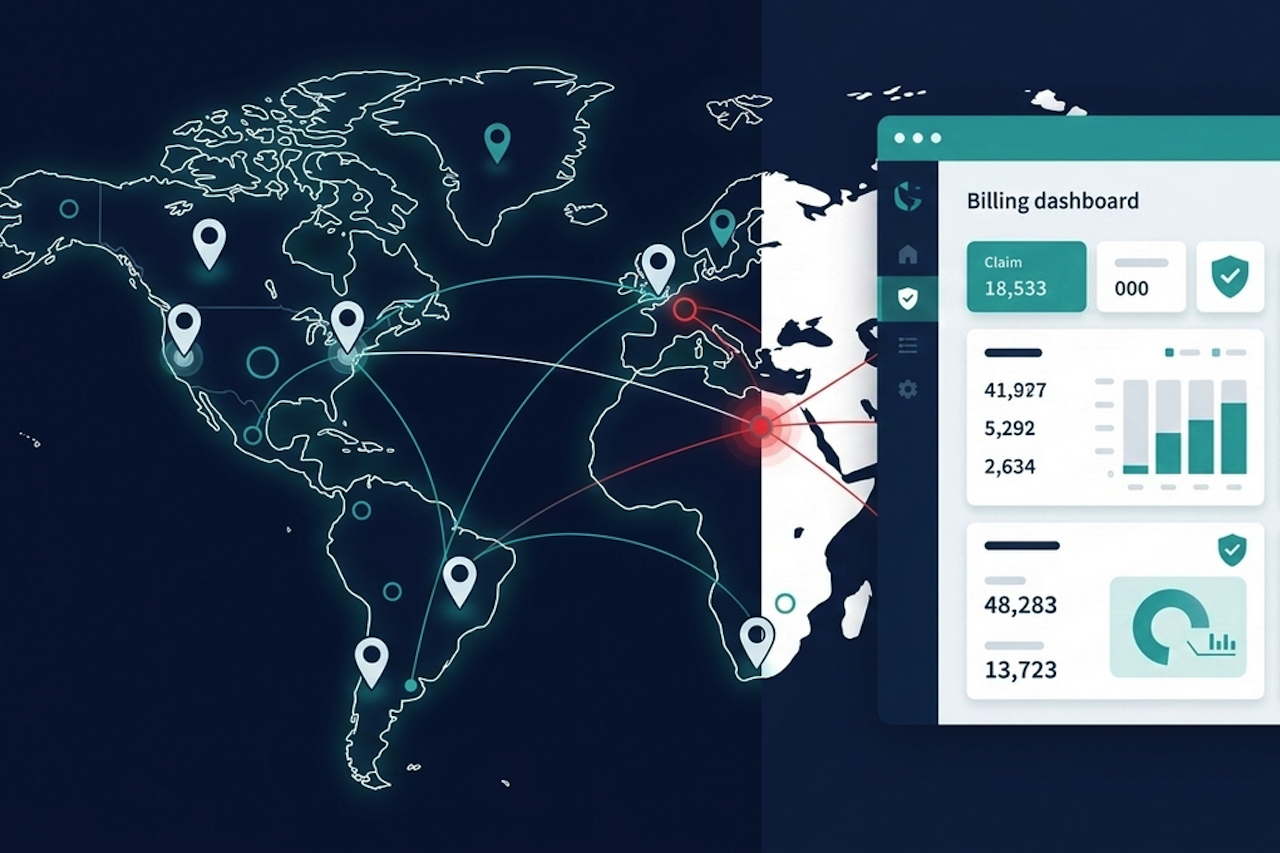
Healthcare billing fraud costs the U.S. healthcare system an estimated $100 billion every year. Behind every fraudulent claim is a chain of overlooked data signals, mismatched IP addresses, unverified provider identities, and billing patterns that fall outside normal parameters. For healthcare organizations navigating an increasingly complex billing environment, the answer may already exist in the cybersecurity tools many IT teams use daily.
The intersection of IP geolocation, identity verification, and healthcare billing fraud prevention is no longer niche; it is quickly becoming a critical layer of revenue cycle protection. Here is how forward-thinking organizations are putting these tools to work.
The Data Problem Hiding Inside Every Fraudulent Claim
Most billing fraud does not announce itself. It shows up as a claim submitted from an IP address registered in a state where the provider has no physical office. It looks like a batch of identical procedure codes filed in rapid succession. It behaves like a legitimate transaction right up until a payer flags it, a denial comes through, and a revenue cycle team spends weeks attempting recovery.
The challenge for most healthcare organizations is that their billing systems are not built to think like cybersecurity tools. They process claims. They verify codes. But they rarely ask: where did this submission originate and does that location make sense?
That question is deceptively simple, and it is exactly what IP-based geolocation is designed to answer.
What IP Geolocation Brings to Healthcare Billing Security
IP geolocation maps an internet connection to a real-world geographic location: country, state, city, and sometimes ZIP code. In a cybersecurity context, it is used to detect anomalies: a login from an unusual country, a transaction originating from a known proxy server, or access requests that do not match a user's established patterns.
Applied to healthcare billing, the same logic holds. Organizations can use IP intelligence to:
- Flag billing submissions originating from locations inconsistent with a provider's registered address
- Detect access from VPNs, proxies, or Tor exit nodes, common tools in credential-based fraud schemes
- Identify high-risk IP addresses associated with previous data breach activity
- Cross-reference claim submission origins with payer-required documentation to identify inconsistencies before submission
None of this requires building a new system from scratch. Many IP lookup and geolocation APIs can be integrated directly into existing billing portals or RCM platforms, adding an automatic background verification layer.
Four Cybersecurity Strategies That Directly Reduce Billing Fraud Risk
1. Real-Time IP Verification at the Point of Claim Submission
The most direct application of IP geolocation in medical billing fraud detection is validating the origin of every claim submission against known provider and facility data. When a submission arrives from an IP address that is geographically inconsistent or associated with anonymizing infrastructure, the system holds the claim for manual review rather than forwarding it to the payer. This single check can intercept external fraud attempts and catch compromised staff credentials before a denial hits the revenue cycle.
2. Multi-Factor Authentication Tied to Identity and Location
Credential theft is one of the most common entry points for healthcare billing fraud. A staff member's login is compromised, allowing access to the billing platform from a remote location, and dozens of claims are submitted before anyone notices. Pairing multi-factor authentication with location-based risk scoring, in which logins from unfamiliar or high-risk IP addresses trigger additional verification, closes this gap significantly. It is a cybersecurity standard that translates directly into billing security.
3. Automated Anomaly Detection Across Billing Patterns
IP data becomes far more powerful when combined with behavioral analytics. By establishing baseline billing patterns, average daily claim volume, typical procedure code distribution, and normal submission time windows, organizations can automatically flag deviations. A sudden spike in high-value claims filed outside business hours from an IP address outside the practice's region is a signal, not a coincidence. Modern revenue cycle management platforms that incorporate these anomaly-detection layers catch fraud before it reaches the payer, rather than after a denial has already disrupted cash flow.
4. Data Breach Monitoring to Protect Patient and Provider Credentials
Fraudulent billing often starts with compromised data, not a sophisticated technical attack. Regularly scanning staff and provider credentials against known data breach databases allows organizations to identify exposed accounts before bad actors exploit them. This proactive approach to credential hygiene is standard practice in cybersecurity. It is increasingly being adopted by billing compliance teams who understand that a single breached login can result in hundreds of fraudulent claims.
Where Revenue Cycle Management Fits In
Cybersecurity tools create the detection layer. Revenue cycle management provides the operational framework to act on what they detect.
A well-structured RCM process does more than submit claims and post payments. It includes insurance verification that cross-checks patient identity data, coding workflows that flag statistically improbable patterns, and denial management protocols that distinguish fraudulent submissions from legitimate billing errors. When IP geolocation and cybersecurity signals are embedded into these workflows, the result is a revenue cycle that is both financially efficient and structurally resistant to fraud.
For organizations looking to build this kind of end-to-end protection, partnering with a team that specializes in healthcare revenue cycle management solutions and understands both the billing compliance landscape and the fraud risk environment can accelerate the adoption of these security-integrated workflows without disrupting existing clinical operations.
What This Means for Healthcare IT and Billing Teams
The traditional separation between IT security and billing operations is becoming a liability. The organizations that are most effectively reducing fraud exposure are the ones where cybersecurity teams and revenue cycle managers share data, tools, and decision-making frameworks.
In practical terms, this means:
- IP lookup tools used by IT for network monitoring should also inform billing submission verification
- Billing portals should enforce the same access security standards as clinical EHR systems
- Compliance and fraud prevention should be integrated into the revenue cycle at every stage, from patient intake through payment posting.
- Anomalies flagged by cybersecurity tools should automatically trigger billing holds, not just IanT's alert.s
Final Thoughts
Healthcare billing fraud is not purely a financial problem; it is a data integrity problem. The signals that expose it are already present in the network traffic, IP logs, and credential activity that cybersecurity teams monitor every day. The organizations making the biggest strides in fraud prevention are the ones finding ways to route those signals into their billing workflows.
IP geolocation and cybersecurity tools are not silver bullets, but they represent a meaningful, implementable layer of protection that most healthcare organizations have to utilize. Paired with a disciplined, compliance-driven approach to revenue cycle management, they form a practical foundation for reducing fraud exposure and the claim denials, financial losses, and administrative burden that come with it.
For IT teams, billing managers, and healthcare administrators alike, the message is the same: the tools are available. The question is whether your workflows are built to use them.
Share this post
Author

Read the latest articles from Anwar UI-Haq
8 Practical Steps to Reduce Cloud Security Risks Without Slowing Teams Down

June 3, 2026
Most cloud security breaches trace back to the same small set of causes: exposed storage locations with incorrect permissions, inactive accounts that were never decommissioned, and infrastructure that drifted from its original configuration without anyone noticing. These are not exotic attack vectors. There are v [...]
Learn moreTop 15 Best Websites to Sell Your Car Online Quickly and Easily

September 25, 2025
Selling a car has shifted from local newspaper classifieds to modern, dynamic websites. This guide highlights a variety of platforms for selling cars, ranging from global marketplaces to local instant-offer services. Whether your priority is speed, value, or convenience, online car-selling platforms can p [...]
Learn moreLeave a comment
All comments are moderated. Spammy and bot submitted comments are deleted. Please submit the comments that are helpful to others, and we'll approve your comments. A comment that includes outbound link will only be approved if the content is relevant to the topic, and has some value to our readers.


Comments (0)
No comment