
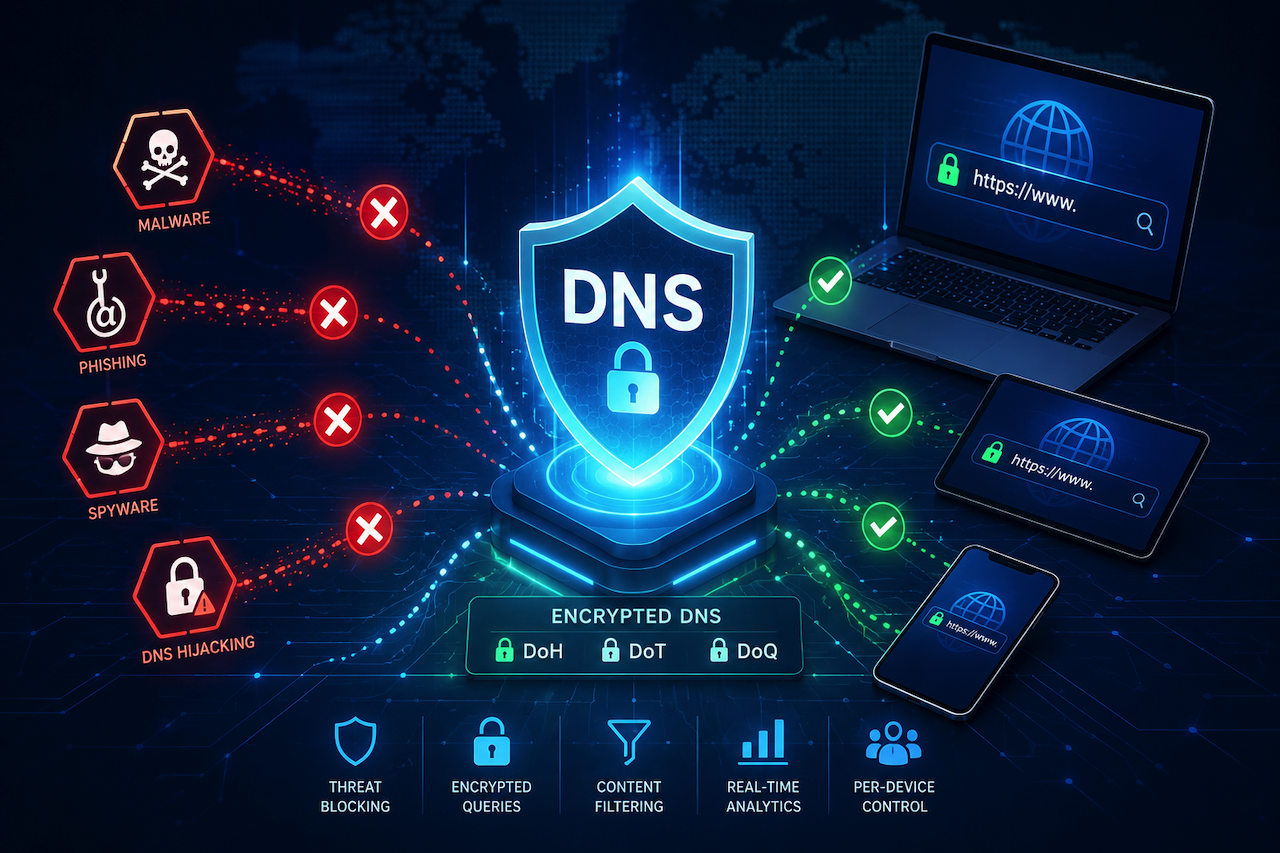
Hackers don't always need to break into your device. Sometimes, they need your DNS to point the wrong way.
Most people browse the internet with their ISP's default DNS servers. It's unencrypted, unfiltered, and completely visible to anyone between you and the server. In 2026, with phishing attacks more sophisticated and data harvesting more widespread than ever, that risk is easy to fix if you know where to look.
This article covers the best DNS services for secure browsing this year and what each brings to the table.
Why Your DNS Choice Affects Security
DNS is the first step in almost every connection your device makes online. A compromised or unprotected DNS means:
- Phishing sites remain accessible: Malicious domains go unblocked if your resolver doesn't check against threat databases.
- Your traffic is visible: Unencrypted DNS queries can be intercepted, monitored, or tampered with.
- Malware can phone home: Many malware strains rely on DNS to reach command-and-control servers; blocking at the DNS level cuts that connection.
- ISPs can track and sell your data: Default resolvers often log every query and share data with third parties.
- DNS hijacking: Without encrypted DNS, attackers on the same network can redirect your queries to malicious sites.
Switching to a secure DNS service addresses all of these at once, without installing anything on individual devices.
Quick Comparison
| Platform | Best For | Threat Blocking | Per-Device | Trial / Entry Plan |
|---|---|---|---|---|
| ControlD | Individuals, families, teams, small and large businesses | Blocks malware, phishing, spyware, cryptomining, and more with custom category controls | Yes | Yes |
| Cisco Umbrella | Large enterprises and organizations | Powered by Cisco Talos, one of the most comprehensive threat databases available | Yes | No |
| Cloudflare Gateway | Teams and businesses | Blocks malware and phishing using Cloudflare's threat intelligence on a global network | Yes | Limited |
| DNSFilter | Businesses and remote teams | Machine learning detects zero-day threats before they appear on static blocklists | Yes | Trial only |
1. Control D
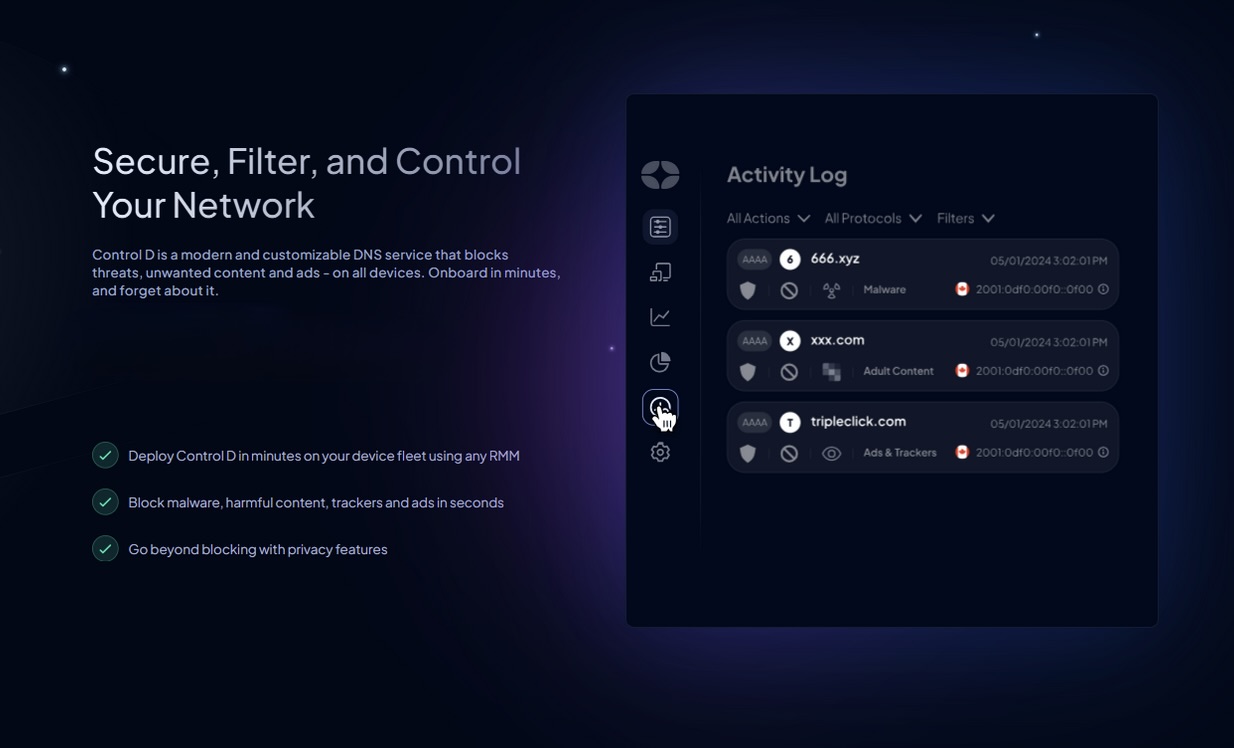
Control D is one of the most capable secure DNS services available in 2026. It combines support for all modern secure DNS protocols with enterprise-grade threat blocking and granular control, allowing you to tailor security rules for each device on your network.
Key Features
- AI malware and phishing blocking: Uses AI and machine learning to automatically block known malicious, phishing, and botnet domains before any connection is made.
- Custom security profiles: Build filtering rules around specific threat concerns, from cryptomining domains to spyware categories.
- Per-device security rules: Set different protection levels for different devices; apply stricter rules to a child's device or a work machine without affecting others.
- Encrypted DNS protocols: Full support for DoH, DoT, DoQ, and DoH/3, ensuring queries can't be intercepted or tampered with in transit.
- DNS redirect and routing: Route traffic through specific servers or block entire categories of domains based on geography or content type.
- Real-time analytics (optional): Monitor blocked threats, query patterns, and suspicious activity per device from a single dashboard.
- Endpoint profiles: Deploy consistent security configurations across multiple devices instantly.
- Tiered plans: Advanced threat categories, per-device rules, and analytics are available through higher-tier plans.
Additional Benefits
- No software installation required; security is applied at the DNS level across every device on the network
- Works on all platforms: routers, Windows, macOS, iOS, Android, Linux
- Regularly updated threat intelligence keeps protection current without any user action
- Flexible enough for home users and enterprises alike
Limitations
- The service can block entire domains but cannot filter or block individual URLs within a domain
2. Cisco Umbrella

Cisco Umbrella is a DNS security platform built on Cisco's Talos threat intelligence, one of the most comprehensive cybersecurity databases in the world. It's designed for organizations that require DNS protection across large networks and integration with Cisco’s broader security suite.
Key Features
- AI-driven threat intelligence: Uses Cisco Talos data to block malware, phishing, ransomware, and command-and-control domains in real time.
- DNS-layer security: Stops threats at the DNS level before any connection is established, reducing exposure significantly.
- Content filtering by category: Enforce browsing policies across the entire organization from a centralized dashboard.
- Per-device and per-user policies: Apply different security rules to different users, devices, or locations.
- Encrypted DNS support: Supports DoH and DoT for secure query transmission.
- Detailed threat reporting: In-depth logs showing blocked threats, query patterns, and policy violations across the network.
Additional Benefits
- Backed by Cisco's global security infrastructure and continuously updated threat feeds
- Integrates with other Cisco security tools for a unified security stack
- Strong fit for businesses, schools, and organizations managing large numbers of devices
Limitations
- Pricing and complexity make it less practical for individual or home users
- No free tier; requires a paid subscription; no personal plan available
3. Cloudflare Gateway
Cloudflare Gateway is the DNS security layer within Cloudflare's Zero Trust platform. It sits atop one of the world's largest network infrastructures and is built for teams and businesses that need centralized DNS filtering and threat protection.
Key Features
- DNS-level threat blocking: Automatically blocks malware, phishing, and known malicious domains using Cloudflare's threat intelligence.
- Content filtering by category: Restrict access to specific content types across the organization from a single dashboard.
- Per-user and per-device policies: Assign different filtering rules to different users, groups, or devices.
- Encrypted DNS support: Full support for DoH and DoT across all platforms.
- WARP client integration: Pairs with Cloudflare's device agent for deeper traffic inspection beyond DNS.
- Built on Cloudflare's global network: Provides low-latency DNS resolution across virtually every region worldwide.
Additional Benefits
- Free tier available for small teams covering basic DNS filtering and threat blocking
- Integrates naturally with other Cloudflare Zero Trust tools for a broader security setup
- Detailed query logs and analytics are available on paid plans
Limitations
- Geared toward teams, not individuals; the interface and feature set are built for IT administrators.
- Advanced features require a paid Zero Trust plan; logging, identity-based policies, and deeper integrations sit behind a paywall
4. DNSFilter
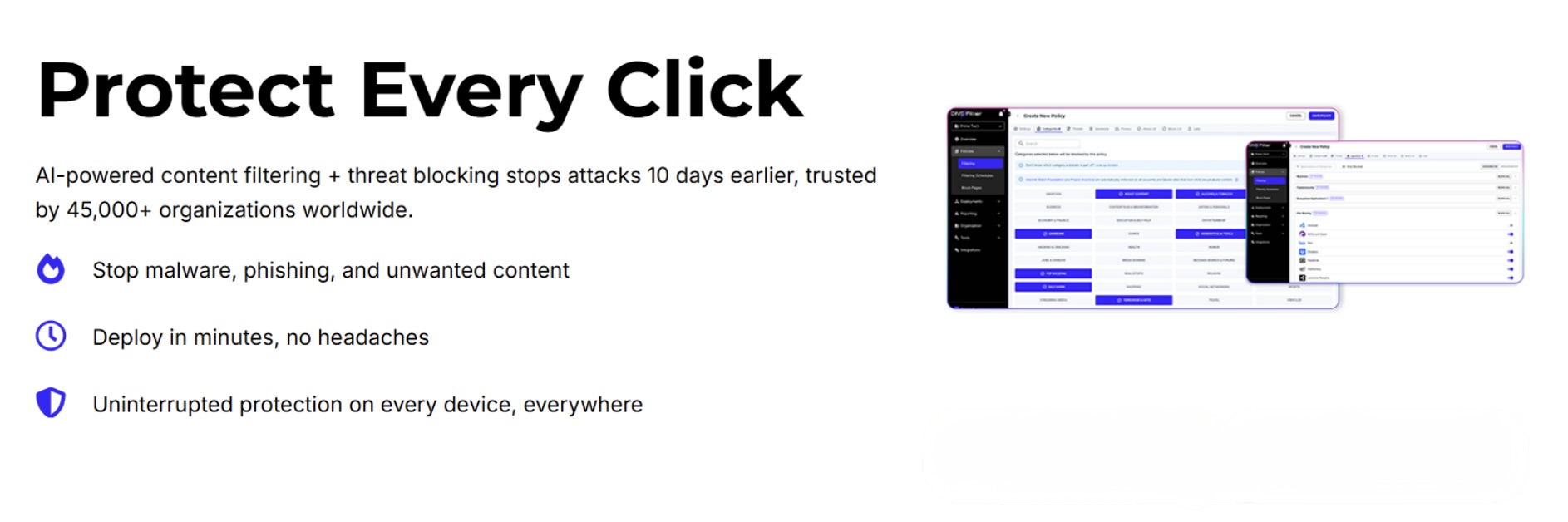
DNSFilter is a cloud-based DNS security platform that uses AI-driven threat detection to block malicious domains in real time. It's primarily aimed at businesses.
Key Features
- AI-powered threat detection: Uses machine learning to identify and block newly registered malicious domains, often before they appear on traditional threat lists.
- Content filtering by category: Blocks specific content types across the network from a central dashboard.
- Per-device and per-network policies: Applies different security rules to different devices, users, or locations.
- Encrypted DNS support: Fully supports DoH and DoT.
- Detailed reporting: Provides in-depth analytics on blocked threats, query volumes, and policy violations.
Additional Benefits
- Global network of DNS resolvers for fast, consistent performance
- Strong fit for small businesses or remote teams needing centralized DNS security management
Limitations
- Does not natively support all device types
- Frequent reports of broken captive portals for remote devices
Which Platform Suits Your Needs
- Control D: Offers extensive customization, advanced threat blocking, and support for a wide range of users and environments.
- Cisco Umbrella: Enterprise-focused DNS security backed by Cisco Talos threat intelligence and integration with Cisco's broader security ecosystem.
- Cloudflare Gateway: Combines DNS filtering with Cloudflare's global network infrastructure for teams and businesses.
- DNSFilter: Uses AI-powered threat detection and is particularly well suited for businesses and remote teams.
Summing Up
All of the DNS services on this list offer stronger security and privacy than a default ISP’s resolver, but they prioritize different areas. Cisco Umbrella emphasizes enterprise security integration, Cloudflare Gateway focuses on DNS filtering and global network performance, DNSFilter leverages AI-driven threat detection, and Control D combines threat blocking, filtering controls, per-device policies, and analytics in a single platform.
The right choice ultimately depends on your specific needs, budget, and desired level of control, whether you are securing a single device, a family network, or an entire organization.
Featured Image generated by ChatGPT.
Share this post
Author

Leave a comment
All comments are moderated. Spammy and bot submitted comments are deleted. Please submit the comments that are helpful to others, and we'll approve your comments. A comment that includes outbound link will only be approved if the content is relevant to the topic, and has some value to our readers.


Comments (0)
No comment