
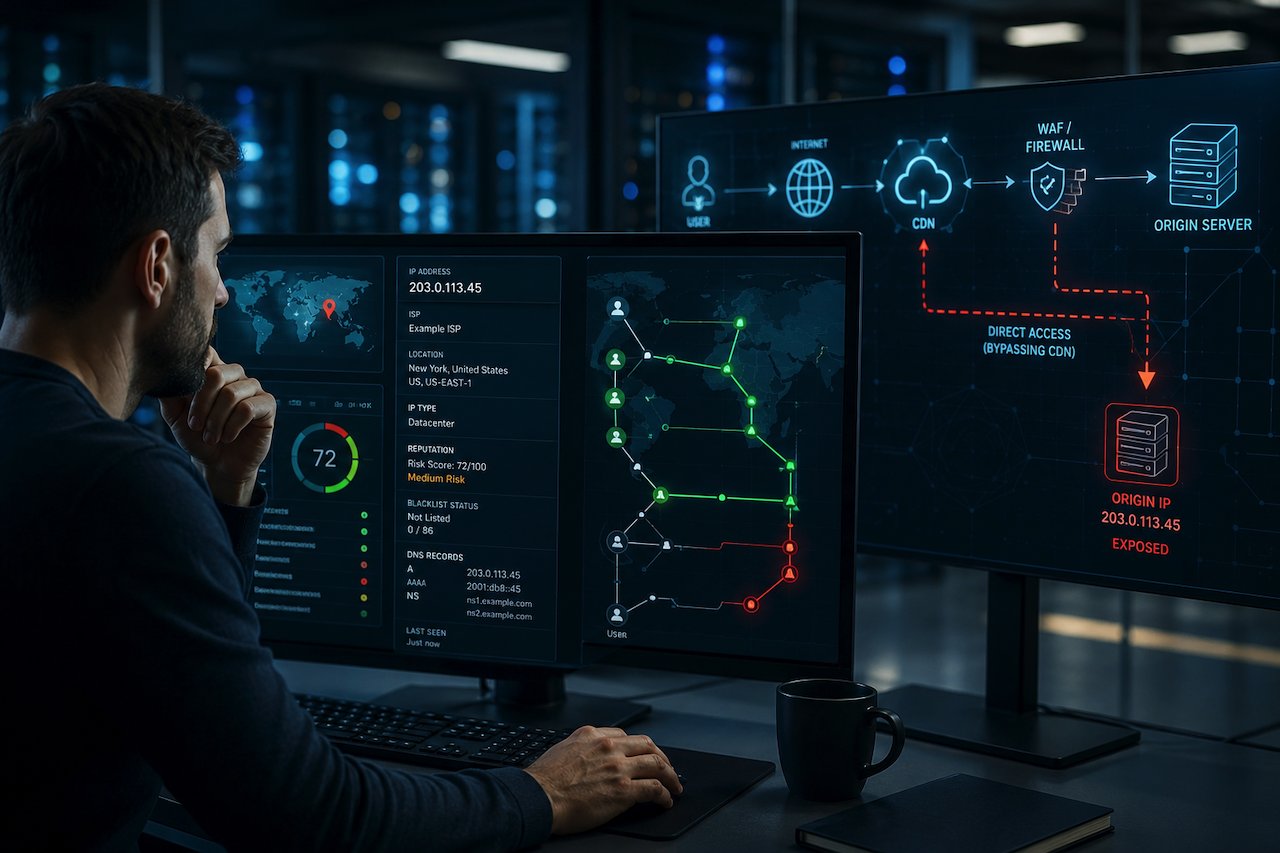
Look up your production server’s IP address using an IP lookup tool. It takes only a few seconds. Note which ISP serves the IP, which region it resolves to, whether it appears on any blacklists, and whether it is identified as a datacenter or residential IP address.
Now digest what you got. Every attacker trying to assess the landscape before taking action did exactly this without needing any credentials first.
Security reviews often begin at the network layer before progressing to source code, CI/CD pipelines, and application architecture. For example, firms such as Nomium may examine publicly available infrastructure information to better understand an organization's external attack surface and identify potential security gaps.
The Diagram Is Not the System
Every software development team has a diagram of how traffic flows from the user to their application via their CDN to the server and through the databases. It’s a perfectly reasonable diagram. But it might be outdated, even if it’s just by a little bit.
The network layer doesn’t care about what you’ve drawn in the diagram.
For example, a team could configure Cloudflare for origin protection and expect traffic to never flow directly into their server. However, the actual origin IP address remains publicly resolvable via a DNS lookup, and there are no firewall rules to prevent direct communication between the user and the server. In other words, the origin is wide open to any attackers willing to abuse it. The developers do not know because the application-level logs capture only events that occur while passing through the front door.
Also, an admin endpoint could be allowed for the IP address of a team member's old office. The IP address of that person changed eight months ago. Instead of adding a new entry for a new IP address, they turned off IP restrictions and forgot about that “temporary change”.
Optimized for the Wrong Problem
The reason why product-oriented development teams miss critical issues like those mentioned above might seem somewhat disturbing—developers are not responsible for network-level infrastructure. While they are focused on solving application-level problems, the network layer operates quite differently. Application developers and network-level administrators require different levels of expertise.
Most application-level teams don’t have anyone owning their infrastructure. As a result, they rely on cloud default configurations and on the knowledge of whoever initially configured their system.
So the system works. Features ship. Users don’t complain. And somewhere in the network layer, there’s a configuration that made sense in a specific context that no longer exists, quietly waiting.
Four Questions Your Firewall Cannot Answer for You
Here are four checks that can help determine whether your infrastructure is operating within expected security boundaries:
1. Can Your Server Make Outgoing Requests to Any Internet Address?
If so, a compromised dependency or third-party component could potentially exfiltrate sensitive information without generating obvious application-level logs. This is a common concern in supply-chain attacks, where attackers focus on manipulating trusted software or services rather than directly targeting the application itself.
2. Does Your IP Geolocate Correctly?
If your organization promises that certain services or data remain within a specific region, inaccurate IP geolocation can create compliance, performance, or user experience issues that may go unnoticed until they cause problems.
3. Does Your IP Range Share a Reputation With Malicious Activity?
Some hosting providers use shared IP ranges that may also be associated with spam, scraping, or other abusive behavior. This can affect email deliverability, reputation scores, and accessibility even when your own systems are operating normally.
4. What Happens If Someone Accesses the Origin IP Directly?
If attackers can reach the origin server without passing through the CDN or security layer, they may bypass protections designed to filter traffic and mitigate threats.
Configuration Is Not a One-Time Event
All this information can be obtained with simple commands such as reverse DNS lookup, traceroute, egress test, or IP reputation check. The main difficulty in this process is not related to diagnostic measures. Rather, it’s the issue of responsibility.
Since no one owns the network layer, these diagnostics might not occur regularly enough, if at all. Therefore, the actual solution would involve treating infrastructure as something dynamic and evolving. It implies the routine tracing of the request path through the infrastructure, rather than reading through the system diagram. Also, explicit egress rules should be created to restrict outbound communication, rather than relying on implicit egress policies. Finally, checking your IP reputation should become routine.
A server IP lookup takes only a few seconds, yet it can reveal information about hosting providers, geographic location, network ownership, reputation, and potential infrastructure exposure. The more important question is not whether this information is available, but whether organizations routinely review and understand what it reveals about their environment.
Organizations that perform infrastructure assessments, including companies such as Nomium.tech, often begin by examining publicly accessible network-layer information before reviewing source code or application architecture. In many cases, these external signals can reveal configuration issues that are not visible through application-level monitoring alone.
Conclusion
Many organizations focus their security efforts on applications, code quality, and user-facing functionality. However, attackers often begin with something much simpler: publicly available network-layer information.
A server's IP address, DNS records, routing paths, reputation data, and exposure to direct traffic can reveal valuable details about an environment before any authentication is required. These signals may not appear in application logs, but they can provide insight into infrastructure weaknesses, outdated configurations, and overlooked risks.
Regularly reviewing network-layer visibility, validating infrastructure assumptions, and treating configuration as an ongoing process can help organizations identify issues before they become security incidents.
Disclaimer
This article is provided for informational and educational purposes only and should not be considered professional cybersecurity, legal, compliance, or technical advice. Readers should conduct their own research and consult qualified professionals before making decisions related to network security, infrastructure management, or risk assessment.
Any references to third-party companies, products, or services are provided as examples only and do not constitute an endorsement or recommendation by IPLocation.net. While reasonable efforts are made to ensure the accuracy of the information presented, IPLocation.net makes no representations or warranties regarding its completeness, reliability, or suitability for any particular purpose.
IPLocation.net shall not be liable for any losses, damages, security incidents, service disruptions, or other consequences arising from the use of, or reliance upon, the information contained in this article.
Featured Image generated by ChatGPT.
Share this post
Leave a comment
All comments are moderated. Spammy and bot submitted comments are deleted. Please submit the comments that are helpful to others, and we'll approve your comments. A comment that includes outbound link will only be approved if the content is relevant to the topic, and has some value to our readers.


Comments (0)
No comment