
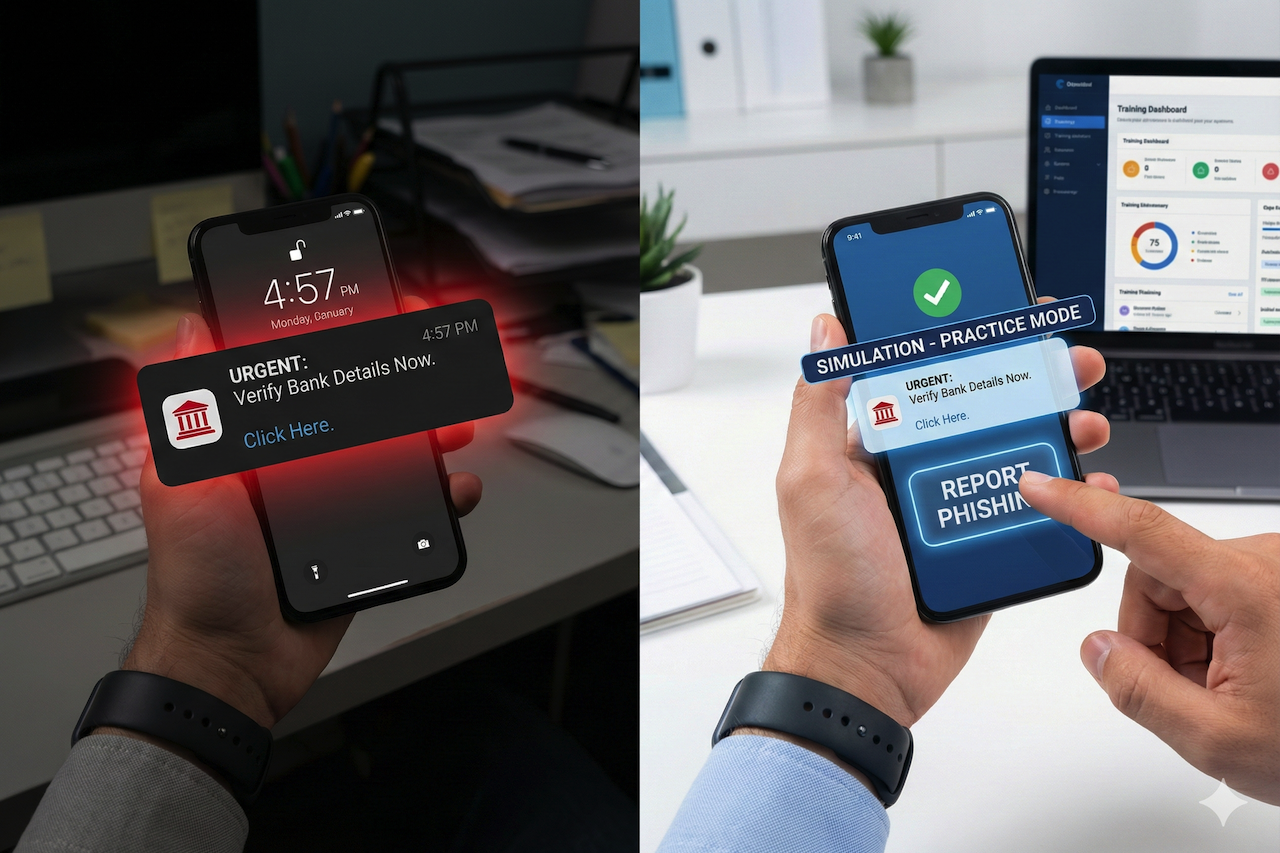
Phishing succeeds because we sometimes let our guard down. A sophisticated social engineering attack might involve a message arriving at 4:57 pm on a Friday, appearing to come from a colleague or a legitimate vendor, and requesting something that seems routine. It could ask you to approve a document, update bank details, or re-authenticate a familiar tool.
That is why one-off awareness sessions typically have limited impact. The training or presentation deck focuses on calm and predictable scenarios. However, when an actual attack comes, it could be more nuanced. It will be well-timed, contextual, and designed to steal a decision in the moment.
Verizon’s Data Breach Investigations Report (DBIR) for 2025 logged 22,052 real-world security incidents, its highest so far, and confirmed 12,195 data breaches. The DBIR notes that synthetically generated text in malicious emails has doubled over the past two years. When the writing in a scam message looks polished, the old mental shortcut of spotting poor grammar is no longer effective.
The safest habit becomes behavioral, not visual. What should be done instead? Pause, verify through a second channel, and report. However, this takes time and commitment to build up.
What Simulations Can Do That Presentations Cannot
That’s why phishing training for employees works best when it is integrated into organizational culture rather than treated as a compliance checklist item. The goal is to build a reflex to check, pause, and report under realistic time pressure, because that is precisely how modern social engineering succeeds.
A slideshow can explain what a suspicious link looks like, but it cannot recreate the moment an authentic lure arrives uninvited and asks for a decision or an action. Simulations can. They show you where people hesitate, where they rush, and which teams are most likely to treat an unexpected request as usual. That difference matters because modern phishing succeeds by borrowing the look and timing of everyday work.
Simulations also give you evidence you can act on. You can see whether a finance-themed lure works better than an HR-themed lure, whether mobile messages are driving more clicks than desktop email, and whether reporting happens quickly or only after someone asks a colleague. Used properly, that data can serve as a map of where your processes are easiest to spoof and where a small change, such as requiring a callback for payment changes, removes an entire class of risk.

Image by Unsplash.
There is another advantage that often gets overlooked. Simulations can strengthen reporting culture. There is a significant increase in threat reporting when organizations run simulations regularly. Even when the exact metrics vary by team, the benefit is that employees are getting faster and more comfortable with raising a flag.
The Threat Landscape Is Pushing Training Towards Realism
The current phishing ecosystem is heavily URL-driven and mobile-aware. A 2025 report on URL phishing notes that URLs are used four times more often than attachments in malicious emails and that at least 55% of suspected smishing messages contain malicious URLs.
Apparently, it’s easier to slip a link past a tired reader than it is to convince them to open a suspicious file.
QR codes add another twist, particularly because they push the risky click onto a personal device. The report cited above also identified 4.2 million QR code threats in the first half of 2025. If your training is still focused on desktop email screenshots, it will not prepare employees for a QR code printed on a letter, embedded in a PDF, or pasted into a chat thread.
Simulations are among the few training methods that can keep up with that shift, as you can change the template, rotate the channel, and test response habits dynamically.
Building a Program That Employees Take Seriously
Start by defining what you want people to do, not only what you want them to avoid. For many organizations, the most valuable behaviors you want to see are pausing before acting on urgent requests, verifying sensitive changes through a second channel, and reporting suspicious messages quickly.
Then set a cadence that matches how quickly people forget. Be consistent. A steady but not easily predicted rhythm is better than a burst of activity followed by silence. Keep early simulations simple, so you measure baseline behavior rather than confusing people with overly elaborate tricks.
Next, tailor scenarios to roles. Differentiate based on the kinds of communication each department commonly receives (HR, finance, IT, etc.). Context is the main reason these lures work in real life, and it is what makes training feel relevant rather than generic.
Finally, keep the learning loop tight. When someone fails to flag a simulation, give a short explanation immediately, ideally one that shows the exact signal they missed, such as a lookalike domain, a mismatched login URL, or an unusual request path. Avoid long remediation modules, because they feel punitive. People learn better from short and specific corrections.
How to Run Simulations Without Damaging Trust
Simulations can backfire if people feel trapped or humiliated. A program designed to catch employees becomes a punitive measure rather than a learning opportunity. Make it a policy to frame it positively instead, and make your expectations explicit.
Tell employees that the organization will conduct realistic tests, that results will be used to improve processes and training, and that reporting is always encouraged, even after a mistake. The idea is to cultivate a sense of shared responsibility.
Separate coaching from discipline. Reserve negative reinforcement for repeated reckless behavior or policy violations. Be clear about that threshold, and keep it rare.
You can also reduce anxiety by designing for graceful failure. For example, if someone clicks on a simulation that they shouldn’t have, the landing page should teach, not shame. If someone reports, acknowledge it. Public recognition should focus on positive actions, such as rapid reporting, rather than calling out individuals for their mistakes.
What to Measure so the Program Improves Over Time
Click rates are a starting point, but they are not the complete story. A more useful measurement set includes how quickly suspicious messages are reported, whether employees choose a safe verification route, and whether the same themes continue to succeed against the same groups.
Track repeat susceptibility carefully, because it can indicate role-specific pressure or gaps in onboarding. Measure reporting quality, such as whether people include headers, screenshots, or the original message, because that affects how fast security teams can respond.
If you have a reporting button, measure adoption and false positives. False positives are not always bad. They can serve as evidence that people are being vigilant, provided the triage process is efficient.
Use simulation outcomes to refine internal processes as well. Payment changes, supplier onboarding, and bank detail updates should require verification steps that an email alone cannot satisfy. When simulations reveal which business processes are easiest to spoof, you get a roadmap for removing high-impact attack paths.
Turning Practice into Instinct
Simulated phishing is more effective than one-off sessions because it trains decision-making the way people actually make them: quickly, in context, and with distractions. When done well, it strengthens the reporting culture, generates actionable data, and keeps pace with modern social engineering tactics, including more polished messages and mobile-first delivery.
When you treat simulations as a feedback loop that improves both human habits and organizational controls, the training becomes something that employees actually use and learn from.
Featured Image generated by Google Gemini.
Share this post
Leave a comment
All comments are moderated. Spammy and bot submitted comments are deleted. Please submit the comments that are helpful to others, and we'll approve your comments. A comment that includes outbound link will only be approved if the content is relevant to the topic, and has some value to our readers.


Comments (0)
No comment