

Many websites struggle with SEO, not because they lack effort, but because they lack clarity. Pages are published, links are built, and tools are checked, yet rankings stagnate and traffic plateaus. In most cases, the real issue is simple: SEO is being done without a proper audit.
An SEO audit is not just a checklist or a tool-generated score. It is a structured diagnosis of how a website performs across technical health, on-page relevance, and off-page authority. Without this diagnosis, SEO becomes guesswork, fixing symptoms instead of identifying root problems.
This is where a clear audit template matters.
Professional search engine optimization services begin with an audit to identify what is broken, what is limiting performance, and what should be prioritized first. Technical issues can block crawling and indexing. Weak on-page elements can confuse search intent. Poor-quality backlinks can quietly harm trust. If these issues are not identified early, even consistent SEO efforts can fail to deliver results.
This free SEO audit template is designed to bring structure to that process.
It combines technical, on-page, and off-page SEO into a single, practical framework that helps you evaluate a website systematically, whether you are a business owner reviewing your own site or a marketer preparing for optimization.
In the sections ahead, you’ll learn:
- What an SEO audit actually covers
- How to use this template step by step
- What to look for under technical, on-page, and off-page SEO
- How to turn audit findings into actionable priorities
By the end, you’ll have a clear framework for understanding your website’s SEO health and avoiding blind optimization.
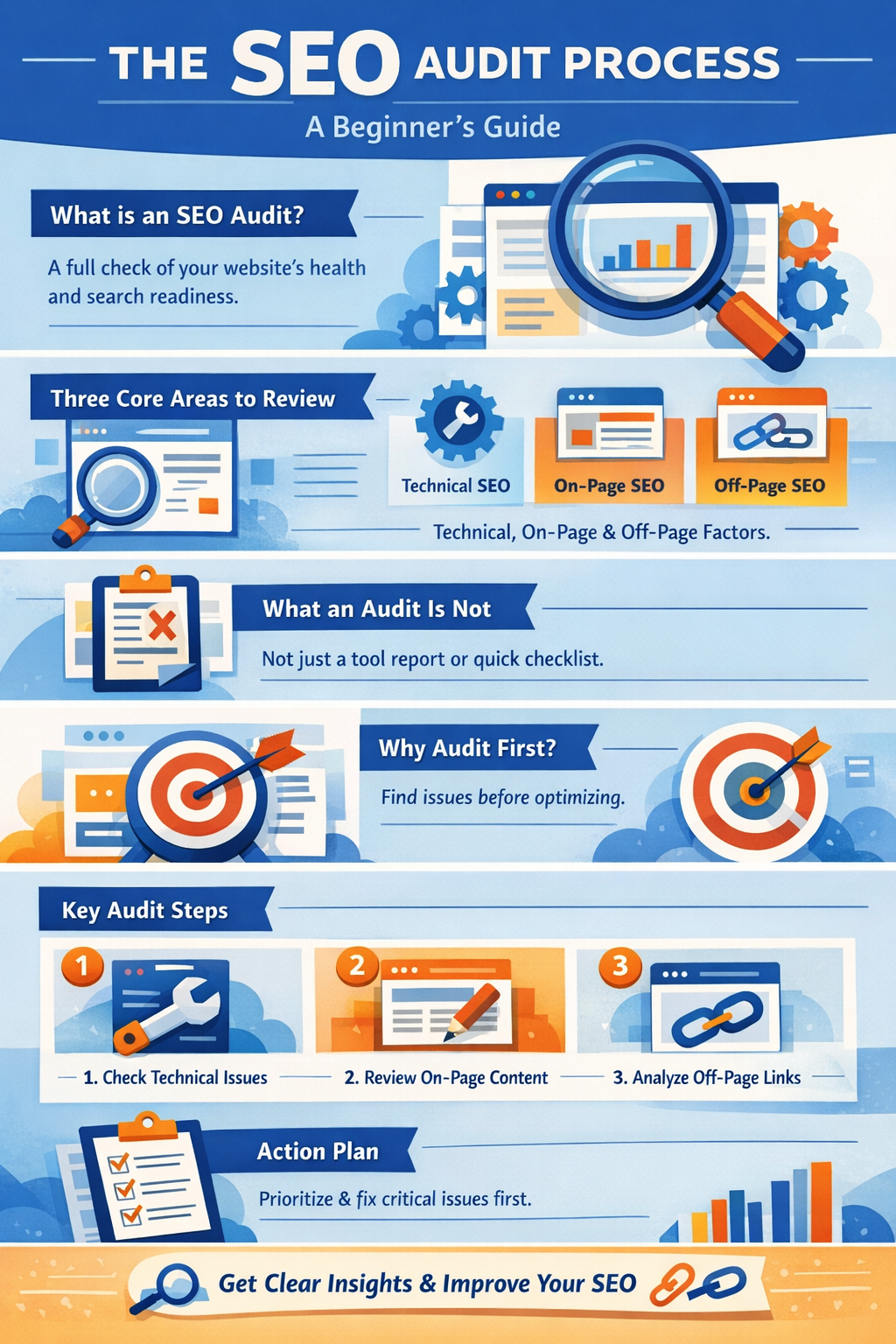
Image generated by ChatGPT.
What Is an SEO Audit?
An SEO audit is a comprehensive evaluation of a website's readiness to rank in search engines. It evaluates the site from a search engine’s perspective and identifies issues that hinder visibility, relevance, or trust.
Unlike SEO tools that only show scores or warnings, a real SEO audit explains why a problem exists and how it affects performance.
What an SEO Audit Actually Checks
A proper audit reviews three core areas:
- Technical SEO Audit: This checks whether search engines can crawl, index, and understand your website correctly. Issues here can block rankings entirely, even if content and links are strong.
- On-Page SEO: This evaluates how well your pages align with search intent. It covers titles, headings, content quality, internal linking, and keyword alignment.
- Off-Page SEO: This focuses on authority and trust signals, primarily backlinks, brand mentions, and overall reputation across the web.
An audit brings all three together instead of analyzing them in isolation.
What an SEO Audit Is Not
An SEO audit is not:
- A single tool report
- A keyword ranking list
- A one-time checklist you never revisit
- A fix-by-itself solution
Tools support audits, but they don’t replace analysis or prioritization.
Why SEO Audits Should Come Before Optimization
Without an audit, SEO efforts are often misdirected.
For example:
- Content is updated while indexing issues remain unresolved
- Backlinks are built while pages are technically blocked
- Keywords are targeted without matching search intent
Audits prevent wasted effort by showing what to fix first.
How Often Should an SEO Audit Be Done?
An SEO audit should be done:
- Before starting SEO work
- After significant website changes or redesigns
- Periodically, to catch new issues as the site grows
SEO is not static. Audits help keep optimization aligned with current conditions.
Why This Matters for Long-Term SEO
SEO success depends on strong foundations. An audit reveals both what is working and what is not, so decisions are based on evidence, not assumptions.
This is why structured audits are a core part of professional search engine optimization services, and why they determine whether SEO efforts scale or stall.
How to Use This SEO Audit Template

This SEO audit template is designed to help you understand a website’s SEO condition before making changes. It works best as a diagnostic framework, not as a checklist to rush through. The goal is clarity, knowing what is holding a site back and why.
You do not need advanced technical knowledge to use this template. What matters more is following the structure, observing, and documenting findings honestly, rather than guessing or fixing issues midway.
Start With Observation, Not Fixes
Begin by reviewing the website as it currently exists. Treat the audit as a snapshot of the site’s SEO health rather than a to-do list. This mindset prevents incomplete or misdirected optimization later.
Work through the audit in a logical order: start with technical foundations, then review on-page elements, and finally examine off-page signals. Each stage depends on the previous one.
Document Issues Clearly as You Go
As you use the template, note what is working and what is not. Avoid vague descriptions. A thorough audit explains the issue and where it appears, without immediately jumping to solutions.
Clear documentation turns the audit into a decision-making tool rather than a collection of observations.
Separate High-Impact Issues From Minor Ones
Not every SEO issue deserves immediate attention. Some problems directly block crawling, indexing, or visibility, while others only slightly reduce performance. The value of an audit lies in recognizing this difference.
When issues are correctly categorized, it becomes easier to decide what must be fixed first and what can wait.
Understand Page-Level vs Site-Wide Findings
Some audit findings apply to the entire website, including security, crawlability, and performance. Others, such as content relevance and internal linking, vary from page to page.
Keeping these separate avoids confusion during implementation and helps prioritize work more effectively.
Use the Audit to Plan, Not Panic
Once the audit is complete, resist the urge to fix everything at once. A good audit naturally identifies an order of action: technical issues are addressed first, followed by on-page improvements and authority-related work.
This sequence ensures that subsequent SEO efforts are built on a stable foundation.
Know What This Template Is Meant For
This template exists to provide clarity, not execution. It does not implement fixes, rewrite content, or build links. Its purpose is to ensure that any subsequent optimization work is intentional, prioritized, and evidence-based.
When used correctly, this audit template removes guesswork and helps SEO move forward with direction rather than assumptions.
Technical SEO Audit Template

Technical SEO forms the foundation of every website’s search visibility. If search engines cannot properly crawl, index, or load your site, even the best content and backlinks will struggle to perform. This part of the audit focuses on identifying issues that silently block or limit performance.
Crawlability and Indexing Checks
The first step is to confirm that search engines can access and correctly interpret your website. Problems here often prevent pages from appearing in search results.
Check whether:
- Important pages are crawlable by search engines
- Robots.txt is blocking essential sections
- XML sitemaps exist and are accessible
- Key pages are indexed in Google
If crawlability or indexing fails, other SEO efforts become ineffective.
Site Structure and URL Health
A clean structure helps search engines efficiently navigate your website. Poor URL practices can lead to duplicate content, confusion, or wasted crawl budget.
Review:
- Whether URLs are descriptive and straightforward
- If duplicate URLs exist for the same content
- How redirects are handled
- Whether canonical tags are used correctly
A logical structure improves both crawl efficiency and user experience.
Page Speed and Core Web Vitals
Page performance affects rankings and user engagement. Slow-loading pages often lead to higher bounce rates and weaker search visibility.
Audit:
- Mobile and desktop loading speed
- Core Web Vitals performance
- Heavy scripts or unoptimized images
- Layout shifts or delayed interactions
Speed issues should be prioritized early in any SEO action plan.
Mobile-Friendliness Review
Since Google primarily uses mobile-first indexing, mobile usability is critical.
Check whether:
- The site adapts properly to different screen sizes
- Text and buttons are readable and accessible
- No mobile usability errors are reported
A poor mobile experience can limit rankings even when desktop performance is strong.
Security and HTTPS Validation
Website security influences trust and visibility.
Confirm:
- HTTPS is active across all pages
- No mixed content warnings exist
- SSL certificates are valid and updated
Security issues can undermine user confidence and degrade search performance.
Error Detection and Technical Warnings
Technical errors accumulate quietly if left unchecked.
Identify:
- Broken internal links
- 404 or server errors
- Pages buried too deep in the site structure
- Crawl anomalies reported by search engines
Resolving these issues improves crawl efficiency and long-term stability.
Why the Technical Audit Comes First
Technical SEO issues often block progress without apparent symptoms. Fixing them early ensures that content, on-page optimization, and authority-building efforts are built on a stable foundation.
This is why professional search engine optimization services always begin with a structured technical audit before moving on to on-page optimization.
On-Page SEO Audit Template

On-page SEO determines how clearly your website communicates with search engines and users. Even when a site is technically sound, weak on-page signals can prevent pages from ranking for the correct queries. This part of the audit focuses on relevance, alignment of intent, and clarity.
Page Titles and Meta Descriptions
Titles and meta descriptions shape how your pages appear in search results and influence click-through rates. Poorly written or duplicated tags reduce visibility, even if rankings improve.
During the audit, review whether:
- Each page has a unique, descriptive title
- Titles reflect actual search intent, not just keywords
- Meta descriptions are present and readable
- Important pages avoid duplication
Strong metadata improves both rankings and user engagement.
Headings and Content Structure
Headings help search engines understand content hierarchy and context. Disorganized heading structures often signal weak relevance.
Check if:
- Each page has a single, clear H1
- Subheadings follow a logical order
- Headings support the main topic rather than repeat keywords
Well-structured content improves readability and search engine crawlability.
Content Quality and Search Intent Match
Content should exist to solve a user’s problem, not just to target a keyword. Pages that fail to match intent rarely perform well over the long term.
Audit content to see whether:
- The page fully answers the query it targets
- Information is up to date and accurate
- Thin or repetitive content exists
- Pages provide value beyond surface-level explanations
Search engines reward usefulness, not length alone.
Internal Linking and Page Relationships
Internal links guide both users and search engines through your website. Weak internal linking often leaves important pages isolated.
Review:
- Whether key pages receive internal links
- If the anchor text is descriptive and natural
- Whether orphan pages exist
Strong internal linking improves crawl flow and topic authority.
Images and Media Optimization
Images support content, but can harm performance if unoptimized.
Check whether:
- Images include descriptive alt text
- File sizes are optimized
- Media supports content relevance
Proper optimization improves accessibility and page speed.
Keyword Usage and Cannibalization
Keywords should be mapped intentionally, not scattered across pages.
Audit whether:
- Multiple pages target the same keyword unnecessarily
- Keyword usage feels natural
- Pages compete with each other in search results
Resolving cannibalization helps rankings stabilize.
Why On-Page SEO Audits Matter
On-page SEO bridges the gap between technical foundations and authority-building. It ensures that when search engines access your site, they clearly understand what each page is about and who it is for.
Without strong on-page signals, even well-built websites struggle to convert visibility into traffic.
Off-Page SEO Audit Template

Off-page SEO reflects how trustworthy and authoritative your website appears outside its own pages. Even a technically perfect, well-optimized site can struggle if its external signals are weak, risky, or inconsistent. This part of the audit focuses on authority, reputation, and risk.
Unlike technical or on-page SEO, off-page factors are not entirely within your control, making auditing them even more critical.
Backlink Profile Overview
The first step is understanding the overall state of your backlink profile. This is not about counting links, but about evaluating their quality, relevance, and growth pattern over time.
During the audit, look at:
- How many unique domains link to the site
- Whether links come from relevant industries
- If link growth appears natural or sudden
A healthy backlink profile grows steadily and reflects genuine recognition.
Link Quality and Relevance
Not all backlinks help SEO. Some links contribute authority, while others add noise or risk.
Assess whether links:
- Come from credible, contextually relevant websites
- Appear editorial rather than automated
- Add value rather than existing solely for SEO
Low-quality links dilute trust and can hold rankings back even when no penalties are visible.
Anchor Text Distribution
Anchor text patterns reveal how links were built.
Review whether:
- Brand names dominate anchor usage
- Keyword anchors appear natural and varied
- Repetitive or aggressive anchors exist
Unnatural anchor text distributions are a common risk signal in SEO audits.
Toxic Links and Risk Signals
Some backlinks actively harm performance.
Audit the profile for:
- Links from spam-heavy domains
- Irrelevant foreign sites
- Link networks or directories with no editorial value
Identifying risky links early helps prevent long-term damage.
Brand Mentions and Authority Signals
Authority is not built through links alone. Mentions, citations, and references also contribute to trust.
Check whether the brand:
- Is mentioned without links
- Appears consistently across platforms
- Has signals beyond backlinks
These elements support long-term credibility.
Why Off-Page Audits Are Often Ignored (and Why They Matter)
Off-page SEO is more complicated to control, so it is often overlooked. However, unresolved off-page issues quietly limit growth. A proper audit helps you determine whether your site lacks authority—or carries hidden risk.
This step completes the picture started by technical and on-page audits, allowing SEO decisions to be made with full context rather than assumptions.
Local SEO Audit Template

Local SEO becomes critical when a business depends on location-based searches, map visibility, or nearby customers. Even strong websites can underperform locally if local signals are weak or inconsistent. This part of the audit focuses on accuracy, proximity signals, and local trust.
Not every website needs a local SEO audit, but if your business serves a specific city or region, skipping this step often leads to missed visibility in Google Maps and local search results.
Google Business Profile Review
The first thing to audit is the Google Business Profile, which serves as the primary data source for local rankings. An incomplete or poorly maintained profile can limit visibility, regardless of the website's quality.
During the audit, review whether:
- The profile is verified and active
- Business categories accurately reflect services
- Descriptions are clear and guideline-compliant
- Photos, updates, and engagement signals are present
A strong profile improves relevance and user trust.
NAP Consistency Across Platforms
Consistency in name, address, and phone number is one of the strongest local trust signals. Minor inconsistencies across platforms can undermine confidence and confuse search engines.
Audit whether business details match across:
- Website contact pages
- Directories and listings
- Map platforms and social profiles
Consistency reinforces legitimacy and location accuracy.
Reviews and Reputation Signals
Reviews influence both rankings and user decisions. An audit helps identify whether reputation signals are helping or hurting visibility.
Check:
- Review quantity and recency
- Overall rating trends
- Whether reviews receive responses
- Patterns in customer feedback
Active reputation management strengthens prominence.
Local Content and Location Signals
Search engines look for confirmation that a business genuinely serves a location.
Audit whether the website includes:
- Location-specific service pages
- Local references are used naturally
- Content that supports local intent
Thin or generic location content often limits local performance.
Why Local SEO Audits Matter
Local SEO issues rarely cause sudden drops, but they quietly restrict growth. An audit helps surface gaps in visibility, trust, and engagement that would otherwise go unnoticed.
When combined with technical, on-page, and off-page audits, local SEO completes the full picture of a website’s search readiness.
SEO Audit Summary and Action Plan
An SEO audit only becomes valuable when its findings are clearly summarized and translated into action. Without this step, even the most detailed audit risks becoming a document that sits unused.
The purpose of the summary is not to repeat every issue, but to highlight the most critical and those that should be addressed first.
How to Summarize SEO Audit Findings
Start by grouping findings into broad categories rather than listing individual issues. This helps stakeholders quickly understand the situation without becoming overloaded with technical details.
A clear audit summary should answer:
- What is blocking search visibility right now
- What is limiting performance but not blocking it
- What is already working well
This high-level view makes decision-making easier and avoids reactive fixes.
Turning Audit Findings Into an Action Plan
Once issues are summarized, the next step is sequencing them correctly. SEO improvements should follow a logical order, not be driven by urgency or convenience.
A practical action flow usually looks like this:
- Fix technical issues that affect crawling, indexing, or performance
- Improve on-page elements to align with search intent
- Strengthen off-page and authority signals after foundations are stable
This order prevents wasted effort and ensures each improvement supports the next.
Why Prioritization Matters More Than Volume
Trying to fix everything at once often leads to incomplete execution. An effective audit-driven plan focuses on impact over quantity.
Some changes deliver immediate improvements, while others support long-term growth. Understanding this difference helps set realistic expectations and timelines.
Common Mistakes After an SEO Audit
One of the biggest mistakes is treating the audit as a one-time exercise. Websites evolve, competitors change, and search behavior shifts. An audit should guide ongoing optimization, not mark the end of your SEO work.
Another mistake is acting on tool scores alone without understanding context. Numbers without interpretation often lead to the wrong fixes.
When to Use a Professional SEO Audit
Free templates provide clarity and direction, but some situations require deeper expertise. Large websites, competitive industries, or complex technical setups often benefit from structured audits conducted by experienced teams.
This is where professional approaches, such as a technical SEO audit framework, help identify deeper issues that templates alone may not surface.
Final Thoughts
An SEO audit is not about finding faults; it’s about gaining clarity. It shows where a website stands, what is holding it back, and how to move forward intelligently.
When used correctly, this audit template turns SEO from guesswork into a structured process. Whether you manage SEO internally or work with external specialists, starting with a clear audit ensures that every subsequent optimization effort is purposeful, prioritized, and measurable.
Featured Image generated by Google Gemini.
Share this post
Leave a comment
All comments are moderated. Spammy and bot submitted comments are deleted. Please submit the comments that are helpful to others, and we'll approve your comments. A comment that includes outbound link will only be approved if the content is relevant to the topic, and has some value to our readers.





Comments (0)
No comment