
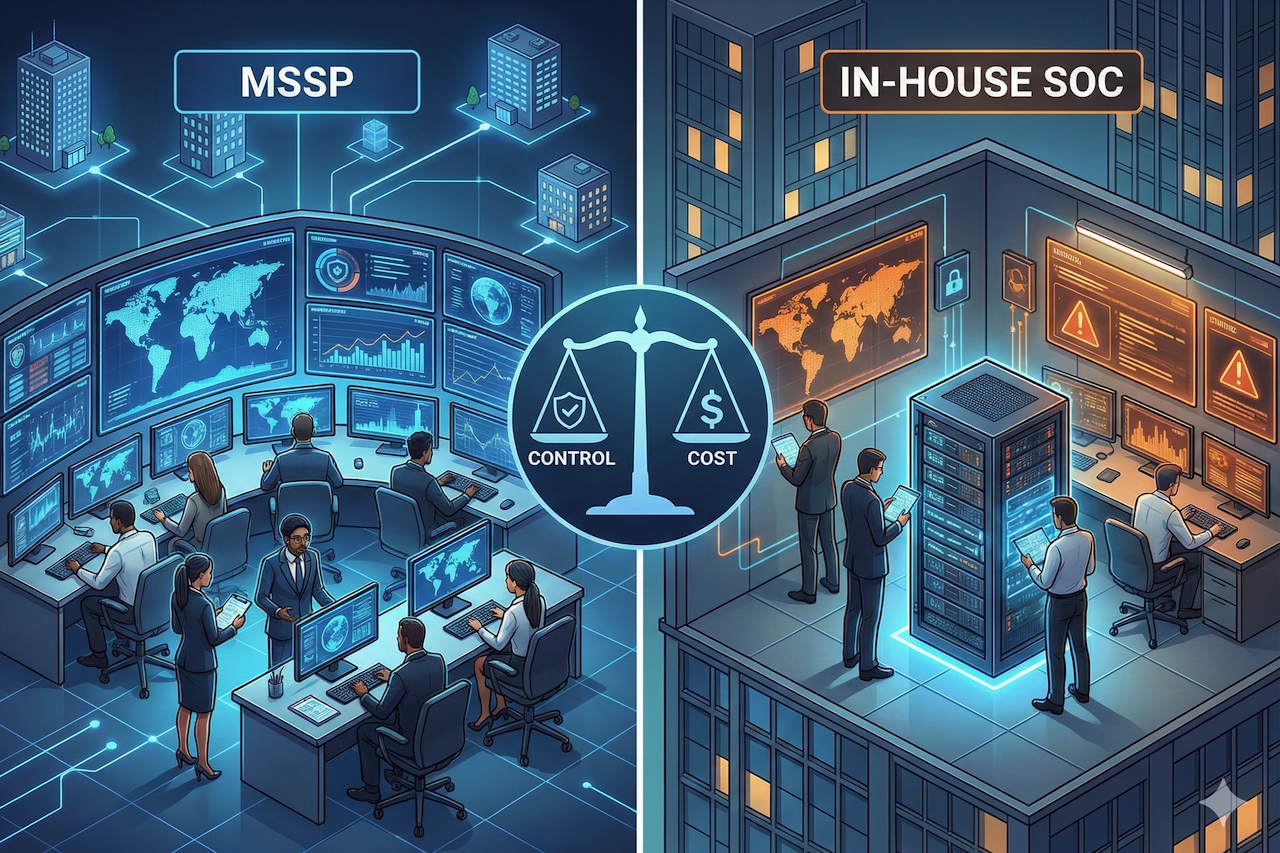
Choosing between an MSSP (Managed Security Services Provider) and an in-house SOC (Security Operations Center) comes down to how your organization balances control, expertise, and long-term investment. Both models strengthen security, yet they approach the challenge from very different angles. Some teams prioritize predictable costs and rapid deployment. In contrast, others value direct oversight and internal knowledge. Understanding the trade-offs helps you align security operations with business goals rather than reacting to threats as they arise.
Featured Image generated by Google Gemini.
Scope of Responsibility
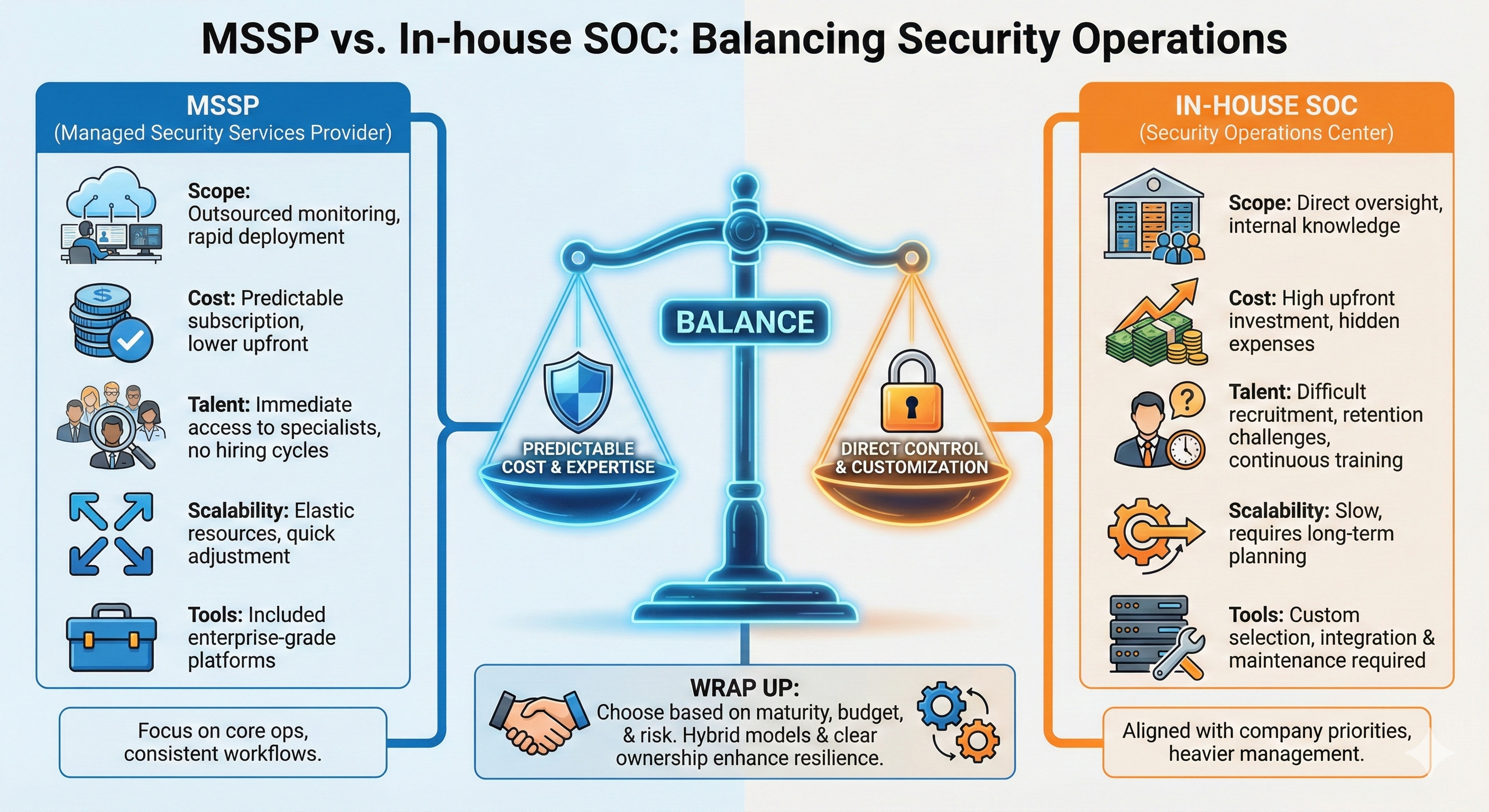
When you partner with an MSSP, you hand over monitoring, detection, and incident response to a remote team that handles these tasks every day. That arrangement frees your internal staff to focus on core operations instead of chasing alerts. It also creates consistency, as seasoned analysts follow structured workflows and respond quickly when suspicious activity is detected.
Operating an in-house SOC provides direct oversight, which many leaders find reassuring. Your team is closer to the business, understands internal processes better, and can align security actions with company priorities with minimal back-and-forth. However, that level of control comes with heavier managerial responsibility, and you’ll need leadership ready to guide daily security operations.
Some organizations land somewhere in the middle with a shared responsibility model. You might keep strategic decision-making inside while outsourcing continuous monitoring. This hybrid setup often works well for companies that want expertise without losing internal direction. It also allows teams to mature gradually instead of building everything at once.
Clear ownership matters more than most people realize. When everyone knows who handles alerts, escalations, and remediation, response times improve naturally. Confusion tends to slow things down, and attackers benefit from hesitation. Setting expectations early helps prevent incidents from escalating into drawn-out situations that disrupt productivity and create unnecessary stress.
Cost Structure and Budget Impact
According to experts from VirtualArmour, predictable pricing draws many companies toward MSSPs. Most providers charge a subscription fee, making budgeting far easier than dealing with surprise expenses. Finance teams appreciate stability because it reduces much of the guesswork in long-term planning. You can forecast security spending with confidence, rather than scrambling whenever new threats demand attention.
Building an internal SOC requires serious upfront investment. You’ll need monitoring platforms, detection tools, secure infrastructure, and a space where analysts can actually operate. Those costs stack up quickly, and they arrive long before the SOC delivers full value. Organizations sometimes underestimate this phase, only to realize later that the setup is resource-intensive.
Staffing pushes the budget even further. Skilled analysts command substantial salaries, and competition for talent keeps compensation high. Beyond that, training never really stops, since threats evolve constantly. Retention adds another layer, because replacing experienced professionals often costs more than keeping them satisfied in the first place.
Hidden expenses catch many decision-makers off guard. Technology upgrades, compliance requirements, and after-hours coverage all demand funding. Even overtime during major incidents can strain financial plans. Looking at the total cost rather than just the visible line items gives you a more realistic view before committing to either direction.
Talent Availability and Expertise
One significant advantage of MSSPs lies in immediate access to experienced cybersecurity specialists. These professionals analyze threats across multiple environments, which sharpens their instincts over time. Exposure to diverse attack patterns helps them recognize unusual behavior faster, and that awareness often translates into stronger protection for your organization without lengthy recruitment cycles.
Internal teams, on the other hand, often struggle with the ongoing skills shortage. Finding qualified analysts takes time, and competitors frequently chase the same candidates. Even after hiring, workloads can stretch smaller teams thin. That pressure sometimes leads to fatigue, which no security leader wants in a role that demands constant vigilance.
Continuous learning becomes part of daily life for an in-house SOC. Certifications, simulations, and threat briefings keep analysts sharp, yet they also require budget and scheduling flexibility. Teams that commit to development usually perform better, though leadership must treat training as essential rather than optional if they expect consistent results.
Broader expertise usually strengthens detection accuracy. MSSPs draw on large analyst pools, while internal teams build familiarity with company-specific systems. Both angles offer value, yet combining contextual awareness with great technical skill often delivers the strongest defensive posture for organizations that can support it.
Scalability and Operational Flexibility
Growth rarely happens at a perfectly predictable pace, which explains why scalable security appeals to leadership. MSSPs adjust coverage as your organization expands, adding resources without forcing you into lengthy hiring cycles. That elasticity helps companies stay protected during periods of rapid change instead of scrambling to catch up.
Expanding an internal SOC takes patience. Recruiting, onboarding, and integrating analysts into workflows requires months of coordination. Meanwhile, your risk exposure doesn’t pause. Organizations that underestimate this timeline sometimes discover that operational maturity lags behind business growth, creating gaps they never intended.
Flexible service tiers add another layer of adaptability. You might start with basic monitoring and later move into advanced threat hunting as your risk profile evolves. This step-by-step approach keeps spending aligned with actual needs rather than pushing you toward oversized capabilities too early.
Moments like mergers or geographic expansion test security readiness. Rapid scaling becomes critical when infrastructure changes overnight. Providers that already operate at scale can quickly extend protection, helping leadership focus on integration rather than worry whether defenses can keep pace with transformation.
Technology Stack and Tool Management
Many MSSPs deploy enterprise-grade tools as part of their service, sparing clients the headaches of ownership. You gain access to sophisticated detection platforms without negotiating licenses or managing updates internally. That convenience often shortens the path to operational readiness while keeping your technology aligned with current threat intelligence.
Internal SOC teams face a different challenge: selecting tools that actually work well together. Integration requires planning, testing, and ongoing tuning. Without coordination, tool sprawl can creep in, leaving analysts juggling dashboards rather than focusing on the meaningful signals that deserve attention.
Visibility improves dramatically when toolsets stay organized. Centralized data streamlines investigations and reduces the risk of overlooking subtle warning signs. Teams that invest time in thoughtful architecture usually respond faster because information flows naturally rather than hiding in disconnected systems.
Regular updates remain nonnegotiable. Attack techniques shift constantly, and outdated defenses invite trouble. Whether managed internally or externally, keeping platforms current ensures your detection capabilities reflect today’s realities instead of yesterday’s assumptions.
Wrap Up
There’s no universal answer to the MSSP versus in-house SOC debate; the option that best supports your operational maturity, budget, and risk tolerance. Organizations that evaluate responsibilities, scalability, and talent needs upfront tend to make more confident decisions. Whether you outsource, build internally, or combine both approaches, clarity on expectations helps ensure your security strategy remains resilient as threats continue to evolve.
Featured Image generated by Google Gemini.
Share this post
Leave a comment
All comments are moderated. Spammy and bot submitted comments are deleted. Please submit the comments that are helpful to others, and we'll approve your comments. A comment that includes outbound link will only be approved if the content is relevant to the topic, and has some value to our readers.


Comments (0)
No comment