
Most website owners think about security and SEO as separate concerns. Security is an IT problem. SEO is a marketing problem. The two teams rarely talk, and the budgets rarely overlap.
That framing is a mistake and the Japanese keyword hack is probably the clearest example of why.
What is the Japanese Keyword Hack?
The Japanese keyword hack is a category of SEO spam attack that has been active for well over a decade. It works by injecting thousands of auto-generated pages into an existing website, each targeting Japanese-language search queries. The pages are typically hidden from the site owner – they load correctly in Google's crawl but return a 404 or redirect to the homepage when visited directly. The intent is to hijack the domain's authority and redirect it toward affiliate pages, usually selling counterfeit goods.
What makes it particularly effective and particularly damaging is that it exploits something Google inherently trusts: an established domain with real backlinks and a real history. The attacker isn't building a new site from scratch. They're borrowing yours.
How the Japanese Keyword Hack Typically Happens
The most common entry points are outdated plugins and themes on WordPress installations. A plugin that hasn't been updated in six months is a known quantity to automated scanners that probe for vulnerabilities at scale. Once access is obtained, the attacker typically creates a backdoor file, sometimes disguised as a legitimate WordPress core file, that allows them to inject content without triggering obvious alerts.
File permission misconfigurations and compromised hosting credentials are also common vectors. In some cases, the injection occurs at the server level rather than in WordPress itself, making it harder to detect with standard plugin-based security scans.
How Site Owners Typically Find Out
Rarely from their own monitoring. More often, it surfaces through one of three channels.
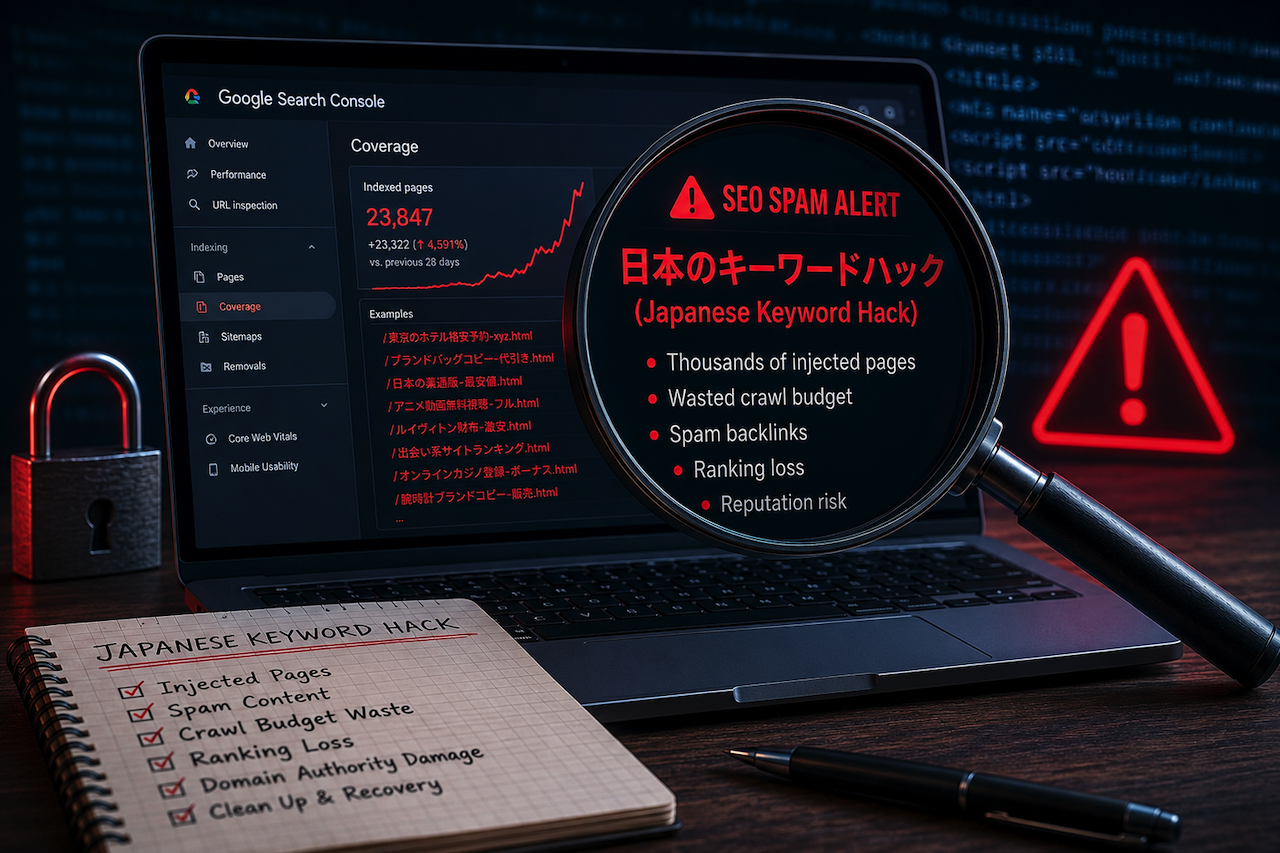
The first is Google Search Console. The coverage report starts showing a spike in indexed pages – sometimes hundreds, sometimes tens of thousands – for URLs that have no equivalent in the site's own content management system. The pattern is hard to miss once you know what you're looking at, but easy to ignore if you're only checking rankings and not crawl data.
The second is SERP snippets. Someone searches the brand name and sees Japanese results appear beneath the main homepage listing. This tends to create a more urgent response than anything in Search Console because it's visible and embarrassing.
The third and most common is a routine technical audit. A crawl of the site turns up URL patterns that don't match any known template. Filtered by response code, these pages often return 200s for a crawler but behave differently for a logged-in user. The divergence between what Google sees and what a human sees is the tell.
Liam Ridings, experienced SEO and founder of both Safari Digital SEO Agency and SEO Agency Singapore, notes that he has seen the damage firsthand when uncovering Japanese keyword hack infections during audits that were originally scoped for something else entirely, such as a site migration, a Core Web Vitals review, or a routine link profile analysis. In many cases, the infection had already been present for months.
The SEO Consequences of the Japanese Keyword Hack
The damage compounds over time. In the early stages, the injected pages are being crawled and indexed without yet affecting the legitimate pages. Crawl budget is being consumed, meaning Google's allocation of time and resources for crawling your site is being spent on thousands of spam pages rather than your real content.
As the infection matures, a few things begin to happen simultaneously. The spam pages accumulate their own signals, including low-quality backlinks from other compromised sites and negative user engagement signals from visitors who land on redirected pages. Over time, those signals become associated with your domain. At the same time, Google's quality assessments of your site begin to reflect your overall profile, not just your legitimate content.
In more advanced cases, the legitimate pages begin losing visibility. Rankings that had been stable for months start slipping without any obvious change to the content or technical setup. During this phase, site owners often spend months chasing the wrong explanation, adjusting content, building links, and reviewing Core Web Vitals while the real cause remains undetected.
Cleanup and Recovery
Effective remediation requires working through several layers.
The priority is to identify and close the entry point. This means auditing file permissions, reviewing recently modified files, checking for unfamiliar admin users, and scanning for backdoor files. Tools like Wordfence or Sucuri can assist, but a manual review of the uploads directory and active plugins is often necessary alongside automated scanning.
The second step is removing the injected content. This typically involves identifying the URL patterns used by the injected pages, which are often appended with Japanese characters or structured as subdirectories, and either bulk-deleting them or blocking them via robots.txt while the cleanup is in progress. Submitting a removal request through Google Search Console for the affected URL patterns can help accelerate deindexation.
The third step is to request a Google reconsideration if a manual action has been applied, or to submit updated sitemaps to trigger a recrawl of the legitimate site structure once the injected content is cleared.
Recovery timelines vary. Sites that catch the infection early, within weeks of the initial compromise, can recover meaningful rankings within two to three months of cleanup. Sites where the infection persisted for over a year face a longer rehabilitation period, and in some cases, domain authority never fully returns to its pre-infection baseline.
What This Tells Us About Security and SEO
The lesson from the Japanese keyword hack isn't really about Japan or keyword spam. It's about Google evaluating domains holistically. A site's trust and authority aren't stored in its best pages; they're distributed across everything Google has indexed under that domain. When malicious content occupies a significant portion of that index, the damage isn't quarantined to the spam pages. It spreads.
Security hygiene, including keeping software updated, auditing file permissions, using two-factor authentication for hosting and CMS accounts, and regularly monitoring crawl data, isn't just IT housekeeping. It's a direct input into the signals that determine how Google values your domain.
The sites that treat security as an afterthought tend to discover the cost of that decision in their rankings, often long after the original compromise.
Conclusion
The Japanese keyword hack demonstrates how closely website security and SEO are connected. A single compromise can lead to spam content, wasted crawl budget, reduced search visibility, and long-term damage to a site's reputation. By maintaining strong security practices and monitoring search performance regularly, website owners can reduce the risk of infection and protect both their users and their organic search presence.
Featured Image generated by ChatGPT.
Share this post
Leave a comment
All comments are moderated. Spammy and bot submitted comments are deleted. Please submit the comments that are helpful to others, and we'll approve your comments. A comment that includes outbound link will only be approved if the content is relevant to the topic, and has some value to our readers.


Comments (0)
No comment